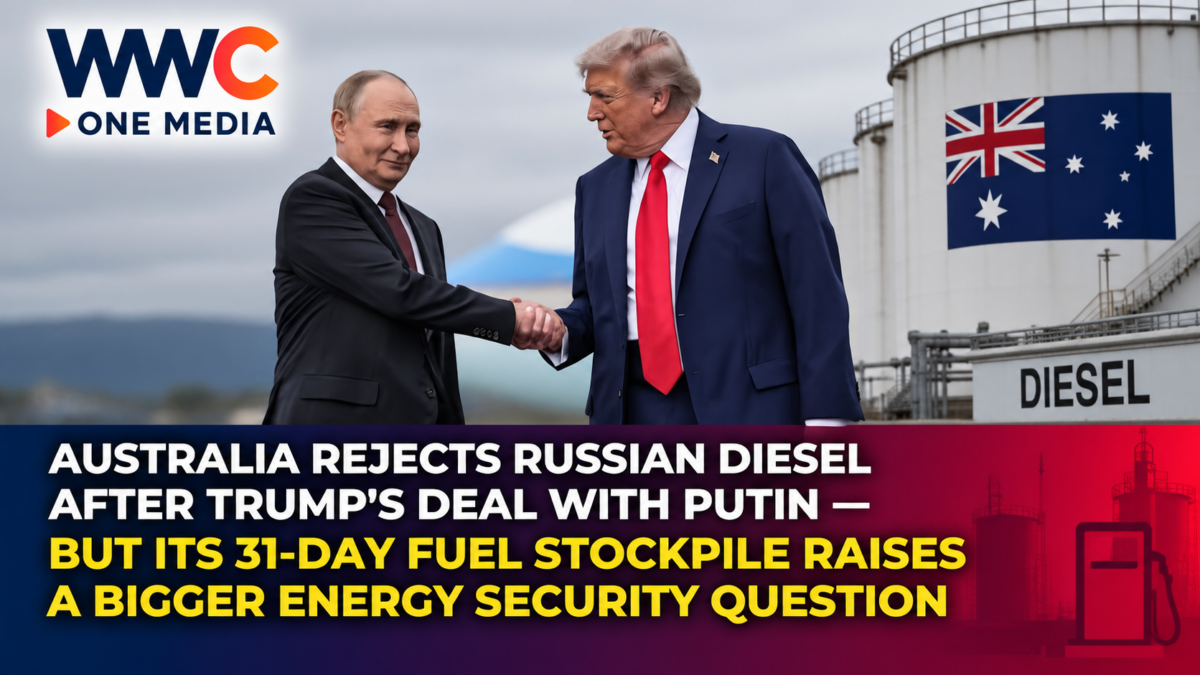
SYDNEY, Australia — October 10, 2026 — Australia has refused to import Russian diesel despite a surprise agreement between US President Donald Trump and Russian President Vladimir Putin to release additional fuel into global markets, exposing a sharp difference between two close allies over how to handle a worsening international energy crisis.
Australian Minister for Climate Change and Energy Chris Bowen said Canberra would maintain its restrictions on Russian fuel imports, arguing that Moscow should not financially benefit from the continuing war in Ukraine.
Speaking in western Sydney on Saturday, Bowen made the government’s position clear: Australia neither needs nor wants Russian fuel.
The decision follows Trump’s October 9 announcement that Russia would supply more than 300,000 metric tons of diesel initially, with further shipments planned for the following months.
The American administration hopes that additional supplies will reduce pressure on fuel prices, which have surged amid disruptions involving Iran, Ukraine and global refining capacity.
But Australia has chosen a different approach.
Canberra says it will rely on existing international suppliers, scheduled shipments and domestic fuel infrastructure rather than reverse its position on Russian energy.
The bigger question is whether Australia can maintain that stance if global diesel shortages persist — particularly when the country reports just 31 days of diesel stock coverage.
Australia Says It Does Not Need Russian Fuel
Bowen reaffirmed Australia’s refusal to purchase Russian fuel during an October 10 press conference.
His comments followed the Trump administration’s decision to temporarily ease restrictions affecting Russian diesel imports.
The Australian government maintains that purchasing Russian petroleum products could generate additional revenue for Moscow while its invasion of Ukraine continues.
Bowen said Australia had arrangements with international trading partners intended to prevent Russian fuel from entering the country’s supply chains.
He emphasized that Washington was entitled to make its own policy decisions but that Canberra would not change its position.
His response underlines an important distinction between Australia and the United States.
Both countries are dealing with higher energy costs and disruptions in international fuel markets.
However, their governments have reached different conclusions about whether relaxing restrictions on Russian fuel is an acceptable response.
Australia is prioritizing sanctions continuity and supplier diversification.
Washington is prioritizing the potential contribution of Russian diesel to global fuel availability.
Trump Announces Major Russian Diesel Agreement
On October 9, Trump announced an agreement with Putin to increase the supply of Russian diesel to the United States and wider international markets.
The initial commitment involves more than 300,000 metric tons of diesel.
Trump also outlined a further 500,000 tons in November and another 1 million tons afterward.
Additional deliveries may depend on the operating condition of Russian refineries, some of which have suffered damage during the war in Ukraine.
The US Treasury issued a temporary authorization allowing imports of Russian diesel until April 7, 2027.
The decision represents a significant shift after years of American sanctions aimed at limiting Russia’s energy-related revenues.
It also follows intensified concern about fuel prices in the United States.
Diesel is particularly important because it is used in trucking, agriculture, construction and other essential industries.
When its price increases, the costs can spread across supply chains and eventually reach consumers.
However, announced shipment commitments are not the same as completed deliveries.
The practical effects will depend on how much fuel Russia can supply, where it is shipped and whether those volumes materially increase global availability.
Why the United States Is Turning to Russia
The global diesel market has come under severe pressure as conflict involving Iran disrupts energy production, refining and transportation.
At the same time, Russia’s refinery industry has faced damage from Ukrainian attacks.
The combination has tightened supplies of refined petroleum products.
According to Reuters, average diesel prices in the United States reached approximately $6.28 per gallon on October 8.
Higher diesel prices affect the transport of food, manufactured goods and agricultural products.
For the Trump administration, easing pressure on those costs has become an urgent economic and political priority.
The new Russian supply arrangement is intended to provide additional fuel to a strained market.
But energy analysts remain skeptical about how much lasting relief the agreement can deliver.
Even a large individual shipment may have a relatively limited effect when measured against worldwide fuel consumption.
Experts Question Whether Trump’s Deal Will Lower Diesel Prices
The initial 300,000-ton Russian diesel shipment is equivalent to approximately 2.25 million barrels.
That sounds substantial, but the United States alone exports roughly 1.5 million barrels of diesel per day.
The scale of existing global fuel flows therefore provides important context.
Industry analysts interviewed by Reuters and Associated Press questioned whether Russia’s additional shipments would meaningfully reduce prices over the longer term.
One concern is that the deal could redirect diesel already destined for other markets rather than significantly increase global production.
Another is that Russian refinery damage may constrain the country’s ability to deliver larger volumes.
The agreement could still help some buyers or provide temporary relief.
However, it does not resolve broader problems involving refinery capacity, damaged energy infrastructure and disrupted shipping.
For consumers, that means lower diesel prices are possible but not guaranteed.
Australia Reports Just 31 Days of Diesel Stock Coverage
Australia’s refusal to import Russian fuel has renewed attention on its domestic supply position.
Bowen reported that Australia had approximately 31 days of diesel stock coverage as of October 10.
Petrol coverage stood at 43 days, while jet fuel coverage was approximately 30 days.
The diesel figure was one day lower than the previous week.
Petrol coverage had improved by two days.
These measurements are important indicators of Australia’s ability to manage supply disruptions.
However, they should not be mistaken for a countdown to fuel exhaustion.
The figures describe how long existing stocks could theoretically cover demand under the relevant calculation method.
Australia continues to receive imports and replenish its inventories.
The more important issue is whether the supply chain can continue operating reliably if the international crisis lasts longer than expected.
Fifty-One Fuel Ships Are Heading to Australia
Bowen also reported that 51 fuel-carrying vessels were expected to arrive in Australia.
The government said approximately 3.2 billion liters of fuel were contracted for delivery during the following four weeks.
These shipments provide an important source of reassurance for Australian consumers and businesses.
They suggest that the country is not relying exclusively on petroleum already held in storage.
Instead, the fuel system continues to depend on regular international deliveries.
However, future shipments remain subject to maritime conditions, refinery operations, transport capacity and geopolitical developments.
Fuel that has been contracted for delivery should not be counted as already delivered.
Maintaining uninterrupted supply will therefore require continued coordination among importers, refiners, shipping companies and government agencies.
Australia Looks to India, Saudi Arabia and Southeast Asia
Canberra is working with existing trading partners to keep its fuel supply network functioning.
Bowen highlighted cooperation with countries including India and Saudi Arabia, as well as partners in Southeast Asia.
Australia also maintains domestic refining operations, although it relies heavily on imported petroleum products.
Diversification can help reduce dependence on any single supplier.
It may also provide alternatives when individual shipping routes or refineries are disrupted.
But having multiple suppliers does not eliminate exposure to global fuel prices.
If diesel becomes more expensive worldwide, Australia’s import costs can increase even when its shipments come from countries other than Russia.
That creates a distinction between fuel availability and fuel affordability.
A country can have adequate supply while households and businesses continue facing higher prices.
Russia’s War in Ukraine Remains Central to Australia’s Decision
Australia has supported international measures aimed at limiting Russia’s financial capacity to sustain its war in Ukraine.
Energy exports are one of Russia’s important sources of foreign revenue.
Allowing additional Russian petroleum sales could therefore create financial benefits for Moscow.
Supporters of maintaining sanctions argue that restricting these revenues is necessary to preserve economic pressure on Russia.
The Trump administration, by contrast, argues that greater availability of diesel is needed to reduce fuel-market pressure.
The conflicting policies illustrate a difficult trade-off.
Restrictions on a major energy exporter can serve foreign-policy objectives while also affecting global supply patterns.
Easing restrictions may improve access to fuel but weaken some of the economic pressure placed on that exporter.
The actual balance of costs and benefits depends on market conditions, shipment volumes and how additional revenues are used.
Ukraine Condemns Washington’s Fuel Agreement
Ukrainian President Volodymyr Zelenskyy criticized the decision to reopen access to Russian diesel.
He argued that providing Moscow with additional commercial opportunities would undermine efforts to pressure Russia over its invasion.
The agreement has also drawn criticism from lawmakers in the United States.
Some opponents question why Washington is easing restrictions after previously supporting tougher measures targeting Russian energy revenues.
The Trump administration maintains that the agreement is intended to address a serious energy-market problem.
The controversy reflects growing tension between efforts to control domestic fuel costs and the continuation of sanctions against Russia.
For Australia, the political and strategic considerations remain sufficiently important that the government has rejected following the American approach.
Australia’s Limited Refining Capacity Raises Long-Term Questions
The latest energy crisis has renewed discussion about Australia’s reliance on imported refined fuels.
The country has significant natural resources but limited domestic refining capacity relative to its fuel needs.
Over time, refinery closures and changes in the petroleum industry have increased dependence on overseas production and international shipping.
That creates exposure to disruptions involving tanker routes, refinery operations and international supply contracts.
Expanding domestic refining could improve some aspects of resilience, but building or upgrading facilities requires substantial investment.
It also takes time.
New refining capacity would not automatically remove Australia’s exposure to global crude oil prices.
For policymakers, strengthening energy security therefore involves multiple approaches, including reliable import relationships, sufficient inventories, functioning domestic facilities and emergency planning.
Could Australia’s Refusal Push Fuel Prices Higher?
Rejecting Russian diesel may limit Australia’s choice of suppliers.
However, that does not establish that domestic prices will rise by a specific amount because of the decision.
Retail fuel prices depend on global wholesale markets, exchange rates, taxes, transportation and distribution costs.
Even countries that do not purchase Russian diesel directly may be affected if additional Russian supply changes international prices.
Alternatively, if the new shipments simply replace diesel from other suppliers, global price relief could be limited.
Australian motorists and businesses will therefore need to monitor actual fuel-market developments rather than assuming that either policy automatically guarantees lower prices.
For transport operators, farmers and manufacturers, sustained diesel price increases remain a major concern because fuel is an important operating expense.
What This Means for the Philippines and Southeast Asia
Australia’s decision has wider implications for the Asia-Pacific region.
Countries such as the Philippines rely on imported petroleum products to support transportation, industry and other essential activities.
Changes in global diesel supply can influence regional pricing and logistics costs.
Higher fuel expenses can eventually affect food distribution, public transportation and business operations.
Australia’s continued reliance on Asian trading partners also demonstrates the importance of regional petroleum supply chains.
However, Canberra’s refusal to buy Russian diesel does not automatically mean fuel shortages will occur elsewhere in Southeast Asia.
The impact will depend on regional supply arrangements, refining capacity, international prices and shipping conditions.
For the Philippines, the broader lesson is the importance of monitoring fuel inventories and reducing vulnerability to prolonged international energy disruptions.
The Bigger Picture: Energy Security Versus Geopolitical Principles
The disagreement between Canberra and Washington highlights a growing challenge for governments during international energy crises.
Fuel availability affects inflation, industrial activity and household expenses.
At the same time, trade policies can have consequences for international security and economic sanctions.
The United States has decided that temporary access to Russian diesel may help alleviate high prices.
Australia has decided that maintaining its restrictions is more important, provided alternative supply arrangements remain adequate.
Neither approach eliminates the underlying challenges facing global energy markets.
Russia’s refinery problems, Middle East disruptions and volatile fuel prices remain important risks.
The real test will be whether governments can maintain reliable supplies without creating additional strategic or economic vulnerabilities.
THE BOTTOM LINE
Australia has rejected Russian diesel despite President Trump’s October 9 agreement with Vladimir Putin to release more fuel into international markets.
Energy Minister Chris Bowen says Canberra will not change its approach because it does not want Moscow to benefit financially while Russia’s war in Ukraine continues.
Australia currently reports 31 days of diesel coverage, 43 days of petrol and approximately 30 days of jet fuel.
The government also says 51 fuel ships are expected and 3.2 billion liters have been contracted for delivery over the following month.
The Trump administration hopes Russian diesel can provide relief from high fuel prices, but analysts question whether the additional supplies will have a lasting impact.
The biggest question is whether Australia can maintain its refusal to purchase Russian fuel while ensuring that households and businesses remain protected from a prolonged global diesel shortage.
Washington is betting on Russian fuel to ease energy-market pressure. Canberra is betting on its existing suppliers. If the crisis deepens, the resilience of those competing strategies will face a much tougher test.