NEW DELHI, India — October 10, 2026 — India’s capital has been placed under extraordinary security restrictions as a fast-growing youth protest movement challenges the country’s election authorities, turning a controversy over voter registration into a major political test for Prime Minister Narendra Modi’s government.
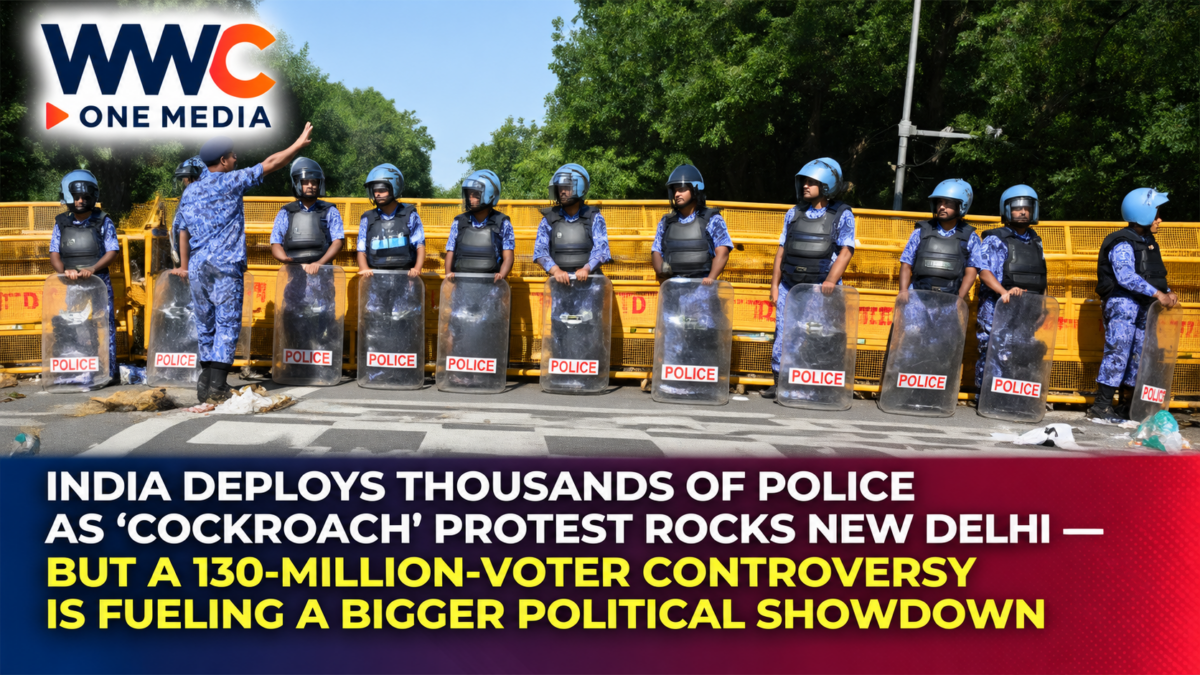
Thousands of police and paramilitary personnel have been deployed across New Delhi ahead of demonstrations organized by the Cockroach Janta Party, an activist movement that began with a viral social media post and has since become a prominent voice in India’s youth-led protests.
Barricades, transport restrictions, internet disruptions and preventive detentions have complicated efforts by protesters to reach Jantar Mantar, the capital’s traditional protest venue.
The demonstrators are demanding the resignation of Chief Election Commissioner Gyanesh Kumar over a sweeping voter-list revision that has affected more than 130 million registrations.
Opposition groups allege that the process could disenfranchise voters and unfairly benefit Modi’s ruling Bharatiya Janata Party.
The Election Commission disputes those allegations, saying its work is intended to identify duplicate and ineligible registrations and improve the accuracy of the electoral rolls.
The bigger question is whether a movement that began as an online protest can force a national reckoning over electoral transparency — or whether the government’s security crackdown will deepen public anger.
New Delhi Becomes a Security Fortress
Authorities have deployed a large police and paramilitary presence in central New Delhi as the Cockroach Janta Party attempts to stage one of its biggest demonstrations.
Reports from Associated Press and Indian media describe more than 23,000 security personnel assigned to the operation, with some outlets placing the figure closer to 25,000 or 30,000.
Police have erected barricades around government offices, transport hubs and roads leading toward Jantar Mantar.
The operation has also involved restrictions on public transportation.
Authorities sought the temporary closure of access points at 57 Delhi Metro stations. Subsequent reporting described closures affecting a smaller number of stations as arrangements changed.
Rail services to major Delhi stations have also been disrupted.
The measures have affected commuters as well as people attempting to attend the protest.
Police maintain that the restrictions are necessary to prevent overcrowding, confrontations and disruptions to essential services.
Critics argue that the response is disproportionate and undermines the right to peaceful assembly.
Cockroach Movement Founder Detained at Delhi Airport
The confrontation intensified when police detained Abhijeet Dipke, one of the movement’s leading organizers, at Delhi airport.
Reuters reported that Dipke was intercepted after arriving from Mumbai ahead of the October 10 gathering.
Two other organizers, Saurav Das and Ashutosh Ranka, were also detained.
Their movement said the detentions were intended to prevent its leadership from participating in the demonstration.
Police had previously denied permission for the gathering.
The detentions raised questions about whether preventive security measures were being used to restrict legitimate political activity.
However, detention does not by itself establish that an organizer has been convicted of an offense.
The circumstances and legal basis of individual detentions must be evaluated separately.
Why India’s Protesters Call Themselves ‘Cockroaches’
The movement’s unusual name has become one of its most recognizable features.
The Cockroach Janta Party emerged in May 2026 following criticism of remarks attributed to India’s Chief Justice Surya Kant concerning unemployed young people.
Dipke responded on social media with a satirical reference to cockroaches uniting.
The post spread rapidly, and supporters adopted the term as a symbol of collective resistance.
Rather than rejecting the derogatory comparison, activists turned it into an identity for a broader political movement.
The group initially gained prominence through demonstrations over education-related controversies, particularly leaked examination papers and perceived failures of accountability.
Its activism expanded during the summer, with large demonstrations and confrontations involving police.
The movement now focuses on electoral transparency and political rights, demonstrating how quickly an online campaign can develop into a national protest network.
The 130-Million-Voter Controversy
At the heart of the latest confrontation is India’s Special Intensive Revision of electoral rolls.
The exercise is intended to update voter registrations by identifying duplicate entries, deaths, changes of residence and other eligibility issues.
But critics say the process has led to the removal or proposed removal of more than 130 million names across affected electoral rolls.
Opposition parties and activists argue that the revisions risk excluding legitimate voters, particularly people with limited access to documentation.
Some claim the changes disproportionately affect marginalized and minority communities.
The Election Commission disputes accusations of political manipulation.
It maintains that the revision process is designed to improve electoral integrity and that mechanisms exist for eligible voters to challenge incorrect exclusions.
A critical distinction is necessary: a reported deletion from a draft voter list is not necessarily proof that a person has permanently lost the right to vote.
The figure of more than 130 million does not establish that 130 million eligible voters were unlawfully disenfranchised.
Determining the actual impact requires examining final electoral rolls, objections, reinstatements and the eligibility of affected registrations.
Why Protesters Want Election Chief Gyanesh Kumar to Resign
Organizers accuse Chief Election Commissioner Gyanesh Kumar of failing to protect the fairness and independence of the electoral process.
They are demanding his resignation and greater public accountability for the voter-roll changes.
The dispute has attracted attention from opposition politicians and civil-rights campaigners.
The Indian Express has reported that concerns about the revisions were raised internally by other election commissioners on multiple occasions.
These reports have intensified scrutiny of how electoral changes are reviewed and implemented.
The Election Commission and the ruling BJP reject accusations that the process is designed to manipulate elections.
The competing claims have made election administration itself a central political battleground.
For protesters, the concern is whether eligible citizens can exercise their voting rights.
For election officials, the stated objective is ensuring that electoral rolls are accurate and legally compliant.
Both electoral accuracy and access to voting are essential to public confidence in an election system.
Police Explain Why the Protest Was Banned
Delhi Police denied permission for the October 10 demonstration, citing procedural and public-order concerns.
Joint Commissioner of Police Nupur Prasad said organizers submitted their application on October 7, only three days before the proposed event.
According to police, the applicable procedure required 10 days’ advance notice.
Authorities also alleged that the movement had failed to comply with directions during an earlier demonstration.
Police imposed preventive restrictions under Section 163 of the Bharatiya Nagarik Suraksha Sanhita, a legal provision permitting specified public-order measures.
Officials argue that the restrictions help protect public safety and prevent traffic paralysis.
Organizers and their supporters contend that the measures are being used to discourage peaceful political expression.
Whether particular restrictions are proportionate is a separate question from whether authorities have the legal power to impose them.
That distinction matters because the right to peaceful protest and the government’s responsibility to maintain public order can come into conflict.
Reports of Mass Detentions Raise Further Questions
The Cockroach Janta Party has alleged that thousands of supporters were detained before reaching New Delhi.
Some organizers claimed that more than 10,000 people had been intercepted or detained across the country.
Those figures have been reported by The Guardian and Al Jazeera as claims by the movement.
They have not been independently verified as a comprehensive national detention count.
Associated Press reported extensive detentions and confrontations during the October 10 demonstrations.
Opposition figures criticized the security response, arguing that the government should permit peaceful demonstrations rather than restrict them.
Authorities have defended the operation as a response to security concerns and unauthorized assemblies.
The dispute highlights the importance of distinguishing verified arrests and detentions from figures supplied by protest organizers.
A Youth Movement Becomes a Political Challenge for Modi
The Cockroach movement reflects growing frustration among parts of India’s younger population over employment, education and government accountability.
Its earlier protests focused on examination irregularities and the difficulties faced by students competing for educational and career opportunities.
The latest demonstrations have widened the movement’s agenda to include voting rights and electoral oversight.
This change is politically significant.
A campaign initially associated with students and young jobseekers is now participating in a wider debate about India’s democratic institutions.
Its supporters believe collective action can pressure authorities to respond to grievances.
The government and ruling party argue that allegations of electoral manipulation are unfounded and politically motivated.
The movement’s long-term influence will depend on whether it can sustain participation, establish clear policy demands and maintain credibility beyond individual demonstrations.
Opposition Parties Join the Debate
India’s opposition has seized on the voter-roll controversy as evidence of what it describes as declining institutional accountability.
Opposition politicians, including Congress leader Rahul Gandhi, have criticized the security restrictions and questioned the electoral revision process.
The BJP rejects those accusations and says opposition leaders are seeking to undermine confidence in election administration for political advantage.
These disagreements should be understood as competing political claims, not established legal findings.
The controversy is particularly sensitive because state elections are approaching in 2027.
Accurate voter rolls are necessary for credible elections, but ensuring accuracy must also involve accessible procedures for eligible citizens.
Public scrutiny of both objectives will remain important as the revision process continues.
Why the Transport Restrictions Matter
The police operation has affected daily life in Delhi beyond the protest itself.
Metro restrictions, train cancellations and road closures have complicated travel for residents, workers and visitors.
The Indian Express reported that authorities prepared buses to transport detained demonstrators and deployed officers with body-worn cameras.
Police said these arrangements were designed to handle crowds and record interactions.
But the scale of the preparations has raised questions about the economic and social costs of wide-ranging restrictions.
When major transport networks are disrupted, the effects can extend to workers, businesses, hospitals and travelers with no involvement in political demonstrations.
That is one reason why the necessity and duration of security measures are drawing scrutiny.
What the Demonstrations Mean for India’s Democratic Institutions
India is the world’s most populous country and conducts elections involving hundreds of millions of voters.
The accuracy of its electoral rolls is therefore a major administrative undertaking.
Election authorities must prevent duplicate or fraudulent registrations while protecting eligible citizens from wrongful exclusion.
The current controversy illustrates how difficult that balance can become when the process is politically disputed.
Transparent procedures, reliable appeals and accurate public information are essential to maintaining trust.
Police must also manage demonstrations in ways that protect public safety while respecting applicable legal rights.
The outcome of the controversy will depend not only on political statements but also on the evidence surrounding voter registration and the handling of protests.
Why the Crisis Matters Beyond India
India’s political stability carries significance across Asia.
The country is a major economy, a growing technology and manufacturing market, and an important diplomatic partner for countries in Southeast Asia.
Large-scale protests may influence investor perceptions, particularly if they lead to prolonged transport disruption or political uncertainty.
However, the existence of political demonstrations does not automatically establish that India’s national economy will suffer a measurable downturn.
The more significant regional issue is how a major democracy manages disagreements over election administration and peaceful assembly.
For the Philippines and other Asian countries, the episode highlights the importance of transparent voter-registration systems and public confidence in electoral institutions.
THE BOTTOM LINE
India has deployed thousands of security personnel and restricted transportation in New Delhi as the Cockroach Janta Party stages protests demanding the resignation of Chief Election Commissioner Gyanesh Kumar.
Police have detained leading organizers, including Abhijeet Dipke, and denied permission for the major October 10 gathering.
The demonstrations are driven by anger over a voter-roll revision involving more than 130 million entries, with protesters alleging voter suppression and the Election Commission rejecting claims of political manipulation.
The actual number of eligible voters permanently excluded has not been independently established by the available reporting.
The biggest question is whether India’s election authorities can restore public confidence in the voter-registration process — and whether security restrictions will calm the crisis or intensify it.
What began as a satirical online campaign has become a high-profile political challenge, forcing India’s government to confront a difficult question: how should a democracy protect public order when thousands of citizens believe their right to vote is at risk?