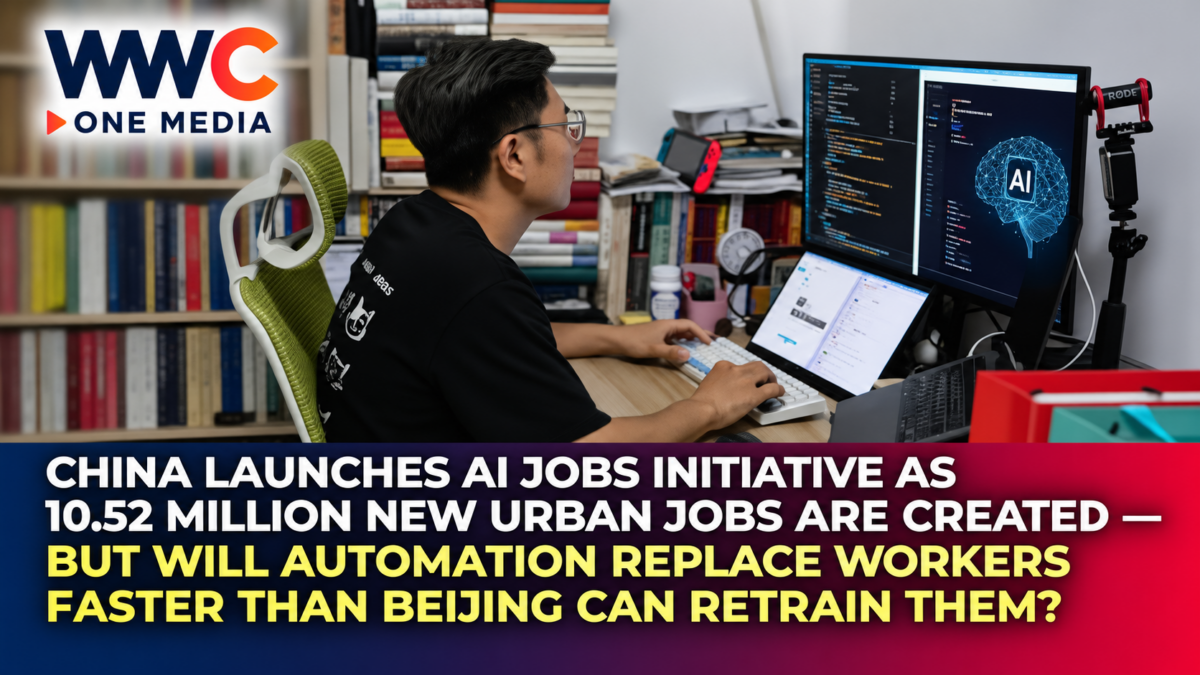
BEIJING, China — October 10, 2026 — China is preparing a major employment initiative designed to help workers adapt to artificial intelligence, signaling growing concern that the technology driving the country’s next industrial revolution could also transform or eliminate jobs across its vast workforce.
The announcement was made on Saturday, October 10, during a State Council Information Office briefing on employment and social security priorities under China’s 15th Five-Year Plan, covering 2026 to 2030.
Vice Minister of Human Resources and Social Security Li Zhong said Beijing will introduce an employment-promotion initiative responding to the development of artificial intelligence and other emerging technologies.
The government plans to encourage new employment opportunities, strengthen workforce skills and expand hiring in industries positioned to benefit from technological change.
The announcement comes as China reports continued job creation despite pressure from weaker domestic demand, structural economic challenges and rapid automation.
According to the Ministry of Human Resources and Social Security, 10.52 million new urban jobs were created between January and September 2026, equivalent to 87.7% of the government’s full-year target.
But the latest figures reveal only part of the story.
The bigger question is whether China can create enough high-quality jobs in the artificial intelligence era before automation disrupts traditional employment opportunities, particularly for young people and entry-level workers.
China Announces New AI Employment Initiative
China’s Ministry of Human Resources and Social Security outlined the initiative at an October 10 government briefing.
The program will focus on responding to the impact of AI and other technological advances on employment while supporting the development of new occupations and skills.
According to Chinese state news agency Xinhua and financial news outlet Yicai, the government also announced several related employment initiatives.
These include expanded vocational skills training, support for migrant workers, improvements in public employment services and greater integration of human-resources services with business development.
The announcement places workforce preparation alongside China’s industrial ambitions.
As Chinese manufacturers, technology companies and service businesses adopt automation, authorities want workers to develop capabilities relevant to changing employer demands.
However, the government has not yet disclosed a comprehensive implementation budget, a verified number of jobs that the new AI initiative will create or an exact timetable for all of its measures.
The announcement should therefore be understood as a policy commitment rather than proof that a specified number of AI jobs has already been delivered.
China Creates 10.52 Million Urban Jobs in Nine Months
The employment announcement followed the release of new labor-market figures.
China created 10.52 million urban jobs during the first nine months of 2026, according to the labor ministry.
That represented 87.7% of its annual urban job-creation target.
Officials said overall employment remained generally stable, with the surveyed urban unemployment rate averaging 5.2% between January and August.
The figures suggest that the labor market has continued to absorb workers despite an uncertain economic environment.
However, urban job-creation statistics do not necessarily measure the quality of employment, wage growth or whether all jobseekers can find positions matching their qualifications.
Nor does a nationwide unemployment average fully capture differences across age groups, regions and educational backgrounds.
China therefore faces the challenge of improving employment quality while maintaining the overall pace of hiring.
Beijing Wants the Services Sector to Absorb More Workers
In addition to the AI-focused initiative, China is preparing measures intended to strengthen employment in the services sector.
Vice Minister Li Zhong said the ministry would work with other government departments on a policy document supporting job creation through services-sector development.
Service industries can include retail, logistics, hospitality, healthcare, technology services and professional business activities.
These industries play an important role in absorbing workers as the economy evolves.
The government also intends to maintain stable employment in labor-intensive sectors.
This reflects concern that rapid industrial modernization could put pressure on jobs in activities where large numbers of people remain employed.
A stronger services sector could help provide alternative opportunities.
But the transition will depend on whether businesses are expanding and whether workers possess the skills required for available positions.
Artificial Intelligence Creates Jobs — and Threatens Others
China is investing heavily in artificial intelligence, robotics, industrial automation and advanced manufacturing.
These technologies can improve productivity and support entirely new occupations.
AI engineers, data specialists, machine-vision developers, robotics technicians and technology-maintenance professionals are examples of jobs associated with the expanding AI economy.
At the same time, automation can reduce the amount of human labor required for some tasks.
Routine office work, customer support, production processes and certain data-processing activities may be particularly exposed.
The effect will vary by industry and occupation.
Some businesses may reduce hiring for repetitive tasks while creating demand for employees capable of operating, maintaining or supervising AI systems.
Others may use AI to increase production and expand employment elsewhere.
This uncertainty is central to Beijing’s latest initiative.
The government is attempting to capture AI’s economic benefits while reducing the risk that workers are excluded from the transition.
AI Skills Are Becoming a Major Priority
Workforce training is an important part of China’s employment strategy.
Workers may need new technical capabilities as businesses introduce more advanced automation.
For some occupations, this will involve specialist programming, data analysis or engineering skills.
For others, it may mean learning to work with AI-supported equipment, digital systems and automated business processes.
Training programs must therefore serve different groups.
University graduates entering the labor market may require opportunities to gain professional experience.
Existing employees may need retraining to perform changing job responsibilities.
Workers displaced from traditional industries may require more substantial support to move into different occupations.
China’s challenge is ensuring that training leads to actual employment rather than simply producing additional qualifications.
Programs will be more effective if they are connected to verified employer demand and include practical pathways into work.
Earlier Recruitment Drives Show Demand for AI Specialists
China has already experimented with targeted recruitment campaigns for emerging industries.
In August, the Ministry of Human Resources and Social Security organized online recruitment events focused on AI, advanced manufacturing, healthcare and foreign trade.
The AI recruitment campaign involved approximately 400 employers offering more than 11,000 positions.
Reported openings included AI agent development engineers, large-language-model algorithm engineers, AI data analysts and machine-vision application engineers.
The recruitment campaign provides evidence that employers are seeking workers with specialized capabilities.
However, advertised vacancies do not equal completed hires.
They also do not prove that workers from declining occupations can easily move into AI-related positions.
The skills required for advanced technology jobs can differ significantly from those used in routine administrative or manufacturing work.
That mismatch could become one of the most difficult problems for employment policymakers.
China Is Also Using AI to Modernize Recruitment
Beijing is not only promoting jobs associated with AI technology.
It is also incorporating AI into government employment services.
In July 2026, four Chinese government agencies issued implementation guidance covering AI applications within human-resources and social-security systems.
The policy included plans to develop AI-supported recruitment tools, improve job matching and help identify the skills employers need.
It also encouraged the development of personalized career guidance and better monitoring of labor-market trends.
The government identified approximately 20 priority application scenarios for development in 2026.
By 2027, authorities intend to explore approximately 50 high-value AI application pathways within the human-resources system.
The longer-term objective is broader integration of the technology by 2030.
These figures describe planned applications and use cases, not numbers of jobs expected to be created.
Successful deployment will also require reliable data, appropriate safeguards and protection against discriminatory or inaccurate automated decisions.
The Government Is Studying AI’s Employment Impact
The July implementation guidance also called for the development of systems to assess AI’s influence on employment.
That includes improved monitoring and analysis of how technology changes workforce demand.
The goal is to identify potential disruptions and encourage technological innovation that creates employment opportunities.
This is significant because the effects of AI may not appear primarily through mass layoffs.
Businesses can reduce employment growth simply by hiring fewer new workers or leaving vacant positions unfilled.
That can be particularly challenging for graduates seeking their first professional opportunities.
Monitoring job vacancies, workforce composition and hiring trends may therefore reveal changes that conventional unemployment statistics do not immediately capture.
However, predicting AI’s net employment effect remains difficult.
Technological change can eliminate some tasks while increasing demand for others, and those changes may occur at different speeds.
Young Workers Face a Difficult Transition
China’s employment challenge is especially important for young people entering the workforce.
University graduates and first-time jobseekers often depend on entry-level positions to gain experience.
But some of those positions involve tasks that AI systems can increasingly assist with or automate.
Research and international reporting suggest that AI adoption may favor workers with established experience in some industries.
A September 2026 Bloomberg report discussed findings from a study spanning 41 countries, in which firms adopting AI experienced stronger growth in senior employment than junior employment.
The study did not establish that every Chinese employer is following the same pattern.
Nevertheless, it illustrates a broader concern facing policymakers.
If companies automate junior-level tasks, young workers may have fewer opportunities to acquire the experience needed for more advanced roles.
Training and employment policies must therefore address not only current skill shortages but also the career pathways through which future professionals develop.
China Wants AI Growth Without an Investment Bubble
The employment initiative also arrives as Beijing tightens oversight of its broader technology development strategy.
On October 9, Reuters reported new Chinese policy guidelines aimed at promoting advanced technology while reducing the risk of speculative investment.
The guidance emphasized technological self-sufficiency, industrial AI applications and safety mechanisms.
It also warned against excessive, poorly coordinated investment in high-technology industries.
The approach reflects an effort to balance rapid innovation with financial and economic discipline.
For employment policy, that balance matters.
Large investments in AI infrastructure may support demand for engineers and construction workers.
But long-term job creation depends on whether businesses can turn those investments into commercially useful products and services.
If projects fail to produce sustainable economic value, employment opportunities may not last.
China is therefore attempting to promote innovation while preventing an investment cycle driven primarily by speculative expectations.
Worker Protection Remains Part of the AI Debate
The rise of AI is also creating questions about labor rights.
In May 2026, Bloomberg reported on a Chinese court decision involving a technology employee who was dismissed following the automation of his work.
The court found that the employer could not lawfully terminate the worker solely on the grounds that AI had replaced his functions under the circumstances of that case.
The decision illustrates how existing labor rules can become relevant when companies introduce automated systems.
However, it should not be interpreted as a blanket nationwide prohibition on every AI-related redundancy.
Employment disputes depend on applicable law, contracts and individual circumstances.
As businesses adopt new technologies, governments may face growing pressure to clarify worker protections, retraining obligations and procedures for managing changes to job responsibilities.
Balancing innovation with employment security will be an important part of China’s policy challenge.
What the Initiative Means for Chinese Technology Companies
The latest announcement could create opportunities for companies involved in AI development, enterprise software, robotics and workforce training.
Businesses may benefit from a larger pool of trained employees and stronger connections with public employment programs.
Recruitment technology providers could also gain opportunities as government agencies modernize job matching and workforce services.
However, the announcement does not guarantee new contracts, subsidies or higher revenue for any particular listed company.
Financial benefits will depend on detailed policy implementation, procurement decisions and actual business demand.
Investors should therefore distinguish between a broad government initiative and confirmed financial commitments.
The strongest long-term beneficiaries may be businesses capable of delivering useful technology while demonstrating sustainable commercial performance.
What China’s AI Jobs Push Means for the Philippines
China’s initiative has implications for other Asian economies, including the Philippines.
As AI becomes more widely used across customer service, software development, manufacturing and administrative work, the demand for different skills may change throughout the region.
The Philippines has substantial employment in business-process outsourcing and other service industries that could be affected by AI adoption.
An October 2026 Financial Times analysis reported evidence of declining call-center employment internationally since late 2023, with the Philippines among the countries experiencing pressure.
However, employment changes cannot automatically be attributed entirely to AI, and developments vary among companies and occupations.
China’s decision to prioritize workforce adaptation highlights a challenge shared by governments across Southeast Asia.
Workers need opportunities to develop capabilities that complement new technology.
Education systems, training providers and employers may need to strengthen cooperation to make those transitions possible.
For the Philippines, areas worth watching include AI literacy, data skills, cybersecurity, digital operations and higher-value business services.
The goal should be to help workers remain competitive as technology changes the structure of employment.
The Bigger Picture: The Race for AI Leadership Is Becoming a Race for Jobs
The global AI competition is often measured through computing capacity, semiconductor technology, investment spending and software breakthroughs.
China’s latest initiative adds another dimension: employment.
Technological leadership may deliver limited social benefits if large parts of the workforce cannot participate in the resulting economic opportunities.
Governments therefore face the challenge of promoting productivity while supporting workers whose roles are changing.
China is attempting to address that issue through training, industry development, employment services and labor-market monitoring.
But the effectiveness of these measures remains untested at a national scale.
There is no guarantee that every worker displaced by automation will be able to transition into a new AI-related job.
The challenge is not simply creating positions in emerging industries.
It is making those opportunities accessible to people with different educational backgrounds, levels of experience and regional circumstances.
THE BOTTOM LINE
China announced a new employment initiative on October 10, 2026, aimed at helping its workforce adapt to artificial intelligence and other emerging technologies.
The government also plans to expand vocational training, support hiring in services and labor-intensive industries, and improve public employment services.
The announcement comes as China reports creating 10.52 million urban jobs during the first nine months of 2026, equivalent to 87.7% of its annual target.
Previous recruitment campaigns and government guidance demonstrate Beijing’s growing focus on AI skills and the technology’s impact on employment.
However, the government has not yet announced a verified number of jobs to be created specifically by the new initiative.
The biggest question is not whether artificial intelligence can generate new opportunities — but whether China’s workers can adapt quickly enough as automation transforms existing jobs.
Beijing wants AI to become a major driver of economic growth. Its next challenge is proving that the technology can also deliver a better employment future for millions of ordinary workers.