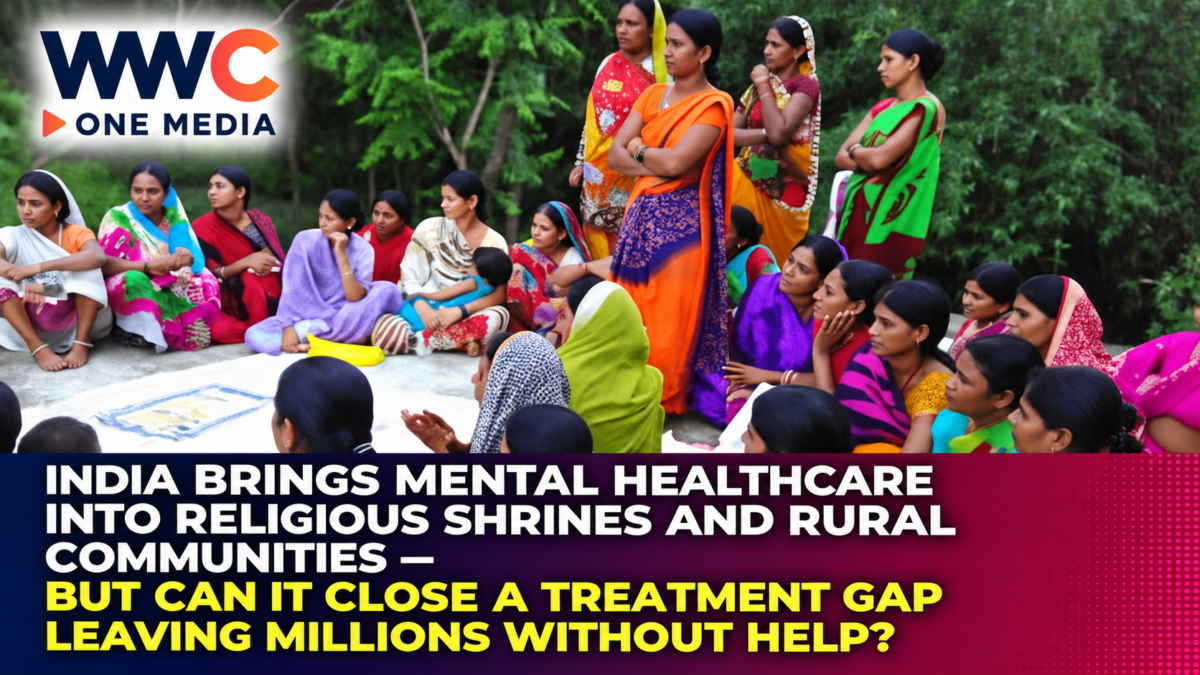
NEW DELHI, India — India is exploring an unconventional approach to one of its most urgent healthcare challenges: bringing professional mental health treatment closer to the religious shrines, villages and community networks where millions of people already turn for support.
A new Financial Times documentary, How India Is Reshaping Mental Healthcare, highlights grassroots initiatives combining culturally familiar support systems with evidence-based medical care, aiming to reach patients who might otherwise struggle to access psychiatrists, counseling or long-term treatment.
The approach represents a significant shift in a country where mental health services remain unevenly distributed and social stigma can discourage families from seeking professional assistance.
Some initiatives work alongside religious communities, helping connect individuals to qualified clinicians without requiring them to abandon their personal beliefs.
Others train local residents to recognize potential mental health symptoms and guide people toward medical services.
But behind these promising developments lies a much bigger challenge:
Can community-based mental healthcare reach enough people to transform a system where an estimated 70% to 92% of individuals who need treatment do not receive it?
India’s Mental Health Treatment Gap Remains Enormous
India faces a substantial shortage of mental health professionals relative to its population.
Research published in The British Journal of Psychiatry in 2026 estimated that approximately 10.6% of Indian adults experience mental disorders.
It also identified major barriers to treatment, including stigma, limited awareness, geographic inequalities and shortages of trained professionals.
The study estimated that India has approximately 0.75 psychiatrists per 100,000 people, compared with a benchmark of three per 100,000 cited by the researchers.
These shortages can be especially severe outside major cities, where specialist mental health services may be difficult or expensive to access.
For patients and families, seeking treatment may involve long-distance travel, repeated appointments and the challenge of managing symptoms without consistent medical support.
The problem is not simply a lack of awareness.
Even families who recognize that professional care is needed may encounter significant difficulties obtaining it.
At Religious Shrines, Faith and Medicine Are Finding Common Ground
One of the most striking examples featured in the Financial Times documentary is the Dawa-Dua initiative associated with the Mira Datar shrine in Gujarat.
The program works with an important reality of Indian community life: many families turn to religious sites or spiritual advisers when confronting experiences they do not fully understand.
Some people interpret severe behavioral changes or psychological distress through religious or supernatural explanations.
Rather than dismissing those families or attempting to replace their beliefs, the initiative seeks to build cooperation between trusted religious figures and healthcare professionals.
People visiting the shrine can continue participating in religious practices while also being encouraged to seek assessment and treatment from qualified clinicians.
The program’s central principle is that religious belief and medical care do not necessarily have to be treated as opposing choices.
Healthcare workers can build trust through community relationships while emphasizing the importance of appropriate diagnosis, medication when indicated and continuing care.
This approach is particularly relevant where distrust, stigma or cultural misunderstandings discourage people from visiting mental health clinics.
Importantly, prayer is not presented as a substitute for evidence-based psychiatric treatment.
The program’s value lies in connecting people with appropriate medical services through institutions they already trust.
A Mother’s Journey Shows Why Access to Treatment Matters
The documentary follows families navigating the challenges of mental illness and obtaining professional help.
Among them is a mother who traveled a considerable distance to seek support for her son after experiencing difficulties managing his behavior.
At the shrine, she was encouraged to combine spiritual practices with medical consultation.
Her account describes early improvements after treatment, while also illustrating the uncertainty and patience involved in recovery.
Individual experiences like this can help make the healthcare challenge more understandable.
Behind national statistics are families seeking explanations, support and a way to improve daily life.
However, personal accounts should not be interpreted as proof that a particular intervention works equally well for every patient.
Mental health conditions vary considerably, and successful treatment depends on accurate assessment, appropriate care and follow-up.
Community Health Workers Offer Another Route Into Care
The Financial Times also examines community-based support in Maharashtra, where the organization Parivartan uses trained local workers to help identify potential mental health problems.
Instead of depending entirely on specialist clinics, community workers visit households and speak with individuals and family members about their concerns.
They may ask about changes in sleep, appetite, behavior, mood and other possible symptoms.
Their role is to recognize when someone may need additional support and connect them with appropriate services.
They are not substitutes for psychiatrists or other qualified clinicians.
This division of responsibility is important because it allows specialist resources to be used where they are most needed.
Community workers can help provide education, follow-up and support, while trained professionals remain responsible for clinical diagnosis and treatment decisions.
The approach is sometimes described as task-sharing, in which different parts of healthcare delivery are distributed among workers with appropriate training and supervision.
For countries with severe shortages of specialists, task-sharing can help expand the reach of existing services.
Tackling Stigma Is as Important as Expanding Clinics
The documentary also highlights the social barriers surrounding mental illness.
Families may fear public judgment, discrimination or being blamed for a relative’s condition.
Some individuals delay seeking help because they worry about how a diagnosis could affect employment, relationships or their place within the community.
These concerns can make recovery more difficult by delaying access to appropriate support.
Community-based programs attempt to address stigma by making mental healthcare more familiar and approachable.
Local health workers and trusted community figures can help explain that mental disorders are health conditions for which professional assessment and treatment are available.
People who have experienced mental health difficulties may also contribute by sharing their recovery experiences, where they choose to do so.
Such participation can help challenge misconceptions and demonstrate the importance of sustained care.
However, reducing stigma requires more than awareness campaigns.
Services must also be accessible, affordable, confidential and responsive to patients’ needs.
India’s Tele-MANAS Program Provides Millions of Remote Consultations
Beyond the grassroots initiatives featured in the documentary, India has been expanding government-supported mental healthcare through digital services.
The National Tele Mental Health Programme, known as Tele-MANAS, launched in October 2022.
The service provides round-the-clock mental health support through a national helpline, with counseling and referrals to more specialized care when necessary.
According to India’s Ministry of Health and Family Welfare, the service had handled more than 3.43 million calls by March 3, 2026.
At that time, 53 Tele-MANAS cells were operating across all 36 states and union territories, with support available in 20 languages.
The government has also introduced a mobile application and video consultation capabilities.
The program is especially relevant for individuals who cannot easily access urban hospitals or specialist clinics.
Telephone-based support can lower geographic barriers and provide an initial point of contact for people seeking assistance.
However, call volumes do not represent the number of unique patients successfully treated.
The quality of care, referrals, clinical outcomes and continued access to services remain important measures of the program’s effectiveness.
Government Expands Mental Health Support Across Hundreds of Districts
India’s broader National Mental Health Programme is another part of the country’s efforts to improve access.
In April 2026, the government reported that support for the District Mental Health Programme had been sanctioned in 767 districts.
The initiative aims to integrate mental health services into more accessible healthcare settings, including primary health centers and community health centers.
Supported activities include assessment, counseling, continuing care, medication, community outreach and referrals.
This approach reflects growing recognition that mental healthcare must extend beyond specialist hospitals.
Primary healthcare facilities and local workers can play important roles in early identification and ongoing support.
For patients in remote communities, access to nearby services can potentially reduce the financial and logistical burden of treatment.
However, approval or expansion of a program does not guarantee equal service availability in every district.
Staffing, training, medicine supplies and the capacity to provide follow-up care remain essential.
Why India’s Approach Matters to Other Developing Countries
India’s experiments with community-based mental healthcare have potential relevance beyond its borders.
Many developing countries face similar challenges involving workforce shortages, uneven healthcare infrastructure and social stigma.
In parts of Asia and Africa, religious institutions and community leaders remain influential sources of support.
Cooperation with trusted local organizations can sometimes help bridge the gap between individuals and formal health services.
But successful partnerships require safeguards.
Patients must have access to qualified professionals, confidential services and treatment based on clinical evidence.
Community involvement should help people reach appropriate healthcare rather than expose them to coercion, unsafe practices or delays in medical treatment.
The approach may offer lessons for countries seeking to expand care without relying exclusively on expensive specialist facilities.
Nevertheless, results from individual programs must be evaluated before assuming that the same model will work in every community.
Funding, Training and Long-Term Treatment Remain Major Challenges
The most difficult test for India’s mental health initiatives may be sustainability.
Community programs require trained workers, adequate supervision, financing and reliable links with medical professionals.
Mental health treatment may also require long-term follow-up.
A patient who receives an initial consultation but cannot obtain subsequent appointments or prescribed medication may remain underserved.
Programs therefore need systems for monitoring referrals, treatment continuity and patient outcomes.
Governments and partner organizations must also protect patient rights, especially for individuals with severe mental health conditions.
Services should be designed around dignity, informed consent and appropriate clinical oversight.
Without these foundations, the expansion of access may not translate into sustained improvements.
World Mental Health Day Brings Renewed Attention to the Crisis
The Financial Times documentary arrives on October 10, World Mental Health Day, when governments and health organizations draw attention to mental health challenges and the importance of accessible care.
For India, the timing highlights the contrast between an enormous treatment gap and the growing number of initiatives attempting to address it.
The country is exploring several complementary approaches: digital counseling, community outreach, primary healthcare integration and cooperation with trusted religious institutions.
Each can help address a different barrier.
But no single intervention is sufficient to resolve the entire problem.
Long-term progress will depend on stronger clinical capacity, reliable funding, continued community participation and meaningful protection of patient rights.
THE BOTTOM LINE
India is exploring ways to make mental healthcare more accessible by connecting qualified professionals with religious communities, local health workers and government-supported digital services.
The Financial Times documentary highlights approaches that recognize the importance of cultural trust while encouraging people to receive evidence-based care.
Meanwhile, Tele-MANAS has handled millions of calls, and government-backed mental health services have expanded across hundreds of districts.
These developments demonstrate growing efforts to make professional support available beyond major hospitals and cities.
However, the country’s treatment gap remains substantial.
The biggest breakthrough may not come from building more psychiatric hospitals alone — but from finding effective ways to bring safe, affordable and continuous care into the communities where people already live.
For India, the real challenge is no longer simply proving that community-based solutions are possible. It is determining whether they can reach millions of underserved people while delivering measurable improvements in mental healthcare.