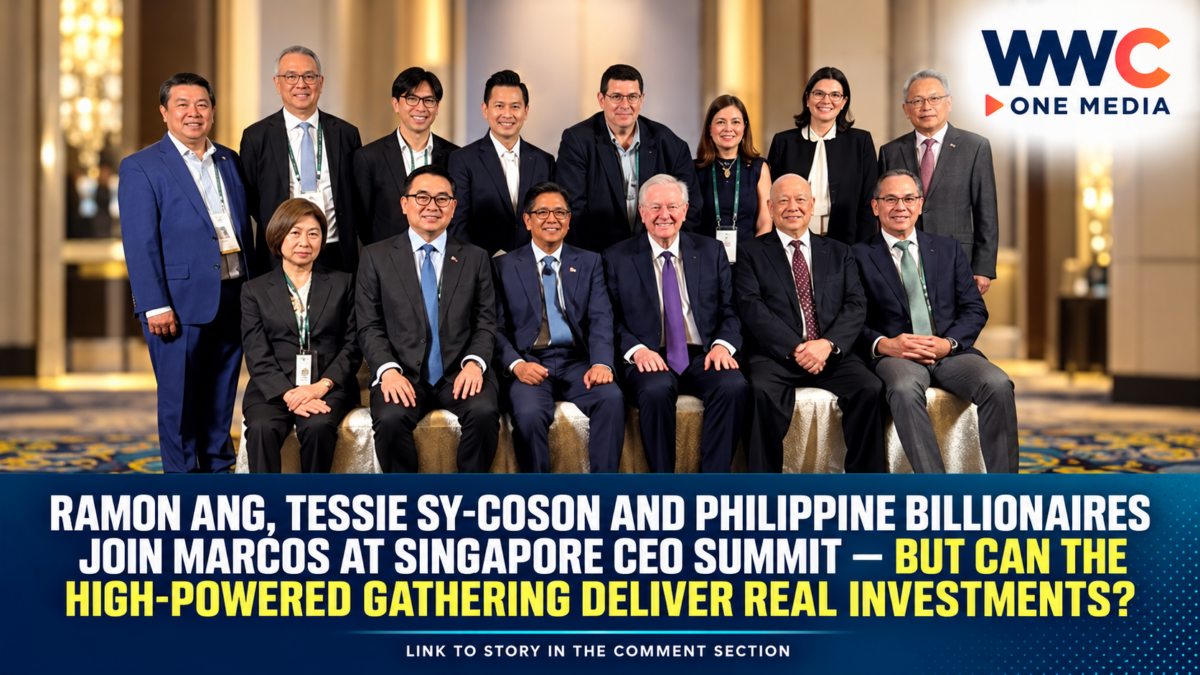
SINGAPORE — Some of the Philippines’ most powerful business leaders gathered in Singapore alongside President Ferdinand Marcos Jr. for the 24th Forbes Global CEO Conference, bringing together influential figures from banking, infrastructure, telecommunications, property development and major family-owned conglomerates at a time when competition for international investment is intensifying.
The high-profile gathering, held on October 7 and 8, 2026, provided an opportunity for Filipino corporate executives to connect with international investors, explore potential partnerships and participate in discussions about the changing global economy.
Among the prominent Philippine personalities reported in attendance were San Miguel Corporation chairman and CEO Ramon Ang, BDO Unibank chairperson Teresita Sy-Coson, Aboitiz Equity Ventures president and CEO Sabin Aboitiz, Converge ICT Solutions co-founder Dennis Anthony Uy, Lucio Tan III and Mariana Zobel de Ayala.
The Philippine delegation also included Finance Secretary Frederick Go and other representatives of the country’s business community.
But behind the exclusive gathering of billionaires, investors and government leaders lies a more consequential question:
Can the Philippines translate its access to some of the world’s most influential decision-makers into fresh investments, better jobs and stronger economic growth?
Philippine Business Heavyweights Gather in Singapore
The Forbes Global CEO Conference assembled senior executives, entrepreneurs, investors and policymakers to discuss the forces reshaping international business.
Forbes promoted the 2026 gathering under the theme “Speed of Change,” emphasizing the rapid transformation of industries through technology, investment and shifting geopolitical relationships.
According to Bilyonaryo, the Philippine contingent included several of the country’s most recognizable corporate figures.
Ramon Ang — San Miguel Corporation
Ang leads one of the Philippines’ largest diversified conglomerates, with major interests in infrastructure, energy, food manufacturing and other industries.
His participation placed a major Philippine infrastructure and industrial investor among international executives discussing economic opportunities and business partnerships.
Teresita Sy-Coson — BDO Unibank
The BDO chairperson represents one of the country’s most influential banking and retail business families.
Her presence highlighted the role of financial institutions in supporting investment, business expansion and economic development.
Sabin Aboitiz — Aboitiz Equity Ventures
Aboitiz attended with his wife, Bettina Araneta.
His conglomerate has interests spanning energy, banking, infrastructure, property and other businesses.
Dennis Anthony Uy — Converge ICT Solutions
Uy, co-founder of Converge ICT Solutions, represents the Philippine telecommunications and digital infrastructure sector.
His participation was particularly relevant as the conference examined artificial intelligence, connectivity and digital transformation.
Lucio Tan III — LT Group and the Lucio Tan business family
Lucio Tan III attended alongside his younger brother Kyle and their uncle Michael Tan.
Their participation reflected the presence of another major Philippine business family with interests in multiple industries.
Mariana Zobel de Ayala — Ayala Group
Mariana Zobel de Ayala was also among those attending, adding a next-generation business leader to the Philippine contingent.
Together, these personalities represented a cross-section of industries central to the country’s economic development.
However, attendance at the conference should not automatically be interpreted as confirmation that the executives signed new investment agreements.
President Marcos Pitches the Philippines to Global Investors
President Marcos attended the conference as part of his working visit to Singapore from October 7 to 11.
Before departing Manila, the President said he intended to present the Philippines as an attractive investment destination for companies involved in emerging technologies and established infrastructure industries.
His investment priorities included artificial intelligence, digital technology, advanced manufacturing, infrastructure, energy and healthcare.
The President also emphasized the need to strengthen the country’s technical capabilities and supporting infrastructure as technological change accelerates.
His participation provided an opportunity to engage with international business leaders beyond the Philippines’ traditional investment partners.
The conference formed part of a wider diplomatic and economic engagement program that included meetings with Singaporean officials and discussions on regional cooperation.
For the Marcos administration, such gatherings are opportunities to promote the Philippines’ investment potential.
But translating investor interest into actual economic activity requires commitments beyond conference presentations.
Companies must still consider operating costs, regulatory conditions, infrastructure reliability and the availability of skilled workers before establishing or expanding operations.
Artificial Intelligence Takes Center Stage
One of the major themes of the Forbes gathering was the growing influence of artificial intelligence on businesses and economies.
During his discussion at the conference, Marcos highlighted the importance of regional cooperation in developing policies and opportunities surrounding AI.
According to Channel NewsAsia, the President discussed the anticipated ASEAN Digital Economy Framework Agreement, which the region is working toward signing at the November 2026 ASEAN Summit.
The agreement aims to provide a framework for greater digital economic cooperation among ASEAN member states.
Its potential areas of significance include digital trade, technology adoption, regulatory coordination and cross-border economic activity.
For the Philippines, a stronger regional digital economy could create opportunities for telecommunications companies, financial institutions, technology businesses and other industries.
However, the benefits will depend on the agreement’s final provisions and how governments implement them.
Marcos emphasized that discussions about AI and emerging technologies should involve cooperation beyond individual countries and economic sectors.
The comments reflected the growing recognition that technological development can create both opportunities and risks requiring international coordination.
Singapore’s Forbes Summit Draws Hundreds of Global Decision-Makers
The 24th Forbes Global CEO Conference was organized with the Singapore Economic Development Board.
Forbes initially announced that approximately 450 executives, thought leaders, entrepreneurs and investors were expected to participate.
Philippine government briefings subsequently referenced more than 470 business leaders.
The difference reflects estimates released at different stages rather than a confirmed final attendance count.
The conference attracted prominent international personalities, including Bridgewater Associates founder Ray Dalio and senior leaders from major Asian financial and investment institutions.
Singapore Prime Minister Lawrence Wong also participated in the event.
The gathering reinforced Singapore’s role as a major destination for international business conferences and investment discussions.
For Filipino executives, it provided an opportunity to engage with investors and business leaders from different industries and geographic markets.
But the economic significance of the conference will ultimately depend on whether those conversations develop into commercial partnerships and investment decisions.
Ray Dalio Warns of Risks Behind the Global AI Boom
Although artificial intelligence attracted significant investor attention, the conference also featured warnings about the scale and sustainability of AI-related spending.
Reuters reported that Ray Dalio characterized aspects of the current AI investment boom as a classic bubble.
His comments reflected concern that financial markets may be placing overly optimistic valuations on companies associated with AI.
Other business leaders also questioned whether the enormous capital flowing into advanced computing infrastructure would generate sufficient returns.
Channel NewsAsia reported that Temasek CEO Dilhan Pillay Sandrasegara suggested capital could be distributed more widely toward AI adoption rather than being concentrated heavily in chips and data centers.
These discussions highlighted an important tension for governments seeking AI-related investment.
While the technology offers opportunities for economic growth, projects must still demonstrate commercial value.
For the Philippines, attracting AI investment would require more than promotional announcements.
Reliable electricity, telecommunications infrastructure, skilled professionals and clear regulations are among the important factors influencing long-term investment decisions.
Singapore’s Prime Minister Stresses Stability and Investor Trust
Prime Minister Lawrence Wong used his conference appearance to emphasize Singapore’s commitment to openness, predictable policies and trusted business institutions.
In his October 8 conversation with Steve Forbes, Wong said stability and confidence were increasingly important in a world facing economic uncertainty.
He also highlighted the need for investment to create productive economic activity rather than merely move capital between jurisdictions.
His remarks provided a broader perspective on competition for investment across Asia.
Countries seeking international capital must offer more than tax incentives.
Investors also consider regulatory predictability, infrastructure, governance, the workforce and the security of long-term business operations.
These are relevant considerations for the Philippines as it competes with Singapore, Vietnam, Malaysia, Thailand and Indonesia for new investment projects.
While the Philippine market offers substantial opportunities, attracting high-value investments depends on whether businesses believe those opportunities can be developed efficiently and sustainably.
Philippine Investment Push Extends Beyond Artificial Intelligence
Marcos’ Singapore visit also highlighted opportunities in infrastructure, energy, healthcare and advanced manufacturing.
These sectors are interconnected.
Technology facilities require dependable electricity and high-quality telecommunications networks.
Manufacturing operations need efficient transport systems, competitive energy prices and access to skilled workers.
Healthcare investment depends on professionals, infrastructure and appropriate regulation.
A country’s ability to attract international investors therefore depends partly on how these supporting systems work together.
The President’s broader agenda included a visit to the Singapore Nuclear Research and Safety Institute to learn about the city-state’s experience in nuclear technology and safety.
The visit forms part of the Philippines’ continuing examination of long-term energy options.
However, discussions about nuclear research and international investment should not be mistaken for confirmation of a new nuclear power project or financing commitment.
For the Philippines, the critical challenge is converting strategic priorities into feasible projects supported by credible investment and implementation plans.
Why the Presence of Filipino Billionaires Matters
The presence of influential Philippine business leaders provides an additional dimension to the government’s investment campaign.
Large domestic conglomerates often play important roles in major infrastructure developments, financial services, industrial expansion and technology-related projects.
Their connections with international investors can support partnerships, financing arrangements and knowledge sharing.
For example, business discussions may explore opportunities involving joint ventures, corporate financing, technology partnerships or expansion into regional markets.
However, these remain potential outcomes rather than confirmed developments from the conference.
There is no verified public announcement in the reviewed reporting establishing that every Filipino executive who attended secured a new investment deal.
It would also be inaccurate to assign specific project values or commercial commitments without supporting company disclosures.
The gathering should therefore be understood as an opportunity for engagement rather than proof of completed investment transactions.
Can Billionaire Connections Translate Into More Filipino Jobs?
For ordinary Filipinos, the economic value of international business conferences is measured less by the prominence of participants than by the outcomes they produce.
New investments can potentially create employment, increase demand for local suppliers and strengthen economic activity.
Technology partnerships may also support workforce development and access to new business capabilities.
But those benefits require actual project implementation.
Investment announcements can take years to translate into operating facilities and sustained employment.
Some discussions never result in finalized agreements.
Even completed projects vary in the number and quality of jobs they generate.
This makes transparency an important part of the investment process.
Clear reporting on signed commitments, project timelines, capital deployment and employment outcomes would help establish the practical benefits of high-level international engagements.
The same principle applies to private-sector participation.
Corporate meetings can create commercial opportunities, but their broader economic significance becomes clearer only when companies disclose and implement specific investment decisions.
ASEAN Digital Cooperation Could Open New Opportunities
The President’s comments about the ASEAN Digital Economy Framework Agreement place the Singapore conference within a broader regional economic strategy.
As the Philippines continues its 2026 ASEAN chairship, discussions about digital trade and technology regulation have become increasingly important.
The region’s diverse economies face different challenges involving internet access, cybersecurity, digital payment systems and technology investment.
A coordinated digital framework could help reduce some barriers to cross-border business activity.
For Philippine companies, improved digital integration may create opportunities to expand services and build partnerships across Southeast Asia.
However, the eventual benefits will depend on the final agreement and the capacity of individual countries to implement its provisions.
The framework should not yet be presented as a completed agreement delivering measurable economic gains.
The November ASEAN Summit will be an important milestone in determining the next steps.
The Bigger Picture: Philippines Competes for Capital in a Changing Global Economy
The gathering in Singapore reflects a wider competition among Asian economies to attract investment in technology, energy and advanced industries.
Businesses are reassessing supply chains, investment destinations and long-term operating strategies as geopolitical and economic conditions change.
For the Philippines, these shifts present both opportunities and challenges.
The country can promote its large consumer market, workforce and position within Southeast Asia.
But investors also evaluate infrastructure, logistics, electricity costs, business regulation and policy stability.
The presence of leading Filipino executives alongside international investors may help strengthen business connections and raise awareness of opportunities.
Yet sustained investment growth will require improvements that extend well beyond conferences.
Strong institutions, clear rules and dependable infrastructure remain central to long-term competitiveness.
THE BOTTOM LINE
President Ferdinand Marcos Jr. joined some of the Philippines’ most influential business leaders at the 24th Forbes Global CEO Conference in Singapore, where executives and investors discussed artificial intelligence, regional cooperation and emerging economic opportunities.
The Philippine participants reported by Bilyonaryo included Ramon Ang, Teresita Sy-Coson, Sabin Aboitiz, Dennis Anthony Uy, Lucio Tan III and Mariana Zobel de Ayala.
Their presence highlighted the country’s representation at a gathering of major business decision-makers.
But the conference also underscored the intense competition for investment and the growing importance of economic stability, technology readiness and infrastructure.
For the Philippines, gathering some of its richest business leaders in one room with global investors is an opportunity — but the real achievement will be turning those conversations into operating businesses, substantial investments and meaningful employment.
The biggest question is not who attended the exclusive Singapore summit, but how much lasting economic value the Philippines can bring home.