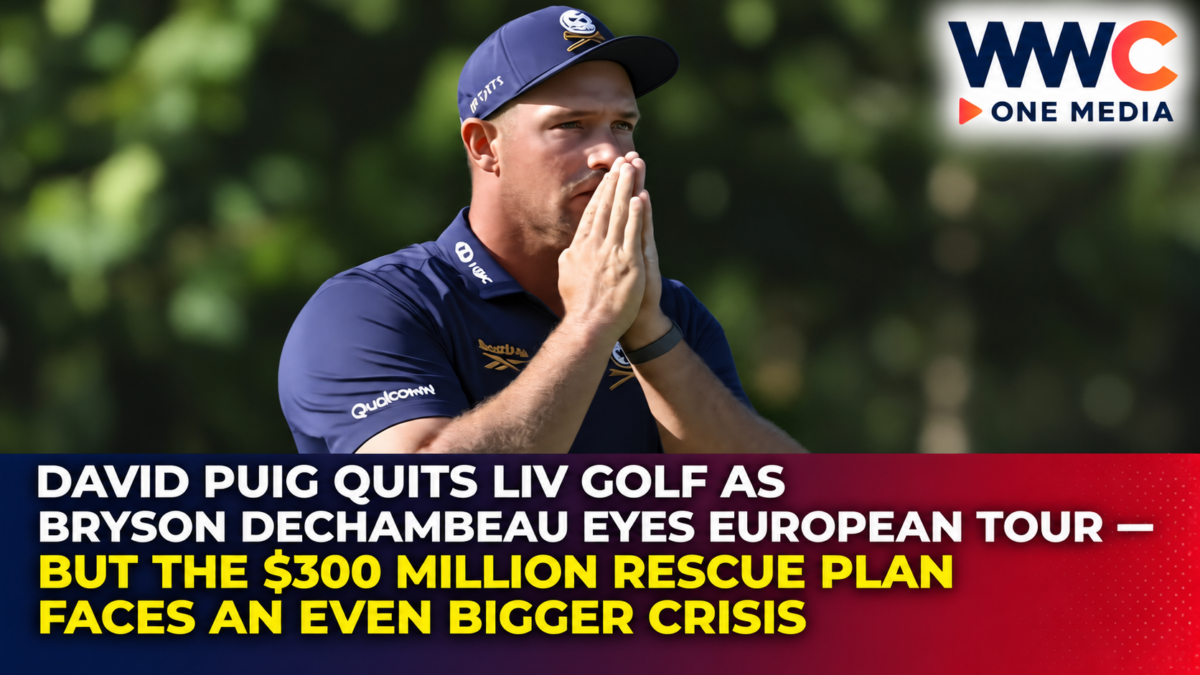
MADRID, Spain — LIV Golf’s fight for survival has suffered another major setback after rising Spanish star David Puig confirmed he will leave the Saudi-backed circuit rather than join its proposed 2027 relaunch, while two-time U.S. Open champion Bryson DeChambeau is reportedly considering more tournament appearances in Europe.
The developments add to growing uncertainty surrounding LIV Golf as its management attempts to rebuild the competition under a new ownership and financing structure following its Chapter 11 bankruptcy filing.
Puig, 24, announced his decision during the Spanish Open, explaining that he wants to compete full-time on the DP World Tour in 2027.
His departure follows former world No. 1 Jon Rahm’s decision to reject participation in the proposed LIV Golf 2.0, placing further pressure on organizers attempting to convince leading players to remain.
The timing is particularly sensitive.
LIV Golf is working toward a reported October 25 deadline to secure enough player commitments to support a potential $300 million restructuring investment involving BC Partners Credit.
But while Puig’s departure is confirmed and DeChambeau’s European plans remain under consideration, one question is becoming increasingly difficult for LIV Golf to ignore:
Can the league convince its remaining stars to stay before its financial rescue plan runs out of time?
David Puig Confirms He Will Not Return to LIV Golf in 2027
Puig confirmed that he does not intend to participate in LIV Golf’s proposed relaunch next season.
The Spanish golfer, who previously competed for Sergio Garcia’s Fireballs GC team, said he wants to focus on a full schedule on the DP World Tour.
His decision represents a significant career change after several seasons competing in the Saudi-backed league.
Unlike established stars who joined LIV Golf after successful careers on traditional tours, Puig entered the breakaway circuit at the beginning of his professional journey.
He had been a standout amateur at Arizona State University before joining LIV in 2022.
The decision allowed him to compete against experienced international players while developing his professional career.
Although Puig never secured an individual LIV Golf title, he achieved success outside the circuit.
He won tournaments on the Asian Tour and captured the BMW Australian PGA Championship in 2025.
Those achievements helped strengthen his international reputation and provided further opportunities to compete on established professional tours.
His latest decision reflects a desire to pursue a different competitive schedule rather than a public rejection of everything he experienced at LIV.
Puig has credited the league with helping him develop into the player he is today.
Why Puig’s Exit Is Another Blow to LIV Golf
Puig’s departure matters because LIV Golf’s proposed restructuring depends heavily on retaining recognizable players.
The league’s original business model relied on substantial financial backing from Saudi Arabia’s Public Investment Fund.
That support enabled organizers to offer large signing bonuses and prize money while recruiting established golfers from the PGA Tour and DP World Tour.
However, the financial situation has changed dramatically.
LIV Golf filed for Chapter 11 bankruptcy protection in September 2026 after Saudi financial support was withdrawn.
The organization is now seeking investment to create a smaller, redesigned competition.
Under the proposed LIV Golf 2.0 structure, players could receive ownership interests in the league and its teams.
The objective is to create a more sustainable business model with greater player participation in the competition’s commercial future.
But the proposal faces an immediate challenge.
If enough leading golfers decide not to participate, prospective investors may question the commercial appeal of the relaunched league.
Puig’s decision therefore adds to the uncertainty surrounding LIV’s efforts to retain players.
Jon Rahm’s Departure Intensifies the Crisis
Before Puig announced his decision, fellow Spaniard Jon Rahm had already rejected the proposed LIV Golf 2.0 arrangement.
Rahm joined LIV Golf in late 2023 after establishing himself as one of the world’s leading players.
His decision to move from the PGA Tour was considered one of the breakaway league’s biggest recruitment victories.
But on October 7, 2026, Rahm confirmed that he would not participate in the proposed new version of LIV.
According to reporting by The Guardian and the Financial Times, Rahm objected to the terms of the restructuring.
His decision created uncertainty over whether other high-profile players would follow.
Sergio Garcia, another major figure in LIV Golf’s original expansion, has also been pursuing a departure from the circuit.
The loss of recognizable names could weaken the league’s ability to attract broadcasters, sponsors and spectators.
For the new management team, retaining established stars while recruiting future talent is becoming one of the most difficult parts of the restructuring.
Bryson DeChambeau Reportedly Considers More European Golf
While Puig has made his decision, DeChambeau’s future remains less certain.
Reports indicate that the American golfer is considering additional appearances on the DP World Tour.
According to golf media coverage, possible events include the Nedbank Golf Challenge in South Africa.
DeChambeau has not confirmed that he is seeking full-time membership on the European circuit.
He also has not publicly announced a definitive departure from LIV Golf.
That distinction is important because tournament participation outside LIV does not automatically mean a player has abandoned the breakaway league.
Professional golfers can sometimes compete across different tours, subject to membership rules, eligibility requirements and contractual arrangements.
DeChambeau’s reported interest in European tournaments nevertheless reflects the wider uncertainty surrounding LIV’s future.
As one of the league’s biggest attractions, his eventual decision could significantly influence the proposed relaunch.
Why DeChambeau Is So Important to LIV Golf
DeChambeau is among the most recognizable golfers associated with LIV.
The two-time U.S. Open champion joined the competition in 2022 after building a successful career on the PGA Tour.
His power-focused playing style, major championship victories and strong digital following have made him a commercially valuable personality in professional golf.
For LIV Golf, stars like DeChambeau provide more than competitive credibility.
They can help attract television audiences, sponsorship agreements and international attention.
The proposed restructuring would benefit from retaining golfers capable of drawing interest beyond the sport’s traditional fan base.
However, DeChambeau must also evaluate his competitive opportunities and financial interests as the league reorganizes.
Reporting by the Financial Times indicates that lawyers representing DeChambeau have been involved in discussions concerning the rights and interests of LIV players.
Those negotiations do not establish that he has accepted or rejected the new league’s terms.
His future remains an important unresolved question.
LIV Golf’s $300 Million Rescue Plan Faces a Critical Deadline
One of the most important developments is LIV Golf’s potential financing arrangement with BC Partners Credit.
According to Associated Press reporting, the investor is expected to provide initial backing as part of a proposed $300 million investment plan intended to support LIV’s emergence from bankruptcy.
The investment remains subject to the necessary approvals and conditions.
The proposed plan would help establish a revamped professional golf competition featuring player equity participation and a revised tournament schedule.
Organizers have discussed a 10-event season in 2027, with approximately half of the tournaments expected to take place outside the United States.
The objective is to create a leaner and more financially sustainable league than the original LIV model.
However, the restructuring depends on securing sufficient participation from players.
Golf Monthly reported that LIV management faces an October 25 deadline to obtain the required commitments.
If too many prominent players decline, negotiations with investors could become more difficult.
The proposed $300 million therefore should not be described as financing already fully received or guaranteed.
Saudi Arabia’s Withdrawal Changes the Economics of LIV Golf
LIV Golf’s original expansion was powered by billions of dollars in investment from Saudi Arabia’s Public Investment Fund.
Since the competition launched in 2022, the fund committed more than $5 billion to establish the league and attract professional golfers.
That funding supported large player contracts, lucrative tournament purses and international events.
But the model also generated substantial costs.
In August 2026, LIV announced major staff reductions as it prepared for the end of its previous financial arrangements.
The restructuring has forced organizers to consider a different approach to ownership, investment and player compensation.
Rather than relying primarily on a single government-backed financial source, LIV 2.0 is expected to involve external investment and greater player ownership.
That transition introduces new uncertainties.
Potential investors must determine whether the redesigned circuit can attract enough viewers, sponsors and commercial revenue to support its operations.
The league’s previous financial resources helped it recruit stars.
Its new structure must convince those same players that the competition has a sustainable future.
LIV 2.0 Could Give Players Ownership in the League
A defining feature of the proposed restructuring is the possibility of giving players equity stakes.
Under the plan described by the Financial Times, golfers could become majority owners of the reorganized competition and its teams.
The model aims to align players’ financial interests with the success of the business.
Instead of receiving only tournament winnings and contractual compensation, participating players could benefit from increases in the value of the league.
However, equity ownership also carries financial uncertainty.
The value of ownership interests depends on the organization’s eventual commercial performance.
If the league struggles to generate sustainable revenue or attract investment, those equity stakes may be worth less than players expect.
For golfers accustomed to guaranteed contracts, the proposed arrangement may therefore require a different assessment of risk.
The willingness of leading players to accept those terms will be crucial.
DP World Tour Could Benefit From LIV’s Uncertainty
The potential movement of former LIV players toward the DP World Tour could strengthen the European circuit.
Puig’s decision to compete full-time provides a clear example.
Other established golfers are reportedly exploring ways to increase their participation in European tournaments or return to traditional professional golf schedules.
However, rejoining the DP World Tour can involve regulatory and financial conditions.
Earlier in 2026, the tour granted conditional releases to several members competing in LIV events.
Those arrangements required players to satisfy specified obligations involving fines, tournament participation and outstanding appeals.
The conditions varied depending on individual circumstances.
The growing interest in established tours could improve the quality of tournament fields and increase the commercial appeal of selected events.
But whether those benefits materialize will depend on individual player decisions and eligibility.
Could the PGA Tour Regain Its Biggest Stars?
LIV Golf’s uncertain future could also create opportunities for the PGA Tour.
Since LIV’s launch, professional golf has experienced deep divisions involving player contracts, tournament eligibility and the structure of international competition.
Some players faced restrictions after joining the Saudi-backed circuit.
Others remained on traditional tours despite the substantial financial incentives offered by LIV.
The league’s financial restructuring may lead additional players to consider returning to the PGA Tour.
However, a return is not necessarily automatic.
Players may need to satisfy eligibility conditions, membership requirements or other obligations before competing regularly.
There is also no confirmed agreement providing a universal pathway for every former LIV golfer.
For the PGA Tour, the potential return of internationally recognized players could strengthen its tournament fields.
But the full impact will depend on how individual situations are resolved.
David Puig’s Decision Highlights a New Career Strategy
Puig’s move also reflects a different approach to professional golf.
At 24, he remains in the early stages of his career.
A full DP World Tour schedule could provide opportunities to compete consistently, improve his world ranking and pursue future qualification for other major competitions.
His victory at the 2025 Australian PGA Championship demonstrated his ability to win outside LIV Golf.
He has also competed in major championships and built experience against leading international players.
For younger golfers, career decisions can involve more than immediate prize money.
Tour access, ranking opportunities, long-term development and eligibility for major championships can influence which schedule provides the greatest benefit.
Puig’s departure suggests that those considerations have become central to his plans.
His decision may encourage other players to reconsider their own priorities, although it does not establish that a wider player exodus is inevitable.
October 25 Could Determine LIV Golf’s Next Chapter
The reported October 25 commitment deadline creates a sense of urgency.
LIV’s management must convince enough players that its proposed 2027 structure offers attractive competitive and financial opportunities.
The organization must also secure financing, satisfy bankruptcy-related requirements and prepare a viable tournament schedule.
Losing established players makes those tasks more complicated.
However, the league still has potential assets, including its international brand, existing team identities and relationships with professional golfers.
The proposed investment arrangement also indicates that some financial institutions see potential in a redesigned version of the competition.
Whether that potential translates into a successful relaunch remains uncertain.
The coming weeks will be critical as players evaluate their options and organizers negotiate the terms of the new structure.
The Bigger Picture: Professional Golf Could Be Entering Another Major Realignment
The uncertainty surrounding LIV Golf represents another turning point in the sport’s evolving commercial landscape.
When LIV launched in 2022, it challenged the traditional professional golf system with guaranteed contracts and substantial prize money.
Its arrival forced established tours to reconsider player compensation, tournament structures and commercial strategies.
But the financial difficulties now facing the breakaway league demonstrate the challenges of building a sustainable sporting business.
Large financial investment can attract top athletes and generate publicity.
Long-term success, however, requires continued player participation, strong commercial partnerships and reliable revenue.
As Puig prepares to return to the DP World Tour and DeChambeau considers additional European appearances, professional golf could experience another period of movement between competing circuits.
The outcome may reshape where leading players compete and how tournaments are organized.
THE BOTTOM LINE
David Puig has confirmed that he will leave LIV Golf’s proposed 2027 competition to pursue a full season on the DP World Tour.
His decision follows Jon Rahm’s departure and adds pressure to a league attempting to rebuild after bankruptcy and the withdrawal of its previous Saudi financial backing.
Meanwhile, Bryson DeChambeau is reportedly considering more European tournament appearances, although he has not confirmed plans to abandon LIV Golf.
A potential $300 million investment involving BC Partners Credit could support the league’s restructuring, but the arrangement still faces conditions and the challenge of securing player commitments.
With an October 25 deadline reportedly approaching, organizers must convince enough leading golfers to participate in the proposed relaunch.
The biggest threat to LIV Golf is no longer simply the loss of one rising star — but the possibility that its financial rescue plan could struggle if too many players decide their futures lie elsewhere.
For David Puig, leaving LIV marks the beginning of a new chapter. For the league he is leaving behind, the next few weeks could determine whether there is another chapter at all.