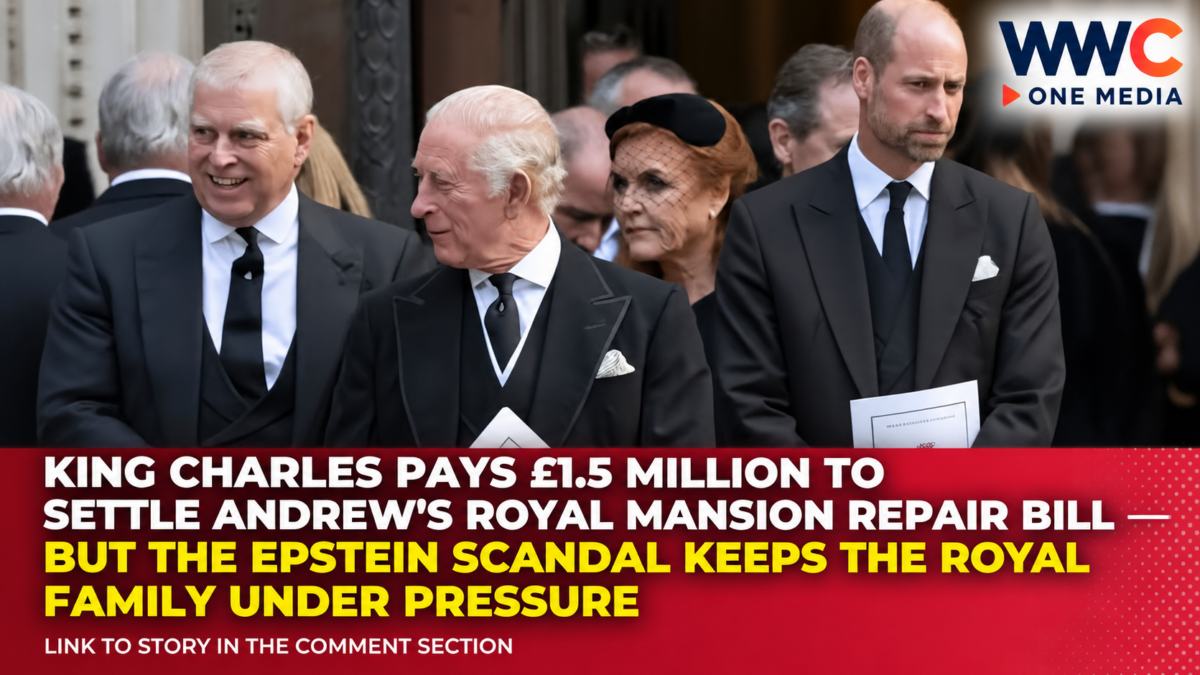
LONDON, United Kingdom — Britain’s King Charles III has stepped in to settle a £1.5-million ($1.98-million) repair bill linked to his younger brother Andrew Mountbatten-Windsor’s former royal residence, adding another extraordinary chapter to the scandal that has shaken the British monarchy.
The payment covers the outstanding repair and restoration costs at Royal Lodge, the sprawling 30-room mansion near Windsor Castle where Andrew lived for more than two decades before being forced to leave following renewed scrutiny of his relationship with convicted sex offender Jeffrey Epstein.
According to Reuters, the Associated Press and British media reports published on October 9, 2026, Charles made the money available from his private income, rather than directly charging the expense to government funds.
The development comes after the Crown Estate formally confirmed that Andrew’s lease on the historic property had ended.
But while the financial settlement closes one chapter of the Royal Lodge controversy, it raises a more difficult question for the King: Can Charles continue financially supporting his disgraced brother while protecting the monarchy from the reputational damage surrounding Andrew’s association with Epstein?
King Charles Steps In to Settle £1.5-Million Mansion Bill
The Crown Estate, which manages Royal Lodge and other properties belonging to the Crown Estate portfolio, confirmed that the mansion’s outstanding repair costs had been settled.
The total assessment for repairs and restoration, described under the lease as dilapidations, amounted to approximately £1.8 million.
However, Andrew was entitled to £302,000 in compensation under the terms of his lease because he surrendered the property before the completion of the first 25 years of his agreement.
Rather than making that compensation payment directly to Andrew, the amount was offset against the repair liability.
The resulting net payment was approximately £1.5 million.
King Charles provided the money from his private income, according to royal sources cited by British news organizations.
The Crown Estate confirmed that it had received the net amount owed and that Andrew had not received a cash payment from the lease’s conclusion.
The arrangement means the estate’s financial claim has been resolved without Andrew personally receiving the early termination compensation.
Why Andrew Faced a £1.8-Million Repair Liability
Andrew acquired a 75-year lease on Royal Lodge in 2003.
Under the arrangement, he agreed to substantial upfront spending on repairs and improvements, reportedly totaling approximately £7.5 million.
In return, he was able to occupy the property for years while paying only a nominal rent.
The arrangement attracted considerable criticism because Royal Lodge is part of the Crown Estate portfolio, whose profits are paid to the British Treasury.
The mansion, located within Windsor Great Park, became one of Andrew’s most recognizable residences.
However, questions about the condition of the building intensified after he was directed to vacate the property.
The Crown Estate assessed approximately £1.8 million in costs associated with its condition when the lease ended.
These costs reflect the financial obligations attached to surrendering the property and should not be confused with the earlier £7.5 million Andrew reportedly spent on renovations.
The net liability was ultimately resolved with funds supplied by King Charles.
Andrew Leaves Royal Lodge After Losing His Royal Titles
The settlement follows a dramatic period in Andrew’s relationship with the British monarchy.
In 2025, King Charles moved to strip his younger brother of his remaining royal titles and require him to leave Royal Lodge.
The decision came amid renewed public scrutiny of Andrew’s past association with Jeffrey Epstein, the American financier and convicted sex offender who died in prison in 2019.
Andrew has repeatedly denied wrongdoing connected to Epstein.
Nevertheless, his association with the late financier became one of the most damaging controversies faced by the modern British royal family.
Andrew vacated Royal Lodge in February 2026 and subsequently relocated to accommodation on the King’s privately owned Sandringham estate in Norfolk.
His departure ended more than two decades of residence at the Windsor property.
For Charles, removing Andrew from Royal Lodge was widely seen as an effort to distance the monarchy’s public institutions from the continuing controversy.
But the newly disclosed financial support shows that the King has continued assisting his brother privately even after taking action to reduce his public royal role.
Royal Lodge Repair Bill Reignites Questions About Royal Finances
The controversy has also renewed attention on how royal properties are funded and managed.
The Crown Estate is a commercially managed property portfolio established by law. Its net revenue is paid to the UK Treasury.
It is distinct from the King’s personally owned assets and private income.
This distinction matters because some of the public criticism surrounding Royal Lodge has focused on whether arrangements involving royal residences provide adequate financial value to the public.
The King reportedly used private funds to ensure the Crown Estate received the remaining repair payment.
That means the £1.5-million contribution should not be reported as a payment directly made by British taxpayers.
However, the public interest in the transaction extends beyond the immediate source of money.
Royal property arrangements remain under scrutiny because of questions about lease terms, maintenance obligations, transparency and whether Crown Estate assets are being managed for appropriate financial returns.
The latest settlement gives the Crown Estate an opportunity to pursue a new use for the property.
Crown Estate Looks to Generate New Revenue From Royal Lodge
Following the formal termination of Andrew’s lease, the Crown Estate said it would examine the property’s future use and opportunities to generate additional financial value.
The early return of Royal Lodge potentially allows the estate to consider arrangements that were previously restricted by Andrew’s long-term lease.
These could include finding another tenant or pursuing an alternative use consistent with the property’s legal, heritage and operational requirements.
However, no final redevelopment plan or new occupant has been confirmed in the reports reviewed.
The property’s large size, historic character and maintenance requirements could affect the options available.
Any future arrangement would also need to account for the mansion’s location within Windsor Great Park and the relevant property management requirements.
For the Crown Estate, the objective is to ensure that the property’s future produces financial value.
The success of that effort will depend on the costs of restoration, the terms of any new agreement and the amount of revenue ultimately generated.
Andrew’s Legal Problems Continue Despite Court Victory
The Royal Lodge settlement comes as Andrew remains under investigation over allegations unrelated to the physical condition of the mansion.
In February 2026, he was arrested on suspicion of misconduct in public office in connection with allegations involving his former role as a British trade envoy.
The investigation concerns claims about his handling of information during that period and his association with Epstein.
Andrew denies wrongdoing and has not been convicted in connection with the investigation.
On October 8, a British court ruled that search warrants obtained by police in relation to Andrew’s properties had been issued unlawfully and must be quashed.
The ruling represented a legal victory for Andrew, but it did not end the underlying police investigation.
The validity of the search warrants and the allegations being investigated are separate legal questions.
The court’s decision should therefore not be interpreted as a finding that Andrew was innocent of the matters under investigation.
Further legal proceedings may determine how evidence obtained through the warrants can be treated.
Buckingham Palace Draws a Line on Legal Expenses
Although Charles has provided substantial private financial assistance for his brother’s housing and the Royal Lodge settlement, Buckingham Palace has reportedly established limits on that support.
According to The Guardian, a palace source said Andrew had been warned that money provided by the King should not be used to fund his legal challenge against police.
The clarification came as Andrew sought judicial review of search warrants connected with the misconduct investigation.
The distinction is significant.
The King has continued helping his brother with private living arrangements, but the Palace has sought to separate that assistance from funding Andrew’s legal defense.
This suggests an effort to balance family responsibilities with the monarchy’s need to maintain institutional distance from Andrew’s legal difficulties.
Nevertheless, the distinction may not end public questions about the financial relationship between the brothers.
King Charles Continues Supporting Andrew at Sandringham
After leaving Royal Lodge, Andrew relocated to the Sandringham estate in eastern England.
Unlike the Crown Estate, Sandringham is privately owned by the monarch.
Reports indicate that Charles has continued to provide financial assistance covering elements of Andrew’s accommodation and personal support.
The amount of that ongoing assistance has not been fully disclosed.
The arrangement means Andrew no longer occupies Royal Lodge, but continues receiving support from the King.
For the monarchy, the situation creates an unusual tension.
Charles has taken steps to remove his brother from the public royal structure while maintaining financial support as a family member.
The extent and future duration of those arrangements remain matters of public interest.
National Audit Office Findings Increase Scrutiny of Royal Property Arrangements
The Royal Lodge controversy follows wider scrutiny of royal property finances.
A June 2026 National Audit Office report examined several arrangements involving members of the royal family and properties connected to the Crown Estate.
The report highlighted issues involving lease structures, property use and financial transparency.
Among the matters attracting attention were Andrew’s previous rental arrangements and income associated with properties on the Royal Lodge estate.
These findings contributed to public debate over whether historic royal property agreements remain appropriate under modern expectations of transparency and financial accountability.
The arrangements vary considerably between individual properties and royal family members.
It would therefore be misleading to treat all royal residences as having identical funding or rental structures.
Nevertheless, the scrutiny reflects growing interest in understanding the financial relationship between the monarchy, privately owned royal assets and publicly accountable estate holdings.
Why the Epstein Scandal Still Threatens the Monarchy’s Reputation
The broader controversy surrounding Andrew has created a persistent challenge for the British royal family.
Although Charles has attempted to separate the monarchy’s public duties from his brother’s conduct, new developments continue attracting international attention.
The Royal Lodge settlement is a financial and property matter.
But because it involves Andrew, it also brings renewed scrutiny to the monarchy’s response to the Epstein scandal.
The central issue is not simply the amount paid.
It is whether private financial assistance can be maintained without undermining efforts to establish accountability and distance the institution from unresolved allegations.
Andrew has denied wrongdoing related to Epstein, and allegations should not be presented as established criminal findings.
The monarchy’s reputational challenge, however, is broader than the outcome of any individual proceeding.
Public confidence can also be affected by perceptions of privilege, transparency and how senior figures respond to controversy.
The Bigger Picture: Private Family Support Versus Public Accountability
King Charles faces a difficult balancing act.
As monarch, he represents an institution expected to maintain public confidence and uphold standards of conduct.
As Andrew’s older brother, he also has personal family responsibilities.
The £1.5-million Royal Lodge settlement demonstrates how these two roles can intersect.
The payment resolved a financial obligation owed to the Crown Estate, while preventing the cost from remaining outstanding.
Yet it also brought attention to Charles’ continuing willingness to provide substantial financial support to Andrew.
The fact that the money reportedly came from private income limits the direct taxpayer-funding concern.
But it does not entirely remove public interest in how royal assets are managed and how private support arrangements are structured.
The future of Royal Lodge and the outcome of Andrew’s legal difficulties will likely remain important developments in the wider controversy.
THE BOTTOM LINE
King Charles III has provided approximately £1.5 million from his private income to settle the outstanding repair and restoration bill on Royal Lodge, the former Windsor residence of Andrew Mountbatten-Windsor.
The payment covers the net amount owed after a £302,000 early lease-surrender credit was deducted from the total £1.8-million liability.
The Crown Estate has confirmed the lease’s termination and plans to explore ways to generate financial value from the property’s return.
However, the settlement comes against the backdrop of ongoing scrutiny over Andrew’s relationship with Jeffrey Epstein, royal property finances and an unresolved investigation into allegations of misconduct in public office.
For King Charles, paying the bill may have settled Andrew’s Royal Lodge debt — but it has not settled the much larger controversy surrounding his brother’s place in the royal family.
As the monarchy attempts to preserve public trust, the bigger question remains:
Can the King continue supporting Andrew privately while convincing the public that the royal institution has genuinely moved beyond the scandal?