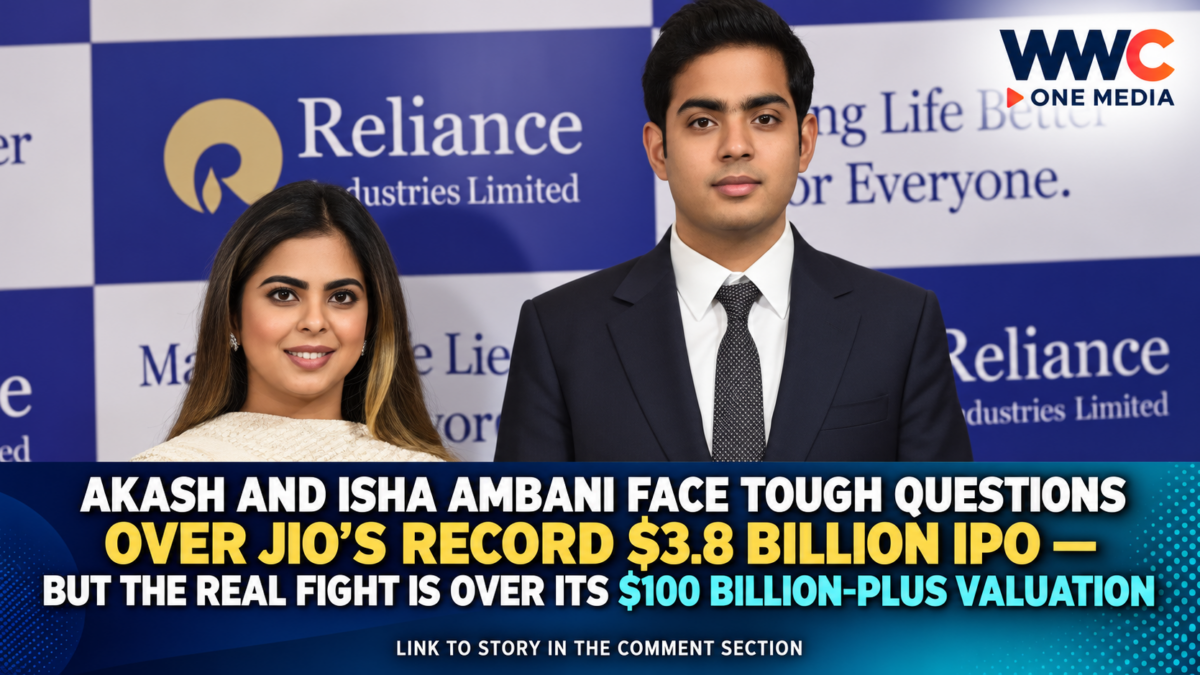
MUMBAI — India’s most anticipated IPO is entering its most difficult stage, as Akash and Isha Ambani face global investors asking whether Jio Platforms deserves to be valued like a high-growth technology company—or like an enormously successful telecom operator.
Jio Platforms is preparing what could become the largest initial public offering in Indian history, with the company expected to raise around $3.8 billion through the sale of newly issued shares.
Reuters reported that the offer is currently expected to open on October 21, with a stock-market debut potentially following on October 28, subject to final filings and market conditions.
That alone would make the transaction historic.
But the more important question now being debated behind closed doors is valuation.
Bloomberg reported this week that Jio may seek an equity valuation of around ₹11 trillion, or about $114 billion, below some earlier expectations.
Other banking sources cited by Indian media have discussed an enterprise value of roughly $143 billion to $146 billion.
Those figures are not necessarily directly comparable because enterprise value and equity value measure different things.
But the gap highlights how actively investors are debating what Jio is really worth.
And that debate goes to the heart of the IPO.
Jio wants investors to see much more than a telecom company
Most Indians know Jio because of mobile phones.
That is understandable.
Reliance Jio launched commercially in 2016 and completely transformed India’s telecom industry with cheap data and aggressive pricing.
Within a decade, it became the country’s largest telecom operator.
Reliance says Jio now has more than 524 million digital subscribers, making it one of the largest digital networks anywhere in the world.
But management does not want the IPO story to stop at mobile connectivity.
Jio Platforms also includes ambitions across:
AI;
cloud computing;
enterprise networking;
fixed broadband;
digital applications;
devices;
and other technology services.
That broader portfolio is crucial because technology companies generally command higher valuation multiples than mature telecom operators.
The IPO debate therefore comes down to a simple question:
How much of Jio’s value comes from what it is today—and how much should investors pay for what it hopes to become?
Akash and Isha Ambani led the global roadshows
The overseas investor meetings were led by Akash Ambani, managing director of Jio Platforms and chairman of Reliance Jio, and his sister Isha Ambani, executive director of Reliance Retail Ventures.
The roadshows took them through major global financial centres including:
the United States;
the United Kingdom;
Dubai;
Hong Kong;
and Singapore.
That is significant for more than fundraising.
The meetings also put the next generation of the Ambani family directly in front of some of the world’s biggest institutional investors.
Mukesh Ambani built Reliance into India’s largest private-sector conglomerate.
Akash, Isha and Anant Ambani are increasingly taking responsibility for its next era.
The Jio IPO is therefore becoming both a capital-markets test and a succession test.
Investors are scrutinizing the next generation directly
Global fund managers considering a multibillion-dollar IPO are not simply buying numbers.
They are buying management.
They want to know:
who makes strategic decisions;
how capital is allocated;
what returns new investments can generate;
how aggressively the company will pursue AI;
and whether management can maintain discipline once Jio becomes independently listed.
For Akash Ambani in particular, the stakes are enormous.
Jio is the business most closely associated with his leadership.
The IPO will give public markets a direct mechanism for grading that leadership every trading day.
That is a very different environment from operating inside privately controlled Reliance Industries.
Jio already produces enormous profits
One reason Jio can credibly ask for a huge valuation is that it is not a speculative technology startup.
It is already highly profitable.
Reliance says Jio Platforms generated ₹1.47 trillion in FY2026 revenue, equivalent to about $15.5 billion, up 14.6% year on year.
EBITDA rose 18.8% to approximately ₹762.6 billion, or about $8 billion.
Its EBITDA margin reached 51.9%.
Profit after tax exceeded ₹300 billion, or about $3.2 billion, for the first time.
Those are formidable numbers.
Few telecom companies grow at that pace while producing margins above 50%.
That gives the bullish valuation argument real substance.
But most of that profit still comes from telecom
This is where investor skepticism becomes more understandable.
Despite Jio’s technology ambitions, its current economics remain heavily dependent on connectivity.
Telecom subscriptions still generate the majority of revenue and cash flow.
That means investors may ask whether the company deserves a premium technology valuation before businesses such as AI, cloud and enterprise software become much larger contributors.
One recent market analysis summarized the central concern neatly:
Jio wants to be valued as a technology platform, while its financial statements still resemble those of an exceptionally strong telecom operator.
That does not make the valuation wrong.
It simply means future businesses must eventually justify the premium.
The $114 billion valuation may reflect investor pushback
Bloomberg reported that Jio may now seek a valuation of around ₹11 trillion, or $114 billion, after completing early demand discussions.
That would still make Jio one of India’s most valuable listed companies.
But it is lower than some previous market estimates.
Jefferies, for example, had previously valued Jio at around $180 billion, while other reported IPO expectations ranged well above $140 billion.
A lower IPO valuation can mean several things.
Investors may be demanding a discount.
Reliance may be deliberately leaving upside for new shareholders.
Or the final structure may reflect differences between enterprise value and equity value.
Until Jio publishes its final price band, no single valuation should be treated as definitive.
The IPO itself may represent only about 3% of the company
The offering is expected to consist mainly or entirely of newly issued shares rather than existing investors selling large positions.
Jio’s draft prospectus showed Reliance Industries owning 66.43% of the company before the offering.
Meta owns approximately 9.98%.
Google holds about 7.73%.
Saudi Arabia’s Public Investment Fund, KKR and Vista each own about 2.31%.
The planned fresh issue is expected to represent roughly 2.9% of Jio’s pre-IPO equity base.
That is an unusually small float for such a large company.
It means the listed shares could be scarce relative to investor demand.
It also means Reliance will remain firmly in control.
Meta and Google are not rushing for the exit
Another important signal is what existing strategic investors appear not to be doing.
Current reports suggest the IPO could proceed without a large offer-for-sale component, meaning major investors such as Meta and Google may retain their positions rather than cash out immediately.
That matters because those companies invested heavily in Jio in 2020.
Meta invested through Jaadhu Holdings.
Google also took a major stake.
Together with other global investors, Jio raised roughly $20 billion during that funding round.
If those investors remain after the IPO, it reinforces the argument that they still believe Jio has substantial long-term upside.
Reliance still owns two-thirds of Jio
Reliance Industries’ 66.43% stake means Jio will remain a controlled company after listing.
That has advantages.
Reliance can continue supporting long-term investment.
Jio can coordinate with the broader group.
The company retains access to one of India’s strongest balance sheets.
But investors will also ask governance questions.
Minority shareholders want confidence that decisions benefiting Reliance as a parent also benefit Jio itself.
Related-party transactions, capital allocation and future restructuring will therefore receive much more scrutiny after listing.
One major use of IPO proceeds is debt reduction
Reuters says much of the approximately $3.8 billion raised is expected to be used to repay borrowings associated with Jio’s telecom operations.
Other market reports suggest around ₹275 billion of proceeds may go toward debt reduction.
That is relatively conservative.
Jio is not presenting the IPO solely as a giant funding round for speculative expansion.
Reducing debt strengthens the balance sheet and can improve cash flow.
But some growth investors may ask whether a business seeking a premium tech multiple should be using so much of its IPO proceeds for debt repayment instead of aggressive investment.
Jio’s 5G spending cycle is becoming less intense
One answer is that a large part of Jio’s heavy telecom investment is already behind it.
The company spent aggressively building nationwide 5G infrastructure.
Reliance has indicated that much of the core 5G capitalization cycle has now matured, which should gradually allow cash flow to improve.
That changes Jio’s financial profile.
Instead of spending enormous sums simply to build network capacity, management can increasingly focus on monetizing what already exists.
That means:
higher tariffs;
more broadband;
enterprise services;
cloud;
AI;
and digital products.
For public-market investors, that transition could be crucial.
JioAirFiber has become a major new growth platform
Reliance says JioAirFiber has become the world’s largest fixed-wireless broadband operator.
The service already connects around 13 million homes.
That gives Jio a path to expand beyond mobile phones.
Home broadband customers can generate higher recurring revenue.
They can also become users of:
streaming;
cloud storage;
smart-home products;
gaming;
and other services.
The more products Jio can attach to each household, the more valuable every broadband connection becomes.
The company is handling extraordinary volumes of data
Jio’s network carried approximately 241 exabytes of data in FY2026, up more than 30% year on year.
That scale gives the company an unusual strategic asset.
Data traffic itself does not automatically create high profits.
But a network serving hundreds of millions of users provides opportunities to distribute:
AI services;
advertising;
payments;
commerce;
cloud products;
media;
and enterprise applications.
The entire IPO thesis depends partly on Jio becoming better at monetizing that distribution advantage.
Tariff increases could become one of the easiest profit levers
Indian mobile prices remain relatively low compared with many global markets.
That has helped Jio build scale.
It also means average revenue per user has room to increase.
Brokerage analysts expect another round of telecom tariff increases could occur, potentially around the end of 2026.
Even modest price increases across more than 500 million customers can have enormous earnings impact.
That makes tariff policy one of the simplest ways Jio can improve profitability after listing.
But it also creates political and competitive sensitivity.
Jio built its brand around affordability.
Push prices too aggressively and consumers may rebel.
Akash Ambani says affordability will remain central
Akash Ambani has said Jio’s objective is not simply to extract higher revenue from every customer.
He has emphasized that monetization must remain connected to providing more value while preserving broad access.
That reflects Jio’s original strategy.
Its growth came from making mobile data dramatically cheaper.
The challenge now is different.
The company needs to raise revenue per user without undermining the affordability that created its dominance.
That balance will matter enormously to IPO investors.
AI may be the biggest valuation wildcard
Artificial intelligence is one of the most important parts of the Jio story—and one of the hardest to value.
Reliance has made AI central to its broader corporate strategy.
Jio has already partnered with Nvidia on AI infrastructure.
It is building capabilities around:
cloud computing;
data centers;
enterprise AI;
and consumer applications.
The bull case is compelling.
India has more than a billion potential digital users.
Jio controls direct distribution to hundreds of millions of them.
If AI services become mass-market products, Jio could be one of the most powerful channels for delivering them.
But those businesses have not yet reached anything close to telecom scale.
Investors are therefore being asked to pay partly for future potential.
That is where the “technology valuation” becomes difficult
A mature telecom operator might be valued primarily on:
EBITDA;
cash flow;
subscriber growth;
and spectrum economics.
A technology platform may be valued partly on:
ecosystem power;
AI opportunity;
cloud growth;
data;
network effects;
and future optionality.
Jio sits directly between those categories.
That creates the valuation tension.
If investors see it mostly as telecom, they may resist very high multiples.
If they see it as India’s digital operating system, they may be willing to pay much more.
Competition with Bharti Airtel remains intense
Jio’s dominance does not mean it has no serious competitor.
Bharti Airtel remains a formidable rival with strong mobile economics, premium customers and a large enterprise business.
Some analysts even argue Airtel currently offers superior cash-flow efficiency.
That comparison matters because Jio cannot be valued in isolation.
IPO investors will constantly compare:
subscriber quality;
ARPU;
EBITDA growth;
capital intensity;
free cash flow;
and enterprise value
with Airtel.
A very high Jio valuation could even cause investors to reconsider whether Airtel itself is undervalued.
The IPO could reprice the entire Indian telecom sector
That is one reason analysts are watching the transaction so closely.
Once Jio has a public market price, investors will have a new benchmark.
They can compare Jio directly with:
Bharti Airtel;
Vodafone Idea;
and international telecom and digital platforms.
A successful IPO could lift valuations across the sector.
An underwhelming one could force investors to reassess assumptions about growth and pricing power.
The deal is therefore bigger than Reliance.
It may establish how Indian telecom assets are valued for years.
The IPO may also reshape Reliance’s own valuation
Reliance Industries currently contains multiple enormous businesses:
energy;
petrochemicals;
Jio;
retail;
media;
and new energy.
Conglomerates often trade at a discount because investors struggle to assign precise values to each division.
Listing Jio creates a visible market price for one of Reliance’s crown jewels.
That can make the parent easier to value.
But it can also create a holding-company discount because investors may prefer owning Jio directly rather than gaining exposure through Reliance.
Brokerage estimates suggest Reliance shares may already reflect a significant discount to the implied value of its major subsidiaries.
This is also the biggest test yet of Mukesh Ambani’s succession plan
For years, investors have watched Mukesh Ambani gradually divide responsibilities among his children.
Akash has taken the lead at Jio.
Isha is deeply involved in Reliance Retail.
Anant Ambani has taken major responsibility in energy and newer businesses.
The Jio IPO is the first moment when one of those next-generation businesses could receive a standalone public valuation on this scale.
That matters psychologically.
The market is no longer simply trusting Mukesh Ambani’s record.
It is beginning to price the leadership of his successors.
Isha’s presence on the roadshow is significant too
Isha Ambani is not Jio’s day-to-day chief executive.
But her role in the global meetings highlights how closely Reliance’s consumer businesses are connected.
Telecom.
Retail.
Digital media.
Payments.
Commerce.
AI.
These businesses increasingly overlap.
A Jio customer can also be a Reliance Retail shopper and a consumer of Reliance-owned digital services.
That ecosystem is one of the Ambani group’s strongest strategic advantages.
Isha’s participation helps communicate that broader story.
Investors may be asking how independent Jio really is
A standalone listing naturally creates another question.
Where does Jio end and Reliance begin?
Jio benefits from the wider Reliance ecosystem.
But public shareholders need clarity over which opportunities belong inside Jio.
For example:
Will future AI businesses sit entirely inside Jio?
Will cloud infrastructure remain within the digital unit?
How will Jio interact financially with Reliance Retail?
Who owns customer data across the group?
Those governance questions can become increasingly important after listing.
The tiny free float could create volatility
If only around 3% of Jio is initially sold to the public, demand could exceed available stock.
That may support the share price.
It could also create volatility.
A small free float means fewer shares are available to absorb large buy or sell orders.
Index funds may eventually need shares.
Foreign institutions may want large positions.
Domestic retail investors could also rush into the offering.
Scarcity can make the first weeks of trading unpredictable.
Retail demand could be extraordinary
Jio is one of India’s most recognizable corporate brands.
Millions of potential retail investors use the company’s services every day.
That creates an unusually strong emotional connection.
Akash Ambani said this week that listing Jio carries a “great responsibility” and emphasized sharing the value created with Indian citizens, including retail shareholders.
That is a powerful marketing message.
But retail enthusiasm can also create valuation risk.
A beloved consumer brand is not automatically a cheap investment.
India’s IPO market is already booming
The timing also reflects a strong domestic capital-market environment.
Reuters says nearly 250 companies are preparing offerings that could collectively raise around $48 billion.
Fundraising between April and September 2026 reached record levels.
Jio would arrive as the largest and most closely watched deal in that wave.
Its success could encourage even more giant Indian companies to go public.
Its failure could cool enthusiasm.
The deal would easily surpass India’s previous IPO records
Hyundai Motor India’s 2024 listing raised approximately $2.9 billion.
The National Stock Exchange’s recent flotation raised around $2.3 billion.
Jio’s expected $3.8 billion deal would surpass both.
That makes execution unusually difficult.
A deal of this size cannot rely only on domestic retail demand.
It needs major allocations from:
global pension funds;
sovereign wealth funds;
mutual funds;
insurance companies;
and large institutional investors.
That is why the Ambani roadshows matter so much.
Foreign investors have become more selective
The global IPO environment has also become less forgiving.
Recent major offerings have faced delays because investors are increasingly questioning ambitious valuations.
Even companies with strong growth narratives have been forced to postpone or resize deals.
Jio therefore cannot rely simply on its name.
Institutional investors will demand financial discipline.
That may explain why valuation expectations appear to have become more conservative.
The final price band will tell us who won the argument
Right now there are several competing valuation references.
Bloomberg: around ₹11 trillion, or $114 billion.
Some Indian banking sources: enterprise value around $143 billion-$146 billion.
Earlier brokerage estimates: even higher.
Only the final IPO price band will resolve the issue.
If Reliance prices aggressively, it will signal confidence that global demand is strong.
If it accepts a larger discount, it may be prioritizing a successful debut and long-term shareholder returns.
Neither outcome is inherently negative.
But the final number will reveal how much resistance investors showed during the roadshow.
Jio does not need to prove it can dominate telecom anymore
That battle is largely won.
More than 500 million users.
Nationwide 5G.
Massive data traffic.
High margins.
Strong profit growth.
Those achievements are already established.
The IPO asks a much bigger question.
Can Jio turn that network dominance into a broader technology ecosystem?
Because that is where the largest valuations come from.
Investors are really buying the next decade
Nobody investing in a company valued above $100 billion is paying only for next year’s earnings.
They are paying for what the business could become.
For Jio, that future may include:
AI;
cloud computing;
home broadband;
enterprise technology;
satellite connectivity;
payments;
digital commerce;
and applications that have not even been built yet.
That optionality is valuable.
It is also uncertain.
And uncertainty is exactly what global investors are trying to price.
The Ambani heirs now have to prove the empire can outperform without relying only on their father
That may be the most important hidden story behind the roadshow.
Mukesh Ambani built the strategic vision.
But public markets increasingly want to know whether the next generation can execute it.
Akash and Isha Ambani have spent weeks sitting across from institutional investors answering those questions directly.
Not through family reputation.
Not through a shareholder speech.
Through valuation negotiations.
That is a very different test.
India’s biggest IPO could become the biggest test of the Ambani succession
If Jio lists successfully and compounds value for years, Akash Ambani will have established himself as the leader of one of Asia’s most important digital companies.
If the valuation proves too aggressive or growth slows, public markets will make that visible immediately.
That is the trade-off of going public.
Jio gains access to billions in capital and an independent market valuation.
It also loses the protection of being valued quietly inside Reliance.
Every quarter will matter.
Every strategy will be scrutinized.
Every capital allocation decision will be priced.
Jio has already changed how India uses the internet.
The $3.8 billion IPO now asks investors to believe it can do something even bigger:
transform the world’s largest telecom-scale customer base into an AI, cloud and digital-services powerhouse.
That is why the toughest question facing Akash and Isha Ambani is not whether Jio deserves to become India’s biggest IPO.
It is whether global investors should pay a technology premium today for businesses Jio still has to build tomorrow.