ADDIS ABABA/ASMARA — A rapidly escalating confrontation between Ethiopia and Eritrea is threatening to create another security crisis around the Red Sea, potentially adding a dangerous new front to one of the world’s most important shipping corridors.
The immediate trigger is renewed fighting in northern Ethiopia.
Eritrean troops have reportedly crossed into Ethiopia’s Tigray region, while Ethiopian forces have responded with drone strikes against them.
Residents and military officials cited by international media said Eritrean forces moved into towns including Adigrat and Idaga Hamus, with reports placing them dozens of kilometers inside Ethiopia.
Eritrea has not publicly provided a detailed confirmation of the troop movements.
But the reported incursion represents one of the most serious signs yet that relations between the two former allies are moving toward direct military confrontation.
That would be dangerous enough on its own.
The bigger global risk is geography.
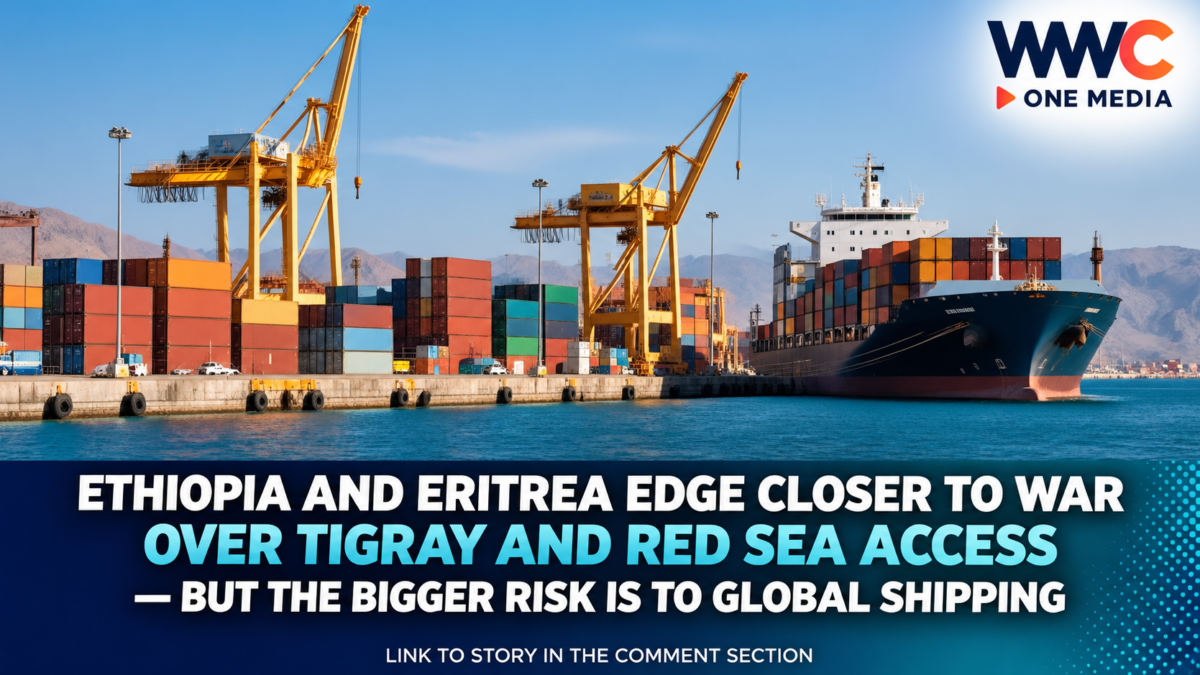
Eritrea controls roughly 1,000 kilometers of Red Sea coastline, including the strategic ports of Assab and Massawa.
Just to the south sits the Bab el-Mandeb Strait, the narrow gateway connecting the Red Sea and Suez Canal with the Gulf of Aden and the Indian Ocean.
It is already one of the most vulnerable maritime chokepoints in the world.
A new Horn of Africa war could make it even more dangerous.
Ethiopia and Eritrea have effectively gone from allies to enemies again
The reversal has been extraordinary.
Only a few years ago, Ethiopian Prime Minister Abiy Ahmed and Eritrean President Isaias Afwerki were political partners.
Their 2018 reconciliation ended a decades-long state of hostility following the 1998-2000 Ethiopia-Eritrea border war.
Abiy won the 2019 Nobel Peace Prize partly for that rapprochement.
Then, during Ethiopia’s 2020-2022 Tigray war, Eritrean forces fought alongside Ethiopia’s federal government against the Tigray People’s Liberation Front, or TPLF.
But that alliance did not survive the peace settlement.
Relations deteriorated after Ethiopia’s 2022 agreement with Tigrayan leaders and worsened further as Abiy began publicly arguing that landlocked Ethiopia needed direct access to the Red Sea.
By October 2026, the diplomatic relationship had effectively collapsed.
Ethiopia ordered the closure of its embassy in Eritrea and expelled 10 Eritrean diplomats.
Eritrea responded by severing diplomatic ties.
That is not normal diplomatic friction.
It is the kind of breakdown that often removes the last channels available for stopping military escalation.
Abiy has made Red Sea access a national strategic priority
The dispute is especially explosive because Ethiopia’s demand for maritime access has become increasingly central to Abiy’s political agenda.
After being sworn in for another five-year term, the Ethiopian leader again said his government would work to obtain an outlet to the sea.
He called sea access essential to Ethiopia’s modernization and long-term development.
Ethiopia’s Foreign Ministry has taken a similar position.
In an October 5 statement, it said Ethiopia’s geographic and historical connection to the Red Sea could not be ignored and argued that the country’s interests must be reflected in regional maritime discussions.
Ethiopia says it wants to achieve that access peacefully and through negotiation.
That qualification matters.
There is no confirmed Ethiopian declaration that it intends to seize Eritrean territory by force.
But Eritrea increasingly appears unconvinced.
Assab is the port that worries Eritrea most
At the center of the anxiety is Assab.
The Eritrean port lies relatively close to Ethiopia and historically served Ethiopian trade before Eritrea became independent in 1993.
After independence, Ethiopia became landlocked.
It now depends overwhelmingly on neighboring Djibouti for access to international shipping.
That creates both economic and strategic vulnerability.
For a country with a population of well over 100 million, relying heavily on one foreign maritime corridor is a major national-security concern.
Some Ethiopian political figures have therefore looked toward Assab as the most natural alternative.
That has alarmed Asmara.
Reuters reported earlier this month that Eritrea fears Ethiopia could ultimately try to take Assab by force, while Abiy continues to say the issue should be settled peacefully.
That contradiction is now one of the most dangerous fault lines in the Horn of Africa.
Eritrea believes the Red Sea question is about sovereignty
From Eritrea’s perspective, the issue is not simply commercial access.
It is national sovereignty.
Eritrea fought a 30-year independence struggle before formally separating from Ethiopia in 1993.
Any suggestion that Ethiopia has a historical claim over Eritrean coastline therefore touches the most sensitive issue in modern Eritrean political history.
That helps explain why Asmara reacts so sharply to Ethiopian rhetoric about sea access.
To Addis Ababa, maritime access can be framed as an economic necessity.
To Eritrea, the same argument can sound like a challenge to the borders created by independence.
That difference in interpretation makes compromise extraordinarily difficult.
Eritrea, Egypt, Sudan and Somalia have pushed back together
The maritime dispute is also becoming regional.
On October 4, leaders and officials from Egypt, Eritrea, Sudan and Somalia met in Egypt and declared that governance of the Red Sea should remain the responsibility of countries that actually possess Red Sea coastlines.
The message was clearly relevant to landlocked Ethiopia.
The grouping is strategically important because Ethiopia already has serious tensions with Egypt and Sudan over the Grand Ethiopian Renaissance Dam on the Nile.
Add Eritrea and Red Sea access to the equation and the disputes begin overlapping.
That creates the possibility of regional blocs forming around competing security interests.
Ethiopia accuses Eritrea, Egypt and Sudan of backing its enemies
Addis Ababa has accused Eritrea, Egypt and Sudan of supporting forces opposed to the Ethiopian government during the renewed conflict in northern Ethiopia.
Those countries deny the accusations.
If those allegations hardened into direct military involvement, the conflict could become far larger than another Ethiopian civil war.
It could evolve into a regional confrontation linking:
Ethiopia;
Eritrea;
Egypt;
Sudan;
Tigrayan forces;
and potentially outside Gulf powers.
Reuters has warned that the new fighting already involves a much more complicated alliance structure than the 2020-2022 Tigray war.
The new Tigray fighting is what makes the crisis immediate
For months, Ethiopia-Eritrea tensions were largely diplomatic.
That has changed.
Tigrayan forces launched a major offensive in September, capturing airports and clashing with federal troops.
The fighting became the largest breakdown of the 2022 peace agreement that ended the previous civil war.
Government-aligned forces later entered the Tigrayan capital, Mekelle.
Fighting spread across northern Ethiopia.
Then Eritrean forces were reported inside Tigray.
Ethiopia responded with drone strikes.
That sequence transforms the Ethiopia-Eritrea dispute from theoretical strategic rivalry into something much closer to direct interstate warfare.
The previous Tigray war was catastrophic
That history matters.
The 2020-2022 conflict became one of the deadliest wars of the century.
Estimates vary, but researchers and officials have put the death toll in the hundreds of thousands when battle deaths, famine and lack of medical care are included.
Entire regions were devastated.
Millions were displaced.
Human rights groups documented atrocities committed by multiple parties.
Eritrean forces were accused of serious abuses during their intervention.
The Pretoria peace agreement in 2022 stopped most of the fighting.
But many of the underlying disputes were never fully resolved.
Now those unresolved issues are resurfacing with different alliances.
This time, the Red Sea makes the stakes even bigger
The previous war was primarily understood as an Ethiopian internal conflict with regional involvement.
A new Ethiopia-Eritrea war could be different because it would place a major Red Sea coastal state at the center of the conflict.
Eritrea stretches along a strategic section of the African Red Sea coast.
Its southern territory approaches the Bab el-Mandeb, while Assab sits near shipping routes connecting the Indian Ocean with the Suez Canal.
That means instability inside Eritrea could become relevant to international shipping even without ships being deliberately attacked.
War can create:
airspace restrictions;
port closures;
military deployments;
insurance surcharges;
mine risks;
drone threats;
and uncertainty over coastal infrastructure.
Any of those can affect commercial shipping decisions.
Bab el-Mandeb is already one of the world’s most dangerous chokepoints
The Bab el-Mandeb Strait is only around 18 miles wide at its narrowest point.
It separates Yemen from Djibouti and Eritrea and links the Red Sea with the Gulf of Aden.
Ships using the Suez Canal generally must also pass through Bab el-Mandeb.
That means the strait is effectively the southern gateway to one of the world’s most important Europe-Asia trade routes.
Before the recent Red Sea disruptions, enormous volumes of oil, containerized goods and other commodities moved through it.
The U.S. Energy Information Administration estimates about 4.2 million barrels per day of oil crossed Bab el-Mandeb in the first half of 2025.
That was already roughly half the 2023 level because Houthi attacks had forced vessels to divert.
Shipping companies have already learned how costly Red Sea instability can be
The world received a dramatic demonstration beginning in late 2023.
Houthi attacks on commercial vessels caused major shipping lines to divert around Africa’s Cape of Good Hope.
That avoided Bab el-Mandeb and the Suez Canal.
But it came at a cost.
The EIA says routing around the Cape can add roughly 15 days to some voyages between the Arabian Sea and Europe.
Longer voyages mean:
more fuel;
more crew time;
fewer available ships;
higher freight rates;
and more expensive insurance.
Those costs eventually flow through global supply chains.
Consumers can end up paying more even if the cargo itself is never damaged.
The Red Sea is already under pressure from Yemen
This is what makes the Ethiopia-Eritrea crisis especially dangerous in October 2026.
The Red Sea does not currently have spare geopolitical capacity.
Fighting in Yemen has escalated again.
Saudi-backed forces are battling Houthi fighters around territory controlling access to Bab el-Mandeb.
The Houthis have responded with missile and drone attacks.
The conflict has already affected airports and regional infrastructure.
Shipping companies therefore already face substantial risk on the Arabian side of the waterway.
A new conflict on the African side would create a second source of instability.
The Iran war makes the situation even more fragile
There is another layer.
The continuing confrontation involving Iran has already disrupted the Strait of Hormuz.
Tankers face increased attack risk, oil flows have been disrupted and energy companies are increasingly looking for alternative export routes.
That makes the Red Sea more important, not less.
If Hormuz becomes unreliable, Gulf producers seek alternative pipelines and Red Sea export terminals.
But if Bab el-Mandeb and the African Red Sea coast simultaneously become unstable, the world loses another major layer of redundancy.
That is the scenario energy traders fear most:
multiple maritime chokepoints becoming dangerous at the same time.
Eritrea has suddenly become strategically valuable again
For years, Eritrea was one of the world’s most isolated states.
Western governments criticized:
indefinite national service;
political repression;
lack of independent media;
and human rights abuses.
Sanctions reinforced that isolation.
But geopolitical reality is now changing the calculation.
Reuters reported this week that Eritrea’s strategic importance has increased because of its roughly 1,000-kilometer Red Sea coastline, particularly while Hormuz remains unstable.
Foreign governments that once had little reason to engage with Asmara now have strong incentives to prevent instability along its coast.
That gives Eritrea more diplomatic leverage.
Assab itself has international military significance
Assab is more than a commercial port.
Its location has previously attracted outside military interest.
The United Arab Emirates used facilities near Assab during its intervention in Yemen.
That demonstrated how easily the port can become part of wider Gulf security architecture.
If Ethiopia and Eritrea went to war, outside powers would therefore pay close attention to control of:
Assab;
nearby airfields;
coastal roads;
and maritime surveillance positions.
That raises the risk that what begins as a bilateral conflict could attract foreign involvement.
Gulf powers have competing interests across the Horn
The Horn of Africa has become deeply connected to Middle Eastern geopolitics.
The UAE has invested heavily across Ethiopia, Somaliland and other parts of the region.
Saudi Arabia has strong interests in Red Sea security.
Egypt views Ethiopia as a major strategic rival because of the Nile.
Turkey has relationships with both Somalia and Ethiopia.
Israel has its own Red Sea security concerns.
These overlapping interests mean neighboring states are not operating in isolation.
Reuters has warned that the renewed Ethiopian conflict intersects with competing Gulf and regional alliances.
That is one reason escalation could become difficult to contain.
Ethiopia has enormous economic incentives to avoid war
For Addis Ababa, war with Eritrea would be economically destructive.
Ethiopia wants sea access precisely because it hopes to reduce logistics costs and strengthen growth.
A major war would do the opposite.
Military spending would increase.
Foreign investment could decline.
Trade routes could be disrupted.
Insurance costs would rise.
Infrastructure could be damaged.
And northern Ethiopia could again become a humanitarian disaster zone.
That contradiction may be one of the strongest forces pushing toward negotiation.
Ethiopia wants greater access to global trade.
Starting another regional war would make global trade harder.
Eritrea also has little to gain from a prolonged war
Eritrea’s economy is far smaller.
Its population is much smaller.
It has lived under heavy militarization for decades.
A sustained conventional conflict with Ethiopia would impose enormous costs.
And Eritrea is only now trying to rebuild diplomatic and economic relationships after years of isolation.
War could reverse that process.
That gives Asmara its own incentive to avoid an uncontrollable confrontation.
But security dilemmas are dangerous precisely because both countries can believe defensive military moves are necessary.
Each side may think it is preventing the other from attacking first
This is where escalation can become self-reinforcing.
Eritrea sees Ethiopian discussion of Assab and sea access and fears territorial aggression.
It moves troops toward the border.
Ethiopia sees Eritrean troops and alleged support for anti-government forces and fears encirclement.
It launches drone strikes.
Eritrea interprets those strikes as evidence Ethiopia is preparing for war.
Both sides then mobilize further.
Neither needs to begin with a deliberate plan for full-scale war.
The conflict can emerge from reciprocal fear.
Diplomatic ties have already disappeared when they are most needed
That is why the embassy closures are so worrying.
Diplomatic relationships are often most valuable during crises.
Officials can clarify troop movements.
They can communicate red lines.
They can negotiate prisoner exchanges.
They can prevent accidental incidents from escalating.
Ethiopia and Eritrea have now eliminated much of that formal communication structure.
That leaves intermediaries such as:
the African Union;
regional governments;
the United States;
Saudi Arabia;
or the UAE
potentially responsible for crisis diplomacy.
The African Union faces another major test
The African Union helped broker the 2022 Pretoria agreement that ended the Tigray war.
Renewed fighting represents a severe challenge to that peace architecture.
If the conflict expands into Ethiopia-Eritrea war, the AU would be dealing not only with civil conflict but interstate confrontation.
The organization has called for dialogue.
But preventing escalation will require more than statements.
It may require sustained mediation involving both Addis Ababa and Asmara, plus Tigrayan political factions.
The Tigray question remains at the center of everything
This is important because the Red Sea dispute is not happening in isolation.
The immediate battlefield remains northern Ethiopia.
The TPLF and allied opposition groups are challenging the federal government.
Eritrea has historically viewed the TPLF as a mortal enemy.
Yet Ethiopia now accuses Eritrea of supporting forces aligned against Addis Ababa.
That reversal shows how dramatically regional alliances have changed.
Former enemies can become tactical partners.
Former allies can become rivals.
That makes predicting the next stage unusually difficult.
Another refugee crisis could follow
A renewed regional war would have severe humanitarian consequences.
Northern Ethiopia has not recovered fully from the previous conflict.
Agriculture and infrastructure remain fragile.
Aid flows have been disrupted.
Large numbers of civilians are already vulnerable.
A new Ethiopia-Eritrea confrontation could push refugees toward:
Sudan;
Djibouti;
Somalia;
and eventually Mediterranean migration routes.
That would turn the conflict into another international political problem even beyond shipping.
A direct attack on commercial vessels is not required to move markets
This is a key point for investors.
Ships do not need to be hit for freight rates to rise.
Insurers price probability.
Shipping companies price probability.
Oil traders price probability.
If war appears likely near Red Sea ports, risk premiums can increase before the first maritime incident occurs.
Companies may reroute pre-emptively.
That is exactly what happened during earlier Houthi attacks.
Shipping executives often prefer an expensive detour to gambling with a vessel worth tens or hundreds of millions of dollars.
The impact could reach Asia quickly
For Asian economies, the Red Sea route matters enormously.
Goods moving between Asian manufacturing centers and Europe frequently use the Suez route.
Long diversions around Africa increase delivery time and freight costs.
Energy shipments can also be affected.
That means instability around Eritrea could eventually influence:
container rates;
oil prices;
shipping stocks;
retail inventories;
and inflation.
The effects would not remain confined to East Africa.
Europe would be even more exposed
Europe sits at the northern end of the Suez-Red Sea route.
Any sustained disruption raises costs for European imports from Asia and energy flows from the Middle East.
Manufacturers relying on just-in-time supply chains can suffer production delays.
Retailers face higher shipping bills.
Central banks may also worry if transport disruptions contribute to another inflation shock.
The Red Sea crisis of recent years already demonstrated those vulnerabilities.
Another conflict would arrive before the system has fully normalized.
Global shipping is now facing overlapping chokepoint risk
This may be the most important strategic takeaway.
The world’s supply chains were built around several narrow maritime corridors:
the Strait of Hormuz;
Bab el-Mandeb;
the Suez Canal;
the Strait of Malacca;
and the Panama Canal.
Modern trade assumes most of them function most of the time.
In 2026, that assumption looks increasingly fragile.
Hormuz is under pressure.
Yemen is unstable.
Bab el-Mandeb remains militarized.
And now Ethiopia-Eritrea relations are deteriorating along the western Red Sea.
The risks are beginning to overlap.
That creates a new premium for alternative routes
Energy companies are already talking about shifting from “just in time” to “just in case” infrastructure.
That means more pipelines.
More storage.
More ports.
And more alternative routes that allow cargoes to bypass vulnerable chokepoints.
The same logic applies to container shipping.
Supply-chain resilience is becoming almost as important as efficiency.
That is expensive.
But repeated maritime crises make redundancy increasingly valuable.
Ethiopia’s sea-access campaign therefore affects much more than Ethiopia
At first glance, Abiy’s argument is straightforward.
A huge landlocked country wants more reliable access to global trade.
Economically, that makes sense.
But once the preferred coastline belongs to a hostile neighbor, the question becomes geopolitical.
And once that coastline sits next to one of the world’s most important maritime corridors, the consequences become global.
That is why the Ethiopia-Eritrea dispute has moved far beyond a bilateral border argument.
The most dangerous scenario is still avoidable
There is no confirmed Ethiopia-Eritrea war at the scale of their 1998-2000 conflict.
There is also no confirmed closure of Assab or Massawa.
Commercial shipping continues through the wider Red Sea system.
That distinction should remain clear.
The current story is about rising risk, not a completed maritime crisis.
But the warning signs are becoming harder to dismiss:
diplomatic ties have been severed;
Eritrean troops are reportedly inside Ethiopia;
Ethiopia has reportedly struck them with drones;
Tigray is again at war;
and Abiy continues to insist that sea access is strategically essential.
One more war could be enough to reshape Red Sea shipping again
The Red Sea has already absorbed years of disruption.
Houthi attacks pushed vessels around Africa.
The Yemen war has reignited.
The Iran conflict has destabilized energy routes.
Oil traders are still dealing with Hormuz risk.
Now another potential conflict is emerging on the opposite side of the same maritime corridor.
That is why Ethiopia and Eritrea matter far beyond the Horn of Africa.
A clash over Tigray or Assab would not need to shut Bab el-Mandeb completely to have global consequences.
It would only need to convince shipping companies, insurers and energy traders that the western shore of the Red Sea had become another battlefield.
Ethiopia says its future depends on gaining reliable access to the sea.
Eritrea believes its sovereignty may depend on preventing that ambition from becoming a territorial claim.
And between them lies a coastline beside a maritime route the global economy can increasingly ill afford to lose.
The biggest danger therefore is not simply another Ethiopia-Eritrea war.
It is that another war begins just as the Red Sea and the wider Middle East are running out of safe alternatives.