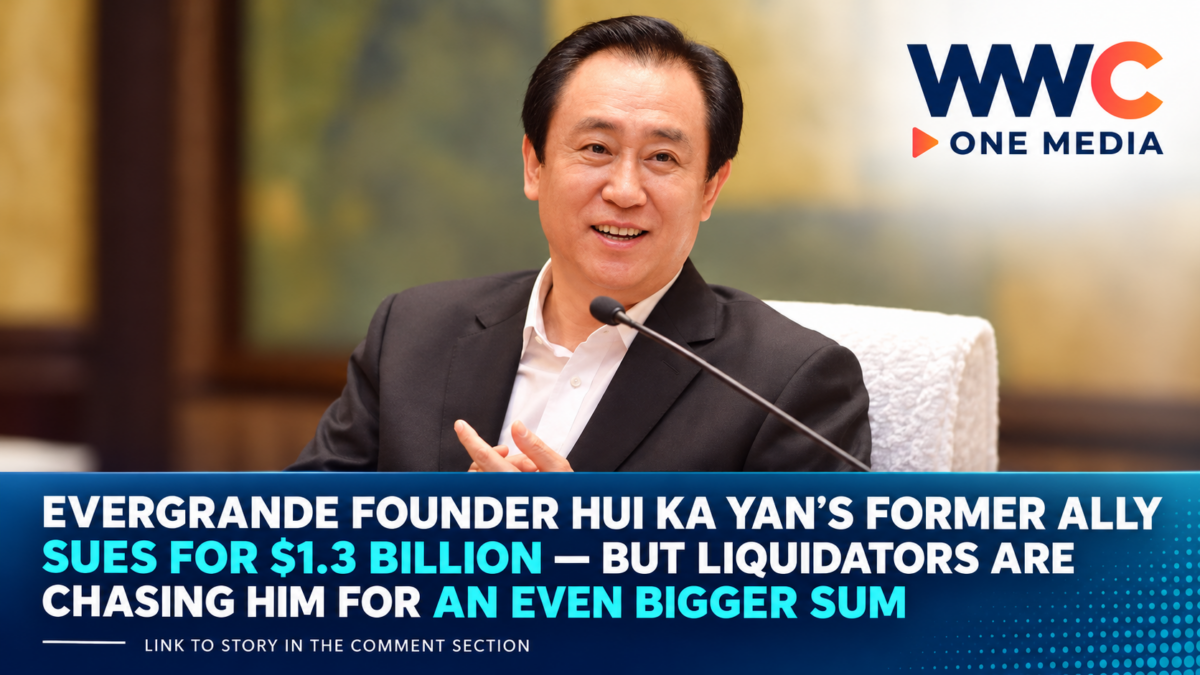
HONG KONG — A former billionaire ally of jailed Evergrande founder Hui Ka Yan is suing him for HK$10.1 billion, or roughly $1.3 billion, in unpaid personal loans—opening another extraordinary chapter in the dismantling of one of China’s biggest property empires.
Hong Kong property tycoon Cheung Chung-kiu, chairman of listed developer C C Land Holdings, filed a High Court lawsuit seeking repayment of the alleged debt plus interest and legal costs.
According to the statement of claim reported by Bloomberg and Hong Kong media, Cheung says he and Hui were longtime friends who entered into a series of verbal loan agreements between May 2010 and October 2020.
Cheung alleges that he advanced Hui a total of roughly HK$29 billion during that decade.
Hui allegedly repaid about HK$18.65 billion between 2014 and 2020.
That left a claimed outstanding balance of approximately HK$10.1 billion.
Cheung says Hui later signed a written acknowledgement on November 15, 2022, confirming the remaining debt.
If Cheung ultimately proves the claim, it would show just how deeply Evergrande’s spectacular rise was intertwined with a private financing network among some of Hong Kong and mainland China’s richest property tycoons.
But the lawsuit contains an extraordinary twist.
Evergrande’s own liquidators are simultaneously suing Cheung for at least HK$18.65 billion.
That means one former Hui ally is now telling a Hong Kong court:
Hui still owes me billions.
While Evergrande’s liquidators are effectively saying:
billions previously transferred to you should come back.
Cheung Chung-kiu was not just another Evergrande creditor
To understand why this lawsuit matters, it helps to understand the relationship between Cheung and Hui.
Cheung is chairman and managing director of C C Land Holdings, a Hong Kong-listed property company with investments spanning Greater China and the UK. Stock-exchange filings confirm his long-standing control of the group.
He was also part of a wealthy circle of tycoons often referred to in financial reporting as the “Big Two Club,” named after a Chinese card game its members were known to play.
The group included influential business figures such as:
Cheung;
Chinese Estates billionaire Joseph Lau;
members of the Cheng family behind New World Development;
and other Hong Kong tycoons.
Hui cultivated close relationships with members of that circle for years.
Those friendships were not merely social.
Billions of dollars moved through transactions involving Evergrande shares, bonds, property projects and related investments.
During Evergrande’s boom years, these connections helped give Hui access to capital outside conventional bank financing.
When the empire collapsed, they also created a web of financial exposures that is still being untangled.
Cheung was an early supporter of Evergrande
Evergrande’s own historical materials show Cheung was among prominent Hong Kong investors who participated in the company’s 2009 initial public offering.
Other wealthy investors joined him.
At the time, Evergrande was one of China’s fastest-growing property developers and investors were eager to gain exposure to the country’s urbanization boom.
That early backing helped cement relationships that would persist through the company’s expansion.
Years later, Bloomberg and other outlets reported that Hui repeatedly turned to his circle of wealthy acquaintances when Evergrande needed money.
The transactions sometimes included:
bond purchases;
share placements;
property acquisitions;
and private financial arrangements.
Bloomberg once estimated that transactions among members of Hui’s circle amounted to at least $16 billion over roughly a decade.
The new lawsuit suggests Hui’s personal borrowing relationships may have been even more extensive than previously understood.
Cheung says the loans began in 2010
According to the new claim, Hui began borrowing directly from Cheung in May 2010.
The alleged lending continued for more than ten years.
The agreements were initially verbal, according to Cheung.
That is notable given the enormous sums involved.
Across the full period, Cheung says he advanced approximately HK$29 billion, equivalent to roughly $3.7 billion at current exchange rates.
Hui then allegedly made repayments totaling HK$18.65 billion.
The remaining HK$10.1 billion is what Cheung now wants the court to recover.
The lawsuit seeks not only repayment of that principal but also:
interest;
legal expenses;
and other relief determined by the court.
Hui has not yet been found liable for the claim.
The 2022 written acknowledgment could become crucial
One potentially important element is Cheung’s allegation that Hui signed a written confirmation of the outstanding balance in November 2022.
That was already a critical period in Evergrande’s collapse.
By then, the company had defaulted on offshore debt and was trying unsuccessfully to negotiate a restructuring with creditors.
A signed acknowledgement—if accepted by the court—could significantly strengthen Cheung’s argument that the money represented personal debt rather than some other type of commercial transfer.
But a court will still need to assess the documents, legal characterization of the transactions and any defenses raised on Hui’s behalf.
The lawsuit is therefore far from settled.
The timing is extraordinary because Evergrande’s liquidators just sued Cheung
Only days before Cheung’s claim against Hui emerged, Evergrande’s liquidators and receivers filed legal action against Cheung.
That lawsuit seeks at least HK$18.65 billion.
According to reports describing the claim, the liquidators allege that Hui and his offshore company Xin Xin (BVI) Ltd. transferred funds to Cheung between 2014 and 2020.
They argue the money was transferred as loans or in exchange for benefits that they say should now be recovered.
Those allegations have not been proven.
Cheung has not been found liable.
But the overlap in numbers is impossible to ignore.
Cheung says Hui paid him HK$18.65 billion as repayments against earlier loans.
Evergrande’s liquidators are seeking at least HK$18.65 billion from Cheung over transfers associated with Hui.
That does not automatically mean the two claims involve precisely the same legal transactions or that one cancels the other out.
But it strongly suggests the courts may ultimately have to examine the same long-running financial relationship from very different directions.
It creates a remarkable circular dispute
The structure of the fight now looks almost circular.
Cheung says:
I lent Hui HK$29 billion.
He returned HK$18.65 billion.
He still owes me HK$10.1 billion.
Meanwhile, liquidators representing the collapsed Evergrande estate and acting as receivers of Hui’s assets are asking:
Were those HK$18.65 billion transfers properly made—and should some or all of that money now be recovered for creditors?
That is an extraordinary reversal from Evergrande’s boom years.
The same private financial network that once helped Hui access huge amounts of capital is now being reconstructed transaction by transaction in court.
The liquidators are pursuing another former associate too
Cheung is not the only former Hui associate facing new recovery efforts.
The liquidators have also brought a separate claim seeking around HK$500 million from Kai Johan Jiang, founder of Swedish electric-vehicle company NEVS.
Evergrande acquired a controlling stake in NEVS in 2019 as Hui attempted to transform the property conglomerate into a major electric-vehicle company.
According to reporting on the new claim, the liquidators allege Jiang received money relating to business advice or services that they say were not properly provided.
Again, those are allegations and have not been established in court.
Combined with the Cheung claim, the liquidators are seeking more than HK$19.15 billion from the two former associates.
That is only one piece of a much bigger recovery campaign
Evergrande’s liquidators have been pursuing money across jurisdictions since a Hong Kong court ordered the company wound up in January 2024.
The developer had accumulated more than $300 billion in liabilities and failed to produce a restructuring plan capable of satisfying offshore creditors.
One of the largest existing actions seeks roughly $6 billion from Hui, his former wife Ding Yumei and former senior Evergrande executives over dividends and remuneration paid before the company’s collapse.
Courts have issued worldwide asset-freeze orders against several defendants.
Evergrande’s liquidation has therefore become less about selling completed apartments and more about tracing:
dividends;
personal assets;
intercompany transfers;
overseas property;
private loans;
and historic transactions involving Hui’s inner circle.
Recoveries so far are tiny compared with creditor claims
That underscores how difficult the liquidation has become.
Reuters reported on October 9 that Evergrande’s liquidators face around $45 billion in creditor claims.
Yet asset sales had recovered only about $255 million so far.
That gap is enormous.
It explains why liquidators are scrutinizing transactions reaching back years before the collapse.
Selling Evergrande’s remaining corporate assets alone is unlikely to satisfy creditors.
Recovering money from former executives, family members and business associates may therefore become essential.
Evergrande Property Services could offer another major recovery
There may finally be progress on one of the more valuable remaining corporate assets.
Reuters reported on October 9 that Asia-focused investment firm PAG entered exclusive negotiations to buy a majority stake in Evergrande Property Services.
Liquidators have been trying to sell a roughly 51% holding in the unit.
Evergrande Property Services currently has a market value of just under $1.6 billion.
If a sale is completed, it could generate one of the largest cash recoveries yet.
But even hundreds of millions of dollars would still represent only a fraction of overall creditor claims.
Evergrande itself has effectively disappeared as an operating investment story
The company was once one of China’s largest developers.
It borrowed heavily to buy land and build apartments across the country.
Its business model relied on:
fast sales;
high leverage;
rising property prices;
and constant access to refinancing.
For years, that model worked.
Then Beijing tightened leverage rules.
Property sales weakened.
Evergrande’s borrowing machine broke.
The developer defaulted in 2021 and eventually entered court-ordered liquidation.
Its shares were later delisted in Hong Kong.
The story is no longer about whether Evergrande can recover.
It is about how much money can be recovered from what remains.
Hui’s personal downfall is now complete
The new lawsuit comes only weeks after Hui’s own legal situation changed dramatically.
On August 20, 2026, the Shenzhen Intermediate People’s Court sentenced Hui to life imprisonment for multiple crimes.
His personal property was ordered confiscated.
Evergrande itself was fined about 8.82 billion yuan, or approximately $1.3 billion, while its main mainland subsidiary Hengda Real Estate was fined 7 billion yuan.
Hui had previously been one of China’s richest men.
At his peak, his fortune was estimated above $40 billion.
Now he is imprisoned, his assets are the subject of receivership proceedings, and former allies and liquidators are fighting over billions allegedly connected to him.
His ability to defend the Hong Kong cases has also weakened
Hong Kong litigation surrounding Hui has become increasingly complicated.
Evergrande’s liquidators previously secured worldwide injunctions restricting his ability to dispose of assets.
A Hong Kong court later appointed the liquidators as receivers over his property.
Court records also show that Hui failed to pay HK$1.2 million in assessed legal costs, resulting in orders affecting his ability to continue defending the consolidated Evergrande proceedings.
In September, a Hong Kong court rejected an attempt by Hui’s lawyers to use assets under receivership to pay those legal bills.
His lawyers told the court that Hui was unable to communicate with them and faced restrictions regarding his assets.
That creates an unusual practical problem for Cheung’s lawsuit.
Even if a creditor establishes a valid claim against Hui, collecting money may be enormously difficult.
A judgment is not the same as getting paid
This is the biggest distinction in the Bloomberg story.
Cheung is seeking HK$10.1 billion.
That does not mean he will receive HK$10.1 billion.
First, the claim must survive litigation.
Second, Hui’s available assets must be identified.
Third, multiple competing legal claims may need to be prioritized.
Fourth, mainland Chinese confiscation orders and Hong Kong receivership proceedings could complicate access to assets.
And fifth, Evergrande’s existing creditors and liquidators are already pursuing massive recoveries.
Even a successful plaintiff can discover that a legal victory is economically worth much less than the judgment written on paper.
China’s confiscation order creates another layer of complexity
The Shenzhen court ordered confiscation of Hui’s personal property when sentencing him to life imprisonment.
Hong Kong courts, meanwhile, have their own asset-freeze and receivership proceedings.
Those jurisdictions operate under distinct legal systems.
That raises potentially complex questions about:
which assets exist;
where they are located;
which orders take priority;
and which creditors can ultimately access them.
It would therefore be premature to assume Cheung’s claim can simply be satisfied from Hui’s former fortune.
Much of that fortune may already be frozen, confiscated, disputed or difficult to locate.
Hui once had one of Asia’s largest fortunes
The scale of his fall makes the current litigation even more dramatic.
In 2017, Hui became China’s richest person.
His net worth was estimated at around $42 billion at its peak.
That wealth was heavily tied to Evergrande shares and related assets.
When the developer collapsed, much of it disappeared.
By the time liquidators arrived, the challenge was no longer merely valuing Hui’s assets.
It was determining:
which assets belonged to him;
which belonged to family members;
which sat inside offshore companies;
and which had already been transferred.
That is why the liquidation now resembles an international forensic-finance investigation.
Ding Yumei’s assets have also come under scrutiny
Hui’s former wife, Ding Yumei, is one of the defendants in Evergrande’s wider recovery proceedings.
Liquidators are seeking to recover roughly HK$2.8 billion in dividends paid through companies associated with her between 2018 and 2020.
UK courts previously froze assets while allowing Ding limited monthly living and legal expenses.
She has argued that she was not involved in Evergrande’s management.
No finding of liability should be inferred merely from the freezes or claims.
But the proceedings show how far liquidators are willing to look beyond the listed company itself.
The Cheung connection extends into London property
There are also longstanding links between the Hui and Cheung circles in Britain.
Ding has lived in a luxury apartment at Thames City, a major London development associated with C C Land.
Cheung’s company and private vehicles have been major investors in UK property.
The relationships became even more visible after reports about a huge mansion at 2-8a Rutland Gate, overlooking Hyde Park.
The property had publicly been associated with Cheung when it changed hands in 2020, but later reporting said Hui was ultimately behind the purchase through offshore structures connected to his family.
Those reports did not themselves establish misconduct.
But they demonstrate how interconnected the men’s personal and commercial worlds had become.
The “Big Two Club” became part of Evergrande’s shadow financing system
During the boom, Hui’s relationships with fellow tycoons were often presented as evidence of his influence.
Friends bought bonds.
They participated in share offerings.
They invested in Evergrande-related businesses.
Companies traded property assets with one another.
That social capital became financial capital.
It helped Hui sustain an empire whose growth demanded enormous amounts of cash.
But highly interconnected financing creates a hidden weakness:
when the central company fails, losses spread through the network.
That is exactly what happened after Evergrande defaulted.
Several former allies suffered large paper or realized losses on Evergrande-related investments.
Now some of those relationships are turning into lawsuits.
The new litigation could reveal how Hui financed himself personally
This may ultimately be the most significant element of Cheung’s case.
Evergrande’s corporate borrowing was widely documented.
Its bonds, bank loans and supplier liabilities were visible to varying degrees.
Private loans between Hui and fellow tycoons were much harder for outsiders to see.
If Cheung’s allegations are substantiated, they would provide a rare window into the personal financing arrangements used by one of China’s richest businessmen during the height of the property boom.
A cumulative HK$29 billion in alleged personal loans is extraordinary even by billionaire standards.
It raises questions about why Hui needed such large sums personally and how those transactions intersected with Evergrande and offshore entities.
Those questions may become central to the litigation.
But the lawsuit should not be mistaken for proof of hidden wrongdoing
It is important to separate suspicion from established fact.
Cheung says the money represented loans.
Evergrande’s liquidators have made their own claims about transfers to Cheung.
Neither side’s newest allegations have been adjudicated.
The existence of large private transactions does not automatically prove fraud, asset stripping or other misconduct.
The courts will need to determine the legal nature of the money flows.
That may take years.
Creditors are fighting over a shrinking pool
The economic context makes every claim more aggressive.
Evergrande’s creditors are collectively owed tens of billions of dollars.
The company’s property assets have fallen sharply in value.
China’s housing downturn has made project sales more difficult.
Many subsidiaries have separate creditors.
Offshore bondholders often rank behind claims attached directly to mainland assets.
That means every billion recovered from a former insider or associate becomes unusually valuable.
A HK$10 billion claim is enormous.
Against Evergrande’s overall collapse, even that can look small.
Evergrande remains the clearest symbol of China’s property crisis
The developer’s downfall became the defining event of China’s housing-sector crisis.
For decades, property developers borrowed aggressively because home prices appeared to rise almost continuously.
Local governments depended heavily on land sales.
Households treated apartments as investments.
Banks financed developers.
Suppliers accepted delayed payments.
The entire ecosystem relied on continuous growth.
Evergrande pushed that model further than most.
Its failure exposed how fragile the structure had become.
Beijing allowed the collapse rather than fully rescuing Hui
Perhaps one of the most important signals from the Evergrande saga was what Beijing did not do.
There was no wholesale bailout restoring shareholders and offshore creditors.
Authorities instead focused on:
housing-project completion;
domestic financial stability;
buyers who had prepaid for homes;
and gradual restructuring of the property sector.
Hui’s own prosecution and life sentence made the political message even clearer.
The era when a highly connected property magnate could assume his company was too important to fail had ended.
The liquidation is now rewriting Hui’s billionaire friendships
That may be the most fascinating part of the latest lawsuit.
During Evergrande’s rise, Hui’s relationships with other wealthy businessmen helped project strength.
Access to billionaire friends meant access to capital.
Access to capital meant Evergrande could keep expanding.
Today, those same relationships are being reduced to legal claims and repayment schedules.
Friendship is becoming evidence.
Private understandings are becoming statements of claim.
Transfers once made between allies are being scrutinized by liquidators.
And money that appeared to circulate inside a trusted tycoon network is now being fought over by creditors.
Cheung’s lawsuit could become one of the biggest personal-creditor claims against Hui
HK$10.1 billion is roughly $1.3 billion.
That is larger than many listed-company acquisitions.
It is an extraordinary amount for one businessman to claim personally from another.
And if the alleged HK$29 billion lending history is established, it would reveal the scale at which China’s property elite operated outside conventional corporate financing channels.
But the headline amount may ultimately prove easier to establish than to collect.
Hui’s assets are already subject to:
confiscation;
receivership;
asset freezes;
and competing lawsuits.
The question is no longer simply whether he once had enough money to pay.
It is who legally controls what remains.
The most remarkable number may actually be HK$18.65 billion
Because that figure appears at the center of both sides of the dispute.
Cheung says Hui repaid him HK$18.65 billion.
Liquidators are separately pursuing at least HK$18.65 billion from Cheung relating to transfers from Hui and his offshore vehicle.
Until detailed pleadings are tested, it would be wrong to say those are legally identical sums.
But the overlap illustrates the central challenge facing Evergrande’s liquidators:
determining whether billions that left Hui’s orbit before the collapse were legitimate payments, recoverable loans, transfers for consideration—or assets that should ultimately be returned.
That is the battle now moving through Hong Kong’s courts.
The collapse has moved from property crisis to asset hunt
Five years ago, the key question was whether Evergrande could repay its bonds.
Then the question became whether it could restructure.
Then whether it could avoid liquidation.
All of those battles are effectively over.
The company defaulted.
Restructuring failed.
A court ordered liquidation.
Hui went to prison.
Now the final stage has begun:
finding the money.
Liquidators are selling corporate assets.
They are tracing dividends.
They are pursuing former executives.
They are examining family wealth.
And they are taking former business associates to court.
Cheung is now doing the opposite—trying to prove that he should be paid from Hui’s remaining estate.
That means the Evergrande collapse has entered its most personal phase.
The former friends are now creditors and defendants
There may be no clearer symbol of Evergrande’s destruction.
Cheung and Hui were once members of the same billionaire social circle.
Their businesses interacted.
Their fortunes rose during China’s historic property boom.
Today Hui is serving a life sentence.
Evergrande is in liquidation.
Liquidators are suing Cheung for billions.
And Cheung is suing Hui for billions of his own.
The HK$10.1 billion lawsuit is therefore about much more than one unpaid loan.
It is another window into the hidden financial relationships that helped sustain Evergrande during its rise—
and the increasingly bitter fight over who gets what remains after one of the largest corporate collapses China has ever seen.
The billionaire friendship network once helped Hui build his empire.
Now the courts may spend years deciding which of those friends were creditors—and which must give money back.