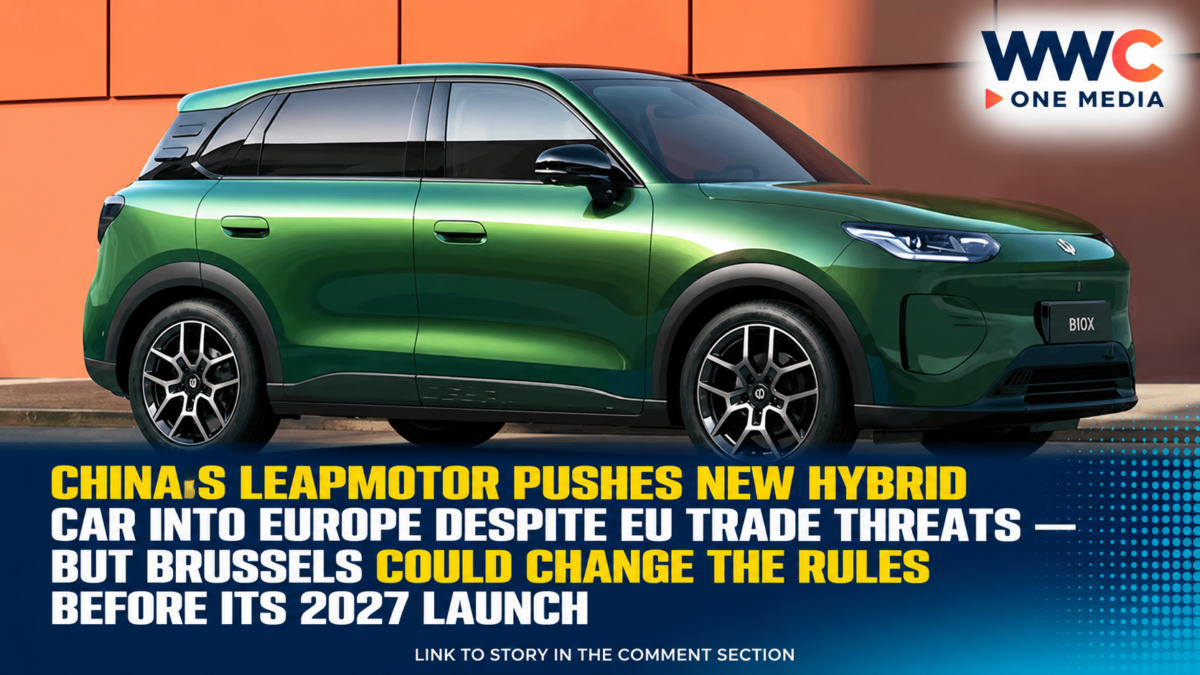
PARIS / HANGZHOU — Chinese electric vehicle manufacturer Leapmotor is preparing to introduce a new plug-in hybrid car in Europe during the first half of 2027, pressing ahead with its international expansion despite the European Union’s growing efforts to restrict imports of Chinese-made vehicles.
The decision places Leapmotor directly in the middle of an escalating trade dispute between Beijing and Brussels, where European officials are considering new restrictions on Chinese hybrid car imports to protect domestic manufacturers.
According to an October 8 Bloomberg report, Leapmotor co-President Michael Wu confirmed that the company intends to launch the new model in Europe during the first six months of 2027.
Wu indicated that the company would continue with its plans regardless of whether the European Union ultimately introduces the proposed restrictions.
The announcement comes as Chinese automakers gain a rapidly growing share of the European market, particularly in hybrid vehicles that have largely avoided the additional EU duties imposed on Chinese-made battery-electric cars.
For Leapmotor, the strategy is about more than introducing another vehicle.
The company is betting that demand for affordable hybrid technology will remain strong enough to support its European ambitions—even if trade barriers become more difficult to navigate.
Leapmotor’s next European hybrid is coming in 2027
Bloomberg reported that the upcoming vehicle is expected to reach Europe in the first half of 2027, with Leapmotor continuing product development despite the uncertainty surrounding European trade policy.
The model’s precise name, European price, technical specifications and launch countries have not been confirmed in the accessible reporting.
That distinction matters because Leapmotor already offers vehicles with range-extender technology in Europe.
Its existing B10 and C10 Hybrid EV models use a petrol-powered generator to support an electric drivetrain, while the newly reported 2027 vehicle is described as a plug-in hybrid.
The two technologies are related but not necessarily identical.
In September, Chinese automotive publication CnEVPost reported that Leapmotor was increasing its investment in plug-in hybrid development, with overseas launches expected as early as the first half of 2027.
The earlier report also indicated that the company wanted to broaden its product portfolio beyond battery-electric vehicles to reach additional international buyers.
That makes the October announcement part of a larger product strategy rather than an isolated decision.
Europe is preparing a new crackdown on Chinese hybrid vehicles
The planned launch comes at a particularly sensitive moment for Chinese automakers.
The European Commission is considering safeguard measures that could limit imports of hybrid vehicles manufactured in China.
Bloomberg reported on October 7 that the proposals could involve import restrictions designed to address the EU’s widening trade imbalance with Beijing.
The measures are being considered after Chinese hybrid imports surged, particularly as battery-electric vehicles faced additional European tariffs.
The Financial Times reported on October 8 that China had rejected European requests for voluntary restrictions on hybrid vehicle exports.
That disagreement could push Brussels toward unilateral trade measures if negotiations fail.
The EU imposed definitive countervailing duties on China-made battery-electric vehicles in October 2024.
Those additional duties vary by manufacturer and are applied on top of the EU’s standard vehicle import tariff.
However, the same additional anti-subsidy duties do not automatically apply to conventional or plug-in hybrid vehicles.
This difference has helped Chinese companies expand hybrid sales while remaining competitive on price.
Brussels is now examining whether that trade-policy gap should be narrowed.
Chinese car brands are winning European market share
Chinese brands’ European market share
~12%
August 2026 new-car sales
Share of plug-in hybrid sales
~1 in 3
Chinese brands, August 2026
Source: Dataforce market figures reported by Bloomberg, September 23, 2026. Figures refer to Chinese brands collectively, not Leapmotor alone.
Chinese automakers have been steadily gaining customers in Europe by offering increasingly competitive electric and hybrid vehicles.
According to Dataforce figures reported by Bloomberg, Chinese car brands captured nearly 12% of Europe’s new-car market in August 2026.
They also accounted for approximately one-quarter of hybrid sales and one-third of plug-in hybrid sales.
The expansion has been supported by competitive pricing and demand from consumers who want lower fuel consumption without relying entirely on charging infrastructure.
Traditional European carmakers are facing growing competition in a sector that has historically been dominated by brands such as Volkswagen, Renault, Peugeot and other established manufacturers.
For European policymakers, the issue is no longer simply whether Chinese electric vehicles can compete.
It is whether Chinese automakers could become major players across several categories of the European car market.
Stellantis gives Leapmotor an unusual advantage
One major factor distinguishing Leapmotor from some Chinese rivals is its partnership with Stellantis, the multinational automotive group behind brands including Peugeot, Fiat, Opel and Jeep.
In 2023, Stellantis acquired an approximately 21% stake in Leapmotor.
The companies also established Leapmotor International, a joint venture owned 51% by Stellantis and 49% by Leapmotor, to manage international sales and manufacturing activities outside Greater China.
The arrangement gives Leapmotor access to established automotive distribution networks and manufacturing expertise.
According to a May 2026 Stellantis announcement, Leapmotor had expanded to more than 850 sales and service locations in Europe, with over 40,000 European vehicle shipments during 2025.
The partnership could become especially valuable if the EU adopts more restrictive trade policies.
Manufacturing vehicles within Europe, where commercially feasible, may help reduce exposure to certain import barriers.
However, local production does not automatically exempt vehicles from every trade rule, and any advantage would depend on the final legislation, sourcing arrangements and manufacturing operations.
Leapmotor is preparing a bigger European product offensive
The new hybrid is only one part of the company’s expansion.
On October 5, Leapmotor announced that it would showcase several models at the 2026 Paris Motor Show, scheduled for October 12–18.
The company plans to introduce the B03 electric compact hatchback and the D19 flagship SUV to international audiences for the first time outside China.
Other vehicles in the lineup include the B03X, B05, B10, C10 and T03.
Leapmotor B03 — Compact electric hatchback
Designed for urban motorists seeking an affordable electric vehicle, with a company-stated driving range of up to 392 kilometers for a specified battery version, subject to final homologation.
Leapmotor D19 — Flagship SUV
A larger family vehicle, including a range-extended version with an 80.3-kWh battery and a claimed electric-only range exceeding 300 kilometers.
Leapmotor B10 Hybrid EV — Range-extended SUV
Uses an electric motor for propulsion and a petrol generator for additional range. Its European launch began in January 2026, with selected-market prices starting at €29,900.
Vehicle details from official Leapmotor and Stellantis announcements. The B03, D19 and B10 are distinct from the newly reported, unnamed 2027 plug-in hybrid.
The variety of models reflects Leapmotor’s broader ambition to compete across multiple vehicle categories rather than depend solely on a small lineup of electric cars.
Spain could become a strategic manufacturing hub
Leapmotor’s relationship with Stellantis also creates opportunities to expand production outside China.
During its 2026 earnings discussions, Leapmotor outlined plans to begin producing its B05 model in Spain in 2027 through its cooperation with Stellantis.
The company also discussed localization efforts in Malaysia and Brazil as part of its international manufacturing expansion.
Producing vehicles closer to customers could reduce transportation costs, shorten supply chains and potentially limit exposure to certain import restrictions.
But it would not solve every problem.
European manufacturing involves labor costs, production investment, supplier relationships and regulatory requirements.
Leapmotor would still need to demonstrate that it can produce cars competitively while meeting European standards.
There is also no confirmed announcement that its newly reported 2027 plug-in hybrid will be manufactured in Spain.
Leapmotor wants to become a global automotive powerhouse
The Chinese manufacturer has been pursuing aggressive growth targets.
In September 2025, Reuters reported that Leapmotor Chief Executive Zhu Jiangming expected the company to sell one million vehicles globally in 2026, with an ambition to reach four million annual sales within a decade.
The company also aimed to expand its product portfolio to approximately 15 models by 2027.
These are corporate ambitions rather than confirmed future sales.
But they demonstrate the scale of the company’s plans.
Europe is particularly attractive because buyers are increasingly considering electric and hybrid alternatives as fuel costs, vehicle prices and environmental regulations influence purchasing decisions.
The challenge for Leapmotor is to expand market share while maintaining profitability and adapting to changing trade rules.
What the trade dispute means for consumers
For European buyers, increasing competition from Chinese manufacturers could provide more vehicle choices and put downward pressure on prices.
But proposed import restrictions could alter that dynamic.
If the EU imposes quotas or additional duties, affected Chinese-made hybrids may become more expensive or harder to supply.
European carmakers could gain some protection from lower-priced imports, while consumers might face fewer affordable options.
On the other hand, supporters of trade restrictions argue that action is needed to address unfair competition and protect European industrial capacity.
The outcome will depend on the final policy design, negotiations with China and how manufacturers adapt their production strategies.
No blanket EU ban on Chinese hybrid vehicles has been established.
Why this matters for Southeast Asia and the Philippines
Leapmotor’s international strategy is relevant to Southeast Asia, where Chinese automakers are increasingly competing with Japanese, Korean and Western manufacturers.
The company has already discussed local assembly operations in Malaysia, including production activities involving its C10 SUV.
That indicates a broader effort to diversify manufacturing beyond China and develop regional markets.
For the Philippines, the story highlights the growing importance of affordable electric and hybrid vehicles.
Competition among Chinese automotive brands could eventually expand choices for Filipino buyers, particularly as charging infrastructure and vehicle distribution networks develop.
However, the new 2027 European plug-in hybrid has not been confirmed for a Philippine launch.
Its price, availability and local specifications should therefore not be assumed.
The bigger picture: China’s hybrid strategy faces a turning point
Leapmotor’s decision to proceed with its European hybrid plans underscores how important international expansion has become for China’s automotive industry.
Chinese manufacturers have already demonstrated that they can compete aggressively in battery-electric vehicles.
Now they are expanding into hybrid technology, where consumer demand remains strong and some European trade barriers have been less restrictive.
But Brussels is preparing to respond.
The coming months could determine whether Chinese manufacturers continue expanding through exports or must increasingly depend on regional production and deeper partnerships with European companies.
For Leapmotor, Stellantis provides a strategic advantage.
Yet even that relationship cannot eliminate the risks of changing regulations, trade disputes or intensified competition.
Leapmotor is betting that European drivers will continue embracing affordable Chinese hybrid technology—but the biggest uncertainty is whether Brussels will change the rules before its newest car reaches showrooms in 2027.