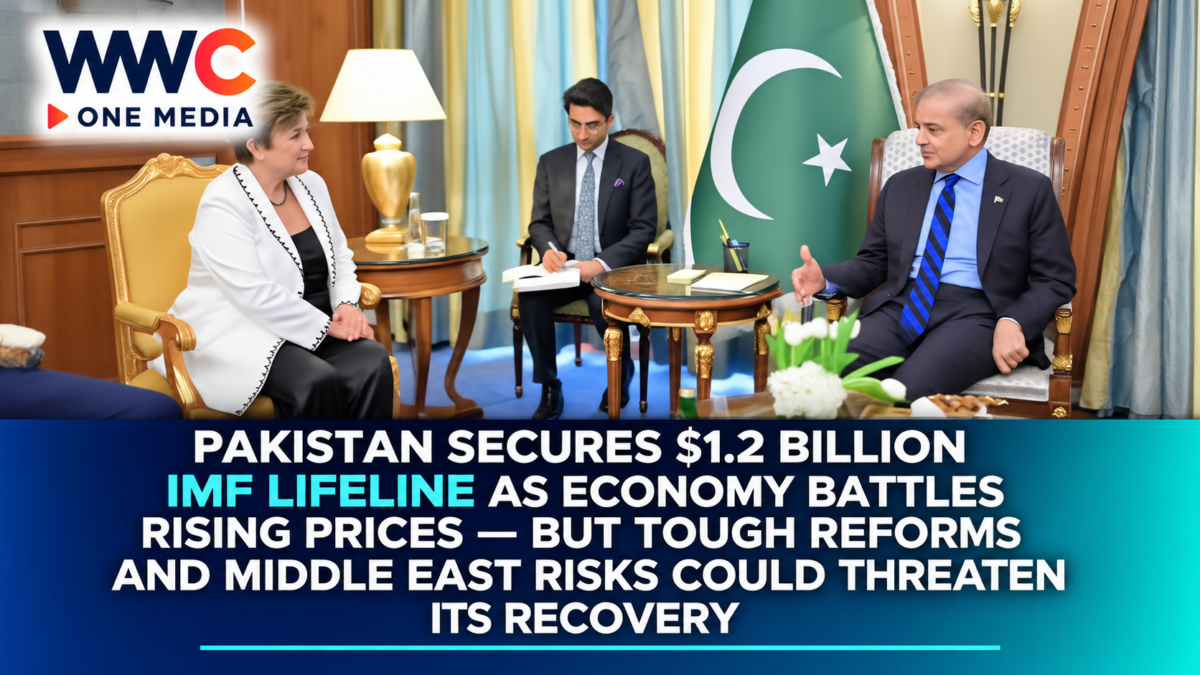
ISLAMABAD, Pakistan — Pakistan has moved a major step closer to securing another $1.21 billion in International Monetary Fund (IMF) financing, providing a potential financial lifeline as the South Asian economy struggles with rising energy prices, external debt obligations and the economic fallout from escalating Middle East tensions.
The IMF and Pakistani authorities reached a staff-level agreement on October 7 following reviews of two lending programs, according to reports published by Bloomberg, Reuters and other international news organizations.
The proposed disbursement would provide approximately $1 billion under the IMF’s Extended Fund Facility (EFF) and another $210 million through its climate-focused Resilience and Sustainability Facility (RSF).
However, the agreement is not yet a final authorization to release the funds. Pakistan must still secure approval from the IMF Executive Board before the money becomes available.
For Prime Minister Shehbaz Sharif’s government, the agreement represents an important vote of confidence in its economic stabilization efforts.
But it also highlights a deeper problem.
Pakistan remains dependent on external financial support to strengthen its foreign exchange reserves, manage debt obligations and protect its economy from international shocks.
And with inflation still squeezing households, higher fuel costs threatening businesses and structural reforms remaining incomplete, the country faces a difficult question:
Can another billion-dollar IMF injection produce a lasting recovery—or will Pakistan continue returning to international lenders for financial support?
Pakistan’s $1.21 billion IMF agreement: What has been agreed?
Potential new funding
$1.21B
Subject to IMF board approval
Cumulative disbursements
$5.7B
If the latest reviews are approved
FY2026 GDP growth estimate
3.6%
IMF estimate
September inflation
10.3%
Approximate headline inflation
Source: IMF mission statement as reported by Business Recorder, Pakistan state radio and Deutsche Welle, October 8, 2026.
The latest agreement covers the fourth review of Pakistan’s 37-month Extended Fund Facility arrangement and the third review of its 28-month Resilience and Sustainability Facility.
The EFF is part of a $7 billion lending program approved in September 2024 to support economic stabilization, strengthen public finances and address structural weaknesses.
The separate $1.4 billion RSF arrangement focuses on climate resilience and reforms designed to reduce vulnerability to environmental and energy-related shocks.
Breakdown of the proposed $1.21 billion financing
US dollars in millions; financing remains subject to IMF board approval
$0$300M$600M$900M$1.2BEconomic program (E…Climate resilience…
Upon Executive Board approval, cumulative disbursements under the two programs would rise to approximately $5.7 billion.
The latest negotiations were conducted by an IMF mission led by Iva Petrova, which held discussions in Karachi and Islamabad between September 23 and October 7.
The IMF also completed discussions under its 2026 Article IV consultation, an assessment of Pakistan’s economic performance and policy direction.
IMF praises Pakistan’s progress—but warns the danger is not over
The IMF acknowledged that Pakistan had made progress toward economic stability despite the damaging effects of the Middle East conflict.
According to the lender’s October 7 statement, real GDP expanded by 4% during the first three quarters of fiscal year 2026.
However, higher energy prices and supply disruptions weakened overall growth momentum, with full-year expansion estimated at 3.6%.
Inflation also eased after reaching a peak in May, declining to around 10.3% in September.
Meanwhile, Pakistan’s gross foreign exchange reserves increased to approximately $21.5 billion by the end of September, supported by policy measures and improvements in external financing conditions.
These figures represent meaningful progress compared with Pakistan’s earlier balance-of-payments difficulties.
Still, the IMF cautioned that the outlook remains vulnerable to geopolitical tensions, volatile energy prices, tighter international financial conditions and trade disruptions.
The warning suggests that Pakistan’s recovery, while gaining momentum, remains exposed to forces largely beyond Islamabad’s control.
Middle East conflict threatens Pakistan’s fragile recovery
Pakistan is particularly exposed to instability in the Middle East because of its dependence on imported oil and gas, financial support from Gulf countries and remittances sent home by overseas workers.
According to Reuters, Ahmad Mobeen, principal economist at S&P Global Market Intelligence, previously identified Pakistan as one of the major Asia-Pacific economies most vulnerable to an extended Middle East conflict.
Higher global oil prices can put pressure on Pakistan in several ways.
More expensive energy imports increase the country’s foreign-currency requirements, raise transportation and electricity costs, and can eventually push consumer prices higher.
Energy shocks also complicate the government’s efforts to control inflation while maintaining economic growth.
Deutsche Welle reported on October 8 that rising food and fuel prices and persistently high unemployment were among the challenges confronting the economy.
For ordinary Pakistani households, this means that better economic indicators may not immediately translate into more affordable food, transport or electricity.
IMF demands fiscal discipline and an end to costly fuel support
The latest financial agreement comes with significant policy expectations.
The IMF wants Pakistan to maintain fiscal discipline, strengthen tax collection, improve public financial management and make its energy sector more financially sustainable.
Among the key priorities is a fiscal year 2027 budget anchored by an underlying primary surplus target of 2% of GDP.
A primary surplus means that government revenue exceeds non-interest expenditure, although the country can still record an overall deficit once debt interest payments are included.
The IMF has also emphasized the importance of reducing costly, broadly targeted fuel subsidies and replacing them, where necessary, with time-limited assistance focused on vulnerable households.
That requirement could create difficult political choices.
Cutting fuel subsidies can reduce government spending and help stabilize public finances, but may also raise costs for motorists, transport operators and businesses unless relief measures adequately protect those most affected.
Pakistan must therefore balance three competing priorities: satisfying its international lenders, stabilizing public finances and limiting the economic burden on households.
Electricity-sector reforms could prove another major hurdle
Pakistan’s energy sector remains a central part of the IMF reform agenda.
The country has struggled with circular debt, a problem in which unpaid bills, subsidies, operational losses and delayed payments accumulate across the power supply chain.
The IMF is calling for timely tariff adjustments, improvements in collection and distribution efficiency, and greater participation from private companies.
The program also emphasizes reducing gas losses and ensuring energy prices better reflect supply costs.
These changes could help improve the sector’s financial sustainability over time.
However, electricity and gas tariff adjustments are politically sensitive, particularly during periods of elevated inflation.
The success of the reforms will depend partly on whether Pakistan can reduce waste, improve collection and strengthen consumer protections without placing an excessive burden on lower-income households.
Pakistan’s reserves are improving, but debt dependence remains
One encouraging development is the strengthening of Pakistan’s foreign exchange reserves.
The IMF reported gross reserves of approximately $21.5 billion at the end of September 2026.
The improvement provides an important buffer against external shocks and can support confidence in the country’s ability to finance imports and meet foreign-currency obligations.
However, gross reserves do not represent unrestricted money available for government spending.
Pakistan continues to face substantial financing requirements and must manage maturing debt, imports and other international payment obligations.
Reuters noted that the country remains reliant on external financing to support its reserves and meet repayments.
The latest IMF agreement may also strengthen confidence among other international creditors and development partners.
But the broader challenge is reducing reliance on repeated external assistance by increasing exports, encouraging investment, improving tax collection and building more resilient domestic industries.
Why Pakistan’s IMF agreement matters to the rest of Asia
Pakistan’s financing agreement has implications beyond its own borders.
The country is a major South Asian economy with important trade, diplomatic and financial relationships across China, the Middle East and international development institutions.
Its financial stability matters for regional investor confidence and its ability to maintain imports, trade commitments and infrastructure investments.
A successful IMF program could improve perceptions of Pakistan’s creditworthiness and support its efforts to attract overseas capital.
Conversely, another severe balance-of-payments crisis could create difficulties for international creditors and investors exposed to the country.
For the Philippines and other energy-importing Asian economies, Pakistan’s experience also highlights the economic vulnerabilities associated with prolonged Middle East instability.
Even countries with different fiscal positions can face similar external pressures when fuel prices rise, trade routes become disrupted and global borrowing costs increase.
Can the IMF deal deliver a lasting turnaround?
The staff-level agreement gives Pakistan another opportunity to build on its stabilization efforts.
Economic growth has shown improvement, inflation has moderated from its earlier peak and foreign exchange reserves have strengthened.
However, several major challenges remain unresolved.
The government must continue improving tax compliance, reducing losses in state-linked enterprises, repairing the electricity sector and protecting vulnerable households from the costs of economic adjustment.
Climate resilience is another long-term concern. Pakistan remains vulnerable to severe flooding, extreme heat and other environmental risks that can damage agriculture, infrastructure and household livelihoods.
The IMF’s climate-focused financing can support reforms in these areas, but sustained implementation will be essential.
And with international energy markets still exposed to geopolitical disruption, another adverse shock could undermine progress.
The bigger picture
Pakistan’s latest IMF agreement should be viewed as an important financial milestone, not proof that its economic difficulties have ended.
The proposed $1.21 billion in fresh funding could reinforce reserves, support external financing and strengthen investor confidence once approved.
But sustainable economic recovery will depend on whether Islamabad can turn its recent stabilization achievements into stronger productivity, job creation, export growth and better living standards.
The challenge facing Prime Minister Shehbaz Sharif’s government is not merely to secure the next IMF disbursement.
It is to build an economy that eventually needs fewer emergency financial lifelines.
Pakistan may be one approval away from another $1.2 billion in IMF support—but the bigger test is whether the country can escape its long-running cycle of debt pressure, costly reforms and external financing dependence.