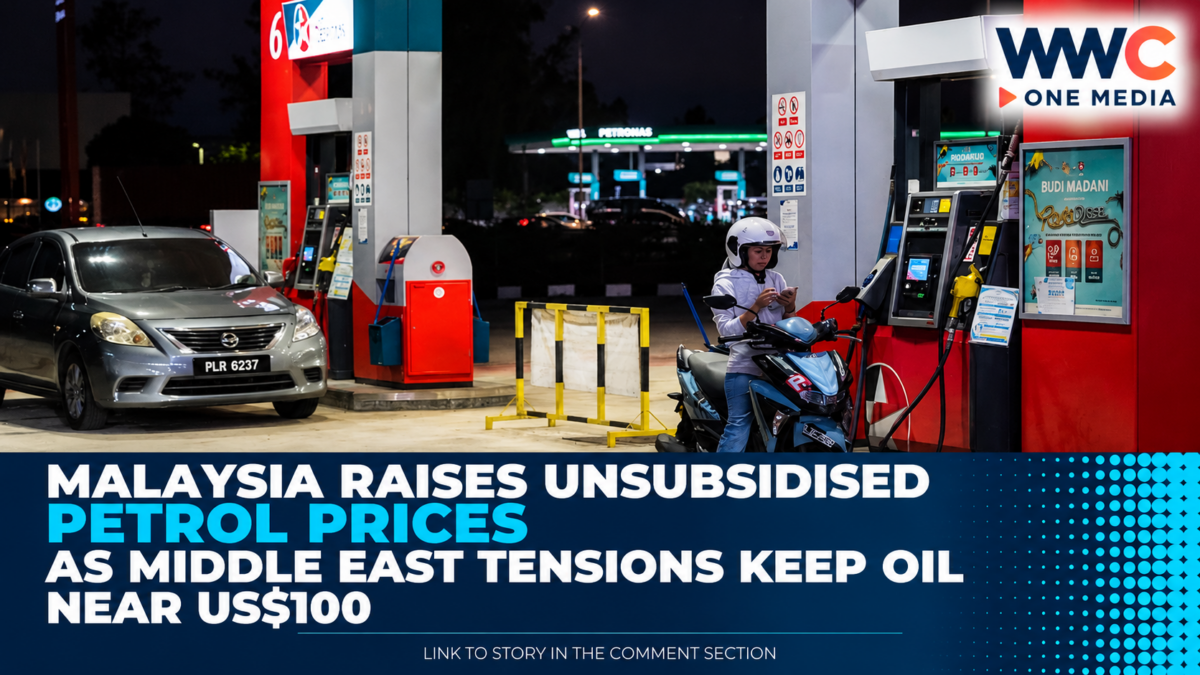
KUALA LUMPUR, Malaysia — Malaysia has raised the prices of unsubsidised RON95 and RON97 petrol by 15 sen per litre for the week beginning Oct. 8, while the price of unsubsidised diesel remains unchanged, as global fuel markets continue to face pressure from geopolitical tensions and tight refined-product supplies.
For the period Oct. 8 to Oct. 14, unsubsidised RON95 will cost RM4.67 per litre, up from RM4.52, while RON97 will rise to RM5.15 per litre from RM5.00. Unsubsidised diesel remains at RM5.27 per litre.
The latest adjustment comes just one week after Malaysia reduced its unsubsidised petrol prices. The Finance Ministry said international fuel markets remained volatile, with Brent crude hovering around US$100 a barrel during the calculation period used to determine the latest prices.
RON95 and RON97 rise 15 sen
The new weekly prices are:
- RON95 without subsidy: RM4.67 per litre
- RON97: RM5.15 per litre
- Unsubsidised diesel: RM5.27 per litre
The increase reflects higher costs for refined petroleum products rather than simply the movement of crude oil prices.
The Finance Ministry said crude oil flows from West Asia had gradually recovered, but global crude prices remained elevated. At the same time, pressure had shifted increasingly towards refined petroleum products.
One factor highlighted by the ministry was China’s decision to suspend most fuel exports for October, reducing the amount of refined petroleum products available in international markets.
The government said restoring global refining capacity and the supply of refined products would be important to easing price pressures in the medium term.
Targeted subsidies keep prices lower for eligible Malaysians
Despite the increase in unsubsidised prices, eligible Malaysians under the government’s targeted subsidy programmes will continue paying significantly less.
Recipients of BUDI MADANI RON95 (BUDI95) will continue to pay RM1.99 per litre.
That compares with the unsubsidised RON95 price of RM4.67, meaning the government is covering RM2.68 per litre, equivalent to about 57 per cent of the unsubsidised price.
For eligible BUDI MADANI Diesel recipients, the retail price remains RM2.10 per litre, compared with the unsubsidised rate of RM5.27.
The government is therefore providing a subsidy of RM3.17 per litre, or about 60 per cent of the unsubsidised price.
The targeted subsidy system means the impact of international oil-price movements is not felt equally by all motorists.
Middle East conflict continues to threaten oil markets
The latest Malaysian price adjustment comes against a backdrop of heightened geopolitical risks in the Middle East.
Oil prices climbed again on Thursday as markets assessed the possibility of further supply disruptions following attacks on shipping in the Gulf and the Strait of Hormuz, a critical route for global energy supplies.
Brent crude rose to around US$102.28 a barrel, while US West Texas Intermediate crude reached about US$89.94 early Thursday.
Before the current conflict, the Strait of Hormuz carried shipments equivalent to roughly 20 per cent of global oil and fuel supplies.
The increased risks to tankers have raised shipping, insurance and logistics costs, adding pressure to the price of petroleum products even as some crude exports from Gulf producers recover.
Refined fuel supply is becoming the bigger concern
Malaysia’s Finance Ministry noted that the latest pressure is increasingly concentrated on refined petroleum products.
That distinction is important because crude oil must still be processed in refineries before becoming petrol, diesel and other fuels used by consumers and businesses.
Even if crude supplies improve, limited refining capacity or reduced exports of finished fuel can keep petrol and diesel prices elevated.
The ministry specifically cited China’s reduced fuel exports as a factor tightening international supplies.
The United States is also facing supply pressures. Offshore oil and gas production in the Gulf of Mexico has been disrupted by a hurricane, while US crude inventories recently fell by more than analysts expected.
Russia-Ukraine war adds to uncertainty
Malaysia also pointed to the continuing Russia-Ukraine conflict as another factor affecting global petroleum markets.
The Finance Ministry said developments in both the Middle East and the Russia-Ukraine war continue to pose risks to the stability of global petroleum supplies and prices.
That leaves energy markets exposed to multiple sources of disruption at the same time.
For consumers, the result can be significant because movements in fuel prices can eventually affect transportation costs and the prices of goods and services.
Government says fuel supplies remain sufficient
Despite the price pressures, the Finance Ministry said Malaysia’s domestic fuel supply remains sufficient.
It urged consumers to use fuel prudently, plan journeys efficiently and reduce unnecessary travel where possible.
The government said it would continue taking a cautious approach to protect households and businesses from global price volatility while ensuring that fuel supplies remain adequate and secure.
For motorists who qualify for the targeted subsidy programmes, the immediate increase in international fuel prices will therefore be partly cushioned.
What motorists need to know
The latest prices apply for Oct. 8 through Oct. 14, after which Malaysia’s Automatic Pricing Mechanism will be used again to determine the following week’s rates.
Whether petrol prices rise or fall next week will depend on developments in international crude and refined-product markets, including the situation in the Middle East.
For now, the latest adjustment means motorists buying unsubsidised fuel will pay more at the pump, while eligible BUDI MADANI recipients will continue to benefit from significantly lower prices.
With Brent crude again trading around the US$100 mark and shipping risks remaining elevated, Malaysia’s fuel prices are likely to remain closely tied to developments in global energy markets in the weeks ahead.