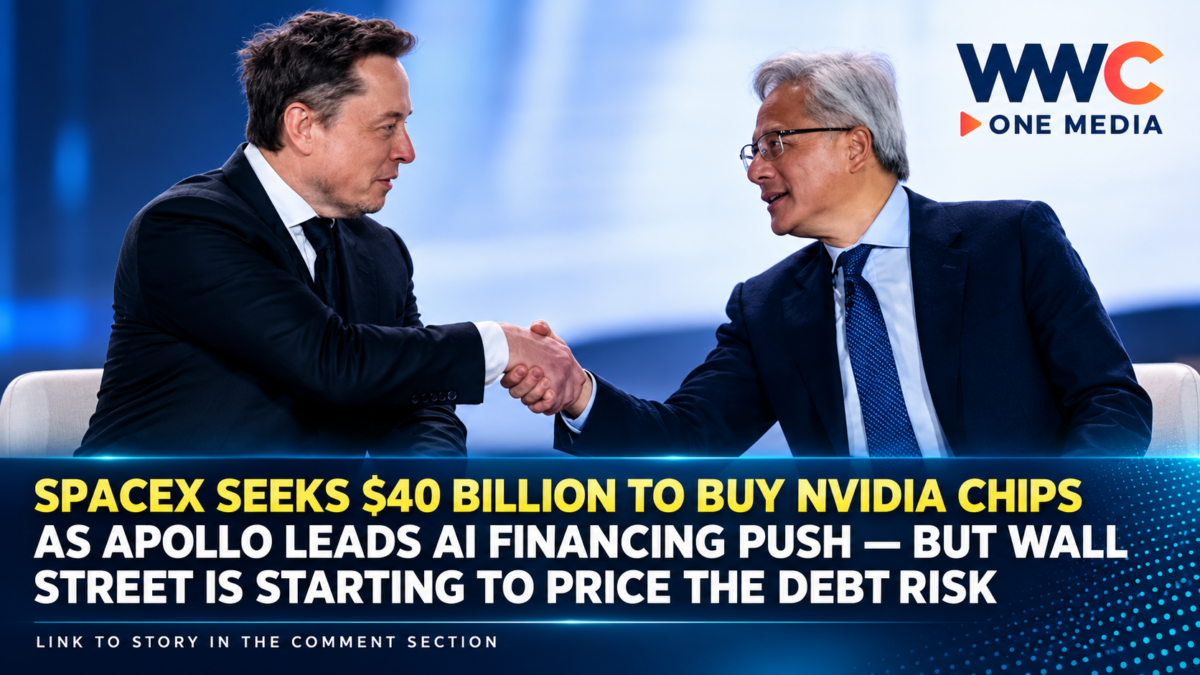
NEW YORK — SpaceX is preparing one of the largest corporate borrowing packages of the AI boom, seeking roughly $40 billion to buy Nvidia chips and dramatically expand its computing infrastructure as Elon Musk pushes the rocket and satellite company deeper into artificial intelligence.
The proposed financing would include about $30 billion of investment-grade bonds and $10 billion in bank loans, according to reporting citing people familiar with the talks. Apollo Global Management is expected to lead the transaction, while bond manager Pimco has also been among the institutions involved in discussions.
The deal is expected to close in 2027 and remains under negotiation, meaning the final structure, pricing and investor participation could still change.
The scale is extraordinary even by today’s AI standards.
SpaceX is no longer being valued simply as a launch company or the owner of Starlink.
It is increasingly trying to become a major supplier of AI computing capacity—using huge quantities of Nvidia hardware to build data-center infrastructure that can be rented to frontier AI companies and other customers. Reuters Breakingviews reported that SpaceX aims to increase computing capacity from roughly 1.4 gigawatts to 15 gigawatts by the end of 2027, a scale approaching the largest global cloud operators.
But the strategy comes with a major trade-off.
SpaceX is using debt markets on a massive scale to accelerate its AI ambitions, and investors are already demanding more compensation for the financial risk.
The $40 Billion Package Has Two Main Pieces
The proposed financing is relatively straightforward in headline terms.
SpaceX is seeking:
- roughly $30 billion in investment-grade bonds;
- about $10 billion in bank loans;
- with Apollo expected to lead the broader financing effort.
The proceeds would primarily support purchases of advanced Nvidia AI chips and related infrastructure.
This is not yet a completed $40 billion capital raise.
That distinction is critical.
The company is still arranging the financing, and the transaction is expected to close only in 2027.
Why Apollo Is at the Center of the Deal
Apollo’s involvement is not surprising.
The investment giant has become one of the most aggressive financiers of AI infrastructure.
In August, Nvidia announced partnerships with Apollo, BlackRock, Blackstone, Brookfield, Goldman Sachs and KKR intended to mobilize more than $500 billion of third-party capital for AI computing infrastructure over time.
Apollo President Jim Zelter described modern compute as a mission-critical infrastructure asset capable of attracting long-duration institutional capital.
That is a major change in how Wall Street thinks about GPUs.
Historically, semiconductor purchases were simply corporate capital expenditures.
Now investment firms are increasingly treating high-end AI compute almost like aircraft, power plants or industrial equipment—assets that can be financed, leased and underwritten against expected cash flows.
Apollo Has Already Financed Musk’s AI Expansion
Apollo has prior experience funding infrastructure tied to Musk-controlled businesses.
In January, Apollo-led funds provided $3.5 billion in financing as part of a $5.4 billion transaction involving Valor Compute Infrastructure and xAI.
That deal financed Nvidia GB200 GPUs that were then leased to an xAI subsidiary under a triple-net structure.
That transaction demonstrated the financing model now spreading across the AI industry:
an investment vehicle buys expensive computing hardware;
institutional capital finances the purchase;
and an AI company leases the equipment over time.
The new SpaceX transaction is far larger.
Nvidia Chips Are Becoming Financeable Infrastructure
Nvidia has actively encouraged this shift.
The company says its computing systems can be treated as productive infrastructure because they support revenue-generating AI workloads across multiple customers and applications.
Nvidia argues that the combination of CUDA software, high customer demand and broad model compatibility helps extend the useful economic life of its hardware.
For lenders, that matters.
A bank is more comfortable financing expensive equipment if it believes the equipment can retain value and be redeployed to another customer if necessary.
This is one reason AI-chip financing has expanded so quickly.
SpaceX Wants to Become More Than a Rocket Company
The borrowing plan underscores how dramatically SpaceX’s strategy is evolving.
SpaceX remains the world’s dominant commercial launch company and operates the massive Starlink satellite network.
But it is also expanding into AI compute.
Reuters Breakingviews reported that Chief Financial Officer Bret Johnsen believes the company could achieve very short payback periods on new computing capacity because customers are willing to pay premium prices for scarce AI infrastructure.
The company has already secured major compute commitments from AI customers.
Anthropic’s regulatory filings disclose a flexible infrastructure agreement with a Musk-linked provider worth potentially $84.5 billion, underscoring the scale of demand for third-party AI capacity.
Reuters separately reported that Anthropic has agreed to monthly payments of roughly $1.25 billion for access to computing capacity under one such arrangement.
These contracts help explain why SpaceX believes borrowing billions to buy GPUs can produce attractive returns.
The Revenue Opportunity Could Be Enormous
The core economics are simple.
Buy scarce Nvidia hardware.
Deploy it quickly.
Lease that computing power to AI companies that need capacity immediately.
If customer demand is strong enough, the hardware can generate revenue far faster than traditional infrastructure assets.
Reuters Breakingviews reported estimates suggesting SpaceX could potentially generate around $10 billion per quarter from large-scale computing capacity under optimistic utilization and pricing assumptions.
That figure is an analytical scenario, not a guaranteed company forecast.
But it illustrates why investors are willing to consider financing packages that would once have looked extraordinary.
The AI Industry Is Running Out of Cheap Ways to Expand
The broader story is not limited to SpaceX.
AI infrastructure has become so expensive that even the world’s largest technology companies are increasingly turning to external financing.
Reuters reported that Broadcom is pursuing roughly $50 billion in financing while SpaceX is seeking its $40 billion package, creating a new wave of corporate borrowing tied to AI chips and data centers.
The Wall Street Journal has also reported large financing initiatives involving Oracle, Broadcom and SpaceX as companies race to secure advanced processors.
This marks a major transition in the AI boom.
The first phase was largely funded with Big Tech’s enormous internal cash flows.
The next phase is increasingly being funded through debt.
Debt Makes the AI Boom More Financially Fragile
Borrowing can accelerate growth.
It also introduces new risks.
If a company spends cash it already has, disappointing returns hurt shareholders.
If it borrows heavily, disappointing returns can also threaten creditworthiness.
Debt requires interest payments regardless of whether an AI data center is fully utilized.
That means lenders are now exposed to assumptions about:
GPU demand;
customer contracts;
hardware resale value;
electricity costs;
and AI profitability.
The AI boom is therefore moving from a technology risk into a credit-market risk.
SpaceX Credit Risk Has Already Jumped
Investors are paying attention.
The Financial Times reported that the cost of insuring SpaceX debt against default recently rose to a record.
Five-year credit-default-swap spreads widened to about 194 basis points, up from roughly 110 basis points in June.
The annual cost of insuring $1 million of SpaceX debt reportedly climbed to about $19,400.
Its existing long-dated bonds also weakened as investors demanded higher yields.
That does not mean investors expect SpaceX to default.
It does mean they perceive more credit risk than they did only a few months ago.
A BBB Rating Opens the Door to Huge Pools of Money
SpaceX’s BBB credit rating is important because it keeps the company inside investment-grade territory.
That allows insurers, pension funds and other institutions with strict credit mandates to buy its bonds.
This dramatically expands the potential buyer base.
A company rated below investment grade would have to rely more heavily on higher-cost junk-bond investors.
SpaceX can instead tap some of the largest pools of long-term capital in the world.
That is central to Apollo’s strategy.
But the Rating Is Not Far Above Junk
BBB is investment grade—but only modestly so.
That means a meaningful deterioration in credit quality could matter quickly.
If debt rises faster than cash flow or the compute business disappoints, ratings agencies could become more cautious.
A downgrade would potentially raise future financing costs.
That is why investors will watch not only revenue growth but also debt ratios, free cash flow and contract quality.
SpaceX Has Already Borrowed Aggressively
The proposed $40 billion package would not come in isolation.
The Financial Times reported that SpaceX had already issued about $25 billion in bonds in June, shortly after its public-market debut.
Adding another $40 billion would significantly increase financial leverage.
The company can argue that the borrowing supports revenue-generating assets.
But bondholders will want proof that the return on those assets remains comfortably above the cost of financing them.
SpaceX’s IPO Changed the Stakes
SpaceX completed a historic public offering in June 2026, raising $75 billion in what Reuters described as the largest IPO ever.
That listing transformed the company from a privately financed Musk enterprise into one whose capital structure and strategic decisions are scrutinized daily by public shareholders and bond investors.
SpaceX also entered major indexes soon after listing, increasing its influence across passive investment portfolios.
The new debt package therefore matters well beyond private credit markets.
Any deterioration in SpaceX shares or bonds can affect broader funds and indexes.
The Market Reaction Shows Investors Are Nervous
SpaceX shares fell about 2.5% after reports of the new financing package, while global bond markets also came under pressure from the surge in technology-sector borrowing.
Reuters said the wave of AI-linked corporate issuance is increasingly competing with government bonds for investor capital.
That could have broader consequences.
If corporations need to issue tens or hundreds of billions of dollars in debt to fund AI infrastructure, investors may demand higher yields to absorb all that supply.
That can push borrowing costs higher across the economy.
AI Debt Is Becoming a Macro Market Issue
The financing boom is large enough to affect Treasury markets.
Reuters reported that long-term U.S. government yields recently reached their highest levels in roughly 24 years amid a combination of inflation fears, fiscal deficits and rising corporate issuance.
SpaceX alone does not cause that move.
But it is part of a much larger wave.
Broadcom, Oracle, SpaceX and other companies are simultaneously raising or considering enormous sums for AI infrastructure.
This creates competition for investor capital.
Nvidia Is One of the Biggest Winners Either Way
For Nvidia, the financing boom is largely positive.
The company sells the hardware.
Whether customers buy chips with cash, debt or leasing structures, Nvidia benefits when orders are completed.
That helps explain why Nvidia is working directly with major asset managers to create financing platforms around its computing systems.
In effect, Nvidia is helping create a financing ecosystem around demand for its own products.
This can broaden the number of customers capable of buying expensive AI systems.
But Circular Financing Is Raising Questions
There is also a risk that the industry becomes too financially interconnected.
Chipmakers invest in AI companies.
Asset managers finance chip purchases.
AI companies sign long-term capacity contracts.
Cloud providers borrow to build infrastructure that those same AI companies use.
Reuters has noted increasing investor concern about the complexity and circularity of AI financing.
Circular financing does not automatically mean the economics are unsound.
Infrastructure industries often involve interconnected lenders, suppliers and customers.
But the more dependent each participant becomes on everyone else’s continued growth, the greater the risk if demand suddenly slows.
Anthropic Shows How Huge the Infrastructure Commitments Have Become
Anthropic offers perhaps the clearest illustration.
Its IPO filings disclose at least $518 billion of long-term AI infrastructure commitments, much of it non-cancelable.
The company has agreements with Amazon, Google, Microsoft, Broadcom and other infrastructure providers.
That means future AI spending is increasingly contractually locked in.
For infrastructure suppliers, that provides visibility.
For AI companies, it creates financial obligations that remain even if growth slows.
SpaceX wants to become one of the major beneficiaries of that demand.
The Bull Case: Compute Is Scarce and Customers Will Pay
The optimistic thesis is straightforward.
AI demand is rising rapidly.
Advanced chips remain scarce.
Customers are willing to pay premium prices for immediate access.
SpaceX can borrow at investment-grade rates.
It can buy Nvidia hardware.
Then it can lease compute at higher returns.
If that spread remains wide enough, the strategy can be extremely profitable.
Reuters Breakingviews said SpaceX management believes the payback period on some capacity could be less than a year.
That would be extraordinarily attractive economics.
The Bear Case: Scarcity Does Not Last Forever
The risk is that today’s pricing reflects temporary scarcity.
More data centers are being built.
More chips are coming to market.
Nvidia faces growing competition from AMD, Broadcom-designed accelerators and custom chips developed by hyperscalers.
If compute supply expands faster than demand, rental pricing could fall.
Customers could also negotiate better terms as more capacity becomes available.
That would lengthen SpaceX’s payback periods.
Debt, however, would remain.
Hardware Depreciation Is Another Hidden Risk
GPUs are expensive but technologically short-lived.
New generations can deliver significantly better performance and efficiency.
That raises an important lending question.
What is a three- or five-year-old AI chip really worth if much faster hardware arrives?
Nvidia argues that its software ecosystem and broad workload compatibility extend the productive life of its systems.
But lenders still have to make assumptions about residual value.
If those assumptions prove too optimistic, collateral backing large financing structures could be worth less than expected.
Electricity Could Become the Next Constraint
Buying Nvidia chips is only one part of the challenge.
Running them requires enormous electricity.
SpaceX’s reported ambition to reach as much as 15 gigawatts of computing capacity by the end of 2027 would represent extraordinary power demand.
That creates additional infrastructure requirements:
power generation;
grid interconnections;
transmission;
cooling;
and backup systems.
The AI arms race is therefore increasingly becoming an energy race.
SpaceX Has One Advantage Most AI Companies Do Not
SpaceX operates businesses that already require large-scale engineering and infrastructure execution.
It builds rockets.
It operates Starlink.
It manages complex global networks.
That may give it an advantage in deploying massive physical infrastructure quickly.
Musk also has xAI, which creates an internal strategic connection between computing demand and supply.
But investors should not assume success in rockets automatically guarantees success in cloud computing.
The competitive dynamics are very different.
Amazon, Microsoft and Google Are Formidable Rivals
Cloud computing is dominated by companies with decades of experience operating data centers.
Amazon Web Services, Microsoft Azure and Google Cloud already have enormous customer relationships and global infrastructure.
They also generate massive cash flows that can be reinvested in AI.
SpaceX may compete through aggressive deployment and premium short-term capacity.
But it will still have to convince customers that its computing platform is competitive on reliability, software tooling, networking and long-term cost.
Buying Nvidia chips is necessary.
It is not sufficient.
Apollo Is Betting Compute Becomes a New Asset Class
The broader significance of the deal may ultimately lie with Apollo rather than SpaceX.
Apollo and its peers are trying to establish AI compute as a new institutional asset class.
If successful, pension funds, insurers and other long-duration investors could pour hundreds of billions into GPU-backed infrastructure.
That could dramatically expand the AI industry’s financing capacity.
Instead of AI companies funding everything themselves, Wall Street would finance the hardware and collect long-term income from leases and contracts.
This resembles how aircraft, renewable-energy projects and real estate are financed.
That Could Extend the AI Boom
Access to financing can remove one of the biggest barriers to growth.
A company does not need $20 billion in cash if investors are willing to finance $20 billion of productive assets.
That allows faster expansion.
It also means the AI boom can continue even if companies’ internal cash flows are insufficient to fund every project.
This is exactly why the Nvidia-Apollo financing ecosystem matters.
But It Could Also Inflate the Bubble
The opposite interpretation is equally important.
Easy financing can encourage overbuilding.
If every company can borrow billions to buy GPUs, supply can eventually outrun demand.
The history of infrastructure investing is full of such cycles.
Telecommunications companies overbuilt fiber.
Energy producers overbuilt capacity.
Real-estate developers overbuilt offices and housing.
AI infrastructure is not automatically immune.
SpaceX Is Making an Enormous Bet on Continued Scarcity
The proposed $40 billion financing package is therefore one of the clearest statements yet about Musk’s view of the AI market.
SpaceX appears to believe computing demand will remain strong enough to justify borrowing tens of billions at today’s high interest rates.
Apollo appears willing to help structure and distribute that risk.
Nvidia benefits from additional hardware sales.
And AI customers gain access to more capacity.
But the economics depend on one central assumption:
AI compute remains scarce and valuable for long enough to pay back the debt.
The Bigger Story Is No Longer Just AI Spending—It Is AI Leverage
The AI boom began with software and chips.
Then it became a data-center story.
Now it is becoming a debt-market story.
SpaceX’s proposed financing shows how far the cycle has progressed.
A company best known for rockets and satellites is preparing to borrow about $40 billion to buy Nvidia processors and expand into large-scale computing.
Institutional investors are being asked to treat GPUs as financeable infrastructure.
Credit-default markets are already pricing higher SpaceX risk.
And the wave of corporate borrowing is starting to influence global bond markets.
If AI demand continues exploding, SpaceX could turn borrowed money into one of the world’s most valuable computing businesses.
But if chip scarcity eases, rental prices fall or infrastructure returns disappoint, the same debt that accelerates growth today could become tomorrow’s biggest financial constraint.
That is why the $40 billion Nvidia deal matters far beyond Elon Musk: it could become one of the clearest tests yet of whether Wall Street can safely finance the next stage of the AI boom.