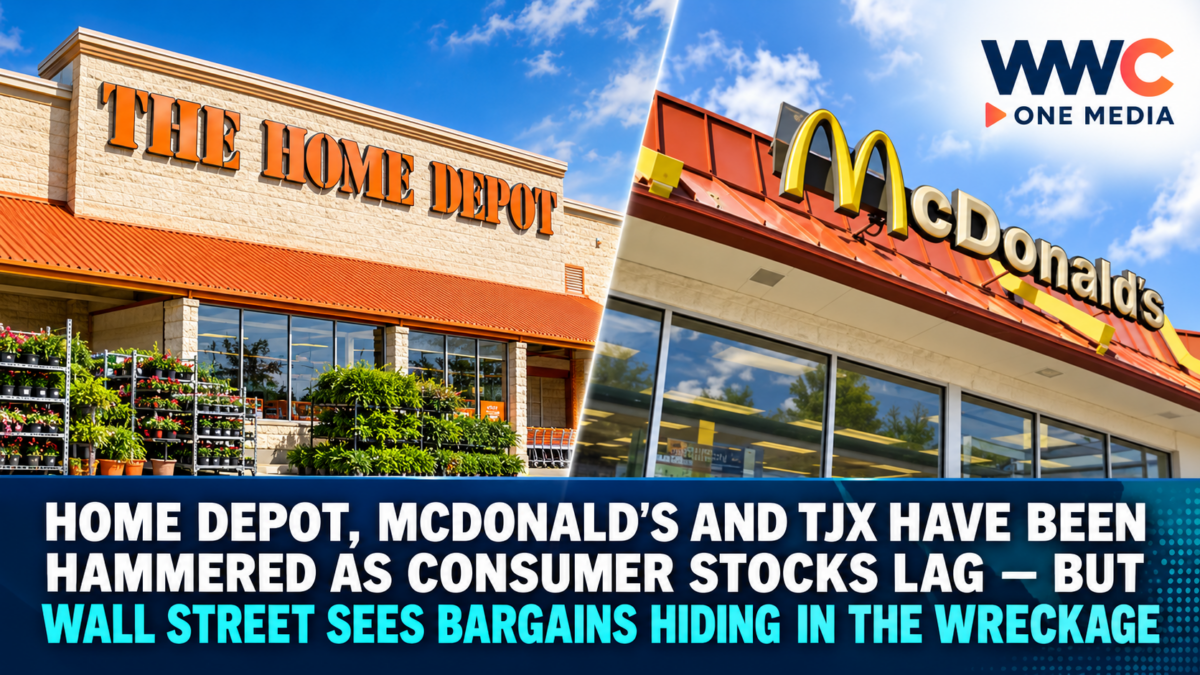
NEW YORK — Some of America’s best-known consumer stocks have been punished even as the broader stock market has remained near record territory, creating what some Wall Street analysts now see as a selective buying opportunity rather than a reason to abandon the entire sector.
Over the past three months, the Consumer Staples Select Sector SPDR ETF has fallen about 4%, while the Consumer Discretionary Select Sector SPDR ETF has dropped roughly 5%.
Over the same period, the S&P 500 gained about 4.3%.
The divergence is striking.
Home Depot and McDonald’s have each fallen about 18% in three months.
TJX Companies, owner of T.J. Maxx, Marshalls and HomeSense, is down roughly 10%.
Walmart has slipped about 3%, while Costco has been roughly flat over the same period.
The selloff has been driven by a difficult combination:
high interest rates;
elevated fuel and energy costs;
persistent inflation;
weak consumer sentiment;
and concern that wage growth is not keeping pace with household expenses.
But analysts say those pressures should not automatically make every consumer stock unattractive.
The real question is whether investors are looking at temporary macroeconomic weakness—or companies whose underlying businesses have actually deteriorated.
Consumer Stocks Have Fallen Behind the Rest of the Market
The broader S&P 500 has remained resilient because technology and artificial-intelligence stocks continue generating strong earnings.
Consumer companies have not received the same support.
Instead, investors have become increasingly worried about household spending power.
Long-term Treasury yields have climbed sharply, pushing borrowing costs higher for mortgages, auto loans and other consumer debt.
Oil prices have also remained elevated.
Those pressures reduce the amount of money households have available for discretionary spending.
That has made investors increasingly cautious toward retailers, restaurants, apparel companies and home-improvement chains.
Paul Hickey: The Sector Is Being Hit by Macro Pressure
Paul Hickey, co-founder of Bespoke Investment Group, told CNBC that consumer stocks are facing a particularly difficult macroeconomic environment.
High interest rates are making borrowing more expensive.
Energy costs are squeezing household budgets.
And rising Treasury yields give investors a safer alternative to equities.
That last point is especially important.
When government bonds offer higher yields, investors do not need to accept as much risk from stocks to generate returns.
That can compress equity valuations even when corporate earnings remain relatively healthy.
Consumer companies are particularly vulnerable because their results are closely tied to household confidence and spending.
But Wall Street Says Some Stocks May Have Fallen Too Far
Telsey Advisory Group analyst Joe Feldman argues that investors should focus on individual businesses rather than treating the entire consumer sector as one trade.
His reasoning is simple.
A weak economy can hurt most consumer companies.
But businesses with strong balance sheets, reliable cash flow and market-share advantages are usually better positioned to survive difficult periods.
And if their share prices fall sharply enough, valuations can become more attractive.
That is the opportunity some analysts now see in names including Home Depot, McDonald’s, Costco, Walmart and TJX.
Home Depot: Housing Weakness Has Crushed the Stock
Home Depot is one of the clearest examples.
Shares have fallen about 18% over the past three months even though the company has continued delivering positive comparable-sales growth.
Feldman noted that Home Depot has recorded seven consecutive quarters of comparable-store sales growth and expects that trend to continue during the second half of 2026.
The problem is the housing market.
High mortgage rates have discouraged home purchases.
When people do not move, they often delay major renovation projects.
That can reduce demand for flooring, kitchens, lumber and other expensive home-improvement products.
Rising Treasury yields have made the situation even more difficult by keeping mortgage costs elevated.
Home Depot Is Still Benefiting From Professional Customers
One reason analysts remain constructive is Home Depot’s exposure to contractors and professional builders.
Professional customers tend to undertake larger projects than ordinary do-it-yourself shoppers.
That provides some insulation from weakness among individual homeowners.
The company also benefits from a massive store network, strong supplier relationships and significant cash flow.
These advantages do not eliminate housing-market risk.
But they make Home Depot better equipped than smaller competitors to survive a prolonged slowdown.
Melius Research this week initiated coverage of both Home Depot and Lowe’s with Buy ratings, arguing that home-improvement retailers offer a more attractive risk-reward profile than many homebuilders.
Lowe’s Has Been Hit Even Harder
Lowe’s provides another example of how aggressively investors have sold home-related stocks.
Shares closed October 7 at $181.54, about 38% below their 52-week high of $293.06.
The company faces many of the same pressures as Home Depot.
Do-it-yourself spending is soft.
Mortgage rates remain elevated.
Large remodeling projects can be postponed.
But contractor demand and smaller repair projects remain relatively resilient.
That creates a possible opportunity if housing activity eventually improves.
McDonald’s Is Fighting for Lower-Income Consumers
McDonald’s shares have also dropped roughly 18% in three months.
The restaurant giant faces a different challenge.
Lower-income consumers have become more price-sensitive as food, housing and borrowing expenses rise.
That has forced McDonald’s to emphasize value menus, promotions and affordability.
Feldman said the company’s underlying performance remains solid despite consumer pressure.
The strength of the McDonald’s model comes from scale.
The company has enormous purchasing power, global brand recognition and a franchise system that generates relatively stable cash flow.
That makes it difficult to displace even during weak consumer cycles.
Value Has Become Critical in Fast Food
The broader fast-food industry is increasingly competing on affordability.
Consumers have become more selective about restaurant spending.
A family that once ate out several times per week may reduce visits or choose cheaper items.
That makes value offerings more important.
But constant discounting can also damage margins.
McDonald’s therefore has to balance traffic with profitability.
This tension will remain one of the biggest issues facing restaurant stocks as long as inflation remains elevated.
Costco Looks Strong—But It Is Not Cheap
Costco has performed much better than many consumer peers.
Its stock has been roughly flat over the past three months while numerous retail names have declined.
Feldman described Costco’s recent sales and earnings performance as “phenomenal” and highlighted the company’s growing cash position.
That has sparked speculation that Costco could eventually issue another special dividend.
The company last paid a large special dividend in January 2024.
But Costco presents a different problem for investors.
The business is strong.
The valuation is expensive.
That means investors already expect very high performance.
Costco’s Membership Model Gives It an Advantage
Costco’s biggest structural strength is its membership model.
Customers pay annual fees to access warehouses and discounted products.
That creates recurring revenue and customer loyalty.
Members also tend to have relatively high household incomes.
That gives Costco more insulation from economic weakness than retailers serving highly stressed consumers.
Its gasoline business provides another advantage when fuel prices rise.
Consumers can save money at Costco gas stations, which can increase store traffic.
But a great company can still be a poor investment if purchased at an excessively high valuation.
That is why analysts remain positive on Costco’s fundamentals while acknowledging that its stock carries a demanding price.
Walmart May Be the Most Defensive Consumer Play
Walmart has slipped only around 3% over three months despite difficult consumer conditions.
Feldman told CNBC that Walmart’s business is “as good as it has been,” even after a recent same-store-sales miss.
The retailer has several important advantages.
It dominates grocery.
It serves consumers across income groups.
Its scale gives it significant pricing power with suppliers.
And during economic slowdowns, higher-income consumers often trade down to Walmart to save money.
That can allow the company to gain market share precisely when household budgets tighten.
Walmart and Costco Have Survived Multiple Economic Cycles
Hickey highlighted Walmart and Costco as examples of businesses that have repeatedly demonstrated resilience through recessions and inflationary periods.
That does not mean their stocks cannot fall.
Short-term volatility can still be severe.
But companies with strong cash generation, dominant market positions and loyal customers often emerge stronger after weaker competitors struggle.
This is the central argument behind buying high-quality consumer stocks during broad selloffs.
TJX Has a Different Opportunity
TJX Companies has fallen around 10% in three months.
The owner of T.J. Maxx, Marshalls and HomeSense recently suffered from a merchandising mistake.
Management acknowledged that parts of the inventory mix were wrong, hurting results.
But trends have reportedly improved since then.
That creates a different kind of investment thesis.
TJX is not simply being affected by macroeconomic weakness.
Part of its problem was self-inflicted.
If management fixes the merchandising problem, earnings could improve even without a major economic recovery.
Off-Price Retail Often Benefits When Consumers Trade Down
TJX also has a business model that can perform well during difficult economic periods.
It buys excess and discounted inventory from brands and sells those products at lower prices.
When consumers want recognizable brands but become more price-conscious, off-price retailers can gain customers.
The holiday season can be particularly important because shoppers look for affordable gifts and discounted merchandise.
Feldman noted that TJX often performs well around year-end as customers search for what the company describes as “treasure hunt” bargains.
Ross Stores Is the Benchmark TJX Must Beat
One risk is competition from Ross Stores.
Feldman said Ross has continued posting solid sales and earnings while TJX struggled with its merchandising issue.
That creates the perception that Ross may be taking market share.
TJX must demonstrate that recent weakness was temporary.
If sales recover over the holiday period, investors may become more confident that the company has corrected its inventory problems.
If not, concerns about competitive erosion will grow.
The Consumer Economy Is Becoming More Unequal
The weakness in consumer stocks reflects a broader economic divide.
Higher-income households often remain relatively healthy because they own financial assets and have greater savings.
Lower-income consumers are more exposed to rent, food, transportation and debt costs.
That creates what economists sometimes call a K-shaped consumer economy.
Retailers serving wealthier households can perform differently from those relying heavily on lower-income customers.
This divergence is visible across retail.
Costco continues performing strongly.
Luxury spending, meanwhile, has begun to weaken as even affluent consumers become more cautious. Reuters reported that U.S. luxury spending fell 6% year over year in September, marking a third consecutive monthly decline.
Inflation Is Still Hurting Real Purchasing Power
According to the CNBC analysis, wage growth is running around 3% annually, while consumer-price inflation is around 3.4%.
That means average purchasing power is effectively declining.
Even employed consumers can feel worse off if prices rise faster than wages.
This creates pressure on discretionary spending.
People still buy food and basic household goods.
They may delay furniture, clothing, vacations or expensive home projects.
That explains why consumer discretionary stocks have suffered more severely than some defensive retailers.
High Interest Rates Make Big Purchases More Painful
Interest rates are another critical factor.
Consumers financing cars, homes or large purchases now face substantially higher borrowing costs.
CNBC recently reported that consumers are delaying major purchases because of both high inflation and elevated interest rates.
Those delays directly affect companies such as Home Depot, Lowe’s, furniture retailers and automakers.
Higher rates also reduce valuations in the stock market because future profits are discounted more heavily.
That creates a double hit.
Corporate demand weakens at the same time that investors become less willing to pay high multiples.
Treasury Yields Are Competing Directly With Stocks
The 10-year Treasury yield has climbed toward levels last seen more than two decades ago.
That changes investor behavior.
When safe government debt yields little, investors are pushed toward stocks.
When Treasury yields are high, conservative investors can earn meaningful returns without taking equity risk.
This makes expensive consumer stocks particularly vulnerable.
A company needs stronger earnings growth to justify its valuation when bond yields are elevated.
High Oil Prices Add Another Consumer Tax
Energy costs are compounding the problem.
Brent crude has traded around or above $100 per barrel during periods of recent geopolitical tension.
Higher oil prices feed into transportation costs, fuel bills and product distribution.
Consumers feel the effect at gasoline stations.
Retailers feel it through freight expenses.
Restaurants can see food distribution costs rise.
That means high energy prices function almost like an additional tax on both consumers and businesses.
Nike Shows Why Some “Cheap” Stocks Are Dangerous
Not every beaten-down consumer stock is automatically attractive.
Nike is a good example.
The company is attempting a major turnaround under CEO Elliott Hill, but the problems are substantial.
First-quarter sales fell 4% to $11.21 billion, while China sales plunged 26%.
Nike shares have fallen to a 12-year low as investors question whether product innovation, China demand and brand momentum can recover quickly enough.
This is the classic distinction between a bargain and a value trap.
A stock is not necessarily cheap simply because its price has fallen.
The underlying business needs a credible path to recovery.
Lululemon Faces a Similar Problem
Lululemon is another heavily punished consumer name.
Its shares have fallen more than 80% from their late-2023 peak, according to Barron’s.
The company is facing stronger competition from Alo Yoga and Vuori, declining North American sales and concerns about product relevance.
Lululemon has appointed former Nike veteran Maggie Gauger as its new president and chief product officer as part of a broader leadership overhaul.
The stock could eventually recover if the turnaround succeeds.
But analysts remain divided.
That makes it a much more speculative opportunity than Costco or Walmart.
Quality Matters More Than Sector Timing
The strongest message from CNBC’s analysis is not that investors should buy every consumer stock.
It is the opposite.
Analysts argue that periods of broad sector weakness create opportunities to distinguish strong businesses from weak ones.
A high-quality company may fall simply because investors are selling the entire sector.
A weaker company may fall because its competitive position is deteriorating.
Those situations should not be treated the same.
Balance Sheets Become More Important During Stress
Strong balance sheets matter most when borrowing costs are high.
Companies with large cash positions do not need to rely as heavily on expensive debt.
They can keep investing.
They can repurchase shares.
They can pay dividends.
And they can acquire weaker competitors.
This is part of the reason Walmart and Costco are attracting interest.
Their financial strength allows them to focus on gaining customers while weaker businesses concentrate on survival.
Market Share Can Matter More Than Short-Term Sales Growth
Another important factor is competitive position.
A company’s sales can slow even while it gains market share.
That can happen when the entire industry weakens.
For example, if a market shrinks 5% but a retailer’s sales decline only 1%, it may actually be strengthening relative to competitors.
This is one reason investors look beyond headline revenue growth.
Companies that gain share during downturns can emerge in stronger positions when the economy improves.
The Holiday Season Could Decide Several of These Trades
The fourth quarter will be particularly important for consumer stocks.
Retailers generate a large share of annual sales during the holiday period.
Investors will watch whether consumers continue spending despite high borrowing costs and inflation.
TJX has an opportunity to prove its merchandising problem was temporary.
Walmart and Costco can demonstrate whether trade-down behavior remains strong.
McDonald’s can show whether value initiatives are bringing back lower-income customers.
Home Depot will provide clues about whether home-improvement demand is stabilizing.
These results could determine whether the recent selloff was an opportunity—or an early warning.
The S&P 500 Is Hiding a Much Weaker Market Underneath
The contrast between consumer stocks and the broader market also highlights another issue.
Major indexes remain near record highs.
But much of that strength has been driven by technology and AI-related companies.
The S&P 500 has gained even while many consumer stocks have fallen sharply.
That means the headline index can disguise weakness beneath the surface.
Investors looking only at the S&P 500 might conclude that the economy is producing broad-based corporate strength.
The consumer sector suggests a much more complicated reality.
A Falling Stock Is Not the Same as a Broken Company
This distinction is at the heart of value investing.
Home Depot shares can fall because mortgage rates are high.
McDonald’s can decline because lower-income customers are spending less.
TJX can stumble because management chose the wrong merchandise.
Those problems can eventually reverse.
But Nike or Lululemon may face deeper questions about brand relevance and competitive positioning.
Investors have to decide whether earnings weakness is cyclical or structural.
That is much harder than simply buying whichever stock has fallen the most.
The Bigger Opportunity May Come From Patience
Consumer stocks may continue falling if interest rates rise further or the economy weakens.
That means a stock that looks cheap today could become cheaper tomorrow.
Analysts therefore are not necessarily predicting an immediate rebound.
Their argument is that valuations are becoming more interesting for investors willing to hold through volatility.
This is especially true for companies that have already survived multiple economic cycles.
Wall Street Is Hunting for Survivors, Not Just Cheap Stocks
The consumer sector has been hammered because investors are worried about household spending.
Those fears are real.
Interest rates remain high.
Energy costs are elevated.
Real wage growth is under pressure.
And some categories—from apparel to home improvement—are clearly struggling.
But not every company faces the same risk.
Home Depot still has professional customers and positive comparable sales.
McDonald’s retains enormous global scale.
Costco and Walmart have repeatedly gained customers during difficult economic periods.
TJX has a business model built around bargain hunting.
That is why some Wall Street analysts see opportunity after the selloff.
The bigger question is whether investors are buying durable franchises at temporarily depressed prices—or stepping into consumer stocks just before household spending weakens even further.