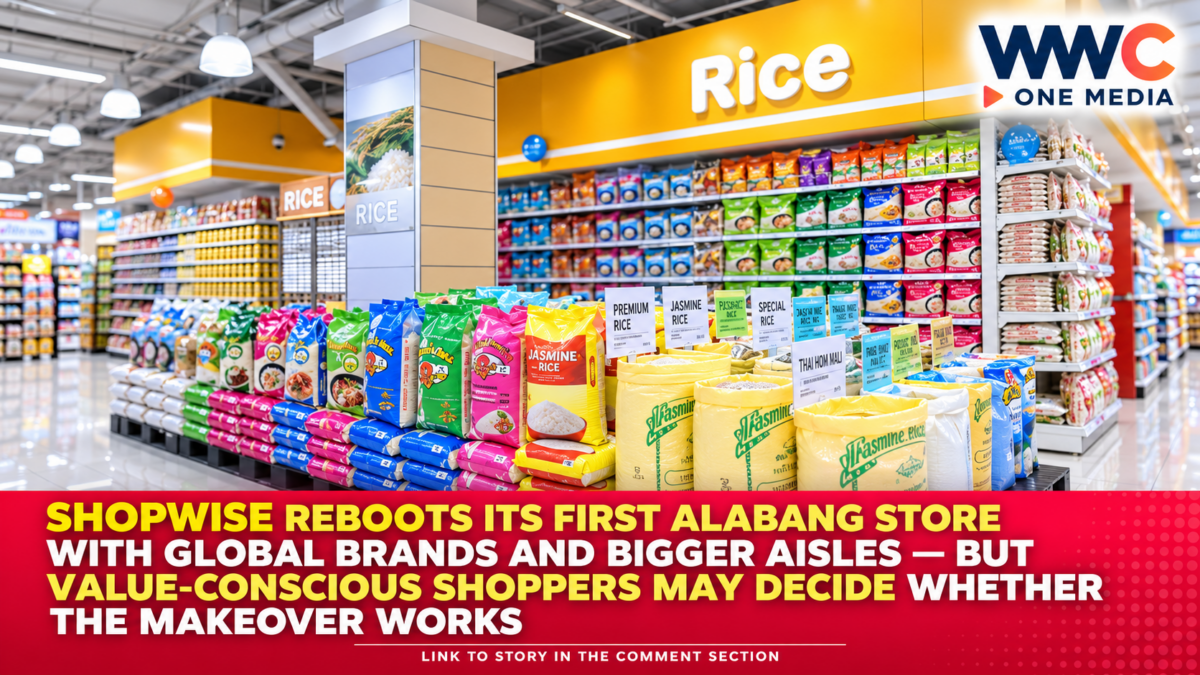
MUNTINLUPA CITY, PHILIPPINES — Shopwise has returned to where its Philippine story began, reopening its original Alabang store with a redesigned layout, broader international assortment and a stronger focus on discovery as supermarkets fight harder for increasingly selective Filipino shoppers.
The Robinsons Retail hypermarket chain reopened its branch at Festival Mall on October 7 after a major refresh nearly three decades after Shopwise first entered the Philippine market at the same location in 1998.
The overhaul includes wider aisles, easier store navigation, a modern-industrial design and expanded ranges across groceries, beauty, wellness and bakery products.
Shopwise is also leaning more heavily into imported brands while retaining local staples, private-label products, promotions and its no-membership-fee model.
The strategy reflects a broader change in Philippine grocery retail.
Consumers increasingly want convenience, value and access to products they once had to buy from specialty stores or online.
At the same time, they remain highly sensitive to price.
That creates a difficult balancing act for Shopwise.
The chain wants to make physical grocery shopping feel more premium and experiential without losing the affordability that made hypermarkets attractive in the first place.
Shopwise Returns to the Store Where It Started
Shopwise Alabang holds unusual importance for the brand.
It was the chain’s first Philippine location when Shopwise launched in 1998, helping introduce the hypermarket format to local consumers. Shopwise describes itself as one of the country’s pioneers in combining groceries, fresh food, apparel, toys and household merchandise under one roof.
Nearly 28 years later, the company is using that original location as a testing ground for what its next generation of stores could look like.
Shopwise deputy general manager Diana Prince Ang said the Alabang branch remains a special part of the company’s history and that the refreshed store is intended to combine that legacy with more opportunities for discovery and value.
The message is important.
Shopwise is not abandoning its traditional hypermarket identity.
It is trying to modernize it.
Wider Aisles and Easier Navigation Are Part of the Strategy
One of the most visible changes is physical.
The store now has wider shopping areas, improved navigation and more comfortable browsing spaces.
Those details may seem cosmetic, but they reflect a larger challenge facing brick-and-mortar retailers.
Consumers can increasingly order groceries and household goods online.
A physical store therefore needs to offer something beyond basic access to products.
Retailers are responding by making stores easier to navigate and more enjoyable to explore.
The goal is to give customers reasons to stay longer, discover new items and potentially spend more.
Shopwise’s redesigned Alabang branch follows that approach.
Imported Beauty and Wellness Brands Take a Bigger Role
The refresh also significantly expands Shopwise’s international product assortment.
The personal-care and beauty section now includes brands such as Fino, Tsubaki, Anua and CeraVe.
These products reflect strong Filipino demand for Japanese, Korean and international skincare and wellness brands.
The grocery aisles also include imported names such as Arizona beverages, Garofalo pasta and sauces, and Massel plant-based stocks.
At the same time, Shopwise continues carrying its own private-label products, including Meadows, Brighter and Hearty.
The strategy gives shoppers multiple price points.
A customer can purchase international specialty products while still buying mainstream local or lower-priced private-label staples in the same trip.
That mix could become increasingly important as Filipino households balance aspiration with affordability.
Fresh Bakery Is Also Getting More Attention
Shopwise has expanded the bakery area with a larger selection of freshly baked products.
Fresh categories can be particularly valuable for supermarkets because they give shoppers reasons to visit stores more frequently.
Packaged groceries can often be ordered online or purchased from smaller neighborhood stores.
Fresh bread, prepared food, meat and produce can give large supermarkets a stronger reason to attract physical visits.
They can also help differentiate one retailer from another.
For a hypermarket such as Shopwise, the challenge is making those categories feel convenient rather than overwhelming.
No Membership Fee Is Still Part of the Pitch
While Shopwise is adding more imported and premium-looking products, it is emphasizing that customers do not need a paid membership to access promotions.
That positioning differentiates the chain from membership-based warehouse formats.
Shopwise says shoppers can continue receiving deals without paying an annual access fee.
To support the Alabang relaunch, the retailer launched a five-day sale from October 7 through October 11, including ₱199 offers, buy-one-take-one promotions and discounts of up to 60% on selected products.
The aggressive promotional approach shows that value remains central to the strategy even as the physical store becomes more polished.
The Bigger Problem: Filipino Shoppers Are Becoming More Price-Conscious
Shopwise’s refresh comes at a difficult time for grocery retailers.
Filipino consumers are still dealing with pressure from household expenses and are becoming more deliberate about where and how they shop.
A 2026 industry analysis reported that sari-sari stores increased their share of grocery spending to 40.9% in 2025, while supermarkets fell to 37.2%, down from 46% in 2019.
That does not mean modern supermarkets are disappearing.
It does mean they face tougher competition from smaller formats that offer convenience, smaller purchase sizes and proximity to residential communities.
For large-format stores, the question is how to convince shoppers that a longer supermarket trip provides enough additional value.
Convenience Is Becoming as Important as Price
Government of Canada research based on Euromonitor data identifies convenience and affordability among the strongest trends shaping Philippine grocery spending.
Consumers increasingly seek time-saving products, healthier choices and low-cost goods, while supermarkets are investing more heavily in promotions, assortment and digital delivery.
The same report projects Philippine supermarket sales to rise from roughly US$11.7 billion in 2024 to US$15 billion by 2029.
That suggests there is still meaningful room for growth.
But competition is becoming more intense.
Retailers must attract consumers who can choose between supermarkets, neighborhood stores, convenience chains, discounters and online grocery platforms.
Robinsons Retail Is Already One of the Biggest Grocery Players
Shopwise sits inside the food division of Robinsons Retail Holdings.
That portfolio includes Robinsons Supermarket, Robinsons Easymart, The Marketplace, Shopwise and Uncle John’s.
Robinsons Retail says its food business operates more than 800 stores nationwide across multiple formats.
Shopwise itself had 16 stores in Robinsons Retail’s latest published store-count data.
That makes it much smaller than some of the group’s other food banners, but it plays a different role.
Robinsons Supermarket targets mainstream grocery shoppers.
The Marketplace focuses on premium consumers.
Robinsons Easymart serves neighborhood convenience.
Shopwise operates as the large-format hypermarket offering groceries alongside general merchandise.
The Alabang refresh therefore gives Robinsons Retail an opportunity to refine the role of its hypermarket format.
Robinsons Retail’s Food Business Is Still Growing
The company has a financial incentive to keep improving its grocery portfolio.
Robinsons Retail reported that food-segment net sales grew 7.4% year-on-year to ₱28.25 billion in the first quarter of 2026.
Same-store sales growth reached 3%, while food-segment EBITDA increased 11.8%.
For full-year 2025, food-segment sales reached ₱125.8 billion, up 4.6%, while EBITDA increased 6% to ₱11.2 billion.
Those results suggest the grocery business remains an important growth engine for Robinsons Retail.
But rising sales do not remove the need to adapt.
Consumer habits are changing quickly, especially among younger urban shoppers.
International Assortment Is Becoming a Competitive Weapon
Imported products have become a larger part of modern Philippine grocery retail.
Consumers exposed to global brands through travel, TikTok, Korean entertainment, Japanese culture and e-commerce increasingly expect international products to be available locally.
Robinsons Retail is already pursuing this strategy through The Marketplace.
Earlier this year, The Marketplace opened a store at Molito Lifestyle Center in Alabang with imported brands including Waitrose, Casino, Woolworths and Meadows, plus specialty cheeses, premium cold cuts and wines.
The Shopwise Alabang refresh brings a more accessible version of that strategy into the hypermarket format.
Rather than focusing purely on premium shoppers, Shopwise can combine imported discoveries with mainstream household products.
Alabang Is Becoming a More Competitive Grocery Market
The location also matters.
Southern Metro Manila has become an increasingly attractive market for grocery and lifestyle retailers.
The Marketplace’s Molito expansion earlier this year targeted affluent consumers in the same broader Alabang area.
Shopwise Alabang serves a broader customer base through Festival Mall.
That creates an interesting internal segmentation for Robinsons Retail.
The Marketplace can focus on premium specialty purchases.
Shopwise can emphasize scale, assortment and value.
Both formats can benefit from rising consumer spending in the southern Metro Manila corridor.
But they must remain sufficiently differentiated to avoid competing primarily with each other.
Hypermarkets Face a Structural Challenge
Large-format stores once had a simple advantage: they offered almost everything under one roof.
That advantage is weaker today.
Consumers can buy groceries from neighborhood stores.
They can order household goods online.
They can visit specialty beauty shops for skincare.
They can purchase ready-to-eat meals from convenience stores.
This fragmentation makes the traditional hypermarket model more difficult.
Large stores require more space and more inventory.
They also depend on shoppers being willing to make longer, less frequent trips.
That is one reason retailers are emphasizing experience and product discovery.
The store must offer something a quick neighborhood purchase cannot.
Shopwise Is Also Returning to Libis
The Alabang refresh is not an isolated move.
Shopwise is also preparing to return to Libis in Quezon City, where it plans to open a large flagship store in November 2026 after nearly a decade away from the area.
That location will occupy the former AllDay flagship site along C-5.
Together, the Alabang renovation and Libis return suggest Robinsons Retail is investing again in Shopwise rather than allowing the format to stagnate.
The company appears to be testing whether a redesigned hypermarket can remain relevant alongside smaller supermarkets, convenience stores and e-commerce.
Physical Stores Still Matter
Despite the growth of online grocery, physical stores remain central to Philippine retail.
Food shopping is highly habitual and often involves fresh products that consumers prefer to inspect personally.
Supermarkets also allow customers to compare brands immediately and combine many purchases into a single trip.
Research on Philippine grocery retail continues to show strong demand for modern trade even as traditional stores remain influential.
This explains why companies continue investing in store design rather than assuming e-commerce will replace physical grocery shopping.
The likely future is not online versus offline.
It is a combination of both.
Health and Wellness Are Also Influencing Assortment
Consumer preferences are changing beyond convenience.
Health-conscious purchasing has become more visible.
Government of Canada research highlights demand for healthy ingredients, eco-friendly products and trusted brands among Filipino shoppers.
Robinsons Retail has already positioned health and wellness as part of its broader food strategy.
The group’s mainstream Robinsons Supermarket banner is explicitly built around healthier food choices.
Shopwise’s larger beauty, wellness and plant-based assortment suggests similar trends are influencing its merchandising.
The challenge is making those categories accessible enough for mainstream customers.
Private Labels Could Help Protect the Value Proposition
Private-label products can become increasingly important when household budgets tighten.
Retailers can use their own brands to offer alternatives to more expensive national or imported labels.
Shopwise carries Meadows along with its Brighter and Hearty brands.
These products can help the retailer preserve a value proposition while simultaneously expanding premium international choices.
That creates a “good, better, best” assortment.
A customer can buy a lower-cost store brand in one category while splurging on a premium imported product in another.
This type of mixed spending behavior is becoming increasingly common as consumers selectively trade up and trade down within the same basket.
The Real Competition Is for Shopping Time
Retail competition is no longer only about prices.
It is also about time.
A consumer deciding where to buy groceries considers traffic, parking, store size, checkout speed and how easy products are to find.
A large assortment loses some of its advantage if navigating the store becomes exhausting.
That is why wider aisles and easier navigation matter.
Shopwise wants the refreshed Alabang branch to feel less like a warehouse and more like a place where browsing is comfortable.
If successful, that could increase the time shoppers spend inside the store.
But it must still remain efficient for customers who simply want to complete their grocery run quickly.
The Makeover Is Really a Test of the Hypermarket’s Future
Shopwise’s Alabang renovation represents more than a cosmetic refresh.
It is an attempt to answer a difficult question facing large grocery formats.
Can hypermarkets remain relevant when consumers increasingly value neighborhood convenience, online ordering and specialized retail?
Shopwise’s answer is to combine scale with discovery.
The Alabang store still offers everyday groceries and general merchandise.
But it now places greater emphasis on imported products, beauty, wellness, fresh bakery, design and shopping comfort.
The strategy makes sense on paper.
The real test will be how consumers respond.
Value Will Still Decide the Outcome
The biggest risk is that a more premium-looking store could create the perception of higher prices.
That would be dangerous in a market where many households remain highly price-conscious.
Shopwise appears aware of the problem.
Its reopening promotions, private-label products and no-membership positioning are designed to reassure shoppers that the refresh does not mean abandoning affordability.
That balance will be crucial.
Consumers may appreciate wider aisles and imported products.
But they will still compare prices.
If Shopwise can make discovery feel exciting without making shopping feel expensive, the Alabang format could become a model for future stores.
If not, shoppers have more alternatives than ever.
Shopwise Is Betting That the Supermarket Can Still Be an Experience
After nearly three decades, Shopwise is returning to its roots to reinvent itself.
The original Alabang branch now looks different.
Its aisles are wider.
Its international assortment is larger.
Its beauty and wellness sections are broader.
And its design is intended to encourage customers to explore rather than simply fill their carts.
But the competitive environment is far tougher than it was in 1998.
Filipino shoppers can now choose from supermarkets, discounters, convenience stores, sari-sari stores and e-commerce platforms.
Shopwise is betting that physical grocery shopping can remain relevant by offering more products, better navigation and a stronger sense of discovery.
But the bigger question is whether shoppers will reward the upgraded experience with bigger baskets—or continue prioritizing whichever retailer saves them the most money and time.