
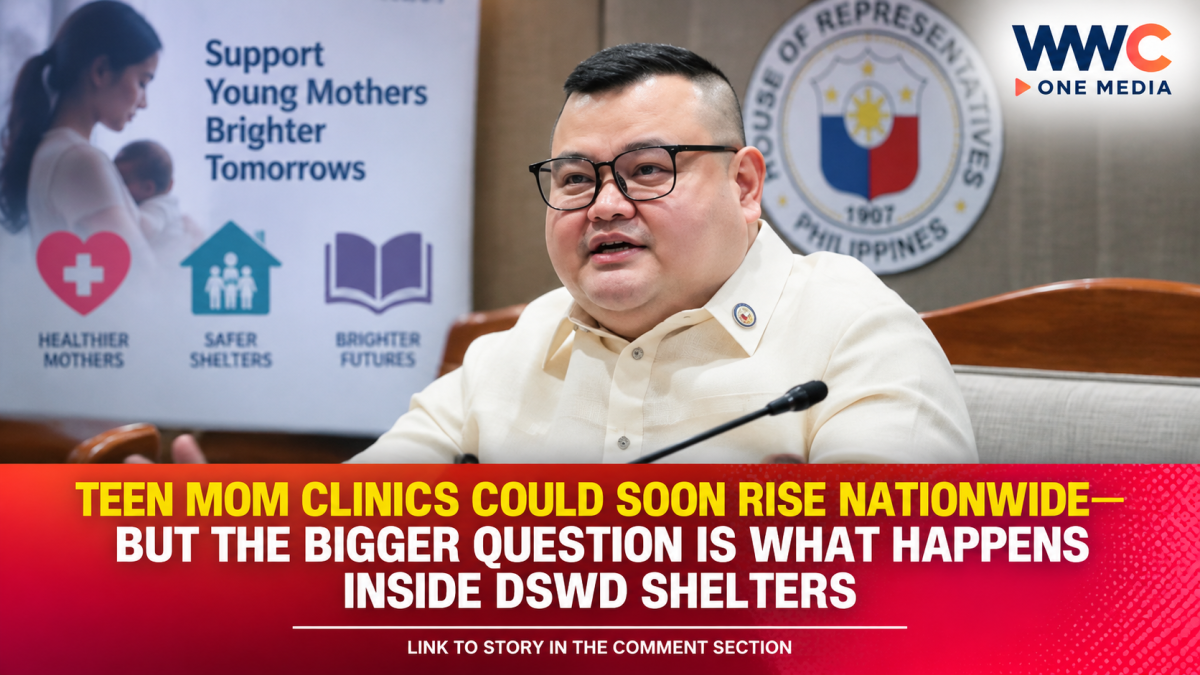
MANILA, Philippines — A new legislative push seeks to give pregnant teenagers and young mothers more specialized medical care, social protection and support, with a proposal calling for dedicated “Teen Mom Clinics” in public hospitals and stronger facilities under the Department of Social Welfare and Development (DSWD).
The measure was filed by Quezon City 5th District Rep. Patrick Michael D. Vargas as House Bill No. 3988, formally titled the “Adolescent Pregnancy Prevention Act.” The House of Representatives’ official records show that the bill was filed on Aug. 26, 2025, read on first reading the following day, and was deliberated upon by the mother committee on March 17, 2026.
The proposal comes as government data continue to show a troubling pattern: while the overall number of births to adolescent mothers has declined, births among the youngest girls have increased.
What the proposed Teen Mom Clinics would do
Under HB 3988, the Department of Health (DOH) would establish specialized Teen Mom Clinics in public hospitals.
The clinics would be designed to provide adolescent mothers with prenatal, ante-natal and post-natal care, as well as postpartum counseling and reproductive-health services intended to help prevent repeat pregnancies.
The bill also proposes strengthening the capacity of existing DSWD residential care facilities for disadvantaged women, with specialized personnel and services for pregnant minors and young mothers.
The proposal is therefore aimed at treating adolescent pregnancy not simply as a medical issue, but as a problem involving health, education, child protection, social welfare and economic opportunity.
DSWD shelters could get major upgrades
The proposed legislation would direct the DSWD to increase the capacity of its existing facilities for disadvantaged women.
The bill envisions multidisciplinary teams that could include social workers, medical professionals, midwives or nurses and psychologists trained to respond to the particular needs of pregnant minors.
It also calls for stronger social-protection mechanisms for adolescents whose pregnancies resulted from sexual violence, abuse or exploitation, including pathways to legal, medical and psychosocial assistance.
This is particularly significant for younger adolescents because pregnancies involving very young girls can raise child-protection concerns.
The numbers behind the push
The proposal cites a sharp increase in births among girls under 15.
According to Philippine Statistics Authority data cited by the Commission on Population and Development (CPD), births to girls aged 10 to 14 increased from 2,320 in 2021 to 3,135 in 2022, a 35.13% jump in one year.
The trend continued in 2023.
The PSA reported 142,276 registered live births to mothers below 20 years old in 2023, representing 9.8% of all registered births. Meanwhile, DSWD reported that births to girls below 15 reached 3,343 in 2023, up from 3,135 the previous year.
That creates an important distinction: overall adolescent births decreased, but pregnancies among the youngest girls continued to rise.
Why pregnancies among very young girls are especially concerning
Government agencies and child-protection advocates have repeatedly warned that pregnancies involving girls below 15 can be associated with sexual abuse, exploitation or other forms of coercion.
The CPD previously described the increase in births among girls under 15 as particularly alarming.
The issue is also tied to Republic Act No. 11648, which raised the age of sexual consent in the Philippines and strengthened protections for children against rape, sexual exploitation and abuse.
For policymakers, the challenge is therefore twofold: prevent unintended adolescent pregnancies while ensuring that girls who are already pregnant receive protection, healthcare and opportunities to continue their education.
DSWD already has a program for teenage mothers
The proposed bill would not be starting from zero.
The DSWD has already implemented ProtecTEEN, formally known as the Psychosocial Support and Other Interventions for Adolescent Mothers and their Families Project.
The program was developed as part of the government’s response to Executive Order No. 141, which declared the implementation of measures addressing the root causes of rising teenage pregnancies a national priority.
DSWD says ProtecTEEN provides psychosocial interventions and support aimed at helping adolescent mothers and their families deal with the challenges associated with early pregnancy.
In 2026, the agency expanded the program further.
The DSWD’s enhanced ProtecTEEN program includes psychosocial healing, health monitoring, educational assistance and economic-capacity building. Beneficiaries who meet program conditions can receive a ₱3,000 monthly grant for 24 months, while the program also supports school reintegration and skills training.
As of July 2026, DSWD said it had provided school-reintegration guidance and TESDA skills training to 828 adolescent mothers across several regions.
Proposed law would bring agencies together
HB 3988 also seeks to create an inter-agency Teenage Pregnancy Prevention Council to coordinate the government’s response.
The proposed council would involve agencies including the DOH, DSWD, DepEd, Commission on Population and Development, National Youth Commission, Department of the Interior and Local Government, Commission on Higher Education and TESDA.
The intention is to make the response more coordinated—from healthcare and social protection to education and livelihood assistance.
Teen centers and education are also part of the proposal
The proposal goes beyond hospitals and shelters.
It also calls for community-level Teen Centers and stronger adolescent health and development services.
This builds on an existing government approach. The CPD reported that functional teen centers have been incorporated into the criteria for the Department of the Interior and Local Government’s Seal of Good Local Governance. These centers are intended to serve as youth-friendly referral points for health and social services.
The proposed framework also addresses education and adolescent reproductive health information.
The House measure seeks a coordinated approach to providing young people with age- and development-appropriate information while connecting them to health and social services.
The bill is not yet law
Despite the attention surrounding the proposal, HB 3988 remains a bill—not an enacted law.
The House’s official legislative record identifies it as a national bill authored by Vargas and shows that it was deliberated upon by the mother committee in March 2026.
It is also important to distinguish HB 3988 from House Bill No. 8910, another Adolescent Pregnancy Prevention Act measure from the 19th Congress.
HB 8910 was approved by the House on third and final reading in September 2023 by a 232-0 vote, but its Senate counterpart, Senate Bill No. 1979, remained pending second reading according to the Senate Legislative Reference Bureau.
The existence of multiple proposals underscores that adolescent pregnancy has been a legislative priority for several years, but no nationwide law incorporating these proposals should be described as already in force.
Why the proposal could matter
For a teenage mother, pregnancy can mean much more than a medical challenge.
It can interrupt schooling, limit employment opportunities, increase financial pressure and expose young mothers to stigma and social isolation.
The proposed Teen Mom Clinics and strengthened DSWD facilities are intended to create a more specialized support system—one that addresses both the immediate health needs of young mothers and the circumstances that can shape their futures.
The government’s existing ProtecTEEN program shows that some of these interventions are already being implemented. The proposed legislation would seek to give a broader and more permanent national framework to such efforts.
But the bigger test will come if Congress moves the proposal forward: whether specialized clinics, stronger shelters and coordinated services can translate into real protection, continued education and better opportunities for some of the country’s most vulnerable young mothers.
WWC ONE MEDIA M.J.E




Leave a Reply