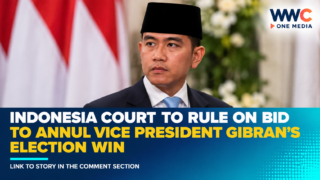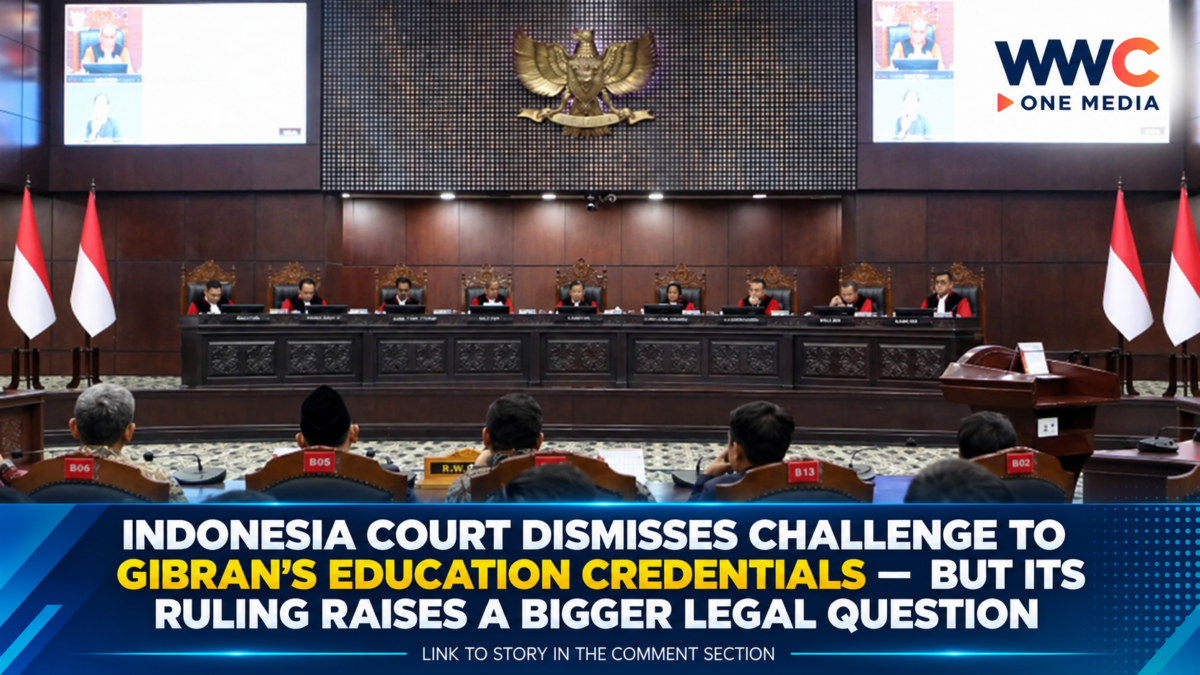
JAKARTA, Indonesia — Indonesia’s Constitutional Court has dismissed a legal challenge seeking to invalidate Vice President Gibran Rakabuming Raka’s 2024 election victory over questions surrounding his education credentials.
But the ruling contains a significant qualification: the nine-member court said it did not find convincing evidence in the proceedings that Gibran possessed a foreign diploma, certificate or degree proving completion of senior high school or an equivalent qualification required under Indonesia’s election law.
Despite that finding, the court said it could not annul or disqualify Gibran through the case brought before it.
The decision was delivered on Tuesday, Oct. 6, and leaves Gibran in office as President Prabowo Subianto’s vice president.
Court Dismisses The Petition, Not Gibran From Office
Chief Justice Suhartoyo announced that all nine Constitutional Court judges dismissed the petition.
The court’s reasoning centered on the nature of the case and the legal standing of the petitioners.
Justice Adies Kadir said the dispute could no longer be treated as a challenge to the 2024 presidential election results because Gibran was no longer a candidate.
He had already been elected, sworn in and inaugurated as vice president on Oct. 20, 2024.
The court therefore concluded that it could not grant the petitioners’ request to cancel Gibran’s position through this particular election-dispute mechanism.
The Education Question Was Not Simply Dismissed
This is where the ruling becomes particularly significant.
The court said it did not find convincing evidence showing that Gibran possessed a foreign diploma, certificate or degree that could be used to establish completion of education equivalent to Indonesia’s senior-high-school level.
Indonesia’s election law requires presidential and vice-presidential candidates to have completed at least senior high school or an equivalent level of education.
The court also noted that no graduation certificate was presented during the proceedings as evidence of such an overseas qualification.
That does not, however, mean the court ordered Gibran removed from office.
Instead, the judges said the issue of whether the education requirement was properly fulfilled falls within the authority of other institutions responsible for assessing candidate eligibility.
What The Petitioners Were Challenging
The petitioners argued that Gibran’s overseas education history did not satisfy the legal requirement for presidential and vice-presidential candidates.
They questioned the use of an equivalency certificate issued by Indonesian authorities to support his eligibility and argued that the required underlying diploma or certificate had not been properly established.
The case therefore focused not simply on where Gibran studied, but on whether the documents used to establish his educational equivalency satisfied the requirements of Indonesia’s election law.
During proceedings, an Indonesian education ministry official acknowledged that no diploma had been submitted alongside the application for the equivalency assessment, according to Reuters’ account of the hearings.
Gibran’s Education Background
Gibran attended Orchid Park Secondary School in Singapore before studying at UTS Insearch in Australia.
He subsequently obtained a bachelor’s degree through the Management Development Institute of Singapore (MDIS).
Gibran has pointed to his university education as evidence of his academic progression.
Following the court ruling, he told reporters that he respected the judicial process and argued that completing a bachelor’s degree would not have been possible had he not completed the required earlier education.
“I completed my bachelor’s degree in Singapore,” he said, according to Reuters.
The court’s ruling, however, specifically focused on whether the documentary evidence established the senior-high-school-equivalent qualification required under election law.
Why Gibran Could Not Be Disqualified In This Case
The court’s explanation rests heavily on jurisdiction and legal standing.
The Constitutional Court’s official account says the petitioners lacked legal standing to bring the case as a presidential-election-results dispute.
It also said the dispute was no longer substantively appropriate because Gibran’s status as a candidate had ended when the elected ticket was inaugurated.
That meant the court could examine the arguments and evidence but could not grant the requested remedy of cancelling Gibran’s vice-presidential position through this proceeding.
In other words, the court’s finding about the evidence and its authority to remove Gibran were two separate questions.
The Ruling Could Still Have Political Consequences
Although Gibran remains vice president, the petitioners’ lawyer Bambang Widjojanto said the ruling could potentially have consequences beyond the case itself.
He argued that the decision could provide grounds for Parliament to consider impeachment proceedings and could affect Gibran’s eligibility for a future election unless he completes an approved government equivalency program.
Those are the petitioner’s lawyer’s interpretations, however, rather than a ruling by the Constitutional Court that impeachment or future disqualification will occur.
The court itself did not order Gibran’s removal from office.
Another Constitutional Court Controversy Surrounds Gibran
The latest case adds to a long-running legal controversy surrounding Gibran’s rise to the vice presidency.
In 2023, the Constitutional Court issued a ruling that effectively allowed candidates under 40 to run for president or vice president if they had previously held certain elected or appointed positions.
The decision opened the way for then-36-year-old Gibran to become Prabowo’s running mate.
That ruling generated protests and criticism because then-Chief Justice Anwar Usman, Gibran’s uncle, participated in the case before later being removed from the position of chief justice over an ethics violation related to the decision.
Gibran and Prabowo subsequently won the 2024 presidential election.
The latest education-credential case has therefore revived questions about the legal circumstances surrounding Gibran’s candidacy.
Why The Case Matters For Indonesia’s Election System
The dispute goes beyond one politician’s academic history.
At its core is a question about who has the authority to determine whether a presidential or vice-presidential candidate satisfies eligibility requirements — and at what stage those qualifications can be challenged.
The Constitutional Court’s ruling effectively separated two issues:
- Whether the evidence presented established Gibran’s required educational qualification.
- Whether the Constitutional Court could use this particular election-dispute proceeding to remove him after he had already taken office.
The court’s answer to the first issue was that it found no convincing documentary evidence of the qualifying foreign diploma in the proceedings.
Its answer to the second was that it could not grant the requested disqualification through this case.
That distinction is likely to remain at the center of the political and legal debate surrounding the decision.
Gibran Remains In Office
For now, the immediate consequence is straightforward: Gibran remains Indonesia’s vice president.
The court has rejected the petition seeking to annul his election victory, and no removal order was issued.
But the ruling has also placed renewed attention on the documentation used to establish his eligibility before the 2024 election.
The court’s own findings mean the education-document question has not simply disappeared.
Instead, the judges said questions concerning the validity and fulfillment of candidate requirements belong to other authorized institutions.
The Bigger Question After The Verdict
The decision closes one legal route for challenging Gibran’s position, but it has opened a different conversation about how Indonesia verifies the qualifications of its highest elected officials.
Gibran’s supporters can point to his progression through overseas education and eventual bachelor’s degree.
The petitioners, meanwhile, have focused on the specific documentary requirement for demonstrating completion of senior high school or its equivalent.
And the Constitutional Court has now made a particularly important distinction: it did not find convincing evidence of the required foreign high-school-equivalent diploma in the case, but it also did not have the legal basis in this proceeding to disqualify a vice president who had already been sworn into office.
For Gibran, that means the immediate threat to his position has been removed.
For Indonesia’s legal system, however, the questions over candidate eligibility, documentary requirements and institutional responsibility are likely to continue.