
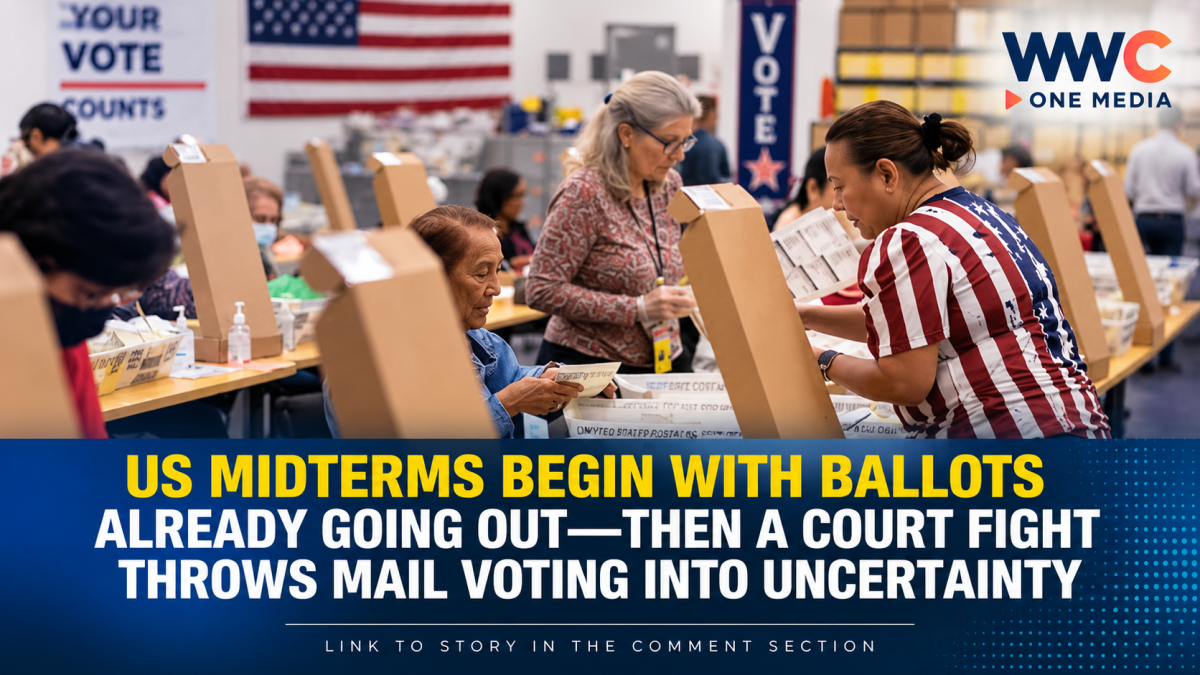
WASHINGTON — The 2026 U.S. midterm elections have officially entered a critical phase, but voters and election officials are facing an unusual problem: the rules governing millions of mail-in ballots remain caught in a legal battle as ballots are already being sent out.
North Carolina became the first state to begin sending mail-in ballots on Friday, Sept. 4, formally opening the voting period ahead of the Nov. 3 congressional elections, which will determine control of the U.S. House and Senate for the final two years of President Donald Trump’s current term.
At the center of the dispute is a Trump administration effort to impose new federal requirements on how states handle mail ballots—changes that election officials and voting-rights groups say could create confusion and potentially prevent eligible voters from successfully casting their ballots.
Federal judge blocks new mail-ballot requirements
The latest development came Friday, when U.S. District Judge Indira Talwani extended an injunction blocking the U.S. Postal Service from implementing key parts of the administration’s new mail-voting requirements.
Talwani ruled that the executive branch does not have inherent authority to impose the changes and said the new requirements conflict with Congress’ existing statutory framework governing elections and the Postal Service.
The ruling is particularly significant because the election process is already moving forward.
North Carolina has begun distributing absentee ballots, while other states are preparing to send theirs in the coming weeks. Election officials have warned that implementing major new technical and administrative requirements at this stage could disrupt established procedures.
What does the Trump administration want to change?
The controversy stems from an executive order signed by Trump in March that sought tighter controls over mail voting.
Under the proposed system, states would provide the Postal Service with lists of voters eligible to receive mail ballots. Ballot envelopes would also have to contain unique barcodes, while the Postal Service would use a new system to screen ballots before delivery.
The administration argues the measures are intended to strengthen election security.
Critics counter that the federal government is attempting to interfere with election procedures traditionally administered by the states and warn that errors in the new system could prevent legitimate ballots from reaching voters.
Trump takes the fight back to the Supreme Court
The legal battle is not over.
The Trump administration has asked the U.S. Supreme Court to intervene and allow the new rules to take effect, setting up another high-stakes legal confrontation just as voting begins.
That leaves election officials confronting a difficult scenario: preparing ballots and election systems under existing state procedures while waiting to see whether federal restrictions will ultimately be allowed to take effect.
Reuters reported that USPS is still developing the technology needed for the proposed system, adding another layer of uncertainty to an already complicated election process.
Whistleblower raises alarm over rushed USPS system
The controversy intensified after a whistleblower raised concerns about the Postal Service’s development of the new screening system.
According to reporting by The Associated Press, the system was developed on an unusually compressed timeline. Critics have questioned whether it has been adequately tested before being used during a national election.
The Guardian separately reported allegations that the system could potentially reject entire batches of ballots if barcode or matching requirements fail, although the ultimate operation of the system remains subject to the ongoing court fight.
USPS has defended its work and said it will comply with court orders while continuing efforts to ensure election mail is handled securely.
Why the timing matters
The dispute comes at a particularly sensitive moment.
Mail voting is already governed by a patchwork of state laws. Some states automatically send ballots to eligible voters, while others require voters to request absentee ballots. Deadlines, identification requirements and rules governing when ballots can be received also differ from state to state.
That means a nationwide federal change introduced shortly before an election could require election administrators to make rapid adjustments across thousands of local jurisdictions.
The federal judge specifically warned that forcing election offices and organizations to make major changes on such short notice could produce “chaos” and increase the risk of voter disenfranchisement.
A wider battle over control of US elections
The fight is also about a much larger constitutional question: Who has the authority to determine how American elections are administered?
States have traditionally played the central role in setting election procedures, subject to federal laws enacted by Congress.
The Trump administration’s proposed mail-ballot rules have therefore triggered lawsuits from Democratic-led states, voting-rights organizations and other groups that argue the executive branch is exceeding its authority.
The administration, meanwhile, maintains that stronger safeguards are necessary to protect election integrity.
The midterms are now officially underway
The stakes extend far beyond mail ballots.
The November election will determine the balance of power in Congress, with Republicans currently holding narrow majorities in both chambers. Democrats are seeking to regain control, making competitive House and Senate races particularly important to Trump’s ability to advance his agenda during the second half of his term.
The election calendar is already moving despite the legal uncertainty.
Ballots are going out. Courts are still fighting over the rules. And election officials are preparing for an election whose procedures could potentially change while voting is already underway.
For millions of Americans planning to vote by mail, the biggest question now is not simply when their ballot will arrive—but which rules will ultimately govern it.
WWC ONE MEDIA M.J.E




Leave a Reply