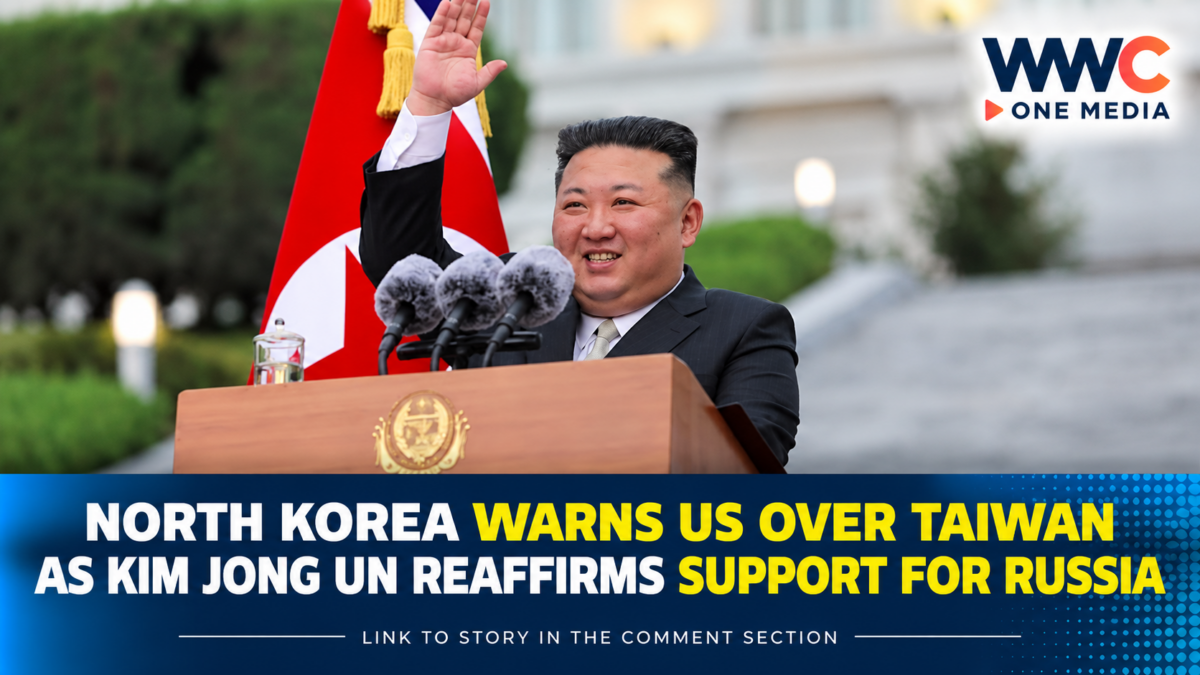
North Korea has warned the United States against confronting China over Taiwan, accusing Washington of worsening tensions in the Taiwan Strait as Pyongyang simultaneously reaffirmed its support for Russia.
The warning came in a commentary carried by North Korean state media on Wednesday (Oct. 7), shortly after the first two of 66 US-made F-16V Block 70 fighter jets ordered by Taiwan arrived on the island.
Separately, North Korean leader Kim Jong Un pledged continued support for Russian President Vladimir Putin in a birthday message, underscoring Pyongyang’s increasingly close relationships with both Beijing and Moscow.
North Korea tells US to ‘think twice’
The North Korean commentary, attributed to international affairs analyst Kim Myong-chol, accused the United States of undermining stability in the Taiwan Strait through military support for Taiwan.
It warned Washington that it should consider whether it was prepared for a direct confrontation with China over Taiwan and whether it could cope with the consequences.
North Korea also reiterated its support for Beijing’s “One China” principle, under which Taiwan is considered part of China’s territory.
The statement reflects Pyongyang’s longstanding opposition to US military alliances and arms sales in the region, but its timing is notable because Taiwan has just begun receiving a major new batch of American fighter aircraft.
Taiwan receives first new F-16V jets
Taiwan received the first two aircraft from its order for 66 F-16V Block 70 fighter jets, part of efforts by Taipei to strengthen its air defences against growing military pressure from Beijing.
China claims Taiwan as its territory and has repeatedly opposed US arms sales to the island.
Washington does not maintain formal diplomatic relations with Taiwan but remains Taipei’s most important international security partner and is legally required under US law to provide the island with defensive capabilities.
Taiwan’s Defence Minister Wellington Koo said this week that Taipei had not received information that another proposed US arms package worth around US$14 billion would be divided into smaller batches.
He said Washington’s commitment to helping Taiwan strengthen its self-defence capabilities remained unchanged.
The latest North Korean warning therefore comes as the United States and Taiwan continue to deepen defence cooperation while Washington tries to manage its broader relationship with Beijing.
Kim Jong Un backs Putin
While North Korea criticised Washington over Taiwan, Kim Jong Un was also strengthening his country’s alignment with Moscow.
In a birthday message to Putin, Kim said North Korea would continue expanding cooperation with Russia under the countries’ comprehensive strategic partnership.
Kim expressed confidence that Russia’s campaign to defend its sovereignty, security interests and territorial integrity would ultimately end in victory.
Although the message did not explicitly mention Russia’s war in Ukraine, its language reaffirmed Pyongyang’s political support for Moscow.
North Korea and Russia have significantly expanded their military and diplomatic ties since Putin and Kim signed a mutual defence pact in June 2024.
North Korean troops supporting Russia
North Korea’s relationship with Russia has moved beyond diplomatic statements.
Ukraine and South Korea estimate that North Korea has sent around 14,000 to 15,000 troops to support Russia’s war effort since 2024.
Pyongyang has also been accused by Ukraine and Western countries of supplying Russia with artillery shells and ballistic missiles for use in the conflict.
North Korea has denied many Western accusations surrounding its military cooperation with Russia, while Moscow and Pyongyang have increasingly presented their partnership as a legitimate strategic relationship.
Ukraine has also recently said it believes Russia may have shared advanced military technology with North Korea in return for Pyongyang’s assistance.
China and Russia ties strengthen North Korea’s position
The latest statements highlight North Korea’s increasingly close alignment with both China and Russia at a time of heightened tensions with the United States and its allies.
North Korea has historically relied heavily on China for economic and diplomatic support, while its relationship with Russia has deepened rapidly since the invasion of Ukraine.
That alignment gives Pyongyang additional diplomatic partners as it faces international pressure over its nuclear and missile programmes.
It also creates overlapping strategic interests among three governments that frequently oppose US-led security arrangements in Asia.
North Korea’s latest statement specifically backed China’s position on Taiwan, while Kim’s message to Putin reinforced a separate strategic partnership with Russia.
Tensions continue across East Asia
The warning comes amid a broader increase in military activity across the region.
North Korea has conducted more than 10 missile launches this year, including a recent intermediate-range strategic ballistic missile test that Pyongyang said was designed to strengthen its nuclear deterrent.
Kim’s sister, Kim Yo Jong, said after the Oct. 3 test that the missile had demonstrated capabilities designed to make interception more difficult. South Korea disputed some of Pyongyang’s claims about the missile’s flight path.
Meanwhile, Taiwan continues to strengthen its military capabilities as Chinese military pressure around the island grows.
The United States is therefore facing security challenges involving North Korea, Taiwan and China’s broader regional ambitions while also maintaining a complex relationship with Russia.
A wider strategic alignment
North Korea’s simultaneous criticism of the United States over Taiwan and support for Russia illustrates the increasingly interconnected nature of security issues in East Asia and beyond.
For Washington, military support for Taiwan is intended to strengthen the island’s ability to defend itself and deter a potential Chinese attack. Beijing, however, views such assistance as interference in its internal affairs.
Pyongyang has now openly aligned itself with Beijing’s position while separately reaffirming its strategic partnership with Moscow.
The statements do not indicate that North Korea is preparing for a direct confrontation with the United States over Taiwan. But they demonstrate how Pyongyang is positioning itself alongside two major powers that are increasingly challenging aspects of the US-led regional security order.
As Taiwan receives more advanced American weapons and Russia continues its war in Ukraine, North Korea’s growing ties with Beijing and Moscow are adding another layer to an already tense geopolitical landscape.