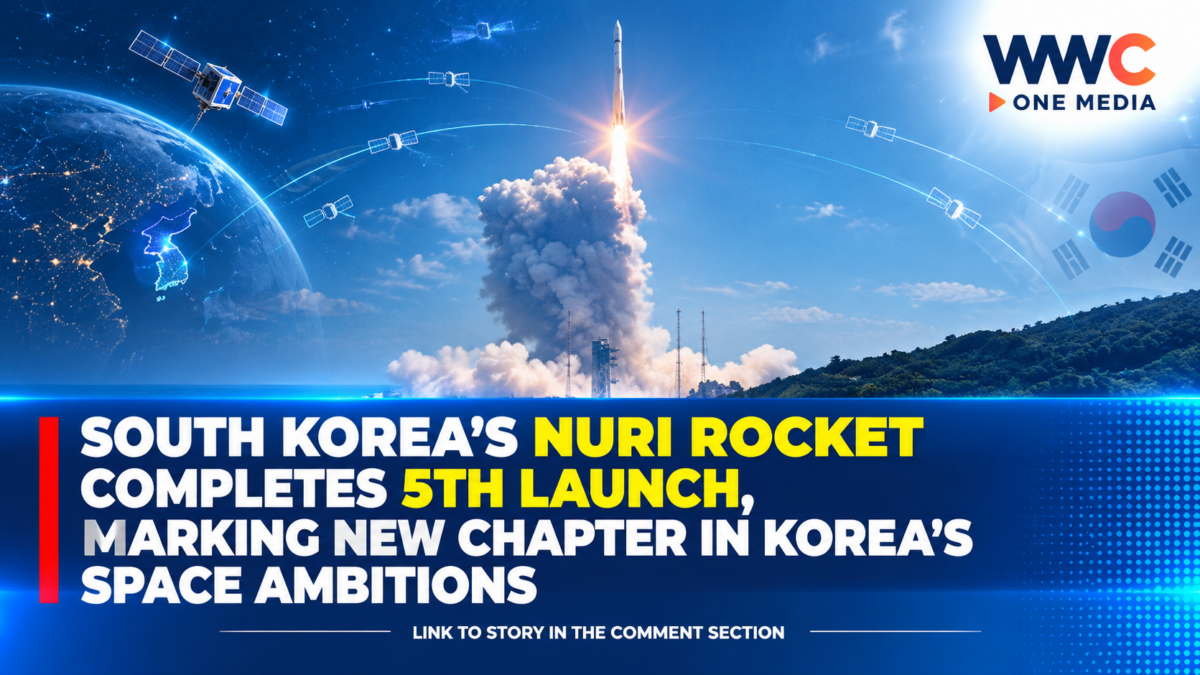
GOHEUNG, South Korea — South Korea’s journey toward becoming a major independent space power has reached another milestone with the successful fifth launch of its homegrown Nuri rocket, a program built through decades of technological development.
The 200-ton rocket lifted off from the Naro Space Center in Goheung at 12:25 p.m. Wednesday and successfully deployed all 15 satellites into orbit during its roughly 20-minute mission.
The mission represents another major step in South Korea’s effort to establish a reliable domestic launch system and expand the use of satellites for national security, disaster response and scientific research.
FROM EARLY ROCKETS TO NURI
South Korea’s space ambitions began long before Nuri.
The country launched the Korea Space Rocket-I, a domestically developed one-stage solid-propellant scientific observation rocket, in June 1993 after three years of development.
That early effort was followed by successive rocket-development programs as South Korea worked toward mastering the technologies required to independently place satellites into orbit.
The development eventually led to the Korean Space Launch Vehicle-II, better known as Nuri.
Nuri’s first launch in 2021 marked a crucial test of South Korea’s ability to develop a space launch vehicle largely through domestic technology. Subsequent missions helped improve reliability and demonstrated that the country could repeatedly launch satellites using its own rocket.
THE FIFTH LAUNCH WAS DIFFERENT
Nuri’s fifth mission was particularly significant because it carried 15 satellites, its largest payload to date.
The payload consisted of five NEONSAT microsatellites and 10 CubeSats. The five NEONSAT satellites are designed to become part of South Korea’s first domestically launched microsatellite constellation.
Each NEONSAT weighs less than 100 kilograms and carries an electro-optical camera capable of distinguishing objects as small as 1 meter in black-and-white imagery and 4 meters in color imagery.
The satellites will be used to monitor the Korean Peninsula and surrounding areas, supporting national security and disaster-response efforts.
Once the full 10-satellite NEONSAT constellation is completed, it is expected to be capable of imaging the Korean Peninsula more than three times a day and revisiting the same location within 24 hours.
Five additional NEONSAT satellites are scheduled to be launched on Nuri’s sixth mission next year.
MORE THAN JUST A ROCKET
The fifth launch also demonstrates how South Korea’s space program is moving beyond one-off launches toward a more sustainable satellite and launch ecosystem.
The 10 CubeSats aboard the mission were developed by universities, local governments and companies and will conduct a variety of missions, including technology testing, space-environment research and monitoring of marine debris and air pollution.
The mission therefore represents more than another successful rocket launch. It demonstrates the growing number of ways South Korean-developed satellites can be used once they reach orbit.
A NEW PHASE FOR KOREA’S SPACE PROGRAM
With the fifth Nuri mission successfully completed, South Korea is moving closer to a regular, domestically controlled launch capability.
The country’s space authorities have emphasized that repeated Nuri launches are intended to improve reliability while expanding the domestic space industry.
The next major milestone will be the sixth Nuri launch, which is expected to carry the remaining five NEONSAT satellites and complete the planned 10-satellite constellation.
What began with South Korea’s early experimental rockets more than three decades ago has now developed into a national launch program capable of deploying multiple satellites for security, disaster response, research and commercial applications.
Nuri’s fifth launch may therefore be remembered not simply as another successful flight, but as a sign that South Korea’s space ambitions are entering a much more advanced phase.
WWC ONE MEDIA G,A