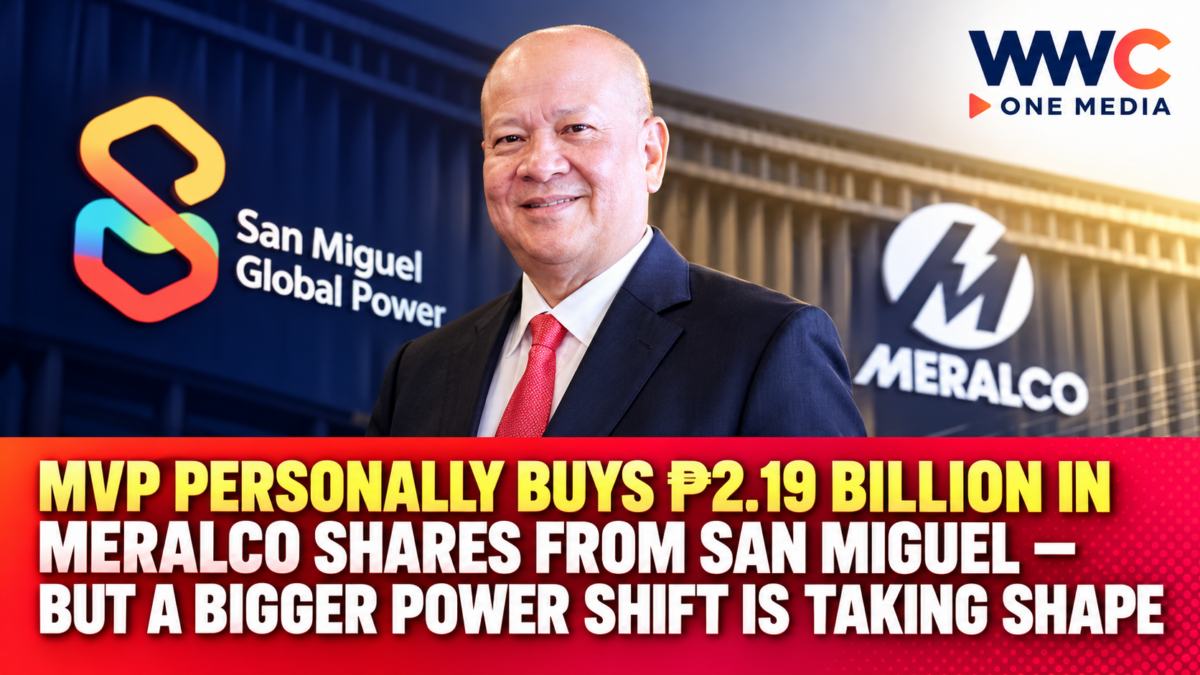
MANILA — Manuel V. Pangilinan is making a multibillion-peso personal investment in Meralco, agreeing to purchase shares directly from Ramon S. Ang’s San Miguel group as two of the Philippines’ biggest business empires reshape their interests in the country’s electricity industry.
San Miguel Global Power Holdings Corporation (SMGP) has agreed to sell 3,767,080 Meralco shares to Pangilinan for approximately ₱2.19 billion.
The agreement was signed on October 6, 2026, with Pangilinan personally identified as the buyer.
The transaction is separate from an earlier agreement under which Metro Pacific Investments Corporation will acquire approximately 21.4 million Meralco shares from the same San Miguel subsidiary for ₱12.4 billion.
Both agreements use a purchase price of ₱580.99 per share.
The personal acquisition represents approximately 0.33% of Meralco’s outstanding shares.
Although relatively small compared with Meralco’s total ownership, the investment is significant because of its size and the identity of the buyer.
Pangilinan is not merely overseeing a corporate acquisition. He is personally taking a financial position in the electricity distributor he already leads.
The latest development highlights growing cooperation between the Pangilinan and Ang business groups, which have a long history of both competition and partnership in the Philippine energy sector.
Pangilinan Makes a ₱2.19 Billion Personal Investment
The October 6 agreement covers exactly 3,767,080 Meralco shares at ₱580.99 each.
The transaction has an agreed value of approximately ₱2.19 billion.
Pangilinan is acquiring the shares in his personal capacity rather than through MPIC.
That distinction matters.
When MPIC purchases Meralco shares, the investment becomes part of the company’s corporate holdings.
A personal investment gives Pangilinan a direct financial interest in the shares he acquires.
However, the agreement should not be confused with a completed transfer of ownership.
As of the announcement, the parties had agreed to the transaction. Completion and any applicable closing requirements still matter.
The personal purchase also should not be presented as proof of Pangilinan’s motivation.
Although investors may interpret the transaction as a sign of confidence in Meralco, the agreement itself does not establish his private investment reasoning.
Metro Pacific Is Also Buying ₱12.4 Billion in Meralco Shares
The personal acquisition follows a much larger transaction announced earlier in October.
On October 1, MPIC entered into an agreement with San Miguel Global Power to acquire approximately 1.9% of Meralco.
The purchase involves roughly 21.4 million shares and is valued at approximately ₱12.4 billion.
According to First Pacific’s official stock-exchange announcement, MPIC’s direct and indirect interest in Meralco would increase from approximately 47.5% to 49.4% following completion.
That would bring the Pangilinan-led investment company’s economic interest closer to the 50% threshold.
However, 49.4% is not the same as majority ownership.
The broader governance structure, existing shareholder arrangements and applicable corporate rules remain important.
The transaction also remains subject to closing requirements.
For MPIC, the acquisition reinforces Meralco’s strategic importance within its infrastructure investment portfolio.
Combined Agreements Reach Approximately ₱14.6 Billion
Taken together, the personal purchase and MPIC’s separate acquisition represent approximately ₱14.6 billion in agreed transactions.
The two buyers are different.
Pangilinan is personally acquiring approximately 0.33%.
MPIC is acquiring approximately 1.9%.
Their combined purchases cover about 25.2 million Meralco shares.
That makes the latest announcement more than an isolated investment by a corporate executive.
It forms part of a broader series of transactions changing the distribution of Meralco shares among major Philippine business groups.
Nevertheless, the combined amount should not be described as a single MPIC investment.
The personal and corporate purchases are legally distinct transactions.
San Miguel Bought the Shares for Just ₱90 Each
The most striking financial detail is the difference between San Miguel’s acquisition cost and its agreed selling price.
According to First Pacific’s October 2 disclosure, San Miguel Global Power purchased the relevant Meralco shares from Land Bank of the Philippines through special block sales in 2025.
The acquisition price was ₱90 per share.
Now, the shares are being sold at ₱580.99 each.
That represents an increase of approximately 546% over the original acquisition price.
For the 3.77 million shares being sold personally to Pangilinan, San Miguel’s original purchase cost would have been approximately ₱339 million.
The agreed selling price is approximately ₱2.19 billion.
The difference amounts to roughly ₱1.85 billion in potential gross gain on the personal transaction alone.
That is before taxes, transaction expenses and other applicable adjustments.
The gain would become realized upon completion of the sale.
The figures illustrate how valuable San Miguel’s earlier acquisition from Land Bank has become.
San Miguel Could Realize Enormous Gains From Both Transactions
The larger MPIC agreement is also financially significant for San Miguel.
Based on its reported original acquisition price of ₱90 per share, the approximately 21.4 million shares being sold to MPIC would have cost roughly ₱1.9 billion.
Their agreed selling value is ₱12.4 billion.
That implies a potential gross gain of approximately ₱10.5 billion before expenses and adjustments.
When combined with the personal transaction, the two agreements could generate more than ₱12 billion in gross gains relative to the reported acquisition costs of the shares involved.
Those are transaction-based estimates, not confirmed net accounting profits.
The final financial effects will depend on completion, taxes, accounting treatment and other costs.
For San Miguel, the transactions offer an opportunity to turn part of its Meralco investment into substantial cash proceeds.
The company has not established that the sales represent a complete withdrawal from Meralco.
Why Is San Miguel Selling?
The transactions raise an obvious question.
If Meralco is a strategically important electricity company, why is San Miguel selling shares?
The agreements do not establish a single definitive reason for San Miguel’s decision.
However, selling an investment at a substantial premium can provide several financial benefits.
It allows a company to realize gains, release capital and improve financial flexibility.
The proceeds could potentially support other business priorities.
San Miguel operates across energy generation, infrastructure, food and beverages, fuel and other industries.
Those businesses require substantial investment.
But it would be premature to assign the sale proceeds to a specific project unless San Miguel announces such a plan.
The confirmed development is that the company has agreed to monetize part of its Meralco holdings at a price substantially above its reported acquisition cost.
The Deal Reveals How Much the Pangilinan Group Values Meralco
The agreed price of ₱580.99 per share is another important detail.
First Pacific previously disclosed that the MPIC transaction price represented a 16.2% premium over Meralco’s 90-day volume-weighted average price of ₱500.09 as of September 30.
This suggests that MPIC was willing to pay more than the stock’s recent average trading price to increase its ownership position.
But the premium should not automatically be interpreted as proof that Meralco shares are undervalued.
Large negotiated transactions can involve strategic considerations that differ from ordinary stock-market purchases.
For the Pangilinan group, an increased holding may provide advantages associated with greater economic exposure and corporate influence.
The personal transaction uses the same negotiated price.
That links both agreements financially, even though the buyers are different.
Meralco’s Strong Earnings Help Explain Its Strategic Appeal
The investment comes as Meralco continues reporting substantial earnings.
According to its first-half 2026 financial results, the company generated approximately ₱26.5 billion in consolidated core net income, an increase of 3.8% from the previous year.
Reported net income rose approximately 11% to ₱26.3 billion.
Total revenue increased to roughly ₱283.7 billion.
The earnings growth was supported by Meralco’s distribution business and stronger contributions from power generation and retail electricity operations.
These figures help explain why long-term investors may view the company as an attractive strategic asset.
Meralco remains deeply embedded in the electricity infrastructure serving Metro Manila and surrounding areas.
It also has expanding interests in power generation and renewable energy.
However, strong earnings do not eliminate regulatory, financing or operational risks.
Meralco Is Becoming More Than an Electricity Distributor
The company’s investment appeal increasingly extends beyond electricity distribution.
Through Meralco PowerGen and related businesses, the group participates in electricity generation.
Its investments include conventional generation projects and renewable energy development.
The company’s expanding portfolio creates potential opportunities to benefit from rising Philippine electricity demand.
But the investment requirements are substantial.
Power plants, solar facilities, transmission connections and supporting infrastructure involve significant capital spending.
Project returns depend on construction schedules, financing conditions, fuel costs and electricity contracts.
This makes Meralco’s financial strength important.
It also means that shareholders must evaluate the company’s future investment requirements alongside its current profitability.
Pangilinan and Ang Have a Long History in Meralco
The latest transactions also reflect an important chapter in Philippine corporate history.
During the late 2000s, San Miguel and the Pangilinan-led group were associated with competing efforts to expand their influence over Meralco.
The contest involved the Lopez family, which had historically controlled the electricity distributor.
Over time, the ownership structure changed.
San Miguel eventually sold a major Meralco stake to the Gokongwei family’s JG Summit Holdings in 2013.
The Pangilinan group subsequently strengthened its position.
In recent years, however, the relationship between the Pangilinan and Ang business groups has become increasingly cooperative.
They have participated in major energy projects and other business arrangements.
The latest share transactions reinforce that changing relationship.
But commercial cooperation does not mean the groups have merged or that all their interests are identical.
They remain separate business organizations.
The Two Business Groups Are Already Energy Partners
Meralco’s power-generation interests have also brought the Pangilinan group into partnerships involving San Miguel.
One major example is the Ilijan gas-fired power complex in Batangas.
Meralco’s power-generation arm and AboitizPower participate through an investment structure associated with the project, while San Miguel retains an interest in related generation assets.
Such partnerships reflect the scale of investment required to develop Philippine electricity infrastructure.
Major generation projects frequently involve multiple investors sharing capital requirements and risks.
That makes the latest Meralco share agreements commercially significant beyond the stock-market transaction itself.
The buyers and seller already operate within an interconnected Philippine energy industry.
Will Pangilinan’s Purchase Change Meralco’s Control?
The personal transaction gives Pangilinan a direct interest equal to approximately 0.33% of Meralco.
The larger MPIC acquisition would increase the investment company’s direct and indirect economic interest to approximately 49.4%.
Those figures suggest a stronger investment position for the Pangilinan side.
But the personal holding should not automatically be combined with MPIC’s stake and described as one legal ownership block without examining beneficial ownership, voting arrangements and applicable disclosure rules.
Likewise, a near-50% economic interest does not automatically establish that MPIC has obtained a new majority stake.
The existing governance structure must be considered.
For investors, the main takeaway is that Pangilinan and MPIC have separately agreed to acquire more Meralco shares.
The precise governance implications depend on the completed transactions and ownership arrangements.
The Timing Comes Amid Electricity-Price Pressure
The transaction also arrives during a challenging period for Philippine electricity consumers.
Power prices remain exposed to fuel costs, generation contracts and regulatory decisions.
Geopolitical tensions have created additional uncertainty in international energy markets.
Meralco has warned that fuel-price volatility could continue affecting electricity costs.
The company must also operate within a regulatory framework governing distribution charges and consumer protections.
For shareholders, those rules influence profitability.
For households, they help determine electricity bills.
The ownership transactions do not, by themselves, establish that electricity rates will increase or decrease.
But they underline the financial importance of a company operating at the center of the Philippine power system.
Investors Must Separate Strategic Deals From Market Prices
Another important consideration is the difference between a negotiated block transaction and ordinary stock-market trading.
The ₱580.99 transaction price was agreed between major investors.
That does not mean every Meralco share currently trades at that price.
Nor does it guarantee that shares purchased in the transaction will increase in value.
A strategic buyer may accept a premium because it wants a large block of shares that would be difficult to acquire through normal trading.
The seller may accept the arrangement because it provides a predictable price for a substantial position.
Ordinary investors should therefore avoid treating the negotiated price as an official target for Meralco’s future stock performance.
What Happens Next?
The next developments will involve completion of the announced transactions.
Investors will want confirmation that the share transfers have been finalized.
They will also examine updated beneficial-ownership disclosures to determine how the transactions affect Meralco’s shareholder structure.
San Miguel’s financial disclosures may eventually clarify the accounting gains recognized from the disposals.
Meanwhile, the Pangilinan group will continue managing its substantial investment in Meralco while the utility pursues expansion in electricity generation and renewable energy.
The investment story therefore has two dimensions.
The first is the immediate transfer of shares between powerful business groups.
The second is the long-term performance of the electricity businesses underlying those shares.
The Bigger Story Is a Changing Philippine Power Alliance
The latest development brings together two major themes in Philippine business.
Pangilinan is deepening his financial exposure to Meralco.
San Miguel is realizing substantial value from shares acquired at a much lower price.
The agreements show how a strategically important utility can become the center of multibillion-peso transactions between leading corporate groups.
For Pangilinan, the personal purchase represents a significant direct investment alongside the much larger corporate transaction by MPIC.
For San Miguel, the sale offers the prospect of substantial gains.
For Meralco, the transactions could further reshape its shareholder base without changing the company’s immediate responsibilities to electricity customers.
Manuel V. Pangilinan has agreed to put ₱2.19 billion of his own money into Meralco shares while his corporate investment group pursues a separate ₱12.4 billion acquisition.
Ramon Ang’s San Miguel group, meanwhile, stands to realize major gains from shares purchased for just ₱90 apiece in 2025.
But the bigger question is whether these deals signal a lasting shift in the balance of influence over the Philippines’ largest electricity distributor—and how the two business empires will use their financial resources in the country’s rapidly changing energy industry.