MANILA, PHILIPPINES — The Zobel family’s Ayala Corporation is preparing to bring back two familiar corporate heavyweights as Japanese conglomerate Mitsubishi Corporation moves to significantly expand its influence over one of the Philippines’ oldest and largest business groups.
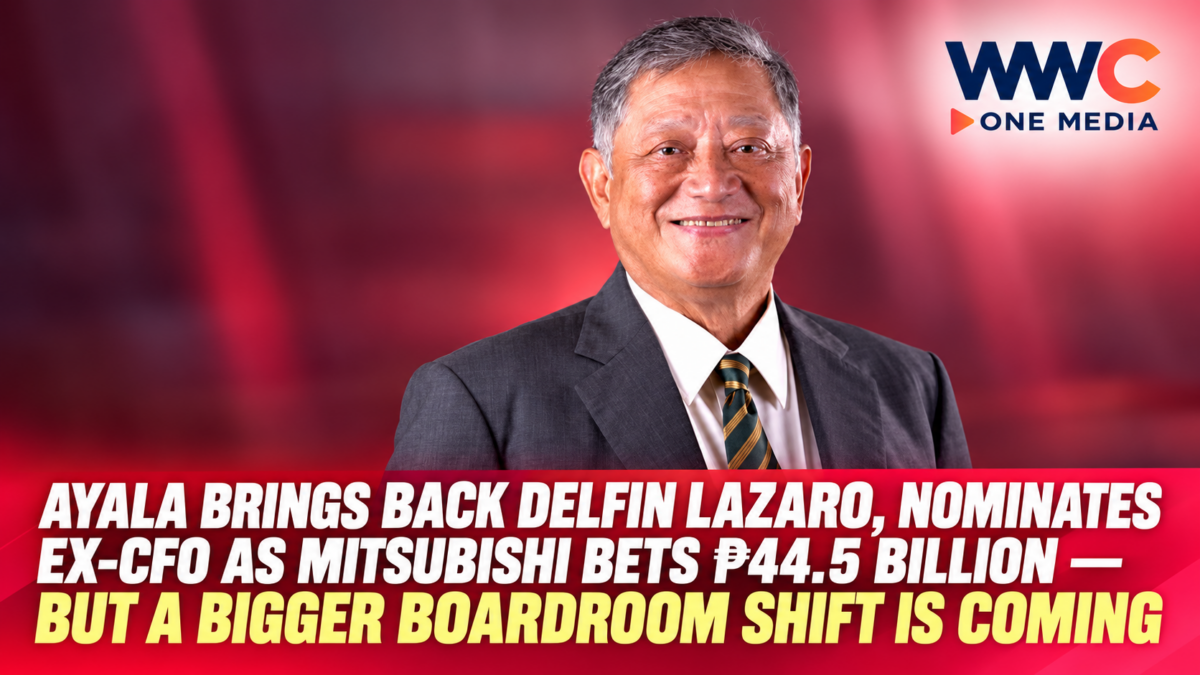
Former Energy Secretary Delfin Lazaro and former Ayala Chief Finance Officer Alberto de Larrazabal have been nominated to fill two additional seats on Ayala’s board of directors.
Their proposed appointments would expand the board from seven members to nine.
The nominations come ahead of a special shareholders’ meeting scheduled for October 27, 2026, when investors will be asked to approve key corporate changes connected to Mitsubishi’s multibillion-peso investment.
At the center of the restructuring is a ₱44.5 billion transaction that would increase Mitsubishi’s economic ownership in Ayala to 15% from 4.7%.
Its voting interest would rise to 20%.
But the bigger story goes beyond two returning executives.
Ayala is preparing for a new phase of corporate governance, capital allocation and Japanese investment—while the Zobel family seeks to preserve its controlling position.
The challenge is determining how those changes will translate into greater value for shareholders.
Delfin Lazaro Makes a Remarkably Quick Return
For Delfin Lazaro, the nomination represents a possible return to Ayala’s board just months after his departure.
The 80-year-old executive stepped down in April 2026 after serving as a director for nearly two decades.
He remained connected to the conglomerate as a special adviser.
Lazaro also serves as co-vice chairman and president of Asiacom Philippines.
His experience spans government, energy, infrastructure and corporate leadership.
He previously served as Philippine Secretary of Energy, giving him experience in one of the country’s most important economic sectors.
His nomination could be particularly relevant as Ayala and Mitsubishi explore additional investment opportunities in energy and infrastructure.
However, the nomination is not yet an appointment.
Shareholders must still vote on the proposal at the October 27 special meeting.
Former CFO Alberto de Larrazabal Is Also Nominated
The second nominee is Alberto de Larrazabal, a former Ayala chief finance officer.
His possible return to a senior governance role comes at a significant moment for the conglomerate.
Ayala is pursuing a strategy focused on strengthening its balance sheet, improving shareholder returns and making more disciplined investment decisions.
De Larrazabal’s financial-management background could be valuable in evaluating those priorities.
The company operates across multiple industries, including banking, real estate, telecommunications and energy.
Managing such a diversified portfolio requires careful capital allocation.
Ayala must determine where additional investments are most likely to generate attractive returns and where existing businesses could operate more efficiently.
The former CFO’s nomination therefore comes as financial discipline becomes increasingly important to the company’s strategy.
His election, however, remains subject to shareholder approval.
The Zobel Family Is Behind Both Nominations
Both Lazaro and de Larrazabal were nominated by Mermac Inc., the Zobel family’s holding company.
According to Bilyonaryo, Mermac controls approximately 57.77% of Ayala’s voting shares.
That gives the family substantial influence over the conglomerate’s governance and strategic direction.
The nominations suggest that the Zobels intend to reinforce the board with executives familiar with Ayala’s operations and corporate culture.
That is significant because Mitsubishi’s expanded investment will introduce a much larger foreign ownership position.
The Japanese company is preparing to acquire a 20% voting interest.
However, that does not mean Mitsubishi will take control of Ayala.
The Zobel family is expected to remain the dominant controlling shareholder.
The board expansion therefore reflects an effort to accommodate a deeper strategic partnership while preserving continuity in corporate leadership.
Mitsubishi Is Making a ₱44.5 Billion Investment
The boardroom developments follow a major agreement announced on September 21, 2026.
Ayala and Mitsubishi signed a definitive investment agreement intended to strengthen their long-standing partnership.
Under the transaction, Mitsubishi plans to invest approximately ₱44.5 billion, equivalent to around US$700 million at the exchange rates referenced when the deal was announced.
The transaction combines newly issued shares, existing shares and a voluntary tender offer.
The agreed purchase price is ₱650 per common share.
Upon completion, Mitsubishi’s economic interest would increase from 4.7% to approximately 15%.
Its voting interest would rise to 20%.
The agreement represents a significant expansion of Mitsubishi’s involvement in the Philippine conglomerate.
But the transaction remains subject to regulatory approvals and other closing conditions.
Mitsubishi has said it expects completion within its 2026 fiscal year.
Why Mitsubishi Is Paying a Premium for Ayala
One of the most notable features of the transaction is its pricing.
The agreed ₱650-per-share price represented a premium of approximately 22% over Ayala’s share price immediately before the announcement, according to Reuters.
The premium suggests that Mitsubishi sees potential long-term value beyond the market valuation reflected in Ayala’s stock at that time.
For the Japanese company, the investment provides greater exposure to several important sectors of the Philippine economy.
These include financial services, property development, telecommunications and energy.
Mitsubishi can also potentially benefit from Ayala’s established distribution networks, customer relationships and operating businesses.
However, paying a premium creates expectations.
For Mitsubishi, the investment must eventually generate financial and strategic benefits sufficient to justify the higher acquisition price.
Ayala’s Board Will Expand From Seven to Nine
Ayala’s board has already approved a proposed amendment to its articles of incorporation to increase the number of directors from seven to nine.
The proposal requires shareholder approval.
The company’s special shareholders’ meeting is scheduled for October 27 at 9 a.m., with participation conducted virtually.
The record date for shareholders entitled to vote was October 5.
The deadline for submitting proxies is October 20.
At the meeting, shareholders will consider the proposed corporate amendments and elect the additional directors.
The expansion is important because corporate boards oversee major investment decisions, risk management and senior management accountability.
A larger board could introduce additional experience and perspectives.
But the effectiveness of the change will depend on how directors exercise their responsibilities.
A board’s size alone does not guarantee stronger governance.
Mitsubishi’s Investment Also Requires a New Share Structure
The proposed transaction includes changes to Ayala’s capital structure.
According to official Philippine Stock Exchange disclosures, Ayala plans to issue approximately 14.6 million common shares to Mitsubishi at ₱650 each.
The transaction also includes the proposed issuance of approximately 71.86 million voting preferred X shares at ₱1 per share.
These preferred shares are intended to help establish Mitsubishi’s expanded voting interest.
Ayala has proposed amendments to its articles of incorporation to create the necessary share structure.
The proposal would also deny existing shareholders pre-emptive rights to issuances of the new voting preferred X shares.
That provision is particularly important from a corporate governance perspective.
Pre-emptive rights generally give existing shareholders an opportunity to participate in certain new share issuances to protect their ownership interests.
Removing those rights for the new share class would facilitate the agreed transaction.
However, the amendments still require the necessary approvals.
The proposed preferred shares should not be confused with ordinary common shares. Their voting and economic characteristics differ.
The Deal Raises Important Questions About Voting Power
Mitsubishi’s planned ownership structure is unusual because its economic and voting interests will differ.
An economic stake represents the company’s financial ownership interest.
Voting rights determine its influence over matters requiring shareholder approval.
Under the transaction, Mitsubishi would hold approximately 15% of Ayala’s economic interests but 20% of its voting power.
That arrangement gives the Japanese investor a larger voice in corporate governance relative to its economic ownership.
However, a 20% voting interest is not equivalent to majority control.
The Zobel family is expected to retain a substantially larger voting position.
The arrangement could give Mitsubishi greater participation in strategic decisions without displacing the existing controlling shareholder.
For minority investors, the important question is whether the new governance structure will promote decisions that benefit all shareholders.
Ayala Could Receive Approximately ₱20 Billion in Fresh Capital
Although the overall transaction is valued at ₱44.5 billion, not all the money will flow directly into Ayala Corporation.
Part of the deal involves purchases of existing shares.
Those payments go to selling shareholders rather than becoming new capital for the company.
Ayala expects to receive approximately ₱20 billion in proceeds.
Management has identified several potential uses for those funds.
One priority is reducing debt.
Another is continuing investments in Ayala and its listed subsidiaries.
The company also wants financial flexibility to support future growth opportunities.
This distinction is critical.
The ₱44.5 billion transaction value should not be described as ₱44.5 billion in fresh cash entering Ayala’s balance sheet.
Only the proceeds from relevant primary issuances and corporate transactions would become available directly to the company.
Debt Reduction Could Be an Immediate Priority
Ayala President and Chief Executive Officer Cezar Consing has emphasized the importance of financial discipline.
The conglomerate wants to strengthen its balance sheet while increasing the returns generated by its investments.
Reducing debt could support that objective.
Lower borrowing obligations can reduce interest expenses and improve financial flexibility.
This may become particularly important during periods of elevated interest rates and economic uncertainty.
For a conglomerate operating across capital-intensive industries, maintaining a healthy balance sheet provides greater freedom to pursue investment opportunities.
It can also help protect the company during weaker economic periods.
But paying down debt is only one part of the strategy.
Ayala must also ensure that its remaining businesses generate returns that justify the capital invested in them.
Consing Wants Better Returns for Shareholders
In a September 23 Bloomberg Television interview, Consing outlined plans to improve Ayala’s financial performance.
The strategy includes stricter return-on-equity requirements across the conglomerate’s operating businesses.
Management also intends to seek higher dividend contributions from subsidiaries and improve distributions to Ayala shareholders.
The company believes Mitsubishi’s participation could help accelerate those improvements.
Mitsubishi has experience managing a diversified portfolio of businesses across multiple industries and countries.
Ayala hopes to draw on that expertise.
However, management’s objectives are not guaranteed financial results.
Higher dividends and improved returns will depend on earnings, cash flow and future investment decisions.
The company’s success must ultimately be measured by performance rather than announcements.
Mitsubishi Is Bringing More Than Money
Mitsubishi’s expanded investment is intended to deepen cooperation across Ayala’s businesses.
According to the Japanese company’s official announcement, the partnership will focus on consumer-oriented industries.
These include financial services, telecommunications and retail.
The companies also intend to explore opportunities in real estate and energy.
Mitsubishi brings an extensive international network and experience across multiple industries.
Ayala provides established Philippine businesses and access to a large domestic consumer market.
The combination could create opportunities for investment, operating improvements and new partnerships.
But identifying commercially attractive projects will require detailed planning.
The companies must determine which opportunities justify additional capital and how they will share risks and returns.
Around a Dozen Mitsubishi Personnel Could Work With Ayala
The partnership may also become more operationally integrated.
Consing has indicated that Mitsubishi could deploy approximately a dozen people across Ayala and selected operating businesses.
Their role would be to help identify opportunities and support value creation.
That could involve sharing expertise, assessing investment proposals and strengthening cooperation across different industries.
The proposed personnel arrangement demonstrates that the investment is intended to go beyond passive share ownership.
Mitsubishi wants to participate more directly in Ayala’s future development.
However, the exact assignments and responsibilities of those personnel have not all been publicly detailed.
The ultimate value of the arrangement will depend on whether closer cooperation produces measurable improvements.
GCash Is Already Part of the Mitsubishi–Ayala Partnership
The two companies already cooperate in financial technology.
In 2024, Mitsubishi and Ayala strengthened their relationship through a joint investment connected to Mynt, the parent company of GCash.
Mitsubishi’s official disclosures show that it holds an indirect interest in Mynt through a 50% investment in AM50 Ventures.
AM50 is an Ayala subsidiary that owns approximately 13% of Mynt.
The investment demonstrates how the partnership can extend beyond traditional infrastructure and industrial projects.
Financial technology is an increasingly important part of the Philippine economy.
Digital payments, mobile financial services and online banking are creating opportunities for businesses with large customer networks.
The partnership could potentially explore further opportunities in these areas.
However, additional projects would still require commercial agreements and investment approvals.
Ayala and Mitsubishi Have Worked Together for Decades
The investment builds on a business relationship lasting more than 50 years.
Mitsubishi has participated in various Philippine ventures through partnerships with Ayala.
Those relationships helped establish trust between the companies long before the latest investment.
The September agreement represents a significant expansion of that partnership.
Ayala is one of the country’s most established conglomerates, with roots dating back to 1834.
Its businesses are involved in many aspects of everyday economic activity.
Mitsubishi, meanwhile, operates a diversified international trading and investment business.
The partnership combines local operating experience with global investment capabilities.
That combination is particularly relevant as the Philippines seeks greater foreign investment.
Japan’s Investment Is a Major Vote of Confidence in the Philippines
The ₱44.5 billion transaction also has implications beyond Ayala.
It represents a substantial commitment by a major Japanese corporation to the Philippine economy.
The Philippine Star reported on October 5 that Ayala management views the deal as an important development in attracting foreign direct investment.
It could also encourage additional joint projects involving Japanese and Philippine businesses.
The expanded partnership highlights the continuing importance of Japan as an investment partner for the Philippines.
Foreign capital can support infrastructure, business expansion and economic activity.
But long-term benefits depend on how effectively the investment is used.
The deal’s economic significance will be measured partly by the business activity and value it generates after completion.
The Zobels Are Maintaining Their Corporate Influence
Despite Mitsubishi’s larger investment, the Zobel family remains central to Ayala’s governance.
Mermac’s substantial voting position gives the family significant influence over shareholder decisions.
The nomination of Lazaro and de Larrazabal reinforces that continuity.
Both executives have extensive experience with the conglomerate.
Their proposed return could provide institutional knowledge during a period of strategic change.
At the same time, Mitsubishi’s expanded voting position introduces a more influential international shareholder.
That creates a new balance between continuity and change.
The Zobels will remain central to the company’s direction.
But Mitsubishi will have a greater financial and governance interest in ensuring that Ayala produces attractive returns.
Minority Shareholders Have Reasons to Watch Closely
The proposed governance changes also matter to ordinary investors.
Ayala trades on the Philippine Stock Exchange under the ticker AC.
Its shareholders have an interest in how the investment affects ownership, voting rights and future earnings.
The creation of a new voting preferred share class is particularly relevant.
Investors may want to examine how the transaction changes voting-power distribution.
They may also consider the effects of issuing new shares and using part of the proceeds to repurchase stock.
The company’s ability to improve financial returns will also influence its market valuation.
For minority shareholders, the central issue is whether the expanded partnership produces benefits that are shared broadly.
That will depend on future corporate decisions.
The October 27 Vote Is the Next Major Test
Ayala’s upcoming special shareholders’ meeting is a critical milestone.
Shareholders are scheduled to consider the proposed changes to the company’s articles of incorporation and elect additional directors.
Approval would allow the company to move forward with important parts of its planned governance structure.
However, the Mitsubishi transaction also requires other regulatory and contractual conditions to be satisfied.
The vote should therefore not be confused with final completion of the investment.
The company’s disclosures indicate that the transaction is expected to close within Mitsubishi’s 2026 fiscal year.
Until the relevant conditions are met, the increased ownership percentages remain expected outcomes rather than completed changes.
The Bigger Challenge Is Creating Value After the Deal
The proposed return of Delfin Lazaro and Alberto de Larrazabal is an important corporate governance development.
But the nominations are only one part of Ayala’s broader transformation.
The company is preparing to receive substantial capital, reduce debt and deepen cooperation with one of Japan’s most influential conglomerates.
Mitsubishi is preparing to become a much larger economic and voting shareholder.
And management is promising stronger investment discipline and improved shareholder returns.
Those ambitions create expectations.
Investors will want evidence that the partnership improves earnings and cash flow.
They will also assess whether the new governance arrangements strengthen decision-making.
For Ayala, the challenge is delivering results across a complicated portfolio of businesses.
The company’s size creates opportunities for collaboration.
But it also requires discipline in deciding which businesses deserve additional capital.
Ayala’s New Boardroom Could Shape Its Next Decade
The nomination of two familiar executives comes at a pivotal moment.
Lazaro could return just months after leaving the board.
De Larrazabal could bring his financial-management experience into a governance role.
Mitsubishi is preparing to increase its investment dramatically.
And the Zobel family is maintaining its influential position.
The immediate focus is the October 27 shareholder vote.
But the larger story concerns Ayala’s long-term transformation.
The Zobel-led conglomerate is reinforcing its boardroom as Mitsubishi prepares to invest ₱44.5 billion in its future.
Yet securing new capital and appointing experienced directors will not automatically produce stronger earnings or higher shareholder returns.
The bigger question is whether this expanded Philippine-Japanese partnership can unlock the value management believes is hidden inside Ayala’s businesses—or whether investors will demand more concrete results before rewarding the conglomerate with a higher valuation.