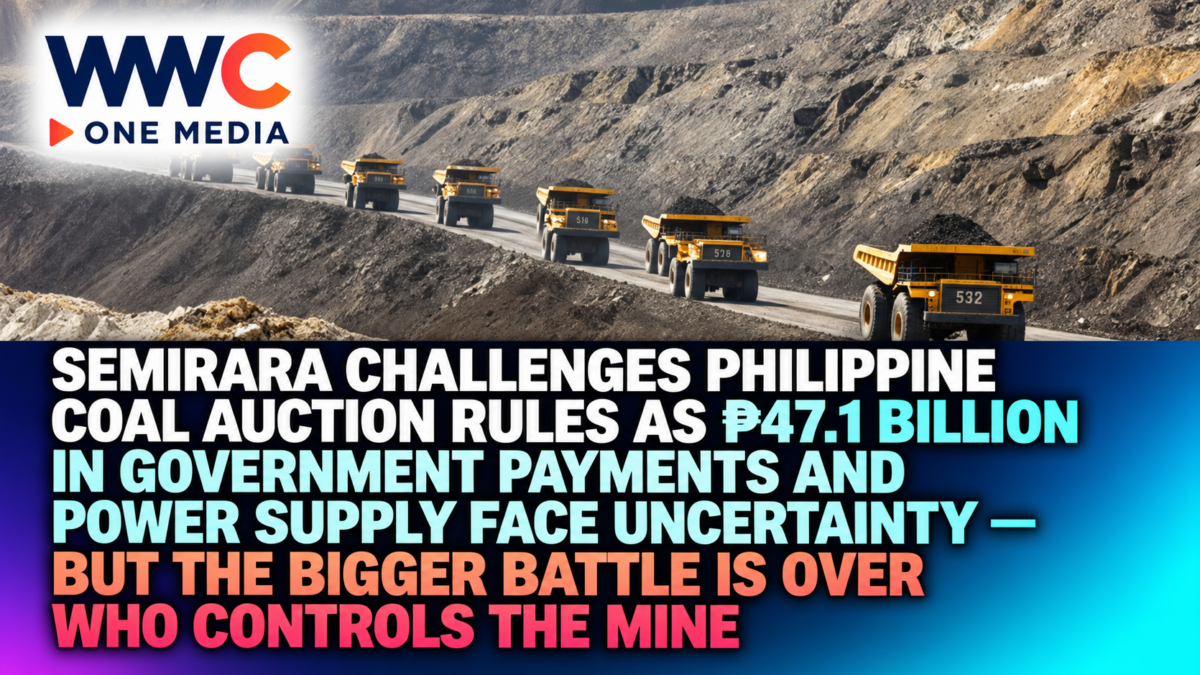
MANILA, PHILIPPINES — A multibillion-peso battle over the country’s largest coal mine is escalating, with Consunji-controlled Semirara Mining and Power Corporation warning that controversial government bidding rules could disrupt coal production, threaten future state revenues and create additional pressure on electricity prices.
The dispute centers on the government’s plan to auction coal operating rights on Semirara Island in Antique before the company’s existing contract expires on July 14, 2027.
SMPC is challenging a proposed requirement that it says would force the incumbent operator to surrender ownership of certain mining assets as a condition of participating in the bidding process.
The company argues that the requirement is unfair because rival bidders do not face the same obligation.
Semirara is also questioning a proposed evaluation system that would rank qualified bidders primarily on their financial offers rather than award significant weight to mining experience, technical capabilities and operational readiness.
The stakes are substantial.
According to SMPC, the company paid approximately ₱47.1 billion in government shares and taxes from 2021 through the first half of 2026.
It also operates a coal-mining business responsible for the overwhelming majority of the country’s domestic coal production.
But the controversy is no longer simply about whether the Consunji family can retain control of its flagship coal operation.
It is becoming a major test of how the Philippines balances government revenue, private-property rights, energy security and uninterrupted electricity generation.
Semirara Says It Should Not Have to Surrender Assets Just to Bid
At the center of the controversy is the treatment of mining equipment, facilities and other assets developed or acquired during the company’s decades of operations.
SMPC argues that the government’s proposed rules could effectively require it to relinquish ownership of those assets before being allowed to compete for a new coal operating contract.
The company maintains that this condition is inconsistent with Presidential Decree No. 972, also known as the Coal Development Act of 1976.
Under SMPC’s interpretation of the law and its existing agreement, certain assets remain privately owned, and the company retains rights concerning their removal following the contract’s expiration.
SMPC says requiring it to surrender ownership simply to participate in an auction would place the incumbent at a disadvantage.
The government, however, has advanced a different interpretation of the contractual and legal provisions governing assets whose costs have already been recovered.
The dispute has reached the courts.
The critical question is whether the government has a legal claim over particular assets associated with the coal operation—or whether those assets remain the property of Semirara.
Until the issue is resolved, the future ownership and use of important mining equipment and facilities remains contested.
SMPC Has Taken the Department of Energy to Court
The conflict did not begin with the latest auction announcement.
In July 2026, Semirara filed a petition for declaratory relief before the Regional Trial Court in Makati City.
The case seeks clarification of the respective rights and obligations of SMPC and the Department of Energy under Coal Operating Contract No. 5.
The dispute arose after the DOE directed the company to provide detailed information about its property, plant and equipment and facilitate a physical inventory.
The regulator intended to use the information in connection with the competitive bidding process.
SMPC objected to the potential disclosure of proprietary information to competing bidders.
The company also disputed the DOE’s position that ownership of assets whose costs had already been recovered could vest in the government.
According to SMPC’s Philippine Stock Exchange disclosure, recovering the cost of an asset through a contractual arrangement does not automatically transfer ownership to the state.
The company wants the court to clarify which assets, if any, may revert to the government and when such rights could take effect.
The court filing does not establish that either party’s interpretation is correct.
It confirms that the legal dispute is real and unresolved.
The Government Wants Better Returns From the Mine
The Department of Energy has a different priority.
Energy Secretary Sharon Garin has emphasized that the government should obtain greater economic benefits from contracts involving valuable domestic energy resources.
Semirara’s existing agreement has operated for decades.
The government believes that a new competitive bidding process could produce better terms for the state.
Under the current contract, SMPC remits a government royalty equivalent to 30% of net proceeds.
A new auction could potentially increase the government’s economic participation.
From the DOE’s perspective, awarding coal resources through a competitive process can help establish their market value.
The agency also wants to strengthen domestic energy supply and ensure that Philippine consumers benefit from the country’s natural resources.
That creates a clear policy conflict.
Semirara emphasizes continuity and operational expertise.
The government emphasizes competition, better contract terms and public benefits.
Neither objective is inherently unreasonable.
The challenge is designing rules that protect both.
Could the Highest Bidder Put Coal Production at Risk?
Semirara’s second major objection concerns how the winning bidder will be selected.
The company argues that the government is placing too much emphasis on financial offers.
Under the proposed framework described in industry reporting, bidders would first undergo an eligibility assessment.
Those who meet the requirements would then be ranked according to their financial proposals.
SMPC argues that this system could treat companies with vastly different operational capabilities as equivalent once they pass the initial qualification stage.
For a complicated operating mine, the company believes that approach creates unnecessary risks.
A bidder may have sufficient money to submit an attractive offer but lack the experience to operate a large, technically demanding mining complex.
Semirara wants technical expertise, operational experience, environmental compliance and the quality of mining plans to receive more meaningful consideration.
However, the existence of a pass-or-fail qualification stage means it would be inaccurate to say the government has eliminated technical screening entirely.
The dispute is about how stringent those qualifications should be and how heavily technical capability should influence the final award.
Semirara Warns of a Possible Production Shutdown
SMPC argues that a new operator could face enormous practical challenges if it wins the auction without access to the equipment and infrastructure currently used at the mine.
The company says an incoming operator might need to acquire hundreds of pieces of heavy equipment, recruit and train thousands of workers and commit billions of pesos before achieving stable production.
This could create delays during the transition from one contractor to another.
The concern is particularly important because Semirara is an established operating mine, not an undeveloped coal deposit.
Its production systems, workforce, infrastructure and equipment have been developed over decades.
Replacing them would not necessarily be straightforward.
SMPC has warned that serious transition problems could result in a temporary halt to mining.
That scenario would affect both coal output and the royalties generated from production.
But an interruption is not inevitable.
Its likelihood would depend on the identity and capabilities of the winning bidder, the final contract terms, asset-access arrangements and the effectiveness of transition planning.
Why Semirara Is Not an Ordinary Coal Mine
The company operates one of the most technically challenging mining sites in the Philippines.
Certain mining operations are conducted far below sea level.
SMPC says it must continuously remove extraordinary volumes of seawater to maintain access to coal deposits.
In its latest statement, the company compared its water-removal requirements to approximately 12 Olympic-sized swimming pools every hour.
That figure illustrates the scale of the engineering challenge.
Water management is not a secondary activity at Semirara.
It is essential to maintaining safe and productive operations.
A serious failure in pumping, drainage or water-control infrastructure could affect mining output.
This is one reason the company insists that operational expertise must be central to the bidding process.
The government’s own earlier statements also identified continuing water seepage as a factor affecting the auction and potentially recoverable coal reserves.
Seawater Problems Have Already Complicated the Auction
The Department of Energy previously acknowledged that water seepage at Semirara was among the issues requiring further evaluation.
The concern goes beyond immediate operating costs.
If water infiltration affects access to certain coal deposits, it could change estimates of economically recoverable reserves.
That would influence how prospective bidders value the contract.
It could also affect proposed mining plans, projected production volumes and expected government royalties.
A bidder making financial commitments based on overly optimistic production assumptions could face difficulties later.
Conversely, a company with a realistic understanding of the mine’s technical challenges could make more sustainable commitments.
This makes accurate geological and operational information particularly important.
It also explains why the dispute over proprietary mine data has become so contentious.
Semirara Accounts for Around 90% of Domestic Coal Production
The mine’s importance to Philippine energy security is difficult to overstate.
According to The Philippine Star’s September 29 report, Semirara accounts for approximately 90% of domestic coal production.
In 2025, SMPC produced a record 19.9 million metric tons of coal, up 24% from approximately 16 million metric tons in 2024.
Those figures demonstrate the scale of the company’s operations.
Semirara supplies coal used in electricity generation and other industrial activities.
However, domestic coal production and total coal consumption are not the same.
The Philippines also imports substantial quantities of coal, particularly from Indonesia.
Semirara’s dominant position in local production therefore does not mean it supplies 90% of all coal consumed in the country.
Nevertheless, a significant interruption in its output could affect domestic supply arrangements and increase dependence on alternative sources.
Could Electricity Bills Increase?
Semirara warns that a disruption in coal supply could contribute to higher electricity costs.
The concern is based on the country’s continued reliance on coal-fired power generation.
If domestic production falls, electricity producers using Semirara coal may need to obtain alternative supplies.
Depending on market conditions, replacement coal could be more expensive.
Additional shipping, handling and fuel-procurement costs could also matter.
Those expenses may eventually influence generation charges.
But the effect on consumer electricity bills would depend on several factors.
These include coal prices, existing supply contracts, generating companies’ fuel inventories and the regulatory treatment of costs.
Not every disruption would automatically produce an immediate increase in electricity rates.
Nevertheless, the risk is significant enough to justify careful transition planning.
For households already facing expensive electricity, the concern is whether a contract dispute could introduce additional uncertainty into the fuel supply chain.
Government Revenues Are Also at Stake
The financial consequences could extend to the national government.
SMPC said it paid ₱43.4 billion in government share and ₱3.7 billion in taxes from 2021 through the first half of 2026.
That brings the company’s reported total to ₱47.1 billion.
These payments illustrate the importance of the mine as a source of public revenue.
The government wants to improve its returns through a new contract.
Semirara argues that an award based primarily on the largest financial offer could backfire if the winning bidder is unable to sustain production.
A higher contractual royalty percentage does not necessarily translate into higher collections if output falls substantially.
That is the economic contradiction at the heart of the dispute.
The government wants a more favorable deal.
But the value of that deal depends on how much coal can actually be produced and sold.
A higher government share of a smaller production base may generate less revenue than a lower share of a consistently productive operation.
The challenge is determining which contract structure provides the best long-term outcome.
Why the Existing Contract Cannot Simply Be Extended
SMPC’s current operating agreement expires on July 14, 2027.
The company previously sought an additional 13-year extension.
However, the DOE rejected that request after obtaining a legal opinion from the Department of Justice.
According to earlier reporting, the DOJ concluded that the existing contract could not be extended beyond its cumulative 50-year term.
The agreement originated in 1977 and was extended in 2008.
As a result, the government decided that a new competitive bidding process was necessary.
Importantly, SMPC remains eligible to compete for a new contract, subject to the final rules and resolution of relevant disputes.
The expiry of the existing contract therefore does not automatically mean the Consunji group will lose the mine.
But the company must compete under the government’s eventual framework.
The First 2026 Coal Auction Was Canceled
The auction has already experienced major delays.
The Department of Energy initially launched the 2026 Philippine Conventional Energy Contracting Program coal bidding round in February.
The offering covered 18 coal blocks across three areas, including ten blocks on Semirara Island.
The agency subsequently postponed the process as concerns emerged over the proposed rules.
On September 15, the DOE terminated the original bidding round.
The government cited stakeholder feedback, operational developments on Semirara Island and the unresolved dispute over mining assets.
It said a revised framework was necessary to ensure that future awards reflected the value of national energy resources and delivered benefits to the government and consumers.
The cancellation did not mean the government had abandoned competitive bidding.
Instead, it signaled an attempt to redesign the rules.
DOE Plans to Relaunch the Auction in October
Following the cancellation, Energy Secretary Garin announced plans to restart the bidding process under revised terms.
In late September, she indicated that the new auction could begin in early October.
The government wants a framework capable of evaluating producing coal assets more effectively.
That includes considering technical capabilities, environmental obligations and financial returns.
The DOE has also expressed interest in prioritizing domestic energy requirements over coal exports.
Such a policy could help ensure that Philippine power producers have access to local coal supplies before producers sell to overseas customers.
However, the precise impact would depend on the final contract provisions and how they are enforced.
As of October 7, the available reports did not establish that the revised auction had already produced a winning bidder.
The outcome remains uncertain.
Why the Government Wants More Coal for Domestic Use
The Philippines continues to depend heavily on coal-fired electricity generation.
That dependence creates vulnerabilities when international fuel prices rise or supply chains become disrupted.
Indonesia remains an important external supplier.
If imported coal becomes more expensive or difficult to secure, domestic production can become more strategically valuable.
The DOE’s interest in prioritizing Philippine energy requirements reflects that concern.
But such a policy must balance several competing objectives.
Domestic electricity producers need reliable supplies.
Coal producers need commercially viable sales arrangements.
The government wants adequate royalties.
And consumers want affordable electricity.
A successful bidding framework must consider how those interests interact.
The Consunji Group Has Decades of Mining Experience
Semirara’s experience is one of its strongest arguments for retaining the coal operation.
The Consunji family’s DMCI group became involved in the company in 1997 and subsequently obtained control.
Since then, SMPC has developed substantial mining infrastructure and operational expertise.
The company also operates power-generation assets.
Its long experience at Semirara gives it detailed knowledge of the deposit, geological conditions and engineering requirements.
Those capabilities could provide an advantage in the auction.
But incumbency does not automatically establish that a company should receive a new contract without competition.
The government’s responsibility is to evaluate whether other qualified operators could deliver equal or better benefits.
This is why the dispute ultimately concerns the standards used to assess bidders.
Rival Bidders Could Still Challenge Semirara
The bidding process has attracted interest from other energy and industrial companies.
Earlier DOE proceedings included representatives from firms associated with San Miguel Global Power, TSR/Sta. Clara and DESCO.
Meralco PowerGen also previously expressed interest before withdrawing.
The existence of rival bidders reinforces the commercial value of Semirara’s coal resources.
However, expressions of interest should not be confused with final qualified bids.
The field of participants could change when the revised auction is launched.
Each potential bidder would need to consider the contract terms, technical obligations and financial commitments.
The unresolved asset-ownership dispute could also influence competitors’ willingness to participate.
An incoming operator may find the opportunity less attractive if important equipment and facilities remain legally contested.
The Asset Dispute Could Affect How Much Companies Are Willing to Bid
One of the government’s objectives is to maximize economic returns.
But uncertainty can reduce the attractiveness of an investment opportunity.
A prospective bidder needs to understand what it is acquiring.
Does the new contract include access to existing mining equipment?
Will the operator need to purchase replacement machinery?
Can it use established infrastructure?
What environmental obligations must it assume?
How quickly can it begin production?
And what happens if the outgoing operator disputes the use of certain assets?
These questions influence both operational planning and financial valuation.
If the answers remain unclear, bidders may discount the amount they are willing to offer.
That could undermine the government’s objective of obtaining better economic terms.
Resolving asset ownership before awarding the contract may therefore be commercially important for all participants.
Workers and Communities Also Face Uncertainty
The dispute affects more than corporate shareholders and government agencies.
Semirara’s operations support employment and economic activity in Caluya, Antique.
Mining requires equipment operators, engineers, technicians, maintenance personnel and administrative workers.
Supporting businesses also depend on the mine.
Transport providers, contractors, suppliers and local service establishments benefit from the economic activity it generates.
A transition to a new operator could affect employment arrangements, training requirements and local procurement.
A well-managed transition might preserve operations and maintain jobs.
A poorly managed one could create disruptions.
That is why the welfare of host communities should remain a central consideration.
The contract award will have consequences lasting well beyond the auction itself.
Environmental and Safety Standards Cannot Be Ignored
Semirara’s technical challenges also raise important environmental and safety questions.
Mining below sea level requires reliable water-management systems.
Operations must comply with applicable environmental regulations and safety requirements.
A new operator would need the expertise and financial resources to maintain those standards.
This concern applies equally to the incumbent company.
A strong bidding framework should require all participants to demonstrate credible operating plans, environmental compliance and the capacity to manage emergencies.
Simply offering the government a larger financial share would not compensate for inadequate safety systems.
At the same time, operational experience should not automatically exempt an incumbent from scrutiny.
The public interest requires consistent standards for every bidder.
Semirara’s Shareholders Face an Important Risk
The dispute also matters to investors in SMPC, which trades on the Philippine Stock Exchange under the ticker SCC.
The company’s earnings depend partly on its ability to produce and sell coal.
Its integrated power business provides another source of income, but mining remains strategically important.
The July 2027 contract expiry introduces uncertainty over the future of its coal operations.
Possible outcomes include winning a new contract, losing the award to another operator or entering further legal and commercial negotiations.
Each outcome could have different implications for future revenue, operating costs, capital expenditures and dividends.
Investors should therefore distinguish between the company’s current operating performance and the risks associated with its next contract.
The legal dispute and auction process could affect market expectations even before a winner is announced.
The Government Faces a Difficult Balancing Act
The DOE has legitimate reasons to seek better returns from a valuable national resource.
Competitive bidding can improve transparency and create opportunities to negotiate more favorable financial terms.
But a competitive process must also recognize the characteristics of an established mine.
Semirara is not an undeveloped deposit where a winning bidder can simply begin exploration.
It is a complex operation requiring specialized equipment, experienced personnel and continuous technical management.
An effective auction should therefore assess both financial offers and the credibility of proposed operating plans.
It should also provide clarity about asset ownership and the rights of the existing contractor.
Without those safeguards, the government risks creating uncertainty that could reduce competition or complicate the transition.
The Biggest Test Comes Before July 2027
The expiration of SMPC’s current contract creates a firm deadline.
The government needs enough time to finalize the bidding rules, evaluate prospective operators, resolve critical legal uncertainties and prepare for a potential transition.
If SMPC wins, production continuity may be easier to maintain because the company already operates the site.
If another bidder wins, the transition could require more extensive planning.
That does not mean a new operator would necessarily fail.
It means that proper preparation would be essential.
A new contractor would need access to suitable equipment, trained personnel, environmental systems and reliable mining infrastructure.
The government must ensure that contract negotiations and legal disputes do not create avoidable operational gaps.
The Real Issue Is Not Just Who Wins
The Semirara dispute reveals a broader challenge in managing Philippine natural resources.
The state owns valuable mineral and energy resources and has a responsibility to ensure that the public receives appropriate economic benefits.
Private companies invest capital, equipment and expertise to develop those resources.
When long-term contracts expire, determining the rights of both parties can become complicated.
The government’s objective should be to obtain the best sustainable economic outcome.
That involves more than selecting the bidder promising the highest immediate payment.
It also involves assessing production capability, safety, environmental compliance, employment continuity and long-term government revenue.
The bidding process must be competitive.
But it must also be technically credible.
Philippine Power Supply Could Become Part of the Fallout
For ordinary Filipinos, the most important issue may be energy security.
Semirara supplies a substantial portion of the country’s locally produced coal.
Any major disruption would affect the domestic fuel market.
Whether that disruption leads to higher electricity prices would depend on replacement supply costs, generation contracts and other market conditions.
Nevertheless, energy security is too important to leave to chance.
The Philippines already faces challenges involving electricity affordability, generation reliability and dependence on imported fuels.
The Semirara auction should not create additional uncertainty without strong contingency planning.
Semirara’s ₱47.1 Billion Warning Puts the Stakes in Perspective
The Consunji-led company has highlighted ₱47.1 billion in government shares and taxes over approximately five and a half years.
That figure illustrates the mine’s financial importance.
But past payments do not automatically determine the value of a future contract.
The government must evaluate expected coal reserves, projected production, operating costs, market prices and available alternatives.
Semirara’s history demonstrates its ability to operate the mine.
The DOE’s position reflects the possibility that the state could secure better terms.
The eventual outcome must reconcile both considerations.
A financially attractive contract is valuable only if it can be executed.
The Bigger Battle Is Over Control, Revenue and Energy Security
The conflict between Semirara and the Department of Energy is approaching a critical stage.
The company’s operating contract expires in July 2027.
The government wants to reopen competitive bidding.
The incumbent operator is challenging proposed rules governing mining assets and bidder selection.
And unresolved legal questions could influence the eventual transition.
SMPC warns that poorly designed bidding requirements may threaten production, government revenues and electricity affordability.
The DOE maintains that a revised framework should protect state interests and deliver greater benefits to Filipino consumers.
Both sides are making arguments with substantial economic consequences.
Semirara says it should not have to surrender ownership of its mining assets merely to compete for a contract it has operated for decades.
The government says valuable Philippine coal resources should be awarded under terms that maximize public benefits.
But the bigger question is whether regulators can design an auction that delivers more money to the state without jeopardizing the coal production, electricity supply and local employment that depend on the country’s largest mine.