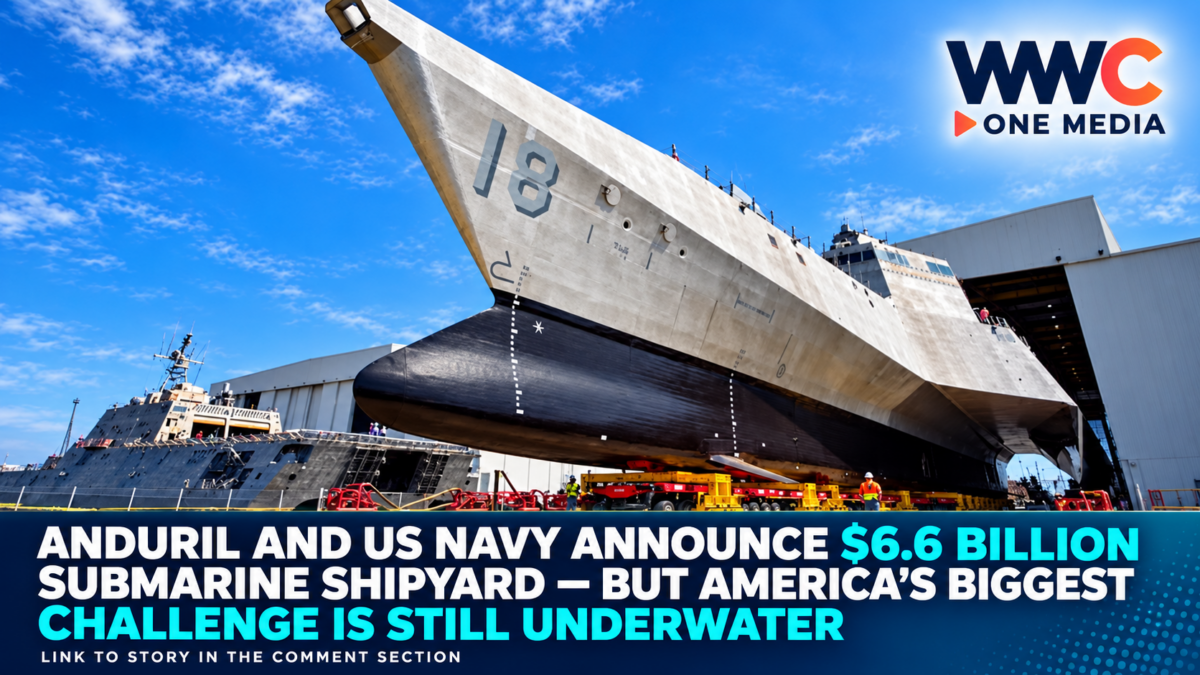
MARYLAND, UNITED STATES — Anduril Industries, the fast-growing defense technology company founded by Palmer Luckey, is making its biggest move yet into traditional military manufacturing with a multibillion-dollar project designed to accelerate production of America’s most advanced attack submarines.
The company and the U.S. Navy announced plans on October 6, 2026, for a new manufacturing complex at Sparrows Point in Baltimore County, Maryland, combining $3.7 billion in private investment with a Navy contract worth up to $2.9 billion.
The combined value reaches $6.6 billion, placing the project among the most ambitious recent efforts to strengthen America’s submarine industrial base.
The planned facility, known as Arsenal-2, will manufacture critical components for the U.S. Navy’s Virginia-class nuclear-powered attack submarines.
Initial production will focus on components such as torpedo tubes, with plans to expand into larger submarine assemblies and potentially complete hull sections.
The announcement marks a significant transformation for Anduril, a company best known for artificial intelligence, autonomous weapons, military drones and advanced defense software.
But the biggest challenge is not developing another sophisticated military technology.
It is solving the industrial bottlenecks that have prevented the United States from building nuclear-powered submarines fast enough to meet its strategic requirements.
A $6.6 Billion Investment in America’s Naval Future
Under the agreement, Anduril plans to invest approximately $3.7 billion in developing the new shipyard.
The U.S. Navy has awarded the company a contract worth up to $2.9 billion for submarine components, with payments linked to demonstrated production outcomes.
The arrangement differs from a straightforward government-funded construction project.
Anduril is expected to provide the initial private capital and assume much of the financial risk associated with delivering the manufacturing capacity.
The Navy’s payments will depend on the company meeting specified production requirements.
Anduril says this approach is intended to encourage efficiency, accountability and faster delivery.
That makes Arsenal-2 more than another defense factory.
It is also a test of whether the Pentagon can use new contracting structures to attract private investment into military manufacturing.
Arsenal-2 Will Cover Two Million Square Feet
The new facility will occupy approximately 2 million square feet at Sparrows Point, a historic industrial site near the Port of Baltimore.
The development is expected to include advanced manufacturing systems, automated production processes and digital technologies designed to improve coordination across complex industrial operations.
Unlike conventional shipyards built around older production methods, Arsenal-2 is being designed as a software-defined shipyard.
Anduril intends to use digital systems to monitor the production process, track components and maintain detailed manufacturing records.
That is particularly important for submarine construction, where even small defects can create major safety risks.
The facility will also incorporate infrastructure for handling large submarine components, including a planned 1,200-foot graving dock.
Initial operations are targeted for 2030.
That means the investment will not immediately solve today’s submarine production delays.
Its principal benefits are expected to emerge toward the end of the decade and beyond.
More Than 3,000 Direct Jobs Are Expected
Anduril estimates that Arsenal-2 will create approximately 3,100 direct jobs as the facility develops.
The project could also support more than 11,000 additional indirect jobs across suppliers, contractors and related industries.
Employment opportunities are expected to include manufacturing engineers, technicians, precision welders, production operators, quality-control specialists and other skilled industrial workers.
The investment could become a major economic development project for Maryland.
But the workforce requirements also expose one of America’s biggest shipbuilding problems.
The United States needs more trained workers capable of manufacturing complex military equipment to extremely demanding standards.
Automation can improve efficiency, but nuclear-submarine production will still depend heavily on skilled people.
Finding and training those workers will be crucial to meeting the project’s production goals.
Why America’s Submarine Industry Needs Help
The U.S. Navy has struggled for years to expand production of Virginia-class submarines.
These vessels are among the most sophisticated attack submarines in the world.
They are designed for intelligence gathering, surveillance, anti-submarine warfare and strikes against targets on land and at sea.
Unlike conventionally powered submarines, Virginia-class vessels use nuclear propulsion, allowing them to remain submerged for extended periods without needing to surface for fuel-related reasons.
Their combination of stealth, endurance and advanced weapons systems makes them central to American naval strategy.
But manufacturing them is exceptionally difficult.
The United States relies on two principal shipbuilders:
General Dynamics Electric Boat and Huntington Ingalls Industries’ Newport News Shipbuilding.
Both companies depend on a vast network of specialized suppliers.
A delay in one critical component can disrupt construction schedules for an entire submarine.
That is where Anduril wants to make a difference.
Torpedo Tubes Are a Major Production Bottleneck
One of Arsenal-2’s first priorities will be manufacturing submarine torpedo tubes.
These components are essential parts of a submarine’s weapons systems.
They must meet demanding engineering, safety and quality requirements.
A production delay involving torpedo tubes can slow the assembly of submarines even when other parts are available.
U.S. naval officials have identified such components as constraints on current Virginia-class production.
Anduril’s entry could add badly needed capacity.
The company eventually wants to expand beyond individual components into larger integrated modules.
That could help the Navy’s existing shipbuilders concentrate more resources on assembling and delivering completed submarines.
USNI News reported that the facility could eventually add an estimated 9 million labor hours annually, representing roughly a 15% increase in capacity associated with the Virginia-class production program, according to administration officials.
Anduril Will Not Build Entire Nuclear Submarines
This distinction is important.
Despite the announcement of a new shipyard, Anduril is not replacing General Dynamics or Huntington Ingalls as a primary submarine builder.
Its role will be to supply components and potentially larger submarine sections.
The existing shipbuilders will remain responsible for integrating and completing the vessels.
That approach may be more practical than attempting to establish an entirely new nuclear-submarine assembly operation.
Building a complete nuclear-powered submarine requires extraordinary technical expertise, extensive certification and highly specialized facilities.
Instead, Anduril is entering the supply chain at points where additional manufacturing capacity could have the greatest immediate impact.
The company hopes to expand its role over time as it demonstrates that its production systems can meet Navy requirements.
Trump Backs a New Generation of Defense Manufacturing
President Donald Trump attended the October 6 announcement at Sparrows Point, presenting the project as part of a broader effort to rebuild American manufacturing and strengthen national security.
The investment fits the administration’s emphasis on expanding domestic industrial capacity and accelerating weapons production.
It also reflects growing Pentagon interest in defense technology companies that promise faster innovation and less dependence on traditional procurement systems.
Anduril represents that emerging generation of military contractors.
Founded in 2017, the company developed its reputation through autonomous systems and software-enabled defense technologies.
Its move into submarine-component manufacturing demonstrates its ambition to compete for a much larger share of Pentagon spending.
Trump also said American taxpayers would receive a 40% stake in the new shipyard.
However, the administration did not immediately explain the precise ownership structure or the mechanism through which that stake would be held.
The claim therefore requires further clarification before it can be treated as a fully documented government-equity arrangement.
Palmer Luckey’s Anduril Is Challenging the Traditional Defense Industry
Anduril’s founder, Palmer Luckey, first gained prominence as the creator of virtual-reality company Oculus.
After leaving Facebook, he helped establish Anduril with the goal of changing how the United States develops and purchases defense technology.
The company has emphasized software, autonomous systems, artificial intelligence and manufacturing approaches intended to move faster than conventional defense procurement.
Anduril’s products include military drones, autonomous surveillance technology and systems designed to connect sensors and weapons across battlefields.
The submarine project represents a major expansion of that strategy.
Instead of producing only advanced military systems, Anduril now wants to manufacture large physical components for some of the world’s most complicated machines.
That puts the company directly inside America’s traditional defense-industrial base.
The AUKUS Agreement Makes the Project More Important
The new facility also has strategic implications for Australia.
Under the AUKUS security partnership, the United States plans to transfer Virginia-class submarines to Australia during the 2030s, subject to the agreement’s requirements and implementation.
The arrangement is intended to strengthen allied naval capabilities in the Indo-Pacific.
But delivering submarines to Australia while meeting America’s own fleet requirements creates additional pressure on U.S. production.
The Navy already faces a substantial submarine construction workload.
Building enough vessels for both countries requires stronger manufacturing capacity, more workers and a more resilient supplier network.
That makes additional submarine-component production strategically important.
Anduril’s new facility could eventually help strengthen the industrial capacity supporting those commitments.
However, the company has not announced a specific number of submarines that Arsenal-2 will enable the Navy to deliver under AUKUS.
China’s Naval Expansion Adds Urgency
The project also reflects growing concern over the balance of maritime power in the Indo-Pacific.
China has invested heavily in expanding and modernizing its navy.
The United States continues to rely on its technological advantages in undersea warfare, including advanced nuclear-powered attack submarines.
These vessels play important roles in surveillance, deterrence and military operations across vast ocean distances.
But technological superiority is only one part of military readiness.
A navy also needs enough operational vessels.
Even the world’s most advanced submarine provides little strategic value if it remains unfinished at a shipyard because critical components are unavailable.
This is why the manufacturing side of military competition is attracting renewed attention.
The question is no longer simply which country can design the most capable equipment.
It is also which country can manufacture and maintain enough of that equipment over time.
The Old Bethlehem Steel Site Gets a New Mission
The location carries historical significance.
Sparrows Point was once home to a major Bethlehem Steel industrial complex.
For generations, the area helped supply American heavy industry.
The site’s decline and the eventual closure of its steel operations reflected the broader contraction of American industrial manufacturing.
Now Anduril wants to turn part of the former industrial property into a modern defense production center.
The symbolism is difficult to miss.
A location associated with America’s previous era of industrial strength is being positioned as part of its next generation of military manufacturing.
The project could provide a significant economic boost to the surrounding region.
But its success will depend on turning that ambition into sustained production, employment and reliable component deliveries.
Arsenal-2 Is Part of a Larger Manufacturing Strategy
The Maryland facility is not Anduril’s first major manufacturing investment.
The company has also developed Arsenal-1, a roughly $1 billion manufacturing facility in Ohio focused on autonomous defense systems.
Anduril says that operation began producing autonomous combat drones in 2026.
The company is also developing submarine-component manufacturing capabilities in California.
That facility is expected to begin producing components before the Maryland complex becomes operational.
Together, the projects demonstrate a broader strategy.
Anduril wants to combine advanced software development with high-volume physical manufacturing.
Its goal is to reduce the gap between designing new military technology and producing enough equipment for operational use.
That ambition challenges the traditional distinction between defense technology startups and established military manufacturers.
The Biggest Challenge Is Execution
The project’s size is impressive.
But the announcement does not guarantee faster submarine deliveries.
Anduril must still build the facility, recruit employees, establish manufacturing processes and demonstrate that its components meet demanding Navy standards.
Submarine construction involves complex engineering requirements and strict safety certifications.
Manufacturing systems must deliver consistent results.
Components must be traceable and reliable.
Production failures or quality problems can lead to costly delays.
Anduril’s software-driven approach may improve manufacturing efficiency, but it cannot bypass the safety requirements associated with nuclear-powered submarines.
That makes execution the central issue.
The company must prove that methods developed in faster-moving defense technology markets can work in one of the world’s most tightly regulated manufacturing environments.
A New Pentagon Contracting Model Is Being Tested
The Navy’s agreement with Anduril also raises an important question about defense procurement.
Traditional military manufacturing projects often depend heavily on government funding and long-term contractual arrangements.
Under this structure, Anduril is committing substantial private capital while Navy payments are tied to production outcomes.
Supporters argue that such arrangements can encourage contractors to deliver results faster and manage costs more effectively.
The structure may also encourage private companies to invest in facilities that would otherwise require direct government construction funding.
However, the model still needs to demonstrate that performance-based incentives can work with complex military production.
Nuclear-submarine components cannot simply be manufactured at the speed of commercial consumer products.
Quality, reliability and certification remain essential.
If the arrangement succeeds, it could influence how the Pentagon finances future industrial expansion.
If it struggles, policymakers may conclude that some military manufacturing requirements remain too specialized for rapid commercial-style scaling.
The Deal Could Reshape Competition Among Defense Contractors
Anduril’s involvement marks an important shift in the U.S. defense industry.
For decades, major military production programs have been dominated by a relatively small group of established contractors.
Those companies possess extensive manufacturing experience and deep relationships with the Pentagon.
Anduril is trying to demonstrate that newer companies can enter those supply chains without replicating every part of the traditional defense-contractor model.
The company’s willingness to commit billions of dollars in private investment could strengthen its position in future competitions.
It could also encourage other technology-focused defense firms to move into manufacturing.
However, the existing shipbuilders remain essential partners.
For the Virginia-class program, the immediate objective is to increase capacity across the supply chain rather than replace the prime contractors.
What the $6.6 Billion Figure Actually Means
The headline investment should be interpreted carefully.
Anduril’s planned private investment amounts to approximately $3.7 billion.
The Navy contract is worth up to $2.9 billion and is tied to production outcomes.
Together, those commitments reach $6.6 billion.
That does not necessarily mean the government has already paid $2.9 billion or that the entire amount represents construction costs.
The Navy’s contract is connected to the manufacturing output expected from the facility.
This distinction matters when evaluating the financial significance of the announcement.
The project combines private infrastructure investment with a potentially substantial stream of government procurement spending.
The Real Test Begins in 2030
The timeline may be the most important limitation.
Arsenal-2 is not expected to begin initial production until 2030.
That means today’s submarine manufacturing bottlenecks will continue to require other solutions in the meantime.
The U.S. Navy must still work with existing shipbuilders and suppliers to increase output.
Anduril’s California facility may contribute earlier production capacity, but the large Maryland complex remains a longer-term investment.
The question is whether its eventual output will arrive quickly enough to support the Navy’s modernization plans and future commitments to Australia.
A delayed facility could reduce the strategic benefit of the investment.
A successful one could provide lasting manufacturing capacity for decades.
America’s Next Naval Advantage May Be Built Inside Its Factories
The announcement reflects an increasingly important reality in global defense.
Modern military competition is not decided only by advanced technology.
It also depends on industrial capacity.
A country can develop sophisticated submarines, aircraft and missiles.
But if production lines are slow, suppliers are overstretched and skilled workers are scarce, its military capabilities may not expand quickly enough.
Anduril is betting that software-driven manufacturing can help close that gap.
Its new Maryland facility will attempt to combine the production discipline of traditional shipbuilding with digital technologies and automation.
The company has billions of dollars committed to the project.
The Navy has offered a substantial contract.
And the United States has a clear strategic incentive to increase submarine production.
But the hardest part comes after the announcement.
Anduril has already proved it can attract billions of dollars to help rebuild America’s submarine industrial base.
Now it must prove that a technology company known for drones and artificial intelligence can manufacture some of the most demanding components in naval warfare—safely, reliably and at the scale the U.S. Navy needs.