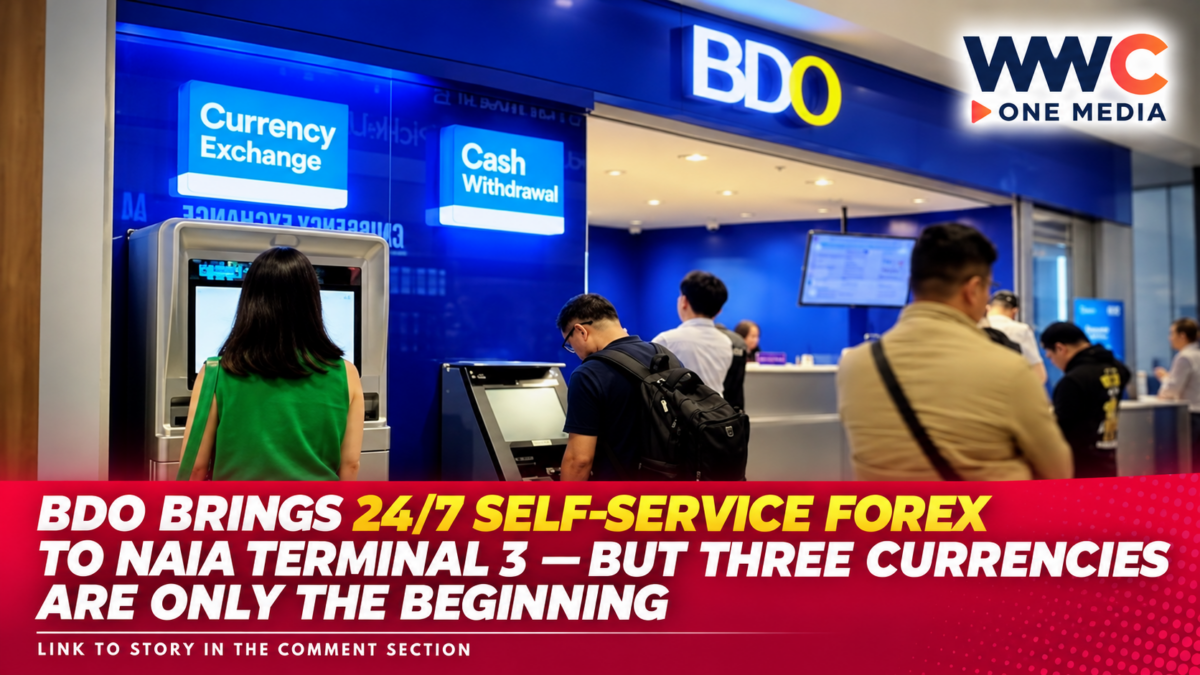
MANILA — Travelers arriving at Ninoy Aquino International Airport Terminal 3 no longer need to queue at a bank counter just to get their first Philippine pesos.
BDO Unibank has launched a 24-hour self-service Currency Exchange Machine at NAIA Terminal 3, allowing arriving passengers to convert selected foreign banknotes into pesos within minutes, without filling out paper forms or waiting for teller assistance.
The machine currently accepts three of the world’s most widely used currencies:
U.S. dollars
euros
and
Japanese yen.
It can process as many as 30 foreign banknotes in a single transaction, authenticates the bills automatically and dispenses the peso equivalent in both notes and coins.
Customers also receive a printed transaction receipt.
But the significance goes beyond another machine inside an airport.
The launch reflects a broader shift in Philippine banking toward automated, round-the-clock financial services, especially in high-traffic locations where customers increasingly expect access without depending on branch operating hours.
Where the New BDO Forex Machine Is Located
The machine is positioned at NAIA Terminal 3’s arrivals area, after passengers pass through immigration and exit the arrival gates.
BDO says travelers will find it directly in front of the bank’s airport branch.
That makes the machine particularly convenient for international passengers who need pesos immediately for:
transportation,
food,
tips,
local purchases,
or other expenses before leaving the airport.
Instead of looking for an open exchange counter after a late-night or early-morning arrival, passengers can use the service at any hour.
BDO says it operates 24 hours a day, seven days a week.
How the Machine Works
BDO designed the process to resemble other self-service banking transactions while including identity and banknote verification.
Travelers first choose which supported currency they want to convert.
They then review and accept the machine’s terms and conditions.
The customer must scan a passport, after which the system captures a photo for identity authentication.
The user inserts the foreign banknotes and reviews the peso amount being offered.
After confirming the transaction, the machine dispenses the corresponding Philippine currency and produces a receipt.
That passport-and-photo requirement is an important part of the system.
Currency exchange remains a regulated financial activity, meaning automation does not eliminate the need for identity checks and transaction records.
The Machine Checks the Notes Automatically
Another important feature is banknote authentication.
BDO says the machine verifies foreign bills before accepting them.
This reduces one of the major risks associated with automated cash exchange: counterfeit or invalid notes.
BDO’s broader foreign-exchange policy similarly states that the bank may reject notes considered counterfeit or demonetized.
For airport users, that means the process combines elements normally handled by a teller—identity checks, banknote validation, conversion and receipt issuance—inside a self-service kiosk.
It Even Gives Coins
One seemingly small detail could make the service particularly useful for travelers.
The machine can dispense not only peso banknotes but also coins.
That means customers can receive closer to the full value of the conversion rather than having the amount rounded simply because the system cannot provide smaller denominations.
BDO described the feature as helping customers receive the “best value” from their foreign currency exchange.
For someone arriving in Manila who needs exact local cash for transportation or a small purchase, that can be more useful than receiving only large bills.
Why BDO Started With USD, EUR and JPY
BDO has not publicly detailed why the automated machine initially supports only three currencies.
But all three are major currencies commonly handled by Philippine banks and carried by international travelers.
The U.S. dollar is particularly important in the Philippines because of remittances, trade and travel.
The Japanese yen reflects Japan’s importance to Philippine tourism, investment and business.
And the euro serves passengers arriving from across the eurozone.
BDO’s regular branch network handles a substantially wider range of currencies, including:
Singapore dollars,
Hong Kong dollars,
British pounds,
Australian dollars,
Canadian dollars,
Saudi riyals,
UAE dirhams,
Chinese yuan,
South Korean won,
and several others at authorized branches.
But the new automated NAIA service is currently limited to USD, EUR and JPY.
That leaves obvious room for expansion if usage is strong.
BDO Says Speed and Convenience Are the Main Goal
BDO Executive Vice President and Branch Banking Group Head Cora A. Mallillin said modern travelers increasingly expect convenience throughout their journeys.
According to Mallillin, the machine is intended to give users more flexibility and control over their forex needs, allowing them to obtain pesos quickly without delays associated with manual processing.
The service is also designed to offer BDO’s foreign-exchange pricing directly at the airport.
The bank describes its exchange rates as competitive, although actual rates can change throughout the day.
That means travelers should still pay attention to the rate displayed on the machine before confirming a transaction.
Travelers Should Still Check the Exchange Rate
Convenience does not necessarily mean every transaction will produce the best possible exchange rate available anywhere in Manila.
BDO itself notes that its published forex rates are indicative and may change without prior notice.
Currency availability is also subject to conditions.
That matters because airport currency exchange has traditionally been associated with convenience rather than necessarily offering the lowest possible conversion cost.
The new machine removes waiting and paperwork.
It does not eliminate the need for customers to compare rates if price is their main concern.
For small amounts needed immediately after landing, however, speed may matter more than chasing a marginally better exchange rate elsewhere.
NAIA Terminal 3 Is a Logical Testing Ground
Terminal 3 is one of the Philippines’ busiest international gateways and handles a large mix of foreign and Filipino travelers.
That makes it a logical location for a self-service currency exchange system.
BDO already operates an authorized foreign-exchange branch at NAIA Terminal 3, as well as at Terminal 1.
The new machine essentially extends that service beyond normal teller operations.
If successful, the concept could theoretically be expanded to other airport terminals or high-traffic travel hubs.
BDO has not yet publicly announced a rollout schedule for additional machines.
Airport Banking Is Becoming More Automated
The forex machine also reflects a wider change in how banks are using physical locations.
Banks once relied heavily on tellers for:
deposits,
cash withdrawals,
fund transfers,
bill payments,
and foreign exchange.
Many of those transactions have since moved to:
ATMs,
cash-recycling machines,
mobile apps,
online banking,
and self-service kiosks.
Foreign-exchange cash transactions have remained relatively dependent on branches because they involve physical banknotes, identity requirements and counterfeit checks.
BDO’s NAIA installation shows that even that service can increasingly be automated.
This Could Matter to OFWs Too
The service is not restricted to foreign tourists.
BDO says both foreign and Filipino travelers can use it.
That makes the machine potentially useful for overseas Filipino workers returning with leftover dollars, euros or yen.
Rather than carrying those notes outside the airport or waiting for a bank branch to open, eligible currency can immediately be converted into pesos.
Still, returning OFWs carrying currencies such as Saudi riyals, UAE dirhams, Singapore dollars or Hong Kong dollars will need to use traditional authorized forex channels for now because those currencies are not yet supported by the machine.
That limitation could eventually become one of the strongest arguments for expanding the machine’s currency menu.
Security Could Determine Whether Travelers Trust It
Automating foreign exchange creates a different customer challenge from ordinary ATMs.
Travelers are handing over foreign cash and relying on the machine to:
authenticate the notes,
calculate the exchange,
dispense the correct amount,
and record the transaction.
BDO’s use of passport scanning, photo verification, automatic banknote authentication and printed receipts is therefore central to building trust.
The location directly in front of an existing BDO branch could also reassure travelers who might be hesitant to place significant amounts of foreign cash into a standalone machine.
It Also Gives BDO an Advantage Over Traditional Money Changers
The machine could increase competition for traditional foreign-exchange counters.
Its biggest advantage is not necessarily price.
It is availability.
A staffed counter requires employees.
A machine can theoretically operate continuously.
For passengers arriving after midnight or before dawn, that difference matters.
If travelers become comfortable exchanging cash through automated machines, banks and money changers may eventually face pressure to offer similar 24/7 services at other airports, shopping centers and tourist areas.
The Philippines Is Moving Toward Cashless Payments — But Visitors Still Need Pesos
The launch comes at an interesting time for Philippine payments.
Digital wallets, cards and QR payments are becoming increasingly common.
But cash remains widely used.
Foreign travelers may encounter smaller merchants, transportation providers or establishments where having pesos remains useful or necessary.
That creates an unusual transition period.
The Philippines is becoming increasingly digital, but international visitors still benefit from immediate access to local cash.
BDO’s machine is designed precisely for that gap.
The Bigger Opportunity Is What Comes Next
Right now, the machine does one relatively simple thing:
It converts three major foreign currencies into Philippine pesos.
But the underlying idea has potentially much broader applications.
Future machines could theoretically support:
additional currencies,
more airport terminals,
multilingual interfaces,
greater transaction limits,
or integration with other travel-banking services.
BDO has not announced those features.
But expanding beyond USD, EUR and JPY would make the service considerably more useful for returning OFWs and regional travelers.
The Philippines receives visitors and workers from markets where Singapore dollars, Hong Kong dollars, Korean won, Saudi riyals and UAE dirhams are common.
Adding those currencies would turn a convenient airport experiment into something much closer to a full automated forex counter.
A Small Machine Signals a Bigger Shift
The physical machine itself may not look revolutionary.
Automated currency-exchange kiosks already exist in airports around the world.
But its arrival at NAIA represents something important for Philippine banking.
A service that once required:
a branch,
a teller,
forms,
manual verification,
and banking hours
can now happen in minutes after a passenger walks through immigration.
That changes expectations.
Once customers become accustomed to 24-hour self-service forex at the airport, they may begin asking why similar convenience is not available elsewhere.
BDO has started with three currencies and one major terminal.
The real story may be what happens if Filipinos and foreign travelers decide that lining up at a forex counter is something they no longer want to do.