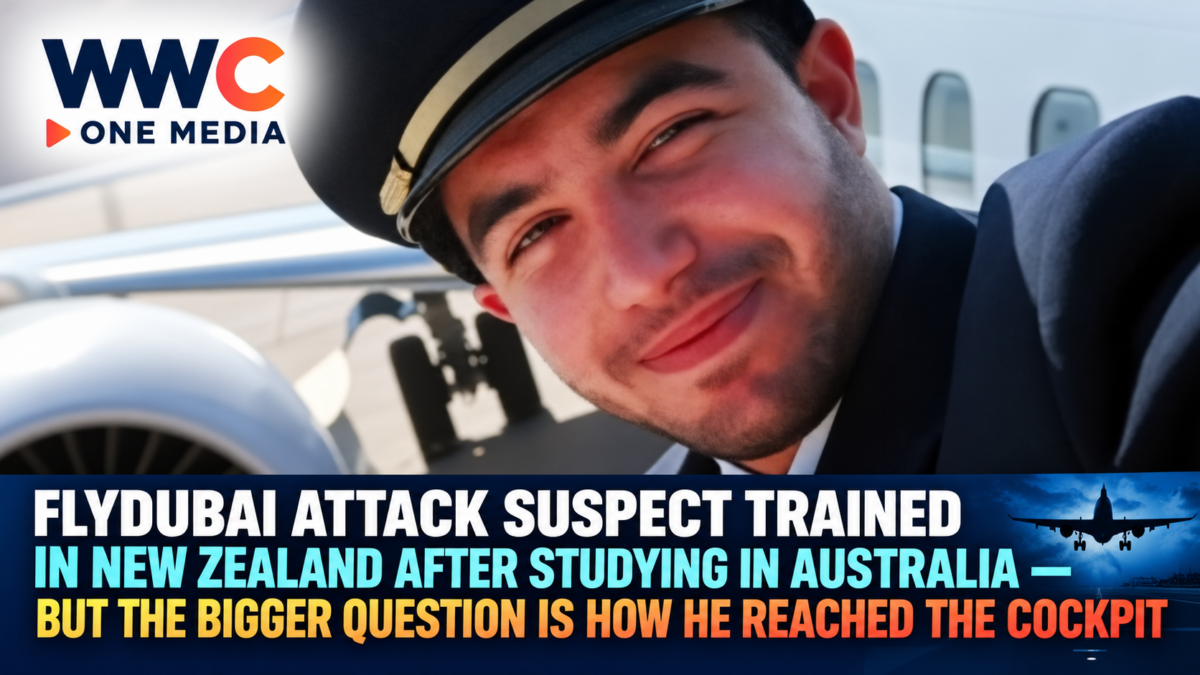
WELLINGTON/DUBAI — The Omani co-pilot accused of attacking the captain of a Flydubai passenger jet and attempting to seize control of the aircraft received flight training in New Zealand years before the incident, authorities have confirmed, widening an already multinational investigation into one of commercial aviation’s most alarming security breaches in years.
New Zealand Police said Hamam al-Hammami was in the country between November 2018 and May 2019 on a six-month student visa while completing part of his flight training for a UK-based company.
Before that, Hammami studied engineering at RMIT University in Melbourne, Australia, from 2015 to 2017 but left without completing his qualification, according to the university.
Authorities in both Australia and New Zealand are now examining his earlier movements and contacts as investigators attempt to determine when, where and how he may have developed the alleged extremist motivations behind the September 30 attack.
But the deeper question is rapidly becoming much larger than his educational history.
How did a pilot who is now accused of trying to turn a commercial airliner into a weapon remain inside an international aviation system built specifically to stop another 9/11-style attack?
What Happened on Flydubai Flight FZ1073
Flydubai Flight FZ1073 was travelling from Dubai to Tel Aviv on September 30 when a violent confrontation erupted inside the cockpit.
UAE Prosecutor General Hamad Saif al-Shamsi said investigators determined that the co-pilot attacked Indian captain Smit Machchhar with an emergency crash axe and attempted to take control of the Boeing 737.
Emirati authorities have described the incident as an attempted “terrorist act.”
The aircraft entered a terrifying rapid descent.
Reuters reported that it lost more than 14,000 feet of altitude in roughly 30 seconds as passengers initially believed they were experiencing severe turbulence.
The wounded captain managed to unlock the cockpit door, allowing passengers and crew to intervene.
The suspected attacker was subdued, and reserve pilots who happened to be aboard helped regain control of the aircraft.
The plane ultimately diverted to Tabuk, Saudi Arabia, where it landed safely.
More than 170 passengers were aboard.
What could have become one of the deadliest aviation attacks in years instead ended without passenger fatalities.
The Captain’s Actions May Have Saved the Aircraft
Captain Machchhar has since been praised for continuing to fight despite suffering serious injuries.
According to reporting on the incident, he managed to resist long enough to open the cockpit and allow others to reach the flight deck.
Passengers then helped restrain the alleged attacker while medical assistance was provided to the captain.
Reuters-verified video from inside the plane showed the injured pilot receiving treatment and a man identified as the co-pilot restrained on the cabin floor.
The episode immediately revived concerns about one of aviation security’s most difficult vulnerabilities:
the threat coming from someone who is already authorised to be inside the cockpit.
New Zealand Confirms the Suspect Trained There
New Zealand Police confirmed on October 6 that Hammami spent approximately six months in the country.
He entered on a student visa in late 2018 and remained until May 2019.
Police said he completed part of his flight training in New Zealand on behalf of a UK-based aviation company.
Authorities are now reviewing relevant records from his time in the country.
The confirmation does not mean New Zealand played any role in his alleged later radicalisation.
Nor is there evidence that his New Zealand flight training was improper.
But investigators are reconstructing his history across multiple countries to determine whether there were warning signs that were missed or information that failed to reach later employers.
He Also Studied in Australia
Before his New Zealand flight training, Hammami spent time in Australia.
RMIT University confirmed that he studied at its Melbourne campus between 2015 and 2017.
He was enrolled in engineering studies but did not finish the qualification.
Australian authorities are examining his time in the country as part of the broader investigation.
The Financial Times reports that investigators are particularly interested in his contacts and possible exposure to extremist ideas during those years.
That investigation remains ongoing.
It would therefore be premature to state as fact that he was radicalised in Australia or New Zealand.
Investigators Are Now Working Across Several Countries
The case has become unusually international.
The United Arab Emirates is leading the criminal investigation because Flydubai is based there and the aircraft is UAE-registered.
Israel is investigating because the flight was headed to Tel Aviv and carried mostly Israeli passengers.
Saudi Arabia became directly involved because the aircraft made its emergency landing there.
Australia and New Zealand are examining Hammami’s earlier history.
Authorities in Oman, his home country, are also facing scrutiny over reports concerning his earlier aviation career.
The UAE says investigators are reviewing physical and digital evidence and attempting to determine the suspect’s motives and whether anyone else was involved.
No terrorist organisation has publicly claimed responsibility.
And while Emirati prosecutors have classified the incident as an attempted terrorist act, the full motive and any possible network behind it remain under investigation.
Was He Acting Alone?
This may become the most important unanswered question.
Israeli investigators currently suspect Hammami may have acted as a lone wolf, according to CBS News citing people familiar with the inquiry.
But investigators have not publicly reached a final conclusion.
The UAE says it is examining possible connections to other individuals as well as digital evidence recovered during the investigation.
That distinction matters enormously.
An attack planned by one radicalised employee presents one kind of aviation-security challenge.
A coordinated plot involving outside assistance would present something much larger.
The Crash Axe Is Now Under Scrutiny
One of the most disturbing details is the alleged weapon.
Authorities say Hammami used a cockpit emergency crash axe.
The tool is normally stored in commercial aircraft flight decks so pilots can break through panels, windows or electrical equipment during emergencies such as fires.
It is therefore not a weapon smuggled through airport security.
It is standard emergency equipment that was already inside the cockpit.
That makes the incident difficult to address through conventional passenger screening.
Airport scanners cannot stop a pilot from misusing equipment that aviation regulations themselves require to be aboard.
The security question therefore shifts from baggage screening to employee vetting, cockpit procedures and continuous monitoring of aviation personnel.
Aviation Security Has Faced This Problem Before
The industry has repeatedly tightened cockpit security since the September 11 attacks.
Cockpit doors were reinforced.
Air-marshal programmes were expanded.
Background checks became more extensive.
But several later disasters demonstrated that threats can also originate from flight crew.
In 2015, a Germanwings co-pilot deliberately crashed an Airbus A320 into the French Alps after locking the captain out of the cockpit, killing all 150 people aboard.
That tragedy led European regulators and airlines to reconsider rules regarding cockpit occupancy and pilot psychological screening.
A Mozambique Airlines crash in 2013 also involved a pilot intentionally taking control of an aircraft after locking another crew member out.
The Flydubai case creates a different variation of the same problem:
What happens when one authorised pilot violently attacks another while both are inside the cockpit?
Passengers Became the Final Security Barrier
Perhaps the most extraordinary part of the incident is that passengers themselves ultimately became part of the aircraft’s defence.
The captain’s ability to unlock the cockpit allowed people outside the flight deck to intervene.
Passengers and crew then helped overpower the suspected attacker.
A Georgian dentist travelling aboard the flight reportedly provided emergency treatment to Machchhar for roughly 45 minutes, helping control his bleeding until the aircraft landed.
The outcome depended on an improbable chain of events:
the captain remained conscious,
the cockpit door was opened,
passengers intervened,
reserve pilots were available,
and the aircraft remained controllable despite its violent descent.
A failure at almost any point could have produced a very different result.
Flydubai Has Suspended Israel Flights
The incident has had immediate operational consequences.
Flydubai suspended services to and from Israel as investigations continued.
The attack comes during an already difficult period for Middle Eastern aviation, with regional conflict repeatedly disrupting routes and forcing airlines to navigate missile threats, airspace closures and rapidly changing security conditions.
Airlines flying into Israel have already faced unusually high security requirements.
The Flydubai incident now raises an additional concern that external airport screening alone cannot solve.
Israel Is Asking How the Warning System Failed
Israeli officials are examining how the accused co-pilot was allowed to operate a flight into Israeli airspace.
The incident triggered fighter-jet preparations as authorities feared the aircraft could represent a hijacking threat.
The aircraft ultimately diverted away from Israel, avoiding an even more dangerous confrontation.
Reports have also raised questions about whether foreign aviation authorities possessed relevant information about Hammami that was not shared effectively across borders.
That issue could become central to the investigation.
Commercial pilots frequently work internationally.
A pilot might:
train in one country,
study in another,
hold a licence issued elsewhere,
work for several airlines,
and fly into dozens of jurisdictions.
A warning held by one government is useful only if the information reaches the organisation that needs it.
The Real Problem May Be Information Sharing
This is where the Australia and New Zealand revelations become important.
Neither studying engineering in Melbourne nor receiving legitimate flight training in New Zealand is suspicious by itself.
Thousands of international students follow similar paths every year.
The issue is whether later warning signs emerged — and whether those warnings travelled with him through the aviation system.
Aviation security increasingly depends on more than a single background check at the moment someone is hired.
Pilots can work for decades.
Their circumstances, behaviour and affiliations can change.
That creates pressure for airlines and regulators to develop ways of identifying serious security risks after employment begins, while also respecting privacy and due-process protections.
Investigators Must Avoid Filling Gaps With Speculation
The case has already produced a flood of competing claims.
Some reports have linked Hammami to extremist material and alleged previous concerns among aviation authorities.
Political figures have also speculated publicly about possible state involvement.
But several major questions remain unresolved.
The UAE has not publicly established the complete motive.
It has not announced that another government directed the attack.
And it has not concluded publicly whether Hammami acted alone or with accomplices.
That distinction is essential.
The confirmed facts are already serious enough without presenting unverified intelligence claims as established conclusions.
The Investigation Is Now Bigger Than One Flight
Flight FZ1073 landed safely.
But the aftermath could affect aviation-security policy far beyond Flydubai.
Authorities will now want to know:
What did previous employers know?
Were earlier warning signs documented?
Did any regulator restrict his flying?
Were those records shared internationally?
Could social-media or behavioural indicators legally and reliably have triggered further review?
Should cockpit emergency tools be secured differently?
And are existing protections designed for a hostile outsider adequate when the threat is an authorised pilot?
Those questions could lead to changes in pilot vetting, international information-sharing and cockpit-security procedures.
New Zealand and Australia Are Pieces of a Much Bigger Puzzle
The discovery that Hammami trained in New Zealand and studied in Australia does not establish responsibility on the part of either country.
Instead, it demonstrates the global nature of modern aviation.
Pilots routinely move through international education, training and employment systems.
That mobility is essential to an industry that faces chronic pilot shortages.
But it also means aviation security can be only as strong as the information shared between countries, regulators and airlines.
Flydubai Flight 1073 survived because the captain resisted, passengers acted and another flight crew was able to regain control.
The next aircraft may not be that fortunate.
The revelation that the accused attacker trained in New Zealand is therefore not the most troubling part of the story.
The bigger question is whether warning signs existed somewhere across his years in Oman, Australia, New Zealand and international aviation — and why none of them stopped him from eventually taking a seat in the cockpit of a passenger jet bound for Israel.