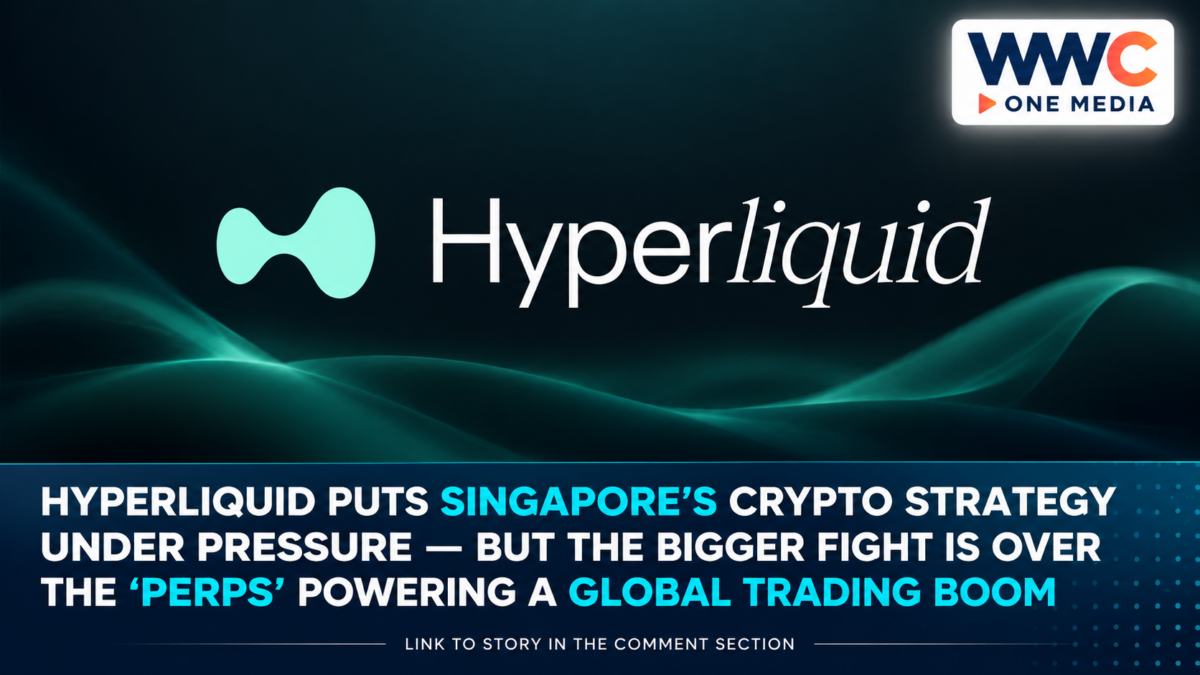
SINGAPORE — Singapore has spent years trying to build one of the world’s most credible digital-asset hubs without repeating the scandals that turned crypto into a regulatory nightmare. Now one of the fastest-growing names in decentralized finance is testing exactly where that boundary lies.
Hyperliquid Labs, the company behind a hugely popular crypto trading platform specializing in perpetual futures — or “perps” — says it is headquartered in Singapore.
But Singapore’s financial regulator says something very different.
The Monetary Authority of Singapore says Hyperliquid is not regulated by MAS, and according to the Financial Times, the regulator does not understand the platform to be regulated in any major jurisdiction.
That has created an awkward situation for a city-state that actively promotes institutional digital finance while repeatedly warning ordinary investors about speculative cryptocurrency trading.
And the controversy goes far beyond one crypto company.
It raises a much bigger question:
Can Singapore remain one of Asia’s leading digital-asset centres while some of the industry’s riskiest products are being built, promoted or operated from within its borders?
What Are Perpetual Futures?
Perpetual futures are derivatives that allow traders to bet on whether an asset will rise or fall without actually owning the underlying asset.
Unlike conventional futures contracts, they have no expiry date.
Traders can maintain positions indefinitely as long as they have enough collateral and continue meeting required funding payments.
They can also use leverage.
That means a trader may control a position worth many times the amount of money originally deposited.
The attraction is obvious.
A relatively small move in the underlying asset can generate a large profit.
But the same leverage can rapidly destroy a trader’s position when the market moves in the opposite direction.
Forced liquidations can happen within minutes during extreme volatility.
That combination of leverage, 24-hour trading and crypto-market volatility is why critics consider perps among the most dangerous retail products in digital assets. FT highlighted consumer advocates describing them as particularly hazardous because they make highly leveraged speculation extremely accessible.
Hyperliquid Turned Perps Into a Crypto Phenomenon
Hyperliquid built its reputation by creating a decentralized trading venue where users can trade crypto perpetual futures without relying on the traditional centralized-exchange structure used by companies such as Coinbase or Binance.
Its rise reflects a major shift in crypto.
Bitcoin trading once revolved largely around buying and selling the underlying token.
Today, a huge share of global crypto activity happens through derivatives.
Perpetual futures have become particularly dominant because they allow continuous leveraged exposure without traders having to roll expiring contracts into new ones.
The product is now so important that even traditional financial exchanges have taken notice.
SGX launched its own Bitcoin and Ethereum perpetual futures in November 2025, saying global perpetual-futures trading averaged more than US$187 billion a day at the time.
But there is a crucial difference.
SGX restricts its Singapore-based crypto perpetual futures customers to accredited, expert and institutional investors and operates the products through an exchange-cleared framework with margin rules, stress testing and exposure limits.
Hyperliquid operates through a very different model.
And that regulatory contrast is exactly where Singapore’s problem begins.
MAS Says Hyperliquid Is Not Regulated
According to the FT, Hyperliquid has confirmed that its headquarters are in Singapore and has been recruiting locally.
But MAS says the platform is outside its regulatory framework.
The regulator previously viewed Hyperliquid’s decentralized characteristics as meaning it was not effectively operating from Singapore in the traditional sense.
Hyperliquid itself has acknowledged that it has never received a licence or regulatory approval from MAS.
MAS has also maintained a longstanding position that cryptocurrency trading is unsuitable for most members of the general public because of its volatility and speculative nature.
That creates an unusual regulatory grey area.
A company can have employees, leadership or corporate functions in one country while the financial protocol itself operates globally through decentralized infrastructure.
Traditional regulation was designed around banks, brokerages and exchanges with identifiable servers, legal entities and customers in particular jurisdictions.
Decentralized finance does not always fit neatly into that structure.
Britain Has Gone Further
Singapore is not the only regulator questioning Hyperliquid.
Britain’s Financial Conduct Authority published an official warning in May and updated it in June.
The FCA said Hyperliquid may be providing or promoting financial services without permission and advised UK consumers to avoid dealing with the firm.
The regulator specifically listed Hyperliquid-related websites and said the company was not authorised to provide regulated financial services in Britain.
That illustrates the fragmented global approach to decentralized crypto markets.
A protocol can be accessible worldwide even when regulators in individual countries say it does not have permission to target their residents.
Blocking or policing those platforms becomes much harder when they do not resemble conventional financial companies.
The U.S. Is Moving in the Opposite Direction
Meanwhile, the United States is moving toward building a clearer federal framework for leveraged crypto trading.
On October 5, the U.S. Commodity Futures Trading Commission proposed rules that would allow qualifying cryptocurrency platforms to opt into a federal regulatory system covering leveraged and margined trading.
The proposal would require measures including anti-manipulation controls and proof-of-reserves requirements.
It comes after U.S. lawmakers failed to complete broader crypto-market legislation.
The initiative could eventually create a regulated path for platforms offering products that today often sit in legal grey areas.
That means Hyperliquid is entering a world in which regulators are taking very different approaches.
Britain is warning consumers away.
Singapore says the platform is outside MAS oversight.
And U.S. regulators are trying to create a pathway for some crypto derivatives businesses to enter the regulated financial system.
Singapore Wants Crypto — Just Not Another Scandal
The dilemma is particularly sensitive in Singapore.
The city-state has aggressively promoted itself as a serious hub for blockchain technology, tokenisation and institutional digital finance.
But regulators have become increasingly cautious about retail crypto following several spectacular failures tied to Singapore.
Terraform Labs, the company behind the collapsed TerraUSD and Luna cryptocurrencies, had strong links to Singapore.
Crypto hedge fund Three Arrows Capital was also based there before collapsing during the 2022 digital-asset crash.
Those episodes damaged confidence and left billions of dollars of losses throughout the industry.
Since then, Singapore has tightened licensing rules and made it harder for unregulated companies to serve customers from the city-state.
The government’s preferred message has increasingly been:
blockchain technology and institutional digital finance are welcome — uncontrolled retail speculation is not.
Hyperliquid complicates that narrative.
Singapore Is Tightening Stablecoin Rules Too
The Hyperliquid controversy arrives while MAS is strengthening other parts of its digital-asset rulebook.
In September, MAS opened a consultation on amendments to Singapore’s Payment Services Act designed to implement a formal regulatory framework for stablecoins.
The proposals include additional licensing, reserve and regulatory requirements intended to address how the stablecoin market has evolved since Singapore first developed its framework.
That demonstrates Singapore is not retreating from digital assets.
It is trying to separate regulated financial innovation from the parts of crypto that authorities view as excessively risky.
But decentralized derivatives make that separation increasingly difficult.
SGX Shows What Singapore’s Preferred Version of Perps Looks Like
Perhaps the clearest contrast comes from Singapore’s own stock exchange.
SGX launched Bitcoin and Ethereum perpetual futures on November 24, 2025.
It described the contracts as combining crypto’s preferred no-expiry structure with the “discipline, trust and transparency” associated with regulated financial markets.
The exchange has built the contracts around:
formal clearing,
margin requirements,
stress testing,
exposure limits,
and restrictions limiting Singapore participation to professional categories of investors.
SGX says early institutional participation has been encouraging and has positioned crypto perps as the foundation for a broader derivatives business that could later expand into dated futures, options and real-world-asset derivatives.
That means Singapore is not opposed to perpetual futures themselves.
The real question is:
Who offers them, who can trade them, and which regulator is responsible when something goes wrong?
Hyperliquid Is Becoming Harder to Ignore
Regulatory uncertainty has not stopped the platform’s ecosystem from expanding.
Singapore hosted the Hyperliquid Forum on October 6, an institutional event focused on investment strategies, trading infrastructure and projects built around the Hyperliquid ecosystem.
Speakers listed for the gathering included representatives from Grayscale, Multicoin Capital, Wintermute and other digital-asset investment firms.
The forum explicitly described Singapore as a location where institutional capital is exploring Hyperliquid.
That is striking given MAS’s position.
The regulator may not supervise Hyperliquid itself, but Singapore has nevertheless become an important physical meeting point for investors, developers and companies involved in its ecosystem.
Singapore’s Crypto Economy Is Still Growing
None of the regulatory caution has stopped digital finance from expanding in the city-state.
FT reports that crypto-related assets in Singapore grew roughly 55% last year.
The city also remains one of Asia’s most important destinations for crypto conferences and capital.
TOKEN2049 in Singapore was expected to attract approximately 25,000 attendees this year, even amid a broader crypto-market downturn.
The event forms part of an extraordinary financial week in the city involving investors, global executives and political figures ahead of Singapore’s Formula One Grand Prix.
Singapore clearly does not want to surrender that position to Hong Kong, Dubai or other competing financial hubs.
But maintaining the industry’s confidence while protecting its reputation for conservative financial regulation will require increasingly delicate balancing.
The Bigger Regulatory Problem: Where Does DeFi Actually Live?
Hyperliquid exposes a question governments around the world still have not fully answered.
If a decentralized trading protocol:
has developers in one country,
users across dozens of countries,
servers distributed globally,
governance partly handled on-chain,
and no traditional financial intermediary,
where exactly is the financial business taking place?
Traditional regulation is based heavily on jurisdiction.
DeFi is designed partly to escape those boundaries.
That tension becomes far more serious once leverage is involved.
A decentralized token swap may create limited systemic exposure.
A highly leveraged derivatives market processing enormous volumes can produce liquidations, counterparty risks and losses at a much larger scale.
And if ordinary investors believe a platform is “Singapore-based,” they may mistakenly assume the product carries Singapore regulatory protections that do not actually exist.
Perps Are Moving Into Mainstream Finance
The irony is that perpetual futures themselves are becoming less exotic.
SGX already offers them.
U.S. prediction-market operator Kalshi launched a stock-index perpetual future on October 6, expanding the structure beyond cryptocurrency.
Institutional investors increasingly view perpetual contracts as a useful financial instrument because traders can maintain continuous exposure without managing traditional expiration dates.
So the debate is no longer simply:
Are perps legitimate?
Instead, regulators are increasingly asking:
What protections should surround them?
Should leverage be capped?
Should retail traders have access?
Should customer assets be segregated?
Should exchanges maintain capital buffers?
And who is responsible when a decentralized platform operates without a conventional intermediary?
Singapore Now Faces a Reputation Test
Singapore has built its global financial reputation around strict supervision, stability and predictability.
That reputation is one of its greatest economic assets.
At the same time, it wants to remain competitive in technologies that could reshape global markets.
Those objectives increasingly collide in crypto.
Being too restrictive could push promising financial innovation toward Dubai, Hong Kong or the United States.
Being too permissive could expose Singapore to another high-profile digital-asset collapse.
Hyperliquid sits directly in the middle of that tension.
The platform represents one of crypto’s most innovative and fastest-growing trading models.
It also specializes in precisely the kind of leveraged product regulators worry can inflict enormous losses on unsophisticated investors.
Singapore may therefore be confronting a problem every major financial centre will eventually face.
The future of finance may be decentralized — but when billions of dollars are being traded with leverage, someone still has to decide who is responsible when the trade goes wrong.