
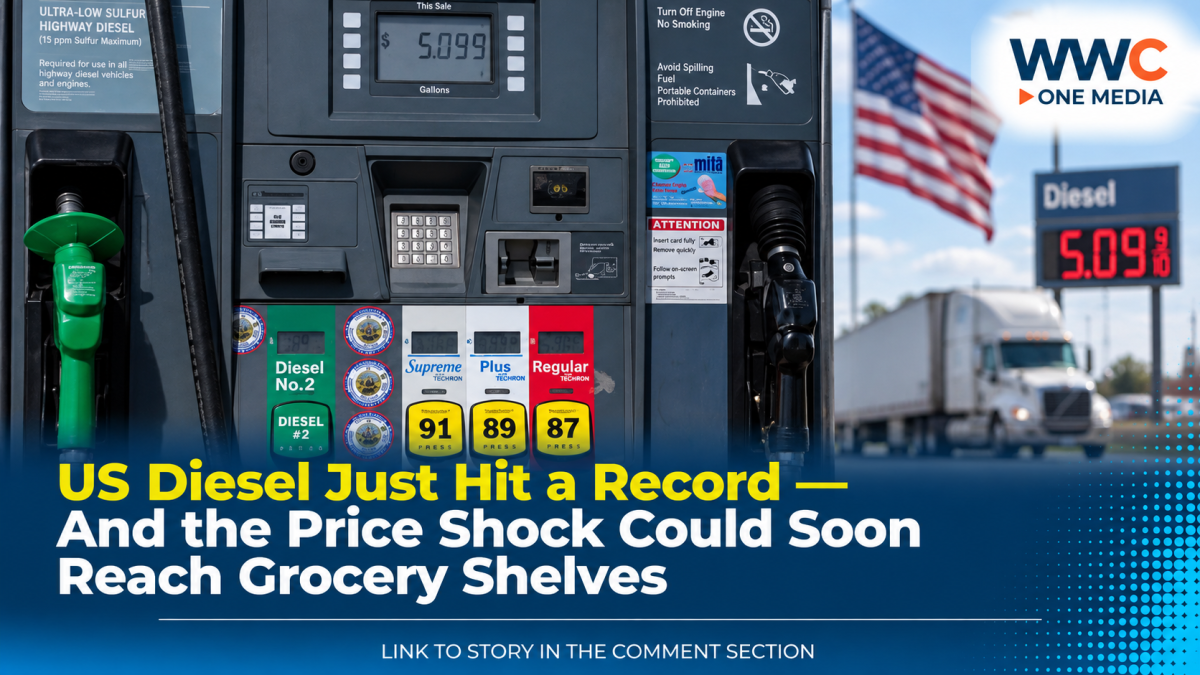
WASHINGTON — A new fuel-price shock is rippling through the US economy.
Diesel prices have climbed to a record high, threatening to raise transportation and production costs for everything from food and farm supplies to packages and other everyday goods.
The national average retail price of diesel reached about $5.85 a gallon on Friday, according to GasBuddy data cited by the Associated Press. That surpassed the previous nominal record set in June 2022.
Reuters had reported the previous day that the national average had already reached $5.82 a gallon, above the June 2022 record of $5.819.
And analysts warn the pressure may not be over.
Why diesel prices are exploding
The latest surge comes as global fuel markets remain under severe pressure following renewed fighting involving the United States and Iran.
The conflict has disrupted energy flows and intensified concerns about supplies of refined fuels, including diesel.
At the same time, Ukrainian attacks on Russian oil refineries have disrupted another major source of global diesel exports. Russia has responded by banning diesel exports through Sept. 30, according to Reuters.
The result is a market where refiners are working hard to produce more fuel while available supplies remain unusually tight.
US refiners have increased operating rates, but disruptions overseas are making it harder for global markets to replenish diesel supplies.
Why diesel matters far beyond the gas station
Diesel is not simply another fuel motorists buy at the pump.
It powers a huge portion of the transportation and industrial economy.
Long-haul trucks rely heavily on diesel to move products across the country. Farmers use it to operate tractors and other machinery. Construction and industrial equipment also depend on diesel.
That means a sustained increase in diesel prices can work its way through the entire supply chain.
When it costs more to move a shipment, companies face a choice: absorb the additional expense, reduce margins or pass some of the increase on to customers.
Economists and industry analysts warn that food can be particularly vulnerable because agricultural production and transportation both consume large quantities of diesel.
Your groceries could feel the impact
The chain reaction can begin long before a product reaches a supermarket.
A farmer may pay more to operate machinery.
A food processor may pay more for fuel and transportation.
A trucking company then pays more to transport the finished products.
Distributors and retailers may face higher delivery expenses.
By the time the goods reach consumers, some or all of those additional costs can be reflected in retail prices.
Produce, meat and seafood are among the categories that can be particularly sensitive to transportation costs because they often require rapid movement through the supply chain.
That does not mean every product will immediately become more expensive, however. The eventual effect depends on fuel usage, transportation distances, contracts, inventories and how much of the increase businesses choose to absorb.
Trucking companies are already feeling the squeeze
The transportation industry is among the first sectors to feel a diesel shock.
Major delivery companies including Amazon, UPS and FedEx have added fuel-related surcharges or adjustments to help offset elevated energy costs, according to AP.
For trucking operators, fuel is one of the largest variable expenses.
A sharp increase in diesel therefore creates pressure even when the number of deliveries remains unchanged.
And unlike a temporary increase in one company’s operating costs, higher fuel prices can affect virtually every stage of a supply chain.
Supplies are unusually tight
The situation is particularly concerning because US diesel inventories were already historically low.
Reuters reported that US distillate inventories — a category that includes diesel and heating oil — were at their lowest August level for that point in the year since 1982, based on Energy Information Administration data.
The latest EIA weekly data showed US on-highway diesel averaging $5.599 a gallon for the week ending Aug. 31, up from $5.454 two weeks earlier. Regional prices were considerably higher in some areas, including $7.218 a gallon in California and $6.497 on the West Coast.
Those weekly figures are different from the newer daily GasBuddy record because the agencies use different measurement periods and methodologies.
Autumn could make the problem worse
Another concern is timing.
Diesel demand typically rises during the autumn harvest season in the Northern Hemisphere.
Farmers need fuel to harvest crops and transport agricultural products, while heating-oil demand also begins increasing as colder weather approaches.
That could put additional pressure on already-constrained supplies.
The combination of tight inventories and seasonal demand creates the possibility of further price volatility if global supplies remain disrupted.
Oil is adding another layer of pressure
The diesel crisis is also connected to the broader surge in crude oil prices.
Reuters reported that Brent and US West Texas Intermediate crude ended the week substantially higher after renewed US-Iran military exchanges.
For the week, Brent gained about 7.6%, while WTI rose roughly 10%.
But crude oil is only part of the story.
Diesel prices are also affected by refinery capacity, inventories, transportation bottlenecks and regional supply conditions.
That is why diesel can sometimes rise sharply even when crude prices are moving less dramatically.
The inflation problem isn’t going away
The immediate concern is not simply expensive fuel.
It is what expensive fuel does to everything else.
Transportation costs can feed into food, manufactured products, construction materials and delivery services. If companies continue passing those expenses to consumers, the fuel shock could add another layer of inflationary pressure.
That creates a difficult situation for policymakers because higher energy prices can push inflation upward even while consumers and businesses are dealing with weaker purchasing power.
The longer the fuel disruption lasts, the greater the risk that temporary transportation costs become embedded in prices throughout the economy.
The warning sign for consumers
For now, the record diesel price is primarily a warning about what may come next rather than proof that every household expense is about to surge.
Businesses have different fuel contracts, inventories and pricing strategies, and some may absorb higher costs rather than immediately raising prices.
But the direction is unmistakable.
Diesel has reached a record, supplies remain tight, and the fuel that moves America’s trucks, farms and industrial equipment is becoming dramatically more expensive.
If the supply squeeze persists into the autumn, consumers could begin seeing more of that fuel shock where it matters most — in the prices of the goods being delivered to their doors and supermarket shelves.
Accuracy & editorial note
The $5.85-a-gallon figure refers to the national daily average reported by GasBuddy and cited by AP on Sept. 4. The EIA’s latest weekly national average, released Sept. 1, was $5.599/gallon for the week ending Aug. 31. These figures should not be presented as contradictory records; they reflect different datasets and time periods.
The link between diesel and consumer prices should also be described as a cost-pressure mechanism, not as a guarantee that every product will rise by a particular amount. The eventual impact depends on supply conditions, business margins, contracts and how long elevated fuel prices persist.
WWC ONE MEDIA J.M.D

Leave a Reply