
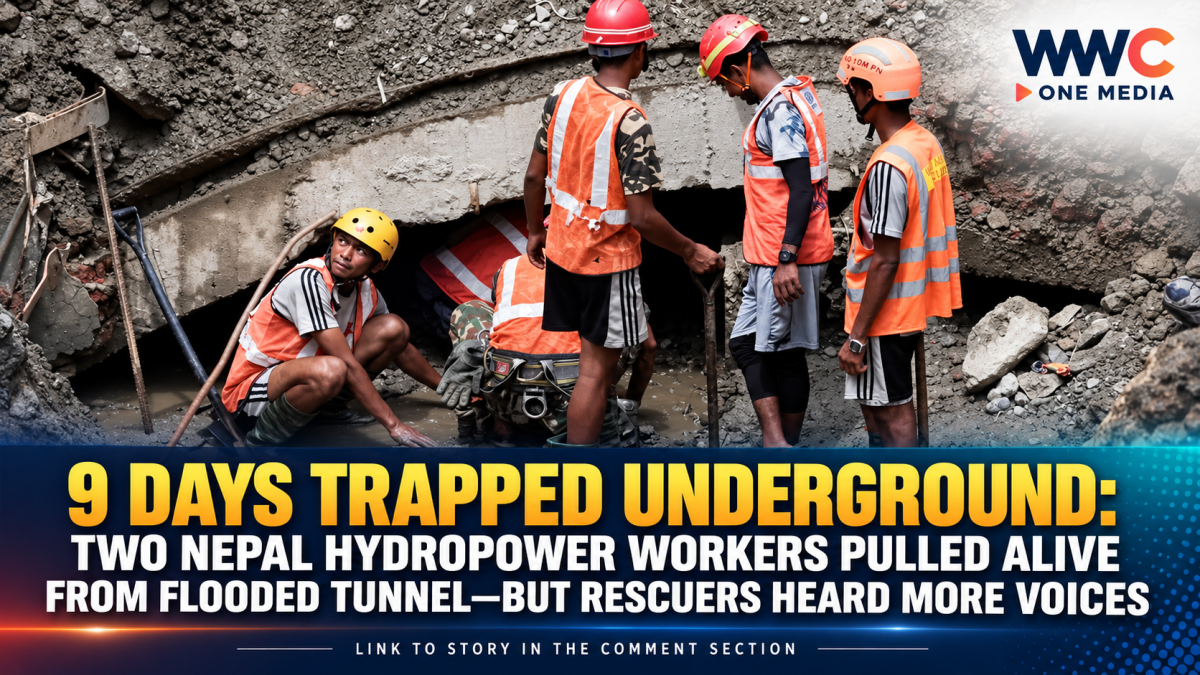
KATHMANDU, Nepal — In a rescue that has given fresh hope to families waiting for news, two hydropower workers were pulled alive from an underground tunnel in Nepal nine days after devastating floods and mudslides swept through the Trishuli River valley.
The two men, identified as Sanjay Sah, a mechanical foreman, and Kabir Maharjan, a mechanical supervisor, were rescued Friday from the Upper Trishuli 3A Hydropower Project, according to Nepalese authorities and reports from Reuters and other international outlets.
The survivors were found roughly 170 metres underground, after rescuers spent days clearing mud, debris and massive rocks that had blocked access to the hydropower facility. Their rescue came nine days after the disaster struck on Aug. 26.
A rescue that changed the mood underground
The operation gained momentum after rescuers reported hearing voices coming from deeper inside the tunnel.
Sah and Maharjan were subsequently located and brought out of the underground complex. Video released by Nepalese authorities showed rescuers hauling one survivor through an opening and carrying the other to safety, where medical teams immediately assessed them.
Both men were taken to an Army hospital in Kathmandu. Reuters reported that their vital signs were stable. Maharjan was unable to move his hands and legs at the time, while Sah’s injuries were described as not critical.
For rescuers, however, the discovery was about more than two lives saved.
It raised the possibility that others could still be alive.
One worker stayed behind to help others escape
Sah later described how he became trapped.
According to The Kathmandu Post, the 30-year-old mechanical foreman was working in the control room when floodwaters began entering the facility. Instead of immediately fleeing, he helped colleagues escape.
Sah said there were around 40 to 45 people in the area at the time. He helped direct them to safety but ultimately ran out of time to escape himself.
During the nine days underground, Sah said he survived while praying and waiting for help.
He also indicated that other workers might still be trapped deeper inside the complex—an account that has intensified the rescue operation.
Hundreds of workers remain missing
The dramatic rescue is unfolding against the backdrop of a much larger humanitarian disaster.
Nepal’s disaster management authorities reported that at least 1,287 people had been killed and more than 5,000 remained missing as of Friday, according to Reuters.
Local authorities estimate that approximately 900 workers from hydropower projects are missing, with roughly 500 believed to be trapped inside tunnels.
The disaster affected multiple hydropower facilities along the Trishuli River, leaving underground structures flooded or buried under enormous quantities of mud and debris.
More than 270 people had already been rescued from damaged hydropower facilities, according to The Guardian, but the condition of many missing workers remained uncertain.
A race against time
Rescue teams face extraordinary obstacles.
Many of the tunnels are filled with water, mud and debris, while access routes and surface infrastructure were destroyed by the disaster. Rescue workers have been using heavy machinery, helicopters and specialist expertise to locate possible survivors.
International assistance has also joined the operation, with specialists from India, South Korea and China supporting Nepalese rescue teams. Australian disaster-response specialists have also been deployed as the search expands.
Australian tunnelling expert Arnold Dix, who has been advising the operation, described the rescue as extraordinary and said the discovery of survivors demonstrated that people could potentially remain alive underground for longer than initially feared.
Hope amid a catastrophic disaster
The floods and landslides devastated communities across northern Nepal after a collapse in the Himalayan region sent enormous amounts of water, ice, rock and mud into the river valley. Authorities have described the event as one of the country’s worst recent disasters.
The damage has extended far beyond the loss of life. Nepalese officials estimate billions of dollars in damage to homes, roads, bridges and infrastructure, including the country’s strategically important hydropower sector.
But inside the tunnels, rescuers are still working with one powerful reason to continue:
Two men survived nine days underground.
And with reports that rescuers have heard voices from deeper within the damaged structures, the search for more survivors is far from over.
For families waiting outside the tunnels, every hour now carries the same question:
Could there be more people still alive beneath the rubble?
WWC ONE MEDIA J.M.S




Leave a Reply