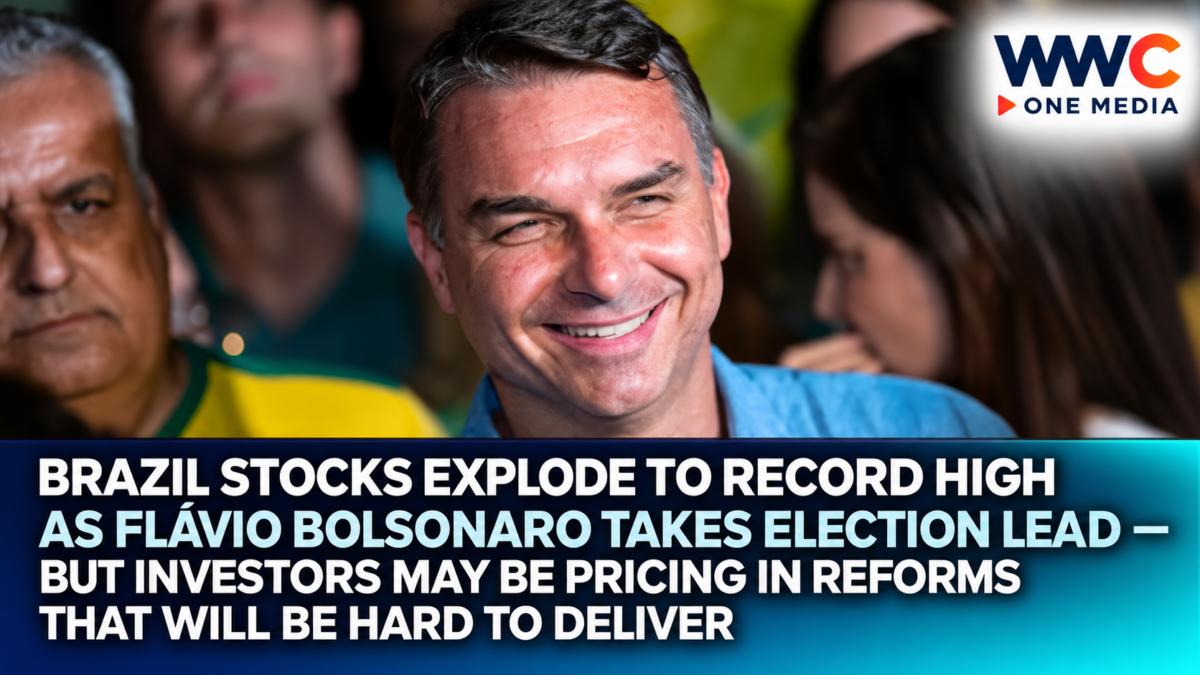
SÃO PAULO — Brazilian markets erupted in one of their biggest rallies in years after right-wing Senator Flávio Bolsonaro stunned political analysts by finishing first in the opening round of Brazil’s presidential election, putting him ahead of incumbent President Luiz Inácio Lula da Silva and suddenly making a pro-market political shift look far more possible.
Brazil’s benchmark Ibovespa surged 7.7% on October 5 to a record closing level of 206,911.89, its strongest single-day gain since March 2020. The index briefly traded above 209,000 during the session.
The Brazilian real also surged, gaining more than 4% against the U.S. dollar in one of its strongest daily moves in years, while bond yields fell and Brazilian stocks listed in the United States jumped sharply.
The market’s message was immediate:
investors believe Flávio Bolsonaro now has a realistic path to Brazil’s presidency — and they are betting that his economic policies would be more favorable to business, fiscal tightening and lower interest rates than another Lula administration.
But the celebration comes with a major warning.
Winning an election is not the same as delivering structural reform.
And Brazil’s fiscal problems are far more difficult than one market rally suggests.
Flávio Bolsonaro shocked expectations
Brazil’s official electoral authority said Flávio Bolsonaro received 56.1 million votes, or 47.03% of valid ballots, while Lula won 53.88 million votes, or 45.16%. Neither crossed the 50% threshold required to win outright.
They will therefore face each other in a second-round election on October 25.
The result was a major surprise because pre-election polling had not shown Flávio with such a clear advantage.
Markets had been positioned for a much tighter contest—or even a Lula lead.
That forced investors to rapidly reprice Brazilian assets when trading opened Monday.
This is Flávio Bolsonaro — not Jair
The distinction matters.
Flávio Bolsonaro is a 45-year-old senator from Rio de Janeiro, attorney and former state legislator.
He is the eldest son of former President Jair Bolsonaro.
Jair Bolsonaro himself is not the 2026 presidential candidate.
He was convicted over efforts connected to overturning the 2022 election result and is serving a 27-year prison sentence, according to Reuters.
Flávio has inherited much of his father’s conservative political movement while trying to present himself as a more predictable economic and institutional figure.
For investors, that distinction has become crucial.
Markets now see Flávio as the favorite
Prediction markets and investors moved sharply toward Bolsonaro after the first-round result.
Reuters reported that betting markets now treat him as a strong favorite for the runoff, helping fuel the extraordinary rally in Brazilian assets.
But the race is not over.
Lula still captured more than 45% of the vote.
The difference between the two candidates was only about 2.2 million votes in a country with more than 158 million eligible voters.
Turnout in the runoff, alliances with defeated candidates and voters who abstained in the first round could all change the result.
Calling Bolsonaro certain to win would therefore go too far.
He is the frontrunner.
He is not yet president.
Investors are betting on fiscal discipline
The strongest reason Brazilian assets rallied is fiscal policy.
Flávio Bolsonaro has attempted to position himself as a candidate who would:
control government spending;
limit debt growth;
reduce taxes;
encourage private investment;
and create conditions for lower interest rates.
That program is attractive to investors worried about Brazil’s large public debt and high borrowing costs. Reuters Breakingviews said Bolsonaro’s promises to cap debt and restrain spending have encouraged hopes of stronger growth and lower interest rates.
A credible fiscal tightening plan could reduce risk premiums on Brazilian bonds.
Lower government borrowing costs could then allow monetary policy to become less restrictive.
And lower interest rates are particularly powerful for Brazilian stocks.
Brazil’s high interest rates have been crushing rate-sensitive companies
Brazil has been operating with extremely high borrowing costs.
That hurts businesses dependent on credit, including:
retailers;
homebuilders;
consumer-finance companies;
small businesses;
and heavily indebted corporate groups.
If investors believe a Bolsonaro government could improve Brazil’s fiscal outlook and eventually create room for lower rates, those sectors become much more valuable.
That explains why some of Monday’s biggest winners were not exporters or oil companies.
They were companies whose earnings are extremely sensitive to domestic interest rates.
Retailers and builders exploded higher
Brazilian retailer Magazine Luiza surged more than 20%.
Cosan, Cyrela and exchange operator B3 also posted extraordinary gains, while Brazilian banks jumped sharply.
BTG Pactual rose strongly.
Itaú.
Bradesco.
Santander Brasil.
Banco do Brasil.
Retail and construction names all benefited from expectations that a more fiscally conservative government could eventually push borrowing costs lower.
That is why the market reaction was so broad.
Only a small number of stocks in the Ibovespa finished lower.
Brazilian stocks listed in New York surged too
The election shock immediately crossed into U.S. markets.
The iShares MSCI Brazil ETF jumped roughly 12% to 14%, depending on the point in the session.
Brazilian investment platform XP Inc. surged about 33%.
Digital bank Nu Holdings climbed roughly 13%.
Petrobras, Itaú Unibanco, Vale and Ambev also advanced.
That suggests the move was not simply local Brazilian speculation.
International investors were aggressively increasing exposure to the country.
Brazil added tens of billions of dollars in market value
The speed of the repricing was extraordinary.
Brazilian equities added close to $100 billion in market capitalization during roughly the first 90 minutes of trading, according to market estimates cited in international coverage.
That shows just how unprepared investors were for the election result.
Markets do not normally move 8% because investors suddenly discover a company has become more profitable overnight.
They move that much when expectations are completely reset.
October 5 was one of those days.
Bolsonaro’s biggest advantage may actually be Congress
The presidential result was not the only reason investors became more bullish.
Brazil’s congressional elections also shifted strongly to the right.
Flávio Bolsonaro’s Liberal Party increased its Senate representation from 15 seats to 28.
It is also projected to hold roughly 121 seats in the Chamber of Deputies, up from 98.
That matters enormously.
Brazilian presidents rarely govern with complete freedom.
Congressional coalitions are essential to passing spending changes, tax reforms and other major legislation.
A Bolsonaro presidency backed by a stronger conservative Congress would have a better chance of implementing economic policy than a Bolsonaro presidency facing a hostile legislature.
Even a Lula victory could face a much tougher Congress
The same congressional result creates a problem for Lula.
If he wins the runoff, he could begin another term facing a legislature significantly more conservative than the one he has dealt with during the current administration.
That could restrict his ability to increase spending or block fiscally conservative legislation.
In other words, markets may see the congressional election as partially positive even if Lula wins.
The rightward shift in Congress itself may impose more fiscal discipline.
That helps explain why Brazilian assets reacted so strongly rather than waiting for October 25.
Jair Bolsonaro’s future remains part of the political equation
The congressional shift also has implications beyond economics.
Reuters reported that the stronger Bolsonaro-aligned legislature could revive attempts to grant amnesty to former President Jair Bolsonaro or increase pressure on Supreme Court justices involved in his conviction.
Those issues could create major institutional conflict.
Investors focused on economic reform may therefore be underestimating political risk.
Brazil has spent years dealing with tensions between:
the presidency;
Congress;
the Supreme Court;
and Bolsonaro’s political movement.
Those conflicts would not automatically disappear under Flávio Bolsonaro.
They could intensify.
Trump has also complicated the Bolsonaro story
The Bolsonaros have strong ideological ties to U.S. President Donald Trump.
But Trump notably avoided directly endorsing Flávio during the first round.
That may actually have helped.
The Washington Post reported that earlier U.S. pressure and sanctions related to Jair Bolsonaro’s legal case had allowed Lula to cast himself as a defender of Brazilian sovereignty.
Trump’s relative silence during the campaign deprived Lula of that argument.
If Flávio wins, U.S.-Brazil relations could shift significantly.
A Bolsonaro administration would likely seek closer ties to Washington and to Trump’s government.
Lula is already trying to reposition
Lula’s campaign now faces a difficult three-week sprint.
Reuters reported that Lula is considering measures designed to reassure markets and centrist voters, including possibly giving Vice President Geraldo Alckmin a stronger economic role or even naming him finance minister if Lula wins.
Alckmin is viewed as more centrist and business-friendly than many figures inside Lula’s Workers’ Party.
Such a move would send a deliberate message:
a fourth Lula term would not necessarily mean a sharp turn toward higher spending.
Whether investors believe that message is another question.
Lula still has a serious path to victory
Despite Monday’s market reaction, Bolsonaro’s lead is narrow enough that a reversal is completely plausible.
AP noted that Lula is focusing on turnout and rebuilding support ahead of the runoff, particularly after unusually high abstention.
Brazil remains deeply polarized.
Many voters who oppose Lula may vote for Bolsonaro.
Many voters who oppose the Bolsonaro family may consolidate behind Lula.
Minor-party voters now have to choose between two dramatically different candidates.
That makes the runoff fundamentally different from the first round.
The market may also be overestimating how easy fiscal reform will be
This is where Wall Street enthusiasm deserves caution.
Brazil’s federal budget is highly rigid.
Large portions of spending are constitutionally mandated or politically difficult to cut.
Pensions.
Public-sector wages.
Social programs.
Health.
Education.
Debt service.
That leaves governments with less room to reduce spending than campaign promises often imply.
Reuters Breakingviews argued that investors may be mistaking electoral momentum for a credible economic turnaround because Brazil has relatively little easy fiscal savings available.
That may become the central issue if Bolsonaro wins.
Promising smaller government is straightforward.
Finding politically acceptable spending cuts is much harder.
Lower taxes could create another contradiction
Bolsonaro has also discussed reducing taxes.
That appeals to businesses.
But Brazil simultaneously needs to improve its fiscal balance.
Cutting taxes without equally large spending reductions can make budget deficits worse.
Worse deficits can push government borrowing costs higher.
Higher borrowing costs can prevent interest rates from falling.
That would undermine precisely the investment case currently pushing Brazilian equities upward.
So markets will eventually need more than broad promises.
They will need detailed numbers.
The real could become one of the biggest winners
Brazil’s currency strengthened more than 4% on Monday, its largest daily gain in roughly four years.
A stronger real can help reduce imported inflation.
Brazil imports fuel, machinery and numerous manufactured goods.
When the real strengthens, those imports become cheaper in local-currency terms.
Lower inflation can create additional room for interest-rate cuts.
That creates another positive feedback loop:
stronger currency;
lower inflation;
lower rates;
higher domestic stock valuations.
This is one reason investors reacted so strongly to the election.
But exporters can actually lose when the real strengthens
Not every Brazilian company benefited.
Exporters earning large amounts of revenue in dollars can be hurt when the real rises.
Brazilian market coverage showed companies such as Suzano and Embraer under pressure during Monday’s rally because the stronger currency reduces the local-currency value of foreign earnings.
That distinction is important.
A Bolsonaro victory would not automatically be positive for every Brazilian stock.
Domestic businesses sensitive to lower rates may benefit.
Exporters may react differently.
Petrobras comes with its own political complications
Oil giant Petrobras also gained during the market rally.
Investors often prefer a more market-oriented government because they expect less political interference in fuel pricing, dividends and investment decisions.
But Petrobras is never a simple election trade.
Oil prices.
Production.
Refining margins.
Government policy.
And global energy demand
can all overwhelm domestic politics.
A Bolsonaro administration could reduce some political-risk concerns.
It cannot control the global oil market.
JPMorgan upgraded Brazilian equities
The election surprise was powerful enough for J.P. Morgan to upgrade Brazilian stocks to overweight, according to Reuters.
The bank cited a more favorable political environment and improving prospects for reform.
That kind of recommendation can reinforce market momentum because global portfolio managers benchmark themselves against large emerging-market indexes.
If major investment banks raise Brazil allocations, foreign capital can begin flowing into:
Brazilian ETFs;
banks;
consumer stocks;
utilities;
infrastructure;
and government bonds.
That can push the rally beyond a single election day.
But the trade could reverse quickly
Election-driven rallies are notoriously volatile.
If new polls show Lula regaining momentum, some of Monday’s gains could disappear.
If Bolsonaro releases an economic plan investors dislike, stocks could retreat.
If institutional conflict increases, risk premiums could return.
If global markets fall sharply, Brazil will not be immune.
And if oil, inflation or U.S. interest rates surge, emerging-market capital flows could reverse regardless of Brazilian politics.
That is why Monday’s 7.7% move should be understood as a repricing of expectations—not a permanent revaluation.
Flávio Bolsonaro is trying to sell himself as the market-friendly heir
His biggest political challenge is balancing two identities.
He needs Jair Bolsonaro’s supporters.
But he also needs moderate voters and financial markets that may fear the institutional instability associated with his father’s presidency and subsequent legal battles.
That creates a delicate campaign.
Move too far toward the center and some hardcore Bolsonaro supporters may become less enthusiastic.
Move too close to his father’s confrontational style and centrist voters may return to Lula.
The markets are currently betting he can manage both.
October 25 will test that assumption.
Brazil’s election has suddenly become one of the world’s biggest market events
Before the first round, global investors viewed Brazil as an important but uncertain emerging-market story.
In a single trading session, that changed.
The Ibovespa hit a record.
The real posted its strongest move in years.
Banks and retailers soared.
International Brazil ETFs jumped double digits.
And Wall Street began talking seriously about a major fiscal-policy shift.
That makes the second-round election far more than a Brazilian political event.
It has become a global emerging-market catalyst.
But the market is already pricing in a lot of good news
This may ultimately be the biggest risk.
Brazilian stocks did not rise 7.7% because investors believe Bolsonaro might make modest improvements.
They surged because investors suddenly see a much higher probability of:
fiscal tightening;
lower interest rates;
less state intervention;
business-friendly reforms;
and a conservative Congress capable of supporting them.
Those expectations are now embedded in prices.
If Bolsonaro wins but struggles to deliver, investors can become disappointed very quickly.
And if Lula stages a comeback, Monday’s rally could prove fragile.
Flávio Bolsonaro has clearly become the frontrunner after his surprise first-round victory.
But Brazil’s markets are now making an even bigger bet:
that an election victory would translate into the fiscal reforms investors have wanted for years.
That remains far from guaranteed.