
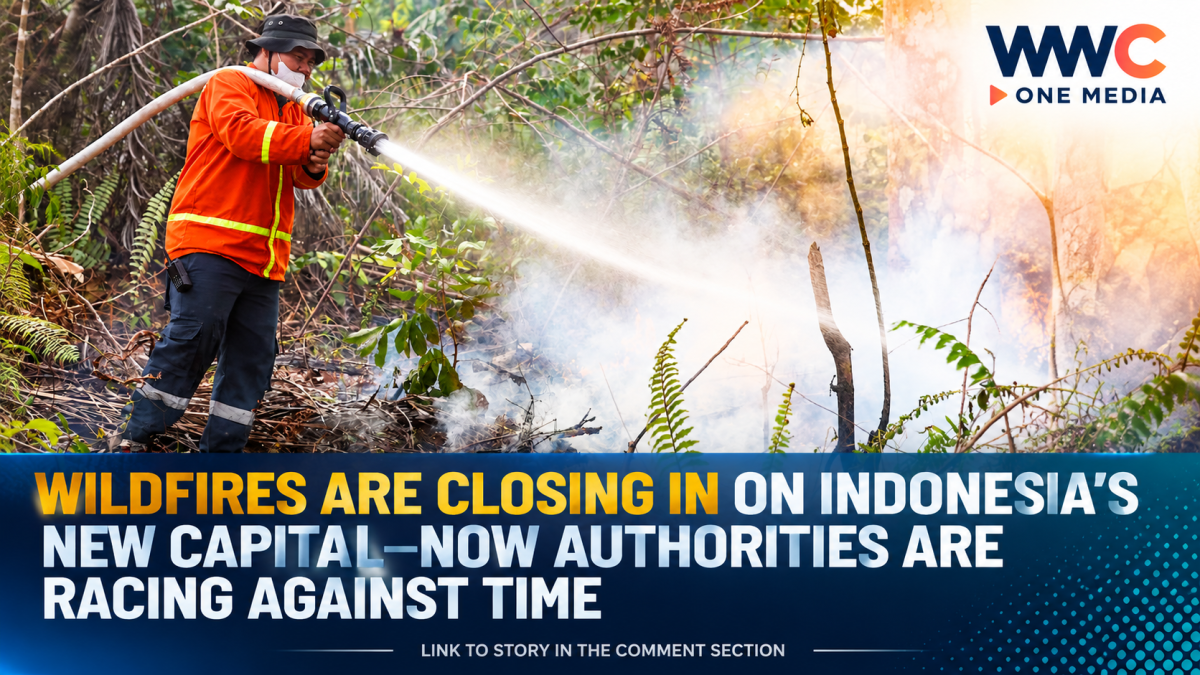
JAKARTA/NUSANTARA — Wildfires are spreading across areas surrounding Indonesia’s under-construction capital, Nusantara, forcing authorities to intensify firefighting efforts as an unusually severe dry season raises fears that the blazes could worsen.
Authorities overseeing the Nusantara capital project have called for stronger intervention, including aerial water bombing and cloud-seeding operations, as fires continue to burn across parts of East Kalimantan on the island of Borneo.
The latest figures available as of September 2 indicate that fires had burned about 400 hectares around Nusantara, including roughly 300 hectares in Bukit Suharto Forest Park, approximately 50 kilometers from the capital’s city center.
Fire threat expands around Nusantara
The eastern portion of Borneo where Nusantara is being built had initially been relatively less affected than other wildfire-hit areas.
That changed as Indonesia entered a particularly difficult dry season.
Agus Riyanto, an emergency-response official with Indonesia’s disaster mitigation agency, said authorities had been asked to strengthen efforts around Nusantara as fires began affecting areas closer to the planned capital.
Indonesia is currently confronting what officials describe as its most challenging dry season in a decade, with conditions worsened by a powerful El Niño phenomenon that has contributed to hotter and drier conditions.
The country’s disaster-response agencies are fighting fires across several provinces on Sumatra and Kalimantan, where the affected area reported by authorities had reached 73,311 hectares.
Indonesia sends aircraft to fight the flames
Indonesia has deployed dozens of aircraft for water bombing and weather-modification operations.
Reuters reported that 53 aircraft were involved in water-bombing and cloud-seeding activities, while Japan has also provided aircraft and personnel to assist Indonesia’s firefighting response.
Japan’s Ministry of Defense confirmed that it ordered an international disaster-relief mission involving three CH-47 transport helicopters and the transport vessel JS Kunisaki to support firefighting operations in Indonesia.
Indonesia’s Air Force has separately deployed a Caracal helicopter equipped with a water bucket to fight a fire near Nusantara.
According to ANTARA, the operation targeted a blaze in Sukomulyo Village, in Penajam Paser Utara, roughly 44 kilometers from Nusantara. The fire had reignited after an earlier firefighting operation and burned about five hectares in the area.
Cloud-seeding efforts, however, have faced a major obstacle: there have not always been enough clouds available for the operation to work effectively.
The wildfire crisis is bigger than Nusantara
The threat is not confined to the new capital.
Indonesia’s wider wildfire emergency has already affected vast areas of the country. Recent reporting indicates that nearly 95,000 hectares burned in July alone, while more than 9,000 fire hotspots were detected during August, according to Reuters.
Authorities have also been investigating potential human causes behind some fires.
Indonesia’s government has inspected companies whose concession areas contained fires, while officials have emphasized that human activity remains a major factor behind the country’s wildfire problem even as El Niño makes conditions considerably more favorable for fires to spread.
Peatlands are particularly vulnerable because drained and degraded peat can dry out and become highly flammable, allowing fires to smolder beneath the surface and making them difficult to extinguish.
Orangutans caught in the wildfire crisis
The environmental consequences are also becoming increasingly visible.
Authorities in East Kalimantan recently evacuated 11 orangutans from a rehabilitation facility after a severe land fire reached a protected forest reserve in Kutai Kartanegara.
The animals were moved to enclosed evacuation cages in Samboja and were reported to be healthy and safe, although conservation officials said their temporary surroundings provide more limited conditions than their normal environment.
The evacuation highlights the wider ecological danger posed by the fires to Borneo’s endangered wildlife.
Haze spreads beyond Indonesia
Indonesia’s wildfire crisis is also becoming a regional problem.
Smoke and haze from fires in Sumatra and Kalimantan have affected neighboring parts of Southeast Asia, including Malaysia, Singapore and the Philippines.
The scale of the haze has become serious enough to disrupt daily life in several countries. Recent reporting has linked deteriorating air quality to school disruptions and health concerns across the region.
A new test for Indonesia’s ambitious capital project
Nusantara is one of Indonesia’s most ambitious infrastructure projects.
Former President Joko Widodo announced the roughly $32 billion plan in 2019 to replace Jakarta as the country’s capital, citing Jakarta’s chronic congestion, flooding and land subsidence.
But the project has experienced delays and budget pressures since President Prabowo Subianto took office in 2024.
The wildfire crisis adds another challenge to a project being developed in a heavily forested region with limited water resources.
Urban-planning expert Wisnubroto Sarosa told Reuters that the surrounding forest environment and water limitations could make Nusantara particularly challenging to manage, even though eastern Borneo has historically faced lower fire risk than some western and central parts of the island.
For now, officials are focused on keeping the fires contained.
Hundreds of Muslims also gathered near the state palace in Nusantara on September 4 for Istisqo prayers, a traditional prayer for rain, as firefighting teams continued battling the blazes.
Fact-check: Is Nusantara itself burning?
No credible evidence currently shows the main government buildings of Nusantara being engulfed by wildfire.
Indonesian police specifically warned against viral social-media posts claiming that forest fires had already spread to buildings inside the capital. Authorities determined that images circulating online were actually from a 2025 fire at a worker-housing facility and were being presented out of context.
The verified situation is serious—but more precise: wildfires have burned hundreds of hectares in areas surrounding Nusantara, prompting authorities to escalate firefighting operations.
With Indonesia entering a particularly difficult period of the dry season and El Niño conditions expected to intensify the challenge, the question now is whether authorities can contain the fires before they move closer to the heart of the country’s planned new capital.
WWC ONE MEDIA J.M.S

Leave a Reply