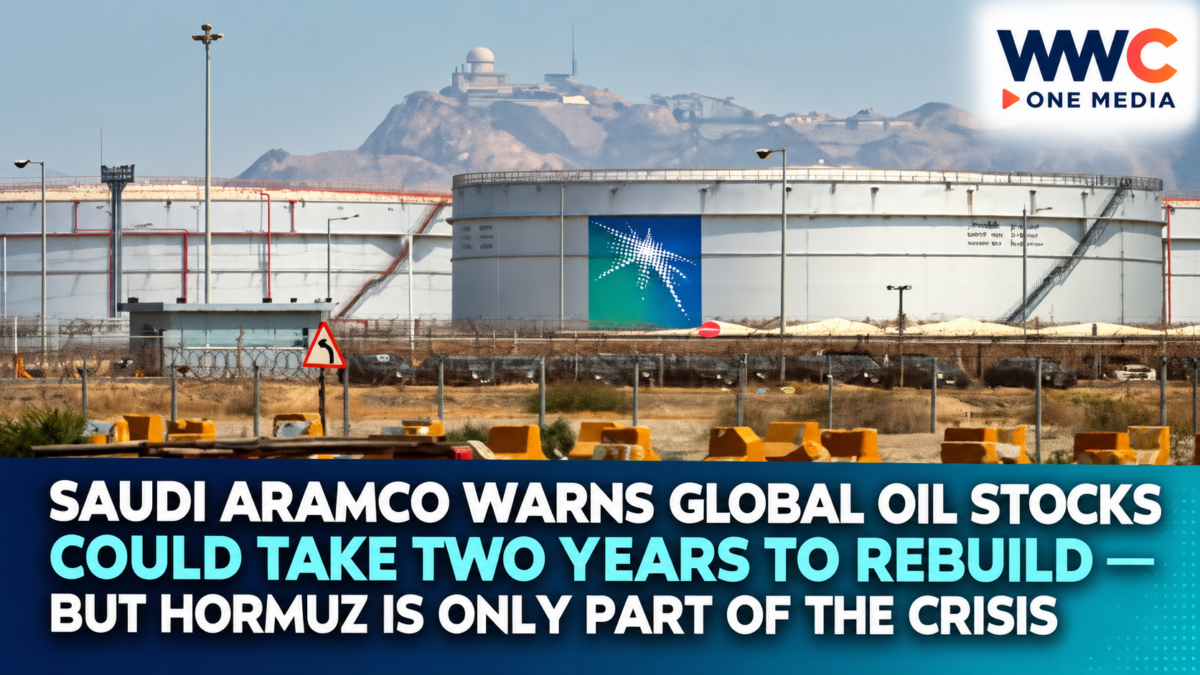
LONDON — The chief executive of Saudi Aramco has delivered one of the starkest warnings yet about the global energy crisis, saying oil inventories depleted by months of Middle East conflict could take as long as two years to rebuild—even after the Strait of Hormuz fully reopens.
Amin Nasser, president and CEO of the world’s largest oil company, told the Energy Intelligence Forum in London that nearly 3 billion barrels of crude oil and refined-product supply have been lost since the conflict involving the United States, Israel and Iran erupted earlier this year.
More than 1 billion barrels have already been drawn from inventories to compensate for those missing supplies, Nasser said.
That has left the global energy system with an increasingly thin buffer against the next disruption.
And while attention remains focused on Iran and the Strait of Hormuz, the bigger danger may be that the world’s oil problem is no longer simply about whether enough crude exists.
It is increasingly about whether crude and refined fuels can actually reach the countries that need them.
Nearly 3 billion barrels of supply lost
Nasser said the world entered the crisis with close to 10 billion barrels of total oil stocks.
Since then, nearly 3 billion barrels of gross supply have been lost—roughly half of the crude oil and refined products that would normally have moved through the Strait of Hormuz during the same period.
More than 1 billion barrels have been taken from stockpiles to compensate.
Nasser estimated that fewer than 6 billion barrels of commercial inventories remain, with much of that oil not realistically available to respond quickly to another major supply shock.
His conclusion was unusually blunt for the head of the world’s largest oil producer.
Global supply resilience, he warned, has become dangerously thin.
Why rebuilding inventories could take two years
The problem is not simply replacing the oil already consumed.
Global demand continues every day.
That means producers would need to supply enough oil to satisfy current consumption and produce additional barrels to rebuild depleted inventories at the same time.
Nasser said restoring inventories while meeting ongoing demand could take up to two years, even after Hormuz is fully reopened and confidence in shipping returns.
One estimate based on his figures suggests the market could require roughly another 2 million barrels per day for around 18 months simply to replenish depleted stocks while normal consumption continues.
That is a massive additional supply requirement in a market already dealing with damaged infrastructure, expensive shipping and constrained refining capacity.
Hormuz remains the center of the crisis
The Strait of Hormuz remains one of the world’s most important energy chokepoints.
Before the current crisis, approximately 21.6 million barrels per day of crude oil, condensate and petroleum products passed through Hormuz during the fourth quarter of 2025.
After Iran effectively closed the waterway during the conflict, average oil flows collapsed to just 4.9 million barrels per day during the second quarter of 2026, according to the U.S. Energy Information Administration.
Crude oil and condensate traffic alone fell from 15.9 million barrels per day to just 3.7 million.
That was a historic disruption.
Saudi Arabia, Iraq, Kuwait, the United Arab Emirates, Qatar and Bahrain all depend to varying degrees on Gulf export routes.
When Hormuz traffic collapsed, some producers were forced to reduce output because they simply could not move enough oil to buyers.
Saudi Arabia has an escape route—but it is not unlimited
Saudi Arabia is better positioned than some of its Gulf neighbors because it has the East-West pipeline, which can carry crude from the country’s eastern producing regions across Saudi territory to Yanbu on the Red Sea.
That gives Aramco a way to bypass Hormuz.
During the 2026 disruptions, Saudi Arabia rerouted additional crude through the pipeline and exported more oil from its western coast.
But alternative infrastructure cannot simply replace all normal Gulf shipping.
The system has capacity constraints, and the East-West pipeline itself has faced security risks amid the widening regional conflict.
That means Saudi Arabia has more flexibility than many producers—but not immunity.
Oil exports are recovering surprisingly quickly
There is some encouraging news.
Middle East crude exports surged again toward the end of September.
Reuters calculations showed flows through the Strait of Hormuz had recovered to approximately 14.2 million barrels per day, around 80% of pre-war levels.
Overall Middle East exports temporarily exceeded 18 million barrels per day as producers adapted through alternative routes and new shipping arrangements.
That improvement helped push oil prices lower on October 5.
Brent crude settled down $1.93 at $100.32 per barrel, while U.S. West Texas Intermediate fell $1.68 to $89.43.
Those declines might appear to suggest the crisis is easing.
Aramco is warning that conclusion would be premature.
The problem is shifting from supply to logistics
One of the most important developments in the oil market is that headline production numbers no longer tell the entire story.
There may be crude available.
But getting it from producer to refinery has become increasingly expensive and complicated.
Tanker freight rates from the Middle East to Asia have soared.
Reuters reported that some very large crude carrier rates reached around $1.2 million per day, compared with roughly $30,000 earlier in the crisis and about $80,000 a year ago.
At those levels, transportation itself can represent a significant share of the delivered cost of a barrel.
Insurance is also more expensive when tankers have to pass through waters where vessels have been attacked.
That means even if crude production recovers, consumers can still face elevated fuel prices because shipping remains constrained.
Saudi Arabia has taken the unusual step of discounting oil to Asia
The impact of those shipping costs can be seen in Saudi pricing.
Aramco unexpectedly cut its November official selling prices for Asian customers to six-year lows.
Arab Light crude was priced at a discount of roughly $5 per barrel to the Oman-Dubai benchmark, after a $3 reduction.
Heavier Saudi grades were also discounted sharply.
Normally, extreme supply uncertainty might encourage an exporter to raise prices.
Instead, Saudi Arabia is cutting them.
One likely reason is that Asian refiners are facing extraordinary freight costs.
A cheaper barrel at the Saudi loading point can partially compensate buyers for much more expensive transportation.
The move also suggests Riyadh is determined to defend market share even during severe logistical disruption.
Refined fuels may be the bigger danger
Nasser’s warning is not limited to crude oil.
He argued that the pressure on refined fuels such as diesel could become even more serious.
That distinction matters.
A country does not run trucks or tractors on crude oil.
It needs refineries to convert crude into gasoline, diesel, jet fuel and other products.
Kuwait Petroleum Corp. CEO Shaikh Nawaf Al-Sabah told the same conference that the world currently faces a refined-products shortfall of around 6 million barrels per day because global refining systems cannot fully replace lost Middle Eastern output.
That means pumping more crude alone may not solve the problem.
The oil still has to reach a functioning refinery with available capacity.
Diesel is becoming particularly sensitive
Diesel is crucial to the world economy.
It powers trucks.
Ships consume related middle distillates.
Farm equipment requires fuel.
Construction machinery uses it.
Many industrial and backup-power systems depend on diesel.
That means diesel shortages can spread inflation throughout supply chains.
Transportation costs rise.
Food becomes more expensive to move.
Factories pay more for logistics.
Construction costs increase.
Governments therefore have good reason to worry about refined-fuel availability even when crude inventories appear sufficient.
The G7 is releasing another 100 million barrels
Governments are trying to stop the situation from worsening.
The Group of Seven agreed to release another 100 million barrels of crude and diesel from emergency reserves, while pledging not to impose energy-export restrictions.
The move was intended to stabilize markets and increase near-term fuel availability.
But Aramco argues emergency stock releases can only buy time.
They do not create new refining capacity.
They do not repair damaged pipelines.
They do not lower tanker-insurance costs.
And every barrel released from emergency reserves reduces the cushion available for the next crisis.
As Nasser put it, emergency reserves can help the world through a difficult period, but they cannot solve the long-term imbalance.
The world has already burned through part of its safety net
This may be the most important point.
Stockpiles exist specifically to absorb emergencies.
In that sense, the system has worked.
A major global oil chokepoint was severely disrupted, but countries were still able to access energy by drawing down inventories and redirecting supplies.
The danger comes if another shock occurs before those inventories are rebuilt.
A hurricane could hit refining infrastructure.
Another pipeline could be attacked.
Russia’s refineries could suffer further damage from Ukrainian strikes.
Shipping disruptions could escalate.
Or Hormuz traffic could deteriorate again.
The global oil system would then enter the next crisis with a smaller safety cushion than it had before the first one.
Ukraine is adding another layer of pressure
The Middle East is also not the world’s only supply problem.
Ukraine has continued attacking Russian oil-refining infrastructure, further reducing available refined-product capacity.
Ukrainian President Volodymyr Zelensky has indicated that strikes on Russian energy infrastructure will continue.
That creates an unusual global squeeze.
Middle Eastern transport routes are disrupted.
Some Gulf refining capacity is constrained.
Russian refineries are being attacked.
Shipping costs are surging.
Inventories are falling.
The market therefore has fewer places to turn when something fails.
Oil prices above $100 remain an inflation threat
Brent crude trading around or above $100 per barrel creates economic consequences far beyond energy companies.
Higher oil prices can eventually raise:
airfares,
shipping costs,
food prices,
electricity costs in oil-dependent markets,
industrial production expenses,
and consumer inflation.
Central banks then face a difficult problem.
If energy-driven inflation remains high, they may be less willing to cut interest rates—or may even need to maintain tighter policy than they otherwise would.
That means an oil shock can eventually affect mortgages, business borrowing and financial markets.
The Strait of Hormuz may be thousands of kilometers away from most consumers.
Its economic effects are not.
Asia has the most to lose
Asian economies are especially exposed because they import enormous volumes of Middle Eastern crude.
Oil flowing from the Gulf normally travels through Hormuz and then across the Indian Ocean toward Asian refineries, often passing through the Strait of Malacca.
That makes countries including:
China,
India,
Japan,
South Korea,
Singapore,
and other Asian importers particularly sensitive to disruptions.
The EIA reported that flows through the Strait of Malacca also fell sharply during the crisis, from 24 million barrels per day in late 2025 to 16.6 million barrels per day during the second quarter of 2026.
The shock therefore traveled far beyond the Persian Gulf.
The crisis also matters to the Philippines
The Philippines is a net petroleum importer.
That means prolonged high international oil and fuel prices can eventually appear in domestic pump prices and transport costs.
The country does not need to import every barrel directly from the Middle East to feel the effects.
Oil is globally traded.
If international benchmarks rise, replacement costs tend to rise elsewhere as well.
For Filipino consumers, sustained global shortages could therefore mean pressure on gasoline and diesel prices, transportation fares, food distribution and inflation.
This is why events at Hormuz can eventually reach households thousands of kilometers away.
One industry leader thinks oil demand may not fully recover until 2028 or 2029
The disruption is becoming significant enough that some oil executives believe demand itself could take years to normalize.
ConocoPhillips CEO Ryan Lance told the Energy Intelligence Forum that oil demand may not fully recover until 2028 or 2029, as high prices suppress consumption and force businesses and households to adapt.
That introduces another complication.
Expensive oil encourages conservation.
Consumers drive less.
Airlines adjust schedules.
Businesses reduce fuel consumption.
Countries accelerate alternative-energy strategies.
So a prolonged supply shock can eventually destroy some demand.
The oil industry therefore faces two opposing forces:
too little accessible supply today,
and potentially weaker demand tomorrow.
Aramco’s warning is ultimately about energy security
Nasser’s argument is not simply that the world needs to produce more oil.
It is that energy security depends on the entire system working together.
Production.
Pipelines.
Storage.
Tankers.
Refineries.
Ports.
Inventories.
Shipping insurance.
Alternative routes.
If any of those pieces fails, oil that technically exists may not arrive where it is needed.
That lesson has become increasingly clear during the 2026 crisis.
Hormuz reopening will not end the problem overnight
Markets naturally focus on whether Iran will fully reopen the Strait of Hormuz.
A complete normalization would unquestionably help.
More tankers could travel through.
Gulf producers could raise output.
Freight and insurance costs could fall.
Refineries could receive more crude.
But Aramco’s warning is that reopening the strait does not magically replace the oil already consumed from inventories.
The stockpiles still need to be rebuilt.
Refineries still need to recover.
Shipping confidence needs to return.
And producers still need to satisfy more than 100 million barrels per day of global demand while accomplishing all of that.
That is why Nasser believes the recovery could take as long as two years.
The next oil shock could be more dangerous than this one
Global markets have shown remarkable resilience.
Middle East exports have recovered.
Saudi Arabia found alternative routes.
Governments released reserves.
Oil prices remain far below the extreme levels some feared when Hormuz traffic first collapsed.
But resilience has come at a price.
The world has used a significant portion of its inventory buffer.
Shipping costs have exploded.
Refining capacity is strained.
And geopolitical conflict continues across several major energy-producing regions.
That is what makes the current situation dangerous.
The question is no longer simply whether Saudi Arabia can pump more barrels or whether Iran allows more tankers through Hormuz.
It is whether the world can rebuild its energy safety net before the next major disruption arrives.
And if Saudi Aramco’s chief executive is right, that safety net may not be fully restored until 2028.