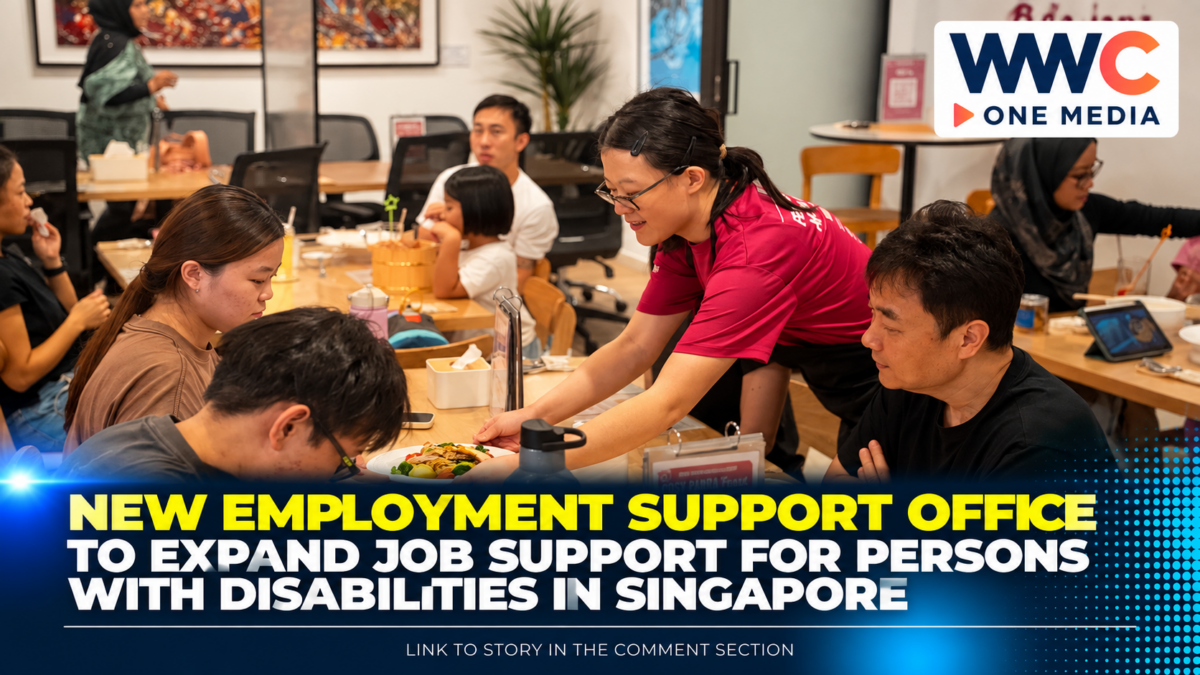
Singapore will establish a new Employment Support Office (ESO) to provide longer-term employment and career assistance to persons with disabilities, as part of a broader set of measures aimed at strengthening support across different stages of life.
The initiative was recommended by the Taskforce on Assurance for Families with Persons with Disabilities, which examined the challenges faced by persons with disabilities, their families, employers, educators and community organisations. The taskforce said many families were concerned about what happens after their children leave school, particularly whether they would be able to secure and retain employment and eventually live more independently.
This transition has been described as a “post-18 cliff”, referring to the uncertainty some persons with disabilities and their caregivers face after completing special education. The taskforce said families wanted greater assurance that they would continue to have access to employment opportunities, skills development and support as their circumstances change.
Official labour force data showed that 34.7 per cent of persons with disabilities aged 15 to 64 were employed in 2025, up from 33.6 per cent in 2024. The government has set a broader target of reaching a 40 per cent employment rate for persons with disabilities under the Enabling Masterplan 2030.
The ESO will be established by SG Enable and is expected to become fully operational in the second half of 2027. It will serve as a central point for career advice, job placement, skills upgrading and employment support, while also helping employers navigate the process of hiring and supporting workers with disabilities.
The office will build on existing Job Placement and Job Support services but will go beyond initial job matching. It is intended to provide longer-term assistance for workers who need additional support to adapt to their roles, develop skills or manage workplace changes such as new supervisors, colleagues or responsibilities.
For employers, the ESO will provide guidance on job redesign, workplace accommodations and inclusive hiring practices. It will also work with industry groups to develop sector-specific playbooks explaining how companies can identify suitable positions, modify roles and integrate persons with disabilities into their workplaces.
The government will also introduce a new Enabling Employment Grant in the first half of 2027. The grant will combine and replace three existing schemes: the Open Door Programme Job Redesign Grant, Open Door Programme Training Grant and Employer Development Grant.
The new grant is expected to cover a wider range of support, including in-house job coaches, customised training, inclusive training programmes and workplace accommodations. In 2025, the three existing schemes collectively supported about 100 employers and disbursed around S$220,000, according to the Ministry of Social and Family Development.
Another measure will target enterprises that employ a significant proportion of persons with disabilities who require moderate levels of workplace support. A new Supported-Enterprise Enabling Grant will help eligible businesses bring in training officers and allied professionals, including therapists and psychologists, to provide structured assistance.
Support for workers will also be strengthened through changes to the Enabling Employment Credit. The scheme currently provides wage support to employers hiring eligible persons with disabilities, including a permanent wage offset and an additional temporary offset for workers who have been out of employment for an extended period. The government plans to raise the income ceiling and increase the amount and duration of the temporary support from 2027.
The measures will also begin earlier in the education system. Schools will provide more opportunities for students with disabilities to gain workplace exposure and develop applied and soft skills. More targeted career planning will be introduced for students in special education schools, while transition programmes will support the growing number of special education graduates moving into Institutes of Technical Education and polytechnics.
Training opportunities will also be expanded. SG Enable plans to extend its 95 per cent course fee grant to eligible mainstream courses offered by accredited training providers, with the first expanded courses expected in the first half of 2027. This could give workers with disabilities access to a wider range of skills-development opportunities beyond courses specifically designed for them.
The taskforce also recommended expanding SG Enable’s Sector Train-and-Place programme beyond its initial hospitality focus. The programme is expected to cover five additional sectors, including food and beverage and information and communications technology, with a target of helping about 800 persons with disabilities gain employment between 2026 and 2030.
The wider package reflects a shift toward supporting not only the entry of persons with disabilities into the workforce but also their ability to remain employed, acquire new skills and develop longer-term careers. Officials have emphasised that meaningful employment involves more than completing individual tasks, with workplace relationships, training and opportunities for progression also playing an important role.
The measures are part of the government’s broader effort to strengthen support for persons with disabilities and their caregivers under the Enabling Masterplan 2030. The taskforce’s recommendations cover employment, education, future care planning and community living, with implementation of several initiatives scheduled between 2027 and 2030.