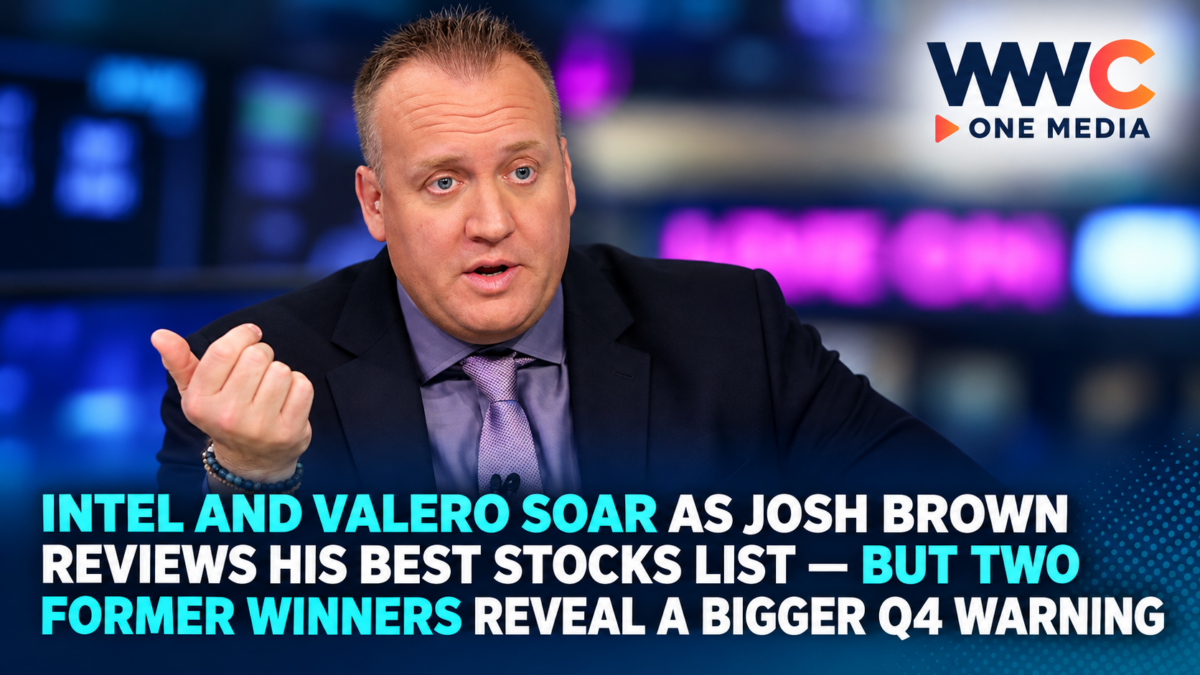
NEW YORK — Intel and Valero Energy have delivered spectacular gains on Josh Brown and Sean Russo’s “Best Stocks in the Market” list, but the beginning of the fourth quarter is also exposing an important lesson for investors: even strong companies can quickly become losing stocks when interest rates, energy prices and market leadership change.
Brown, CEO of Ritholtz Wealth Management, and technical strategist Sean Russo began the fourth quarter by reviewing several names previously featured in their CNBC stock series.
The list had expanded to roughly 145 stocks by October 5, with companies entering and leaving based largely on price trends and relative strength rather than simply because the analysts believe the underlying companies are fundamentally attractive.
That distinction is critical.
Their approach effectively asks:
Which stocks are actually working right now?
Not:
Which companies look cheapest on paper?
And in 2026, those have often been very different things.
Intel has become one of the list’s biggest winners
Few stocks illustrate the change in market perception better than Intel.
According to the review, Intel shares were up roughly 214% for 2026 and around 163% since the stock was first highlighted on January 26.
That is a remarkable reversal for a company that only recently was widely viewed as one of the biggest laggards in global semiconductors.
Intel spent years losing market share in advanced chips, struggling with manufacturing execution and pouring billions of dollars into rebuilding its foundry business.
Now artificial intelligence is changing the narrative.
The company reported $16.1 billion in second-quarter revenue, up 25% year over year, its strongest revenue growth in more than 15 years.
Adjusted earnings came in at 42 cents per share, while Intel forecast third-quarter revenue of between $15.8 billion and $16.8 billion, comfortably above Wall Street expectations at the time.
CEO Lip-Bu Tan said AI is creating unprecedented demand for computing capacity, benefiting Intel across server processors, custom chips, advanced packaging and foundry services.
Intel’s data-center comeback is the real story
Intel’s biggest improvement is coming from data centers.
Its Data Center and AI business generated roughly $6.26 billion in Q2 revenue, as cloud operators expanded CPU purchases alongside massive investments in Nvidia and other AI accelerators.
That matters because AI systems do not run only on GPUs.
Modern data centers still require enormous amounts of:
central processing power;
memory;
networking;
storage;
and packaging.
Investors who once assumed Nvidia’s rise would automatically destroy Intel are increasingly recognizing that explosive data-center construction can expand the overall semiconductor market enough to create multiple winners.
Goldman Sachs now expects U.S. data-center capacity to reach about 64 gigawatts by the end of 2026 and 90 GW by the end of 2027, illustrating the scale of infrastructure still being built.
That environment has helped transform Intel from a turnaround speculation into one of the year’s strongest large-cap stocks.
Intel’s foundry gamble is also regaining credibility
Another major change involves Intel Foundry.
For years, investors questioned whether Intel could successfully compete with Taiwan Semiconductor Manufacturing Co. in advanced contract chip production.
That doubt has not disappeared.
But confidence improved after Intel reaffirmed plans to push its next-generation 14A manufacturing process toward volume production in 2028 and attracted greater interest in advanced packaging and custom silicon.
The stock therefore reflects more than current earnings.
Investors are increasingly assigning value to the possibility that Intel can become strategically important to the United States as Washington attempts to build more advanced semiconductor production domestically.
That makes Intel both an AI trade and an industrial-policy trade.
But a 200%-plus rally creates a new risk
Brown’s review acknowledges that Intel has moved so far that earlier risk levels are no longer particularly useful.
That is an important investing lesson.
A stock can be right for the right reasons and still become much riskier after tripling.
At higher prices:
expectations rise;
valuation expands;
good news gets priced in;
and disappointing execution becomes more damaging.
Intel must now prove that its revenue rebound can turn into durable profit growth while continuing to spend heavily on factories and advanced manufacturing.
The easy part of the comeback trade may already be over.
Valero has been another extraordinary winner
The second standout is Valero Energy.
According to the CNBC-list review, Valero was up roughly 142% year to date and around 113% since its January 8 inclusion.
Unlike Intel, Valero’s rally is not primarily about AI.
It is about one of the year’s most dramatic commodity-market dislocations.
The Iran conflict, disruption around the Strait of Hormuz and attacks on Russian refining infrastructure have pushed global fuel markets into extreme tightness.
That has created exceptional refining margins for U.S. companies capable of turning crude oil into gasoline, diesel and jet fuel.
Valero has been one of the biggest beneficiaries.
Valero just posted a record Q2 profit
The company reported $3.7 billion in second-quarter net income, its strongest quarterly profit since the huge energy shock following Russia’s 2022 invasion of Ukraine.
Adjusted earnings reached $12.54 per share, well above analysts’ $10.12 estimate.
Valero’s refining operating income more than tripled to approximately $4.4 billion.
Its refining margin per barrel almost doubled to $23.62.
Throughput increased to about 3 million barrels per day.
The company also returned $2.6 billion to shareholders during the quarter, while the board authorized another $5-billion share repurchase program during the summer.
Those are exactly the type of fundamentals momentum investors want to see accompanying a rising stock.
The Iran war created a rare refining windfall
Oil refiners do not necessarily benefit simply because crude oil becomes expensive.
Their profits depend heavily on the difference between crude costs and the prices of refined products.
In 2026, that spread widened dramatically.
Middle Eastern shipping disruptions constrained refined-product supply.
Russian refineries faced repeated Ukrainian attacks.
Diesel inventories fell.
Gasoline and jet-fuel markets tightened.
U.S. refiners were therefore able to sell fuel at much stronger margins even as their relative feedstock costs remained manageable.
That created what is effectively a refining supercycle.
Valero happened to be extremely well positioned when it arrived.
Renewable diesel became profitable too
Valero also got help from a business that previously hurt results.
Its renewable diesel operation generated $717 million in Q2 operating income, compared with a $79-million loss a year earlier.
New biofuel mandates and unusually high diesel prices transformed the economics.
This matters because investors are not simply paying for a temporary crude-refining windfall.
They are seeing improved profitability across multiple parts of Valero’s portfolio.
Still, the risk is obvious.
Energy cycles can reverse.
Valero’s biggest strength is also its biggest danger
Valero cannot control global refining margins.
If the Middle East conflict eases, Russian supplies normalize or fuel demand falls sharply, today’s extraordinary margins could compress.
That means some portion of the 142% share-price gain reflects conditions that may not last indefinitely.
This is where momentum investing becomes difficult.
A stock can remain fundamentally strong while the catalyst responsible for its rally begins fading.
Investors therefore need to distinguish between:
a great company;
and
a great company benefiting from an unusually favorable cycle.
Valero currently looks like both.
Then there is CRH—the company doing well while the stock does badly
The list’s losing side may be even more instructive.
Building-materials giant CRH was down roughly 33% from the level where it was added to Brown and Russo’s list and about 31% in 2026, according to the review.
At first glance, that looks like a company in trouble.
The actual operating numbers tell a very different story.
CRH reported second-quarter revenue of $10.8 billion, up 6%.
Net income rose 13% to $1.5 billion.
Adjusted EBITDA increased 7% to $2.6 billion.
Management reaffirmed its full-year outlook for $3.9 billion to $4.1 billion in net income and adjusted EBITDA of $8.1 billion to $8.5 billion.
That means the business is growing while the stock is falling.
High rates can overpower good earnings
CRH illustrates what can happen when the macro environment matters more than company-specific execution.
The U.S. 10-year Treasury yield has climbed to roughly two-decade highs as investors worry about inflation, fiscal deficits and persistent borrowing.
High rates hit construction and housing in several ways.
Mortgage rates rise.
Developers face higher financing costs.
Infrastructure projects become more expensive.
Property values come under pressure.
Corporate acquisitions cost more to finance.
CRH sells aggregates, cement, concrete and other materials heavily exposed to construction activity.
So even with healthy near-term results, investors may worry about what expensive capital eventually does to demand.
CRH is also making a huge acquisition
The company agreed to acquire Arcosa in an $8.5-billion transaction, strengthening its North American aggregates and critical-infrastructure businesses.
Strategically, the deal fits CRH’s plan.
Financially, it arrives at a difficult moment.
Global M&A activity slowed sharply in the third quarter because rising borrowing costs made debt-financed acquisitions more expensive.
Worldwide deal value fell to about $993 billion in Q3, down 41% quarter over quarter.
Investors therefore have to balance CRH’s strong business performance against leverage, financing and cyclical risk.
A good acquisition made during expensive-money conditions can still be punished by the market.
First Solar has been another painful loser
The fourth stock highlighted in the Q4 review is First Solar.
The stock was down around 27% from the level where it had been featured and roughly 32% year to date, according to the review.
By late September, shares were more than 45% below their June 3 high of $320.95.
Again, the operating business itself has not collapsed.
First Solar reported Q2 sales of $1.06 billion and net income of $423 million, or $3.92 per share.
Earnings per share were up 23% year over year.
The company maintained its full-year guidance for:
$4.9 billion to $5.2 billion in revenue;
$2.6 billion to $2.8 billion of adjusted EBITDA;
and 17 to 18.2 GW of module sales.
Its contracted backlog still stood at 45.1 GW.
Those are hardly crisis numbers.
So why has First Solar fallen so hard?
Part of the problem is interest rates.
Utility-scale solar projects require enormous upfront capital.
Higher borrowing costs make project economics less attractive.
A solar farm producing power for 20 or 30 years becomes less valuable when investors can earn more than 5% in government bonds without taking construction or operating risk.
That sensitivity makes renewable-energy stocks particularly vulnerable when Treasury yields rise.
The broader selloff in bond markets has pushed financing costs across housing, infrastructure and clean-energy development sharply higher.
First Solar has therefore suffered even while maintaining strong backlog and earnings guidance.
Policy uncertainty has added another layer
Solar is also unusually dependent on public policy.
Manufacturing credits.
Tax incentives.
Tariffs.
Domestic-content rules.
Trade restrictions.
Permitting.
Any change can alter project economics dramatically.
First Solar’s 2026 adjusted EBITDA guidance assumes roughly $2.1 billion to $2.19 billion in Section 45X manufacturing tax credits.
That does not mean its business exists only because of subsidies.
But it demonstrates how materially U.S. industrial policy affects its reported economics.
Political uncertainty around clean-energy incentives therefore gets reflected quickly in the share price.
First Solar also faces an increasingly aggressive technology fight
The company is simultaneously protecting its technology portfolio.
On October 1, First Solar sued Chinese manufacturer JA Solar and a Corning solar subsidiary for alleged patent infringement.
The case expands a broader intellectual-property enforcement strategy after First Solar shifted away from one International Trade Commission complaint and toward federal litigation.
The lawsuits highlight how fierce global solar competition has become.
Chinese manufacturers have enormous scale and lower production costs.
First Solar’s advantage rests partly on its differentiated thin-film technology and U.S. manufacturing footprint.
Protecting those advantages matters.
But litigation also adds uncertainty.
First Solar proves that strong fundamentals do not guarantee a strong stock
This may be the most important lesson from Brown and Russo’s review.
First Solar is profitable.
Its backlog is huge.
Its earnings guidance remains intact.
Yet the stock is down sharply.
That can happen because share prices represent expectations about the future—not simply current earnings.
Investors may believe:
interest rates remain too high;
solar project economics will deteriorate;
government support could weaken;
or the stock became too expensive earlier in the year.
Fundamental investors sometimes respond to a decline by saying, “But the company is still doing well.”
Momentum investors ask a different question:
Is the stock still working?
That difference explains why names can leave Brown and Russo’s list even if the businesses remain healthy.
Brown’s methodology is deliberately ruthless
“The Best Stocks in the Market” concept is built around price strength.
Brown and Russo are not trying to predict every corporate turnaround.
They prefer companies whose stocks have already demonstrated that buyers are willing to consistently pay higher prices.
That philosophy rests on a simple idea:
strong stocks often stay strong longer than investors expect.
Weak stocks can stay weak even when they appear cheap.
Earlier 2026 installments of the list took the same approach in semiconductors, biotech, capital markets and cybersecurity, with Brown repeatedly emphasizing relative strength and price action.
That explains why Intel and Valero remain interesting despite enormous gains.
Momentum itself is part of the thesis.
The list is not Brown’s personal portfolio
Another distinction matters.
A stock appearing on a “best stocks” research list does not necessarily mean Brown personally owns it in exactly the same size or recommends it for every investor.
Ritholtz Wealth Management’s public 13F filing shows a diversified portfolio containing broad-market ETFs as well as individual stocks.
At the end of June, its largest reported positions included Vanguard Total Stock Market ETF, iShares Core S&P 500 ETF and Invesco QQQ, alongside Apple and Nvidia.
That is a useful reminder for readers.
A stock watchlist and a diversified investment portfolio are not the same thing.
Q4 begins with one of the strangest markets in years
Brown’s review comes at an unusually complicated moment.
The S&P 500 gained roughly 2% during Q3, while the Nasdaq hit records.
Yet Reuters estimates about 40% of S&P 500 stocks were still down for the year as the quarter ended.
That means headline indexes are hiding considerable weakness underneath.
Artificial-intelligence stocks have done much of the heavy lifting.
Microsoft.
Meta.
Nvidia.
Apple.
Several gained more than 10% in Q3 alone.
Meanwhile, rate-sensitive stocks, small caps and many traditional businesses have struggled.
More than half of U.S. stocks have suffered bear-market-sized declines
The divide is even more dramatic outside the biggest indexes.
MarketWatch reported that 54% of Russell 3000 stocks had fallen more than 20% from their June levels, despite the S&P 500 still posting a strong year-to-date return.
That is effectively a stealth bear market beneath a bull-market index.
It explains why stock selection suddenly matters much more.
An investor holding Nvidia sees one version of 2026.
An investor holding a rate-sensitive building, renewable-energy or smaller industrial stock may see something completely different.
That environment is almost perfectly designed for a momentum-oriented list.
Treasury yields are becoming the great divider
The most important force separating winners from losers may not be earnings.
It may be interest rates.
The 10-year Treasury yield has moved above 5%, reaching levels not seen consistently in roughly two decades.
Higher yields hurt long-duration and capital-intensive businesses.
They increase financing costs.
They make future earnings less valuable.
And they give investors a safe alternative to stocks.
But certain companies can thrive anyway.
Intel benefits from enormous AI demand.
Valero benefits from exceptional refining margins.
Those tailwinds have been powerful enough to overwhelm the rate pressure.
CRH and First Solar have not enjoyed the same protection.
This creates an uncomfortable truth about investing
Investors often prefer stories that are easy to understand.
Good company equals good stock.
Bad company equals bad stock.
Markets do not work that neatly.
CRH can post growing revenue and profits while falling 30%.
First Solar can maintain billions in earnings guidance and a 45-GW backlog while losing nearly half its value from a peak.
Intel can triple after years of disappointment.
Valero can double because geopolitical conflict suddenly transforms refining economics.
The stock market prices change in expectations.
Not morality.
Not reputation.
Not yesterday’s results.
Intel and Valero also show why chasing winners can still work
Traditional investing advice often warns against buying a stock after a huge rally.
Sometimes that advice is sensible.
Sometimes it causes investors to miss enormous trends.
Intel was already up substantially when its turnaround became obvious.
Valero had already rallied before record margins showed up in reported earnings.
Momentum investing assumes investors systematically underestimate how long strong trends can persist.
Brown and Russo’s list is built around that possibility.
But it also requires discipline.
If momentum breaks, the thesis changes.
CRH and First Solar show the opposite danger
Value investors often become attracted to stocks precisely because they have fallen sharply.
That can work.
But a stock down 30% can fall another 30%.
A company can remain fundamentally strong while macro conditions keep pushing investors away from the sector.
CRH and First Solar demonstrate why Brown’s methodology is willing to remove losers instead of waiting indefinitely for vindication.
The point is not that the companies are bad.
The point is that the market currently prefers something else.
Q4 could test every one of these trades
Intel now needs to show that AI-driven demand justifies a stock up more than 200%.
Valero needs refining margins to remain strong enough to sustain extraordinary profits.
CRH needs investors to believe infrastructure and construction demand can withstand high rates.
First Solar needs clean-energy economics and policy support to outweigh financing concerns.
That makes Q4 important for all four companies—but for very different reasons.
The market itself is facing the same test
U.S. equities have managed to survive:
oil above $100;
Treasury yields above 5%;
another Federal Reserve rate increase;
Middle East conflict;
and growing concern over AI valuations.
Yet indexes remain near records because corporate earnings have been unusually strong.
Reuters noted that Q2 U.S. corporate earnings increased 53.7%, helping offset almost every macroeconomic shock thrown at stocks during the quarter.
Q3 earnings season will now test whether that support remains strong enough.
If earnings stay robust, winners such as Intel may keep running.
If earnings disappoint while yields remain high, market leadership could change extremely quickly.
The real lesson from Brown’s list is not which four stocks won
Intel and Valero make impressive headlines.
CRH and First Solar make painful ones.
But the bigger lesson is about how quickly leadership changes.
At the beginning of a year, an investor can have a perfectly reasonable view about:
AI;
energy;
construction;
or renewable power.
Nine months later, geopolitics, interest rates and earnings can completely reorder the winners.
Intel and Valero entered Q4 as two of the strongest examples of momentum working.
CRH and First Solar entered it as reminders that fundamentals alone do not control the stock price.
And with the S&P 500 near records while much of the market remains deeply underwater, Q4 may test one of Brown’s core investing principles more aggressively than ever:
sometimes the best stock is not the cheapest company or even the best-known business—it is simply the one investors keep buying.