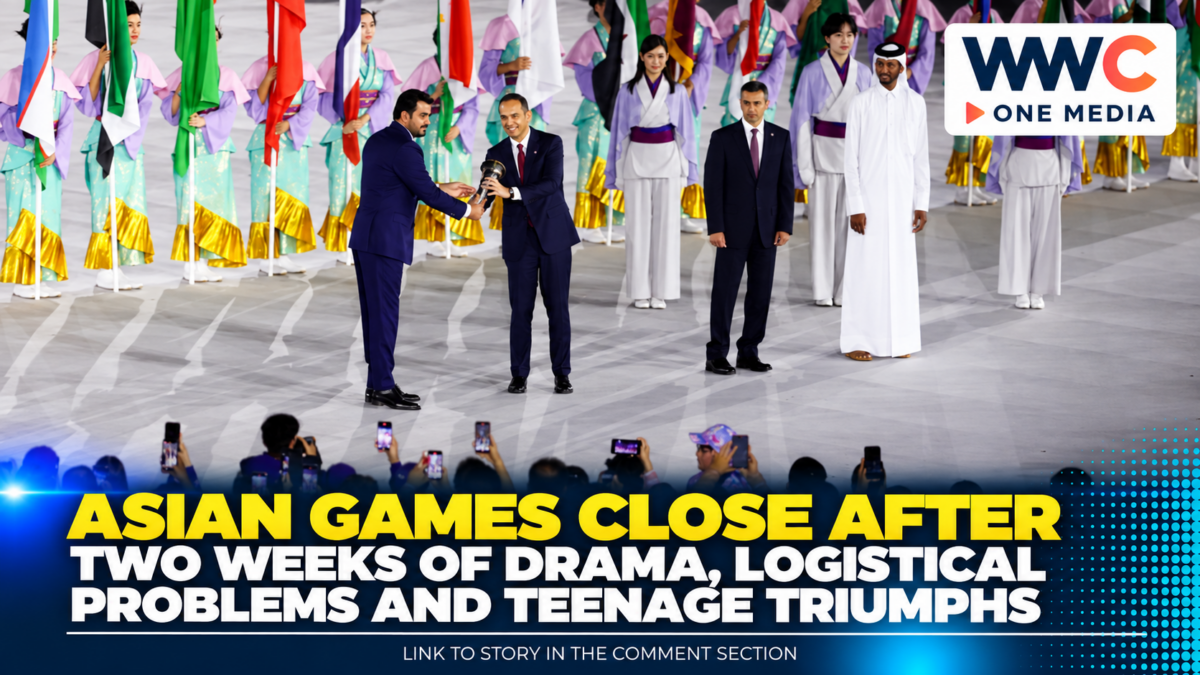
The 20th Asian Games officially closed in Japan on Sunday after two weeks of competition that produced standout performances from a new generation of athletes while also being marked by accommodation, transportation and organisational problems.
The Aichi-Nagoya Games brought together around 17,000 athletes and officials for 469 gold-medal events across venues stretching from Tokyo to Osaka. The closing ceremony was held at Mizuho Park Athletic Stadium in Nagoya, where Olympic Council of Asia President Sheikh Joaan bin Hamad Al Thani declared the Games closed and passed the symbolic torch to organisers of the next edition in Doha in 2030.
The scale of the event created challenges from the beginning. Organisers had planned for about 15,000 athletes and officials, but registrations eventually rose to roughly 17,000, leaving organisers scrambling to provide accommodation and transportation for the additional participants.
Unlike many major multi-sport events, Aichi-Nagoya did not have a dedicated athletes’ village. Participants were instead accommodated in hotels, wooden container-style units and even a cruise ship. Some athletes reportedly waited for hours to complete registration, while others encountered double-booked rooms, incorrect room assignments and cramped accommodation.
Transportation also became a recurring problem throughout the Games. Shuttle buses reportedly failed to arrive or took athletes to the wrong venues, contributing to delays in several competitions. South Korea’s delegation was among those that publicly expressed frustration with the organisation, while Japanese Olympic Committee President Seiko Hashimoto said organisers needed to reflect on whether they had been sufficiently prepared for the unexpectedly high number of participants.
There were also several diplomatic and ceremonial mishaps. At one hockey match, the North Korean national anthem was mistakenly played for South Korea’s men’s team, prompting an immediate apology from the stadium announcer. South Korea later faced another ceremonial issue when its national flag was not raised during the medal ceremony after its men’s football team defeated Japan for gold.
Despite those problems, the sporting competition produced a series of remarkable performances, particularly from teenage athletes. China’s 13-year-old swimmer Yu Zidi emerged as one of the biggest stars, winning three individual gold medals and being named the Games’ female Most Valuable Player. Her performances have also drawn attention ahead of the 2028 Los Angeles Olympics.
Yu’s Chinese teammate Zhang Zhanshuo, 19, made history by becoming the first swimmer to win seven gold medals at a single Asian Games. Japan’s 17-year-old Shin Ohashi also made headlines after breaking the world record in the men’s 200-metre breaststroke.
Teenage success extended beyond swimming. China’s 18-year-old Yan Ziyi won the women’s javelin with a high-level performance, while Thailand’s 20-year-old sprinter Puripol Boonson won both the men’s 100 and 200 metres and was named the men’s Most Valuable Player.
Other athletes also produced notable moments during the final days. Taiwan’s Lin Yu-ting won women’s 60kg boxing gold, adding another Asian Games title after moving up from the 57kg division in which she won at the previous Games. India also collected boxing gold medals, while Malaysia captured both the men’s and women’s squash team titles.
The Games also featured several sports making their Asian Games debuts. Padel, mixed martial arts, teqball and surfing were included in a record programme of 43 sports, while esports returned after its debut at the Hangzhou Games.
China finished at the top of the medal table with 169 gold medals and 341 medals overall, its strongest gold-medal haul at an Asian Games held outside China. Japan finished with 83 gold medals and 269 medals overall, surpassing its previous record of 75 golds at the 1994 Hiroshima Games.
Singapore also recorded a notable milestone when mixed martial artist Tiffany Teo won the country’s first gold medal of the Games in the women’s traditional 60kg final. Teo defeated Uzbekistan’s Khilola Sobirova in the final on Sept. 22 to claim the title.
The organisers’ performance has nevertheless been assessed differently by different observers. The Olympic Council of Asia described the Games as a success, pointing to strong sporting performances, audience engagement and financial results. OCA officials said the event generated nearly 20 per cent more revenue than the 2022 Hangzhou Games and produced 54 world records, 11 junior world records and 89 continental records.
The organisers’ decision to avoid building a large permanent athletes’ village was presented as part of a more financially sustainable approach. OCA officials argued that the model reduced the risk of leaving behind costly facilities after the Games, although the accommodation and transport difficulties showed the challenges of operating such a large event without a central village.
With the Aichi-Nagoya Games now concluded, attention turns to Qatar, which is scheduled to host the next Asian Games in Doha in 2030. The OCA has also discussed the possibility of moving that edition to 2031 so it can serve as a qualifier for the 2032 Brisbane Olympics.
The Aichi-Nagoya Games therefore ended on a mixed but eventful note: a major Asian sporting gathering that delivered record-breaking performances and breakthrough moments for young athletes, while also exposing logistical challenges that organisers and future hosts will have to consider when planning events of similar scale.