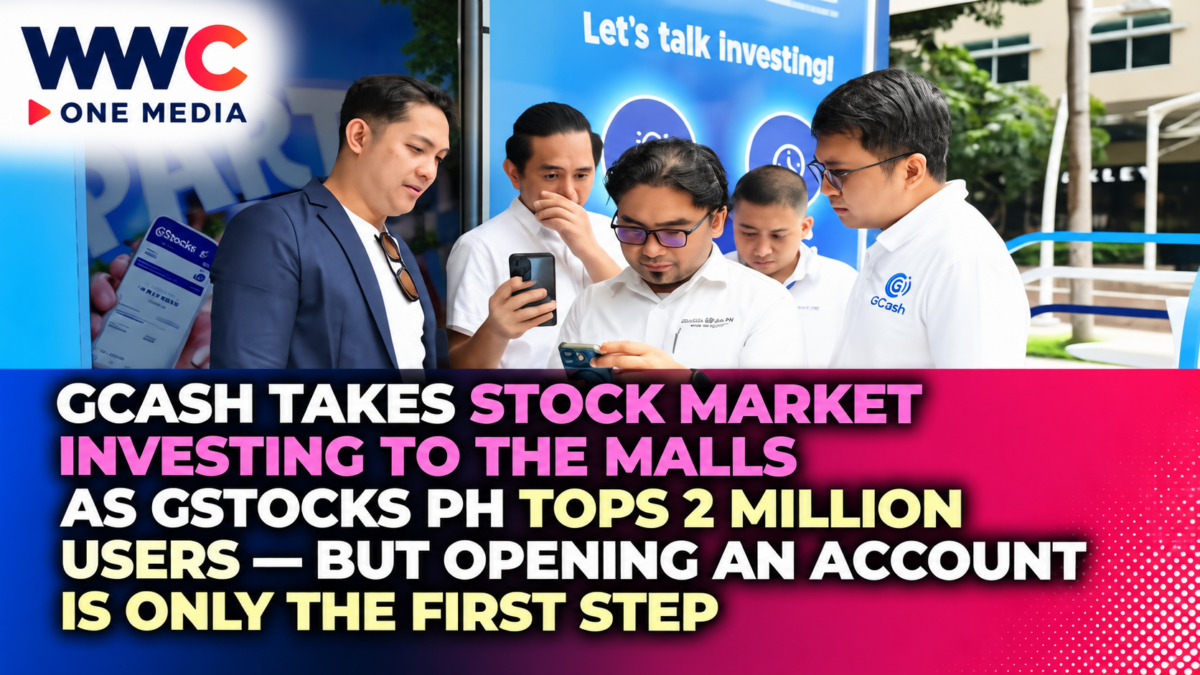
MANILA — GCash is taking stock-market education out of trading screens and into two of Metro Manila’s busiest commercial centers, launching interactive “Part-Owner Era” hubs designed to convince more Filipinos that becoming a shareholder does not have to be complicated, expensive or reserved for the wealthy.
The temporary learning spaces at Bonifacio High Street B2 in Taguig and the second-floor concourse of One Ayala in Makati offer beginner-friendly explanations of how stocks work, how investors can manage risk and why diversification matters.
Visitors can also get assistance opening an account on GStocks PH, the stock-trading service accessible inside the GCash app through licensed Philippine Stock Exchange broker AB Capital Securities Inc.
The hubs opened September 28 and are scheduled to run until October 12, 2026.
But the physical booths are only the visible part of a much bigger shift.
GCash says GStocks PH now serves more than 2 million Filipinos, giving the platform an enormous presence in a Philippine stock market where digital accounts are expanding at a record pace.
That scale creates an opportunity.
It also creates a new challenge:
getting millions of Filipinos to open brokerage accounts is much easier than teaching them how to invest responsibly for years.
GStocks PH Has Become a Major Gateway Into the Philippine Stock Market
GStocks PH allows qualified GCash users to access stocks listed on the Philippine Stock Exchange without needing to separately visit a brokerage office.
The actual broker behind the service is AB Capital Securities Inc., an active PSE trading participant licensed as a broker-dealer.
The distinction matters.
GCash provides the digital interface and access point.
AB Capital provides the brokerage service, research and trading infrastructure.
That means GStocks PH is not simply an e-wallet feature where GCash itself buys shares for customers.
Users are opening a brokerage relationship through a regulated market participant.
More Than 2 Million Users Is a Huge Number for the Philippine Market
The latest figures show how dramatically digital investing has altered local market participation.
GStocks PH now reports more than 2 million users.
Meanwhile, the PSE’s 2025 Stock Market Investor Profile recorded 3.64 million total stock-market accounts, up 27.3% from 2.86 million in 2024.
Retail investors accounted for approximately 3.61 million accounts, or 99.2% of the total.
Around 3.22 million retail accounts were online, and online retail accounts increased 30.5% year on year.
Those numbers show that retail participation is no longer being driven primarily by traditional brokerage offices.
It is increasingly happening through:
phones,
digital platforms,
and financial apps.
But ‘2 Million Users’ Does Not Necessarily Mean 2 Million Active Traders
This is an important distinction.
A registered user or brokerage account is not automatically an active investor.
Some people may:
open an account,
deposit once,
make one trade,
or never trade at all.
GCash itself has acknowledged this challenge.
Darvin Sy Su, GCash general manager for wealth management, recently said the platform has attracted many first-time users who are essentially trying investing, and that the next challenge is converting that curiosity into regular investing behavior.
That is why the educational campaign matters.
The next stage is not simply account acquisition.
It is investor retention.
PSE Has Been Warning About the Same Problem
The Philippine Stock Exchange welcomed the surge in online accounts but has repeatedly stressed that investor education must grow alongside access.
When stock-market accounts jumped above 2.8 million in 2024, PSE President and CEO Ramon Monzon said the important issue was not simply the number of accounts.
Retail investors also need enough knowledge to avoid common investing mistakes.
That becomes even more important when trading moves inside apps people already use every day.
Reducing friction is good for financial inclusion.
But reduced friction can also make it easier for inexperienced investors to act before they understand the risks.
The ‘Part-Owner Era’ Hubs Are Trying to Slow Investors Down Before They Speed Up
That may sound contradictory.
GCash wants stock investing to become easier.
But it also wants new investors to take more time understanding what they are buying.
The hubs therefore focus on basic concepts such as:
what a stock represents,
how market prices move,
portfolio diversification,
and risk management.
The message behind the “Part-Owner Era” campaign is that buying shares means becoming a fractional owner of a real business.
That framing can help move beginners away from thinking of stocks as lottery tickets or short-term bets.
A Stock Is Ownership — Not a Guaranteed Return
This distinction is essential.
When a person buys shares of a listed company, they are buying an ownership interest.
That ownership may produce returns through:
share-price appreciation,
dividends,
or both.
But share prices can also fall.
Companies can cut dividends.
Businesses can lose money.
And even well-known blue-chip stocks can produce negative returns over certain periods.
That is why access without education can be dangerous.
An app can simplify the mechanics of investing.
It cannot eliminate market risk.
GCash Is Offering Research Inside the Platform
To address that gap, GStocks PH includes research from AB Capital Securities.
The platform also offers tools such as:
real-time quotes,
watchlists,
portfolio tracking,
research reports,
price alerts,
limit orders,
and company disclosures.
That gives retail investors tools that historically were more closely associated with full-service brokerage accounts.
It also brings research closer to the moment when users make investment decisions.
That can be helpful.
But research still needs to be understood critically.
A report is information—not a guarantee.
The App Now Organizes Stocks Into Beginner-Friendly Categories
GCash says GStocks PH includes curated categories intended to help beginners navigate the market.
These include stocks grouped around themes such as:
starter investments,
higher-dividend companies,
and
large PSE index companies.
The interface also highlights lower-cost entry points.
That addresses one of the biggest misconceptions surrounding Philippine equities:
that a person needs hundreds of thousands of pesos to begin.
GCash Says Users Can Start With Around ₱500
The platform promotes stock investing for amounts as low as roughly ₱500, subject to the required board lot and market price of the particular stock being purchased.
That is an important psychological change.
Traditional investing was often associated with:
bankers,
wealthy families,
professional traders,
and large brokerage accounts.
A ₱500 entry point reframes the stock market as something accessible to ordinary salaried workers and younger investors.
But low minimums also create another challenge.
The fact that someone can invest ₱500 does not mean every ₱500 should automatically go into stocks.
Emergency savings and high-interest debt may deserve priority first.
The Platform Gives Access to More Than 280 Listed Companies
GCash says GStocks PH provides trading access to more than 280 Philippine-listed companies.
Those companies span:
banks,
property developers,
consumer companies,
utilities,
telecommunications,
industrial firms,
REITs,
energy,
and other industries.
That allows investors to build diversified portfolios rather than relying on a single stock.
But having hundreds of choices can also overwhelm beginners.
This is another reason financial education becomes important.
More options do not automatically create better decisions.
The Philippine Stock Market Is Becoming Far More Digital
The growth has been dramatic.
The PSE recorded just 1.91 million accounts in 2023.
By 2024, the number had jumped to 2.86 million.
By 2025, it had reached 3.64 million.
That means the Philippine stock-investor account base has nearly doubled in only two years.
The PSE itself has previously attributed much of the acceleration to digital platforms and e-wallet integrations such as GCash.
That is a profound structural shift.
GCash Helped Remove One of the Biggest Frictions: Opening the Account
For years, opening a brokerage account could involve:
printing forms,
submitting identification,
sending bank documents,
waiting for approval,
and separately transferring money.
Digital onboarding significantly reduces those hurdles.
Eligible fully verified GCash customers can begin the GStocks PH application from the app and open an AB Capital account digitally.
The trading wallet can also be funded through GCash.
Cash-in and cash-out transactions can be reflected in real time under the platform’s procedures.
That changes the convenience equation dramatically.
But Faster Funding Can Also Encourage Faster Decisions
Traditional friction sometimes discouraged participation.
But friction can also force people to think.
When cash moves instantly from an e-wallet into a trading account, an inexperienced investor may make decisions much faster than before.
That is why educational tools such as the Part-Owner Era hubs should not be viewed merely as marketing.
They can function as a counterbalance to the speed of the platform.
The easier financial transactions become, the more important financial judgment becomes.
GCash Is Also Bringing Education Inside the App
The physical hubs last only until October 12.
GCash therefore needs the educational component to continue digitally.
The company says its app includes InvesTips, research materials and other educational resources for users interested in investing.
It is also expanding its financial-learning strategy through tools such as its AI-powered Pera Coach, designed to provide educational information and guidance inside the app.
This is part of a broader transformation of GCash.
The company increasingly wants to be more than a payments wallet.
GCash Is Becoming a Wealth Platform
For years, GCash was most strongly associated with:
money transfers,
QR payments,
mobile load,
and bills.
Its investment ecosystem now includes multiple products.
GInvest encompasses offerings such as:
GStocks,
GFunds,
GBonds,
and other wealth-related services.
GCrypto has also attracted millions of registrations, while GBonds has expanded access to government securities.
Strategically, the goal is clear.
GCash wants customers who initially used the platform to send or spend money to eventually use it to:
save,
invest,
borrow,
insure,
and build wealth.
That creates a much deeper financial relationship.
Stocks Are Particularly Important Because They Build Long-Term Engagement
Payments are transactional.
A user opens the app, pays, and leaves.
Investing can create a much longer relationship.
A shareholder may return regularly to:
check prices,
read research,
receive dividends,
add funds,
or rebalance a portfolio.
That increases engagement.
For GCash and its brokerage partners, the investor relationship can therefore become much more durable than a simple payment.
But GStocks Is Not GCash’s Brokerage
This should remain clear in any discussion of the service.
AB Capital Securities is the licensed broker behind GStocks PH.
The PSE lists AB Capital Securities as an active local corporate broker-dealer serving retail, institutional and foreign clients.
GCash provides the interface and digital access.
The brokerage relationship and securities-trading services come through AB Capital.
This structure is important for regulation and investor protection.
AB Capital Has Been in the Brokerage Business for Decades
GCash describes AB Capital as one of the Philippines’ long-established brokerage firms.
The GStocks service includes AB Capital market research and trading services inside the digital platform.
That partnership combines two very different strengths.
AB Capital brings traditional capital-market infrastructure.
GCash brings mass-market digital distribution.
That combination helps explain why GStocks scaled so quickly.
A broker could spend years trying to acquire two million individual customers through conventional methods.
GCash already has a massive digital consumer base.
The Biggest Competitive Advantage Is Distribution
This is where fintech changes finance.
The technology behind buying a stock is not new.
Online stock trading existed in the Philippines long before GStocks.
What GCash changed was distribution.
Millions of consumers already had:
the app,
verified identities,
digital wallets,
and transaction histories.
Adding stocks into that environment sharply reduces customer-acquisition friction.
That is why digital financial platforms can expand much faster than traditional standalone brokerages.
But Account Growth Does Not Automatically Mean a Deeper Stock Market
This is another important distinction.
The Philippine market can add millions of retail accounts without automatically solving bigger structural issues such as:
low trading liquidity,
limited IPO activity,
thin participation in smaller listed companies,
or long periods of weak index performance.
More accounts are useful.
But deeper capital markets require actual:
capital,
trading,
new listings,
and long-term investment.
The success of GStocks should therefore eventually be measured by more than account registrations.
PSE Needs Those New Investors to Stay
The Exchange benefits if digital platforms bring people into stocks.
But the ideal outcome is not someone making one trade and leaving forever.
The more important outcome is a generation of Filipinos who:
regularly invest,
understand listed businesses,
participate in IPOs,
hold shares for long periods,
and use equities as part of financial planning.
That would give Philippine companies a deeper pool of domestic capital.
It could also reduce dependence on foreign fund flows.
Young Filipinos Are Becoming Much More Important
Recent market-profile reporting indicates younger investors represent a meaningful share of new retail participation.
Investors aged 18 to 28 accounted for roughly 28% of total PSE accounts in 2025, according to figures cited from the PSE investor profile.
That demographic shift matters.
A 22-year-old opening a stock account has decades of potential investing ahead.
If that person develops a disciplined habit, relatively small regular investments can compound significantly over time.
That is why investor education targeted at beginners can have effects far beyond one promotional campaign.
But Younger Investors Have Grown Up in a Different Market Culture
They have also grown up surrounded by:
crypto,
meme stocks,
social-media influencers,
viral trading content,
and instant financial information.
That creates both opportunity and risk.
Financial markets are more accessible than ever.
So is bad advice.
A confident TikTok video can look as credible as professional research to someone with little investing experience.
That makes reliable education especially important.
GCash Must Avoid Turning Investing Into Pure Gamification
Digital investing works best when convenience encourages discipline.
It becomes more dangerous when the interface encourages people to treat investing like entertainment.
Successful investing often involves boring behavior:
saving regularly,
diversifying,
controlling risk,
avoiding emotional decisions,
and holding quality assets through volatility.
Those behaviors generate fewer viral moments than speculative trading.
But they are generally more compatible with long-term wealth building.
GCash’s emphasis on education suggests it recognizes that tension.
‘Part-Owner’ Is a Useful Message Because It Changes the Psychology
Calling an investor a part-owner is more than branding.
It reframes what a stock represents.
Someone buying shares of a bank is not merely betting that a ticker symbol goes higher tomorrow.
They own a tiny economic interest in that institution.
The same is true for:
a retailer,
a utility,
a property company,
or a food manufacturer.
That mindset can encourage investors to ask better questions:
Does this company make money?
Does it have too much debt?
Can it grow?
Does it pay dividends?
What could hurt its business?
Those are ownership questions.
Diversification Is One of the Hubs’ Main Lessons
GCash says the physical hubs include material on diversified portfolios and managing investment risk.
That may be among the most valuable lessons beginners can learn.
A person who places all available savings into one company is exposed to one company’s problems.
Owning several companies across industries can reduce that concentration risk.
Diversification does not eliminate losses.
It reduces dependence on one outcome.
Dividend Education Could Also Appeal to Filipino Investors
The platform specifically highlights dividend-paying companies.
That can resonate strongly with investors who prefer regular cash returns rather than relying entirely on share-price appreciation.
Many established Philippine companies distribute part of their profits to shareholders.
REITs have also increased awareness of dividend investing.
But high dividend yield alone is not proof that a stock is attractive.
A yield can rise because a share price has collapsed.
Again, education matters.
The ₱1,000-and-Below Lists Need Context Too
GCash promotes beginner-oriented selections that may be purchasable for relatively modest amounts.
This helps break the misconception that stock investing requires large capital.
But affordability and value are different concepts.
A stock that costs ₱5 per share is not automatically cheaper economically than a stock trading at ₱1,000.
What matters is the company’s total valuation relative to:
profits,
assets,
growth,
and risk.
That is another concept new investors need to understand.
Easy Access Could Help Build an Investing Habit
Used properly, low entry thresholds can be extremely valuable.
A young worker may not have ₱100,000 to invest.
They might have:
₱500,
₱1,000,
or ₱2,000 per month.
If investing becomes part of a regular monthly financial routine, those amounts can accumulate.
The real opportunity is not convincing people to make one large trade.
It is helping them develop consistent saving and investing behavior.
That is why GCash now says turning first-time “tryers” into repeat investors is a central challenge.
The Growth Also Benefits Philippine Listed Companies
A broader retail-investor base can eventually improve capital formation.
When companies raise money through:
IPOs,
follow-on offerings,
stock rights offerings,
or other equity transactions,
they need buyers.
A larger pool of domestic retail investors can help absorb those offerings.
That matters particularly when foreign investors are withdrawing money from emerging markets.
A strong domestic investor base can create greater resilience.
But Retail Investors Need Protection From Scams
Greater interest in investing also creates opportunities for fraudsters.
Scammers can impersonate:
brokers,
analysts,
listed companies,
or investment advisers.
They can promise:
guaranteed returns,
secret stock tips,
or supposedly exclusive trading groups.
The more Filipinos enter financial markets, the larger the potential victim pool becomes.
That means financial literacy must include more than learning how to buy shares.
It must include learning how to recognize scams.
Licensed Platforms Matter
One simple protection is confirming that the securities broker is properly licensed and recognized by the Philippine Stock Exchange and regulators.
AB Capital Securities appears on the PSE’s list as an active trading participant.
That does not remove investment risk.
It does distinguish legitimate brokerage access from unauthorized investment schemes.
Investors should still understand that even transactions through legitimate brokers can lose money.
Regulation protects the integrity of the process.
It cannot guarantee market returns.
Digital Wealth Platforms Are Competing for the Same New Investor
GCash is not alone in trying to attract retail investors.
The PSE itself has credited integration with digital platforms, including e-wallets, for the rapid increase in investor accounts.
This competitive environment should continue reducing friction.
Platforms will compete on:
onboarding,
research,
user experience,
education,
fees,
and product variety.
That can be positive for consumers.
But the race to make investing easier should not become a race to make risk disappear from the marketing message.
The Next Frontier Is Foreign Stocks
Mynt has also indicated that it is preparing for a regulatory sandbox involving GStocks Global, intended to potentially expand access to U.S.-listed equities.
If that proceeds, Filipino retail investors could eventually have easier digital access not only to Philippine companies but to names listed in the United States.
That would represent another dramatic increase in choice.
It would also introduce additional risks involving:
foreign exchange,
overseas market volatility,
different disclosure rules,
and international tax considerations.
The need for education would become even greater.
GCash Is Trying to Build the Investor Before Expanding the Product Shelf
That may be the deeper logic behind the current campaign.
GStocks can add more companies.
GCash can eventually add more markets.
But if users do not understand basic investing principles, more products may simply create more ways to make mistakes.
The Part-Owner Era hubs therefore arrive at an important stage.
The platform has already proved it can attract millions of users.
Now it needs to prove it can help develop millions of more capable investors.
The Two Mall Locations Are Symbolic
Bonifacio High Street and One Ayala are not traditional financial-education venues.
They are commercial spaces people visit for:
shopping,
work,
food,
transport,
and entertainment.
Putting stock-market education there sends a deliberate message.
Investing should not feel like something confined to:
bank towers,
trading floors,
or wealthy business districts.
It can become part of everyday financial life.
That is the inclusion story GCash wants to build.
But Real Inclusion Means More Than Making the Button Easy to Find
Financial inclusion is often measured by access.
Can someone open the account?
Can they afford the minimum?
Can they fund it digitally?
Those things matter.
But meaningful investment inclusion requires more.
Can the person understand the product?
Can they evaluate risk?
Can they avoid panic selling?
Can they identify scams?
Can they distinguish investment from speculation?
And can they afford to lose the money they put at risk?
Those questions determine whether access actually improves financial health.
The Philippine Market Has Already Passed the Access Test
The account figures show tremendous progress.
3.64 million market accounts.
3.61 million retail accounts.
3.22 million online retail accounts.
More than 2 million GStocks PH users.
The digital infrastructure is clearly working.
The next question is whether behavior catches up.
Millions of Accounts Could Become a New Investing Generation
If even a fraction of these new users become consistent long-term investors, the implications could be substantial.
More Filipinos could own shares in companies they already interact with every day.
Workers could supplement traditional savings with equity exposure.
Listed companies could gain a wider domestic shareholder base.
Capital-market participation could become less concentrated among wealthy investors.
That is the optimistic outcome.
The Opposite Outcome Is Possible Too
Millions of people could open accounts during a marketing push.
Many could make speculative trades.
Some could experience losses.
Others could abandon the market entirely.
That would create account growth without building a true investing culture.
This is why education cannot be treated as an accessory.
It is the difference between access becoming financial inclusion and access becoming short-lived speculation.
The Real Test Comes After the Hubs Close
The Bonifacio High Street and One Ayala booths close after October 12.
The more important campaign continues after that.
Do new users:
keep learning,
make informed decisions,
diversify,
invest regularly,
and stay in the market?
Or do they open accounts, make one trade and disappear?
Those numbers will say much more about GStocks PH’s long-term impact than foot traffic at a mall activation.
GCash Has Already Changed How Filipinos Enter the Stock Market
That achievement should not be understated.
A few years ago, the PSE had fewer than two million investor accounts.
Now it has more than 3.6 million.
GCash and other digital platforms helped accelerate that transition.
A financial product that once felt distant to many ordinary Filipinos can now be accessed from the same phone used to:
pay bills,
send money,
or buy mobile load.
That is a major change.
But Democratizing Investing Also Democratizes Risk
This is the other side of the same story.
When investing becomes easier, more people benefit from access to wealth-building tools.
More people can also make costly mistakes.
That means platforms taking millions of new investors into the market inherit a responsibility that goes beyond technology.
They need to help users understand what the technology lets them do.
And that is why the most important feature in GCash’s newest stock-market push may not be another trading button.
It may be the effort to teach first-time investors what being a “part-owner” actually means before they put real money at risk.