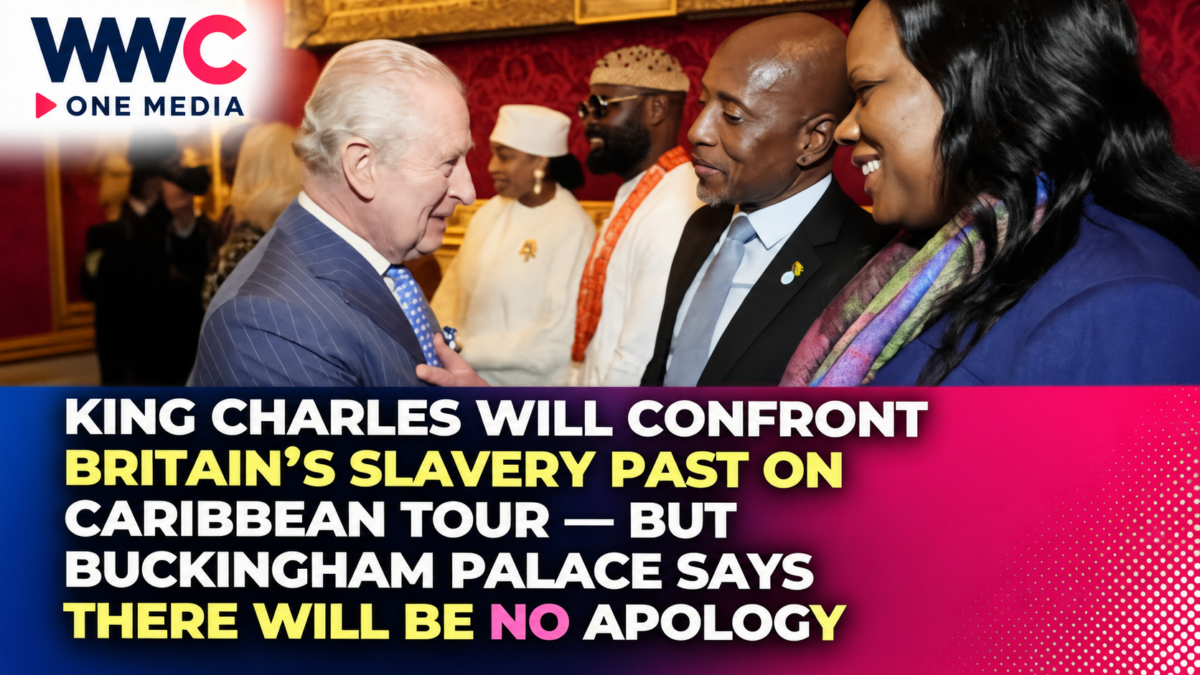
LONDON — King Charles III will travel through the Caribbean later this month under growing pressure to confront Britain’s role in transatlantic slavery, but Buckingham Palace has made one position clear before the trip even begins: the monarch will acknowledge the painful history, but he is not expected to issue a formal apology or offer reparations.
Charles will visit The Bahamas and Guyana before traveling to Antigua and Barbuda, where he and Queen Camilla will attend the Commonwealth Heads of Government Meeting, or CHOGM, from November 1 to 4. The wider royal tour runs from October 27 through November 4.
The Palace says Charles will not “shy away” from what he has previously described as the darkest chapters of Britain’s past.
But there is an important legal and constitutional line.
A formal apology on behalf of the United Kingdom—and any decision to pay reparations—would ultimately be a matter for the British government rather than the King acting independently.
That distinction is now at the heart of one of the most politically sensitive royal tours in years.
Charles Has Already Called Slavery an ‘Atrocity’
The King has gone further than many previous British monarchs in publicly acknowledging the suffering caused by slavery.
Before becoming King, Charles expressed his “personal sorrow” over the transatlantic slave trade during the 2022 Commonwealth summit in Rwanda.
Buckingham Palace has also pointed to previous statements in which he described slavery as an “atrocity” that “forever stains our history.”
Those words matter.
But they stop short of a formal apology.
And for governments and reparations advocates across the Caribbean, that distinction is becoming increasingly difficult to ignore.
Why an Apology Matters So Much
An expression of sorrow and a formal apology are not the same thing.
Sorrow acknowledges suffering.
An apology can be interpreted as accepting responsibility.
That difference becomes especially important when legal claims for reparations are being discussed.
Buckingham Palace has been careful to frame Charles’s previous statements as recognition of historical injustice without moving into language that could imply legal or financial liability.
That is one reason the Palace continues to emphasize that reparations are primarily a government matter.
The British Government Still Rejects Reparations
The United Kingdom’s official position remains unchanged.
British governments have repeatedly rejected calls to pay reparations for transatlantic slavery, preferring to emphasize current development partnerships and future cooperation with Commonwealth countries.
That position creates a difficult balancing act for Charles.
As King, he wants to acknowledge the past.
But as a constitutional monarch, he acts within boundaries shaped by government policy.
So even if he personally wanted to go further, he does not have the freedom of an ordinary political leader.
But Caribbean Governments Are Pushing Harder
Pressure for reparations has intensified across the Caribbean.
The issue is no longer confined to activists or academics.
Governments are increasingly using diplomatic, political and legal avenues to press Britain and other former colonial powers.
Caribbean leaders argue that slavery did not merely cause historic suffering.
They say its economic and social effects continue to shape:
education,
health,
land ownership,
poverty,
public debt,
and development opportunities.
That is why reparations advocates argue the issue cannot be treated simply as something that ended centuries ago.
Jamaica Has Taken the Debate Into the Legal System
One of the most consequential recent developments came from Jamaica.
In September, a Jamaican government delegation traveled to Britain and formally submitted a reparations petition to King Charles.
The petition asked the King to refer three legal questions to the Judicial Committee of the Privy Council.
Those questions include whether the forced transportation and enslavement of Africans in Jamaica was lawful, whether it breached international law, and whether Britain may have a legal obligation to provide reparatory remedies.
That was already historic.
Then came an even more important development.
King Charles Referred Jamaica’s Petition
Jamaica announced in late September that Charles had referred the petition to the Judicial Committee of the Privy Council for legal advice.
Jamaican Culture Minister Olivia Grange described the decision as a major breakthrough.
The Privy Council’s eventual opinion would not automatically force Britain to pay reparations.
But it could influence future negotiations and provide legal guidance that other Commonwealth countries might attempt to use.
That means Charles is entering the Caribbean only weeks after allowing one of the most serious reparations challenges yet to move deeper into the British legal system.
That Makes This Tour Much More Sensitive
If the King were visiting the region under ordinary circumstances, questions about colonial history would still be expected.
But this year the political environment is unusually intense.
Jamaica has launched a formal legal initiative.
Caribbean governments are coordinating more closely.
Reparations will likely be discussed around CHOGM.
And Charles himself has already taken a procedural step that reparations advocates consider significant.
So when he speaks about slavery during the trip, every word will be examined carefully.
The Bahamas Is Already Debating the Monarchy
The Bahamas is one of the countries where Charles remains head of state.
There has also been an ongoing domestic debate about whether the country should eventually become a republic.
That adds another layer to his visit.
The slavery issue is therefore connected to a larger discussion about:
colonial history,
constitutional independence,
and whether Caribbean countries still want the British monarch as head of state.
Barbados already removed Queen Elizabeth II as head of state and became a republic in 2021.
Other countries have openly discussed following that path.
Charles Was Present When Barbados Became a Republic
Charles attended Barbados’s transition ceremony in 2021, when the country replaced Queen Elizabeth II with its own president.
During that ceremony, he described slavery as an appalling atrocity and acknowledged the suffering inflicted during colonial rule.
That appearance was significant.
Rather than resisting the constitutional change, Charles publicly accepted Barbados’s decision.
It became part of his broader message that Commonwealth nations should be free to decide their own relationship with the monarchy.
The 2022 Royal Caribbean Tour Created Backlash
Buckingham Palace also has a recent warning about how badly a Caribbean tour can go.
Prince William and Catherine’s 2022 tour of Belize, Jamaica and The Bahamas was heavily criticized.
Images from parts of the trip were attacked as appearing colonial and out of touch with the region’s modern political mood.
The trip intensified discussion about the monarchy’s relationship with former colonies.
Buckingham Palace appears determined not to repeat that mistake.
Officials say this year’s programs have been developed closely with host governments and will emphasize each country’s present-day achievements and future ambitions rather than treating the tour only as a historical commemoration.
Palace Officials Want the Tour to Look Forward
Buckingham Palace says the tour will focus heavily on what it calls the “vibrant present” and “promising future” of the countries Charles visits.
That will include themes such as:
youth,
culture,
environmental protection,
climate resilience,
economic development,
and regional cooperation.
Guyana, for example, has become one of the world’s fastest-growing oil economies while also promoting rainforest conservation.
Antigua and Barbuda will host the Commonwealth summit.
The Bahamas continues to face intense climate risks from hurricanes and sea-level rise.
All three nations therefore have major current issues that extend far beyond Britain’s colonial past.
But History Will Be Impossible to Avoid
That is the central tension of the trip.
The Palace wants to talk about the future.
Caribbean leaders increasingly insist that the future cannot be separated from the past.
Reparations advocates argue that colonial extraction and slavery helped build wealth in Britain while leaving former colonies with structural disadvantages that remain visible today.
For them, acknowledging that history without discussing material redress is insufficient.
That is why Charles’s language will matter so much.
The Scale of the Slave Trade Was Enormous
Between the 16th and 19th centuries, an estimated more than 12 million Africans were forcibly transported across the Atlantic through the slave trade.
Britain was responsible for transporting more than 3 million enslaved Africans, according to estimates cited in current reporting.
Millions were taken to colonies throughout the Caribbean and the Americas.
The economic system built around their forced labor produced enormous profits for merchants, plantation owners, financial institutions and imperial governments.
Those profits helped shape Britain’s economic development.
Britain Compensated Slave Owners — Not the Enslaved
One of the facts most frequently cited by reparations advocates involves what happened after abolition.
When Britain abolished slavery across most of its empire in the 1830s, the government paid £20 million in compensation to slave owners for the loss of what the law treated as their property.
The enslaved people themselves received no equivalent compensation.
The £20 million represented an enormous share of British government finances at the time, requiring significant borrowing. The associated debt was not fully paid off until 2015.
That history has become one of the strongest symbolic arguments behind modern reparations campaigns.
CARICOM Has a Broader Reparations Agenda
The Caribbean Community’s reparations campaign is also much broader than simply demanding cash payments.
Its longstanding framework includes proposals involving:
formal apologies,
public-health programs,
education,
cultural institutions,
technology transfer,
debt relief,
and support addressing the continuing effects of slavery and colonialism.
That is important because the word “reparations” is often interpreted narrowly as direct checks to descendants of enslaved people.
Caribbean governments generally frame the issue more broadly as long-term development and institutional repair.
Debt Relief Is Part of the Debate
For some Caribbean governments, debt relief is one of the most economically significant proposals.
Small island states often carry high public debt while simultaneously facing enormous climate-adaptation costs.
Reparations advocates argue that former colonial powers should help relieve some of those burdens.
That means future negotiations could potentially involve:
debt cancellation,
infrastructure finance,
education,
healthcare,
technology,
and climate resilience
rather than a single cash settlement.
Climate Change Has Strengthened the Argument
The Caribbean is among the regions most exposed to climate change.
Hurricanes can destroy infrastructure worth a huge share of a small country’s GDP in a single storm.
Sea-level rise threatens coastal communities.
Insurance costs are increasing.
Caribbean leaders increasingly connect those modern vulnerabilities with historic underdevelopment linked to colonialism.
That does not mean every climate problem can be attributed to slavery.
But reparations advocates argue that historical extraction weakened countries’ ability to accumulate the wealth and infrastructure needed to respond to modern crises.
Guyana Brings a Different Dynamic
Guyana is especially interesting because it is experiencing a massive economic transformation driven by offshore oil.
The country has become significantly wealthier in a relatively short period.
Yet Guyanese leaders remain vocal about reparations.
That shows the movement is not simply about poor nations asking wealthy Britain for money.
For many governments, it is fundamentally about historical accountability.
Antigua and Barbuda Will Put the Issue in Front of the Commonwealth
The political pressure will peak when Charles attends CHOGM in Antigua and Barbuda from November 1 to 4.
The Commonwealth includes dozens of countries, many of which were once part of the British Empire.
That makes the organization a natural venue for debates over colonial legacy.
Reparations are expected to feature prominently in discussions surrounding the summit.
The King will therefore not be speaking only to Caribbean audiences.
His comments will be heard across Africa, Asia and the Pacific as well.
The Monarchy’s Own Links to Slavery Have Been Scrutinized
The royal institution itself has also faced increasing examination over historical links to colonial commerce and slavery.
Buckingham Palace has previously said Charles supports research into the monarchy’s historical connections to slavery and colonialism.
That research matters because the relationship between British institutions and slavery extended far beyond plantation ownership.
Banks.
Shipping companies.
Insurance businesses.
Trading corporations.
Government institutions.
Elite families.
Many accumulated wealth through systems directly or indirectly connected to slave economies.
The monarchy is part of that wider historical examination.
Charles Has Tried to Position Himself Differently
Compared with previous monarchs, Charles has adopted a more openly reflective tone about colonial history.
He has repeatedly talked about reconciliation.
He has acknowledged slavery directly.
He has expressed sorrow.
And he has accepted Commonwealth countries choosing republican forms of government.
That approach may help the monarchy adapt to changing attitudes.
But critics argue that words without apology or reparative action eventually reach a limit.
That Limit May Be Reached on This Tour
The question confronting Charles is becoming increasingly straightforward.
How many times can the monarchy acknowledge slavery as an atrocity without apologizing?
For supporters of the current approach, the distinction is constitutionally necessary.
The King cannot unilaterally commit the British state to potentially enormous legal and financial obligations.
For reparations advocates, however, repeated expressions of sorrow can begin to sound incomplete.
They want accountability to move from language to action.
An Apology Could Have Legal Consequences
One reason governments are cautious is that a formal state apology could potentially influence future legal arguments.
An apology does not automatically create legal liability.
But wording that explicitly accepts responsibility could be cited in litigation or reparations negotiations.
That makes every official phrase politically and legally sensitive.
Buckingham Palace therefore distinguishes carefully between acknowledging an atrocity and formally accepting state liability.
Charles Is in a Unique Position
He is simultaneously:
Britain’s King,
head of the Commonwealth,
and head of state in several Caribbean nations.
Those roles can pull in different directions.
When Jamaica petitions Charles, it can do so partly because he is also Jamaica’s monarch.
When Britain sets policy on reparations, he follows advice from British ministers.
That constitutional complexity explains why the reparations debate can become so difficult.
The same person symbolically represents multiple states with different positions.
Jamaica’s Privy Council Move Could Change the Debate
The Jamaica case may ultimately matter more than any speech during Charles’s tour.
If the Privy Council eventually gives an opinion favorable to Jamaica’s arguments, reparations campaigners could gain a significant new legal tool.
If it rejects the arguments, Britain could point to that opinion in resisting future demands.
Either way, the issue is moving beyond symbolism.
That makes the coming months particularly important.
The Palace Is Trying to Keep the Tour From Becoming a Reparations Referendum
Buckingham Palace clearly wants broader coverage.
The tour will highlight culture.
Environment.
Youth programs.
Development.
Commonwealth cooperation.
But the reparations debate is now too advanced to remain in the background.
The Palace itself has acknowledged that significant discussions are taking place over colonial legacies and the intergenerational impact of slavery.
That means Charles is not trying to pretend the issue does not exist.
The strategy is engagement without committing the British government to an apology or compensation.
That May Satisfy Neither Side Completely
Some British politicians and royal supporters may believe Charles already goes too far by repeatedly highlighting colonial wrongdoing.
Some Caribbean leaders will believe he has not gone far enough.
That is the political space the monarchy is trying to occupy.
Acknowledge history.
Avoid denial.
Express sorrow.
Support dialogue.
But stop short of apology and reparations.
Whether that middle ground remains sustainable is becoming increasingly uncertain.
The Future of the Monarchy in the Caribbean Is Also at Stake
The reparations debate overlaps with another issue:
republicanism.
Countries do not need to become republics because of reparations.
Nor does demanding reparations automatically mean rejecting the Commonwealth.
But colonial history shapes both debates.
As younger generations question why a British monarch remains their head of state, the monarchy’s response to slavery can influence broader public attitudes.
Barbados has already changed its system.
Others may eventually follow.
Charles Knows the Commonwealth Is Voluntary
He has previously emphasized that countries should freely decide their constitutional future.
That approach is strategically important.
Trying to pressure Caribbean states to retain the monarchy would almost certainly backfire.
Instead, Charles has tried to redefine the Commonwealth as a partnership among equals rather than a continuation of empire.
The reparations debate is one of the hardest tests of that message.
The Biggest Challenge Is Moving Beyond Symbolism
A royal visit is inherently symbolic.
Speeches.
Ceremonies.
Meetings.
Cultural events.
But Caribbean governments increasingly want measurable outcomes.
They want negotiations.
Legal answers.
Economic programs.
Debt relief.
Institutional partnerships.
An apology, for many advocates, would be only the beginning.
The Caribbean Is No Longer Waiting Quietly
Perhaps the biggest shift is political confidence.
Reparations used to be dismissed in Britain as a fringe idea.
Today, multiple Caribbean governments coordinate their positions.
Jamaica is pursuing a formal legal route.
The issue is expected to feature around a Commonwealth summit attended by the King himself.
That means Britain increasingly has to respond rather than simply ignore the subject.
Charles’s Words Will Be Parsed Line by Line
When the King speaks in The Bahamas, Guyana or Antigua and Barbuda, analysts will listen for several things.
Does he repeat his previous expression of sorrow?
Does he use the word “apology”?
Does he discuss reparations directly?
Does he mention Jamaica’s legal petition?
Does he acknowledge the economic legacy of slavery?
A subtle change in wording could become a major headline.
That demonstrates just how politically sensitive the subject has become.
But No Formal Apology Is Expected
For now, the Palace position is explicit.
Charles will acknowledge the history.
He will not ignore the slavery debate.
But he will not formally apologize on behalf of Britain during this trip.
And unless the British government changes its policy, reparations are not expected to be offered either.
The Bigger Question Is Whether That Position Can Hold
This may ultimately be the real story of the Caribbean tour.
The Palace believes it can acknowledge Britain’s slave-trading past while separating that acknowledgement from formal apology and reparations.
Caribbean governments increasingly challenge that separation.
Jamaica has already moved from political demands into legal action.
Other Commonwealth countries are watching.
CHOGM will give the debate another global platform.
So Charles enters the Caribbean facing a dilemma no carefully choreographed royal schedule can completely avoid:
Britain’s King is prepared to talk about slavery’s horrors—but the countries shaped by those horrors increasingly want to know what comes after the words.