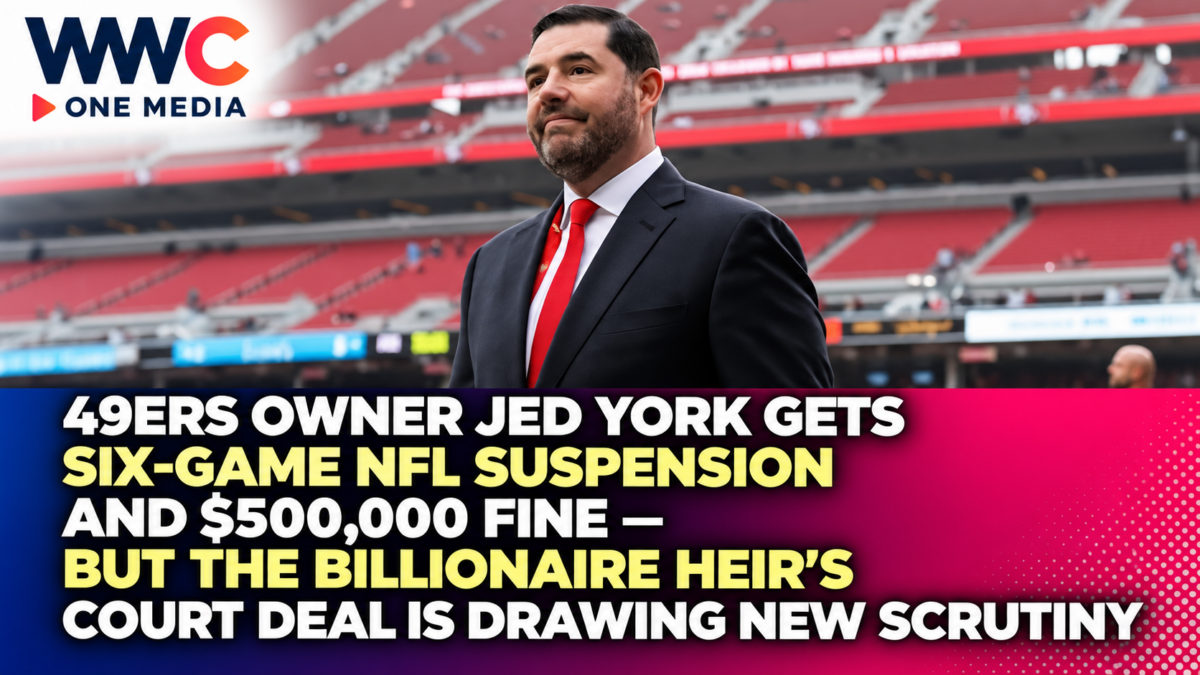
SAN FRANCISCO — San Francisco 49ers principal owner Jed York has been suspended for six NFL games and fined $500,000 after an Ohio prostitution sting led to misdemeanor convictions, adding a major off-field scandal to one of professional football’s most valuable franchises.
The NFL announced the punishment on October 2, saying York violated the league’s Personal Conduct Policy.
York, 46, had already stayed away from the 49ers for their first three regular-season games, and the league is crediting those absences toward the six-game suspension.
He must remain away for another three games and can return after San Francisco’s Week 6 game against the Washington Commanders on October 19.
The financial penalty is substantial in ordinary terms.
But it represents only a tiny fraction of the wealth surrounding the 49ers ownership family.
Forbes currently estimates Denise York and family at about $10 billion, while valuing the 49ers themselves at approximately $10.5 billion.
That contrast makes the story bigger than a simple NFL fine.
York is not merely a team employee facing league discipline.
He is the principal owner and public face of one of the most valuable sports organizations in the world.
The Case Began With an Ohio Prostitution Sting
York’s legal trouble began in August in East Palestine, Ohio, near the Youngstown area where he grew up.
According to court records and law-enforcement information reported by the Associated Press and San Francisco Chronicle, York responded using his phone to what he believed was an online advertisement for prostitution.
The advertisement was actually part of an undercover law-enforcement operation.
York was arrested and initially charged with:
engaging in prostitution
and
possessing criminal tools.
The criminal-tools charge related to the cellphone authorities said he used to communicate in connection with the encounter.
The Prostitution Charge Was Later Reduced
This is one of the most important legal details.
York was not ultimately convicted of engaging in prostitution.
Prosecutors amended that count to the lesser misdemeanor offense of disorderly conduct as part of the case resolution.
York pleaded no contest to:
disorderly conduct
and
possession of criminal tools.
That distinction should be reflected accurately in any headline or article.
The case originated as a prostitution-related sting.
But the final court disposition involved different misdemeanor charges.
York Received Credit for Time Served
The court sentenced York to one day in jail, but credited him with the day he had already spent in custody.
He was also fined $1,150.
Authorities had seized $160 connected to the case, and that money was directed to the Mahoning Valley Human Trafficking Task Force as part of the plea arrangement.
York also completed an online educational course.
Those penalties resolved the criminal case.
They did not end the matter for the NFL.
The NFL Conduct Policy Applies to Owners Too
The league’s Personal Conduct Policy covers much more than players.
It applies to owners, coaches, team employees, league personnel and others working inside the NFL.
The league has long maintained that people associated with professional football can face discipline even where criminal proceedings result in reduced charges—or, in some situations, no conviction at all.
The policy is based on protecting what the NFL describes as the integrity and public confidence of the league.
That is why York’s legal plea did not prevent the NFL from conducting a separate review.
The League Hit York With Six Games and $500,000
After its investigation, the NFL imposed:
a six-game suspension
and
a $500,000 fine.
York had already voluntarily remained away from the 49ers’ first three games while the review was underway.
Those games count toward the punishment.
That leaves three more.
The 49ers are scheduled to face Denver, Seattle and Washington during the remainder of the suspension period, with York eligible to return after the October 19 game.
York Issued His First Major Public Apology
After the NFL announced its decision, York said he accepted the league’s ruling in full.
He described his behavior as an “inexcusable mistake” and apologized to his family, 49ers players, coaches, employees, fans and business partners.
He also said rebuilding trust would take time.
That statement was significant because York had largely avoided extensive public discussion of the incident since his arrest.
The NFL punishment forced the issue back into the spotlight.
The Fine Matches One of the NFL’s Most Famous Owner Punishments
York’s punishment has an interesting precedent.
In 2014, the NFL suspended Indianapolis Colts owner Jim Irsay for six games and fined him $500,000 after he pleaded guilty to a misdemeanor impaired-driving charge.
That is the same combination of suspension length and financial penalty imposed on York.
The comparison reinforces an important league principle:
owners are not automatically exempt from the conduct standards imposed on other NFL personnel.
In fact, the league has repeatedly argued that senior figures should be held to especially high standards because their behavior reflects on the entire organization.
But Another Owner Case Ended Very Differently
There is another notable comparison.
New England Patriots owner Robert Kraft faced prostitution-related charges in Florida in 2019 after a police investigation involving massage parlors.
Those charges were ultimately dropped after courts ruled that video evidence had been obtained improperly.
The NFL did not discipline Kraft.
The distinction is important.
York’s case resulted in a no-contest plea to two misdemeanors.
Kraft’s criminal charges did not result in a conviction.
That gave the NFL materially different legal circumstances to consider.
York’s Court Deal Is Now Facing Questions
The NFL punishment is not the only part of the story receiving scrutiny.
The San Francisco Chronicle reviewed prostitution-sting cases in Columbiana County and found that York’s plea outcome was unusually favorable compared with many other people arrested in similar operations.
According to the Chronicle, York was one of only two defendants among roughly 100 comparable cases during the reviewed period whose prostitution charge was reduced to disorderly conduct.
That does not by itself prove York received improper treatment.
Prosecutors have discretion to negotiate pleas based on individual facts.
But the disparity has raised legitimate questions about why York’s case was handled differently.
There Is No Proven Finding That Wealth Bought Him Special Treatment
That distinction is essential.
Public scrutiny is justified because York is wealthy and powerful.
But there is no established court finding showing the York family’s money or NFL influence caused prosecutors to reduce the charge.
The Chronicle’s reporting identifies an unusual statistical outcome.
It does not establish corruption.
Any stronger conclusion would require evidence that has not publicly emerged.
The 49ers Are Now Worth About $10.5 Billion
The scale of York’s business interests makes the controversy particularly striking.
Forbes values the San Francisco 49ers at $10.5 billion as of September 2026, ranking them among the NFL’s most valuable franchises.
The valuation represents an extraordinary transformation.
The York family’s predecessor, Edward DeBartolo Sr., purchased the team for approximately $13 million in 1977.
Nearly five decades later, Forbes estimates the franchise is worth more than 800 times that original purchase price.
Professional football has become one of the most valuable forms of sports ownership in the world.
Denise York and Family Are Worth About $10 Billion
Forbes estimates Denise York and family’s real-time net worth at roughly $10 billion.
The family owns more than 90% of the 49ers, although a minority stake was sold to several Bay Area families in 2025.
The family also controls interests beyond the NFL.
Through the 49ers’ investment arm, it became the controlling owner of English football club Leeds United after completing a takeover in 2023.
That places York inside an international sports-business empire.
The $500,000 Fine Is Tiny Relative to the Family Fortune
Mathematically, a $500,000 fine represents only about 0.005% of a $10 billion fortune.
For the average fan, half a million dollars is life-changing money.
For a family worth around $10 billion, it is financially minor.
That is why the suspension may carry more reputational weight than the fine.
York loses access and visibility around the team.
The punishment also puts his conduct into the NFL’s permanent disciplinary history.
The reputational consequences are potentially far more valuable than the cash penalty.
York Has Been Running the 49ers for Nearly Two Decades
York took control of the franchise’s day-to-day operations from his parents in 2008.
He later became the team’s principal owner in 2024.
His tenure has included both major criticism and major football success.
Under York’s leadership, San Francisco has reached:
eight playoff appearances,
seven NFC Championship Games,
and
three Super Bowls.
The 49ers also moved into Levi’s Stadium in Santa Clara during his tenure.
That stadium has since hosted major NFL events and other international sporting and entertainment events.
York Stepped Down as CEO Earlier This Year
York remains principal owner, but he is no longer the 49ers’ CEO.
He relinquished that title in February 2026 while retaining ownership and senior organizational authority.
That distinction matters during his suspension.
San Francisco does not suddenly operate without management.
Football decisions continue under the team’s coaches and executives.
The suspension is targeted at York personally, not at the club’s ability to function.
The Team Has Started 3-0 Without Him
Adding another layer to the story, the 49ers opened the 2026 season 3-0 while York stayed away during the league investigation.
That includes victories before the NFL formally announced its discipline.
For football operations, the absence therefore has not produced an obvious immediate collapse.
The team remains atop the NFC West heading into Week 4.
That helps separate two different issues.
The York controversy is a governance and reputation problem.
It is not currently a performance crisis on the field.
Kyle Shanahan Still Runs the Football Operation
Head coach Kyle Shanahan remains responsible for the team’s football performance.
Roster decisions are also handled through the organization’s established football-management structure.
NFL owners can exert enormous influence.
But they do not ordinarily call plays or coach daily practices.
That means York’s absence is more likely to affect executive and ownership functions than Sunday strategy.
The Scandal Still Lands at an Awkward Time
The 49ers remain one of the NFL’s flagship franchises.
They have championship ambitions.
They have one of the league’s strongest brands.
And their ownership group is deeply involved in high-profile sports investments.
A principal owner being suspended by the league therefore becomes a major reputational distraction.
Every question about the case pulls attention away from football.
That is exactly what the NFL’s personal conduct policy is designed to address.
The Policy Is About Public Confidence as Much as Criminal Law
The NFL has explicitly said its conduct rules require people inside the league to do more than simply avoid criminal convictions.
Owners and employees are expected to act in ways that preserve confidence in the sport and its institutions.
That is why league discipline and criminal punishment are separate.
The criminal system asks:
What offense was legally proved or admitted?
The NFL asks another question:
Did the conduct damage the standards or reputation expected of someone connected with the league?
York’s case produced different answers from those two systems.
York’s Legal Penalty Was Much Smaller Than His NFL Penalty
In court, York paid a relatively modest $1,150 fine and received credit for one day already served.
The NFL then imposed a $500,000 fine.
That is more than 400 times the monetary penalty imposed by the court.
The difference illustrates how professional sports leagues can impose significant private discipline beyond the formal criminal-justice process.
For billionaire owners, that private punishment can sometimes carry greater practical consequences.
But the $500,000 Fine Still Raises a Broader Question
Should wealthy owners face larger financial penalties than employees or players because they can absorb ordinary fines more easily?
The NFL’s fine against York is substantial by league standards.
But compared with his family’s estimated fortune, it is almost negligible.
That raises a recurring issue in sports governance.
A fixed-dollar fine does not impose an equal economic burden on everyone.
A $500,000 penalty could be devastating to one person and insignificant to another.
Suspensions therefore become particularly important when disciplining billionaire owners.
Time and access cannot be written off as easily as a check.
The Six-Game Suspension Carries Symbolic Weight
Six NFL games represent more than one-third of a 17-game regular season.
York is being kept away during an important early stretch while the 49ers establish their position in the NFC playoff race.
Even if the team functions normally, the league is sending a visible message:
the principal owner is temporarily not permitted to participate because of his conduct.
That symbolism matters in a league where ownership is one of the most exclusive clubs in American business.
The NFL Has Only 32 Ownership Groups
There are hundreds of active NFL players.
There are only 32 franchises.
That makes disciplinary action against an owner relatively rare and unusually prominent.
Owners collectively hire and oversee the commissioner.
They approve major league policies.
They vote on franchise transactions.
They shape the economic structure of professional football.
When the NFL suspends one of those owners, it is disciplining someone inside its own governing class.
That Is Why York’s Case Is a Test of Consistency
The NFL regularly disciplines players.
Whenever an owner becomes involved in serious off-field misconduct, fans inevitably ask whether the same standards apply upward.
York’s punishment gives the league a concrete answer:
six games and $500,000.
The fact that the penalty mirrors the punishment once imposed on Colts owner Jim Irsay reinforces the appearance of a recognizable owner-discipline precedent.
But public debate over whether billionaire owners should face even stronger sanctions is unlikely to disappear.
The Case Also Raises Questions About Power Outside the NFL
The court outcome has become part of that debate because of York’s enormous wealth and status.
Again, there is no proven evidence that he improperly influenced the prosecution.
But when an extremely wealthy defendant receives an outcome that appears unusual compared with similarly charged defendants, scrutiny is inevitable.
That is part of the cost of holding a position as visible as York’s.
Power attracts examination.
The Human-Trafficking Connection Adds Another Layer
The $160 seized during York’s arrest was ultimately directed to the Mahoning Valley Human Trafficking Task Force.
That detail reflects why many police agencies frame prostitution sting operations within broader efforts to combat trafficking and exploitation.
It is important not to conflate every prostitution case with trafficking.
They are legally and factually distinct.
But law-enforcement agencies often investigate both within overlapping vice operations.
That is part of the broader social context behind the sting that caught York.
The 49ers Brand Is Much Bigger Than One Owner
Despite the scandal, the franchise’s underlying business remains enormously valuable.
Forbes estimates:
$752 million in annual revenue
and roughly
$126 million in operating income
for the latest valuation period.
The team also benefits from the NFL’s national television contracts, revenue sharing, sponsorships, ticket sales and one of the country’s strongest sports markets.
That means the controversy is unlikely to threaten the franchise financially in the immediate term.
The primary risk is reputational.
Fans May Judge York More Harshly Than the Balance Sheet Does
A franchise valuation does not measure trust.
Sponsors can evaluate corporate reputation.
Employees can judge leadership.
Fans can decide whether an owner’s apology feels sufficient.
York himself acknowledged this point by saying trust would have to be earned back over time.
That may ultimately be the hardest part of the punishment.
The six games end on a schedule.
Reputation does not.
There Is No Indication York Will Be Forced to Sell
Nothing in the NFL’s announced punishment suggests York’s ownership stake is in jeopardy.
He remains principal owner.
The league has imposed a temporary suspension and monetary fine.
There has been no announced effort to force a sale or remove the York family from control of the franchise.
Any headline implying York is losing the 49ers would therefore be inaccurate.
The Family Still Controls More Than 90% of the Team
Even after last year’s minority-stake transaction, the York family remains firmly in control.
Forbes says the family continues to own more than 90% of the 49ers.
That means the disciplinary case does not alter who controls one of the NFL’s richest franchises.
It changes the public standing of the person at the top.
The Bigger Question Is Whether Six Games Are Enough
From the league’s perspective, York has been disciplined.
From the criminal court’s perspective, the case has been resolved.
But public scrutiny may continue for a different reason.
A billionaire sports owner:
was arrested in a prostitution sting,
received reduced charges,
pleaded no contest,
paid a relatively small court fine,
and was then fined $500,000 and suspended six games by the NFL.
Those facts invite debate about:
accountability,
wealth,
sports ownership,
and consistency in punishment.
The Wealth Makes the Story More Striking — But It Should Not Distort the Facts
The York family’s estimated $10 billion fortune is relevant because it shows the scale of the ownership empire.
The 49ers’ $10.5 billion valuation is relevant because it illustrates what York represents to the NFL.
But neither figure should turn the legal story into something it was not.
York was initially accused of engaging in prostitution.
That count was reduced.
He was not convicted of that original charge.
He pleaded no contest to two misdemeanors.
The NFL independently determined that his conduct violated league policy.
That is the precise sequence.
The Suspension Ends — The Reputation Test Does Not
York can return after the 49ers’ October 19 game.
His $500,000 NFL fine can be paid.
His criminal case has already been resolved.
But his own apology acknowledged the longer-term problem.
Trust has to be rebuilt.
That will depend less on one press statement than on what York does after his suspension ends.
Because for the principal owner of a $10.5 billion NFL franchise, the biggest consequence may not be losing six games or half a million dollars.
It may be proving that the standards he expects from everyone else inside the organization apply to him too.