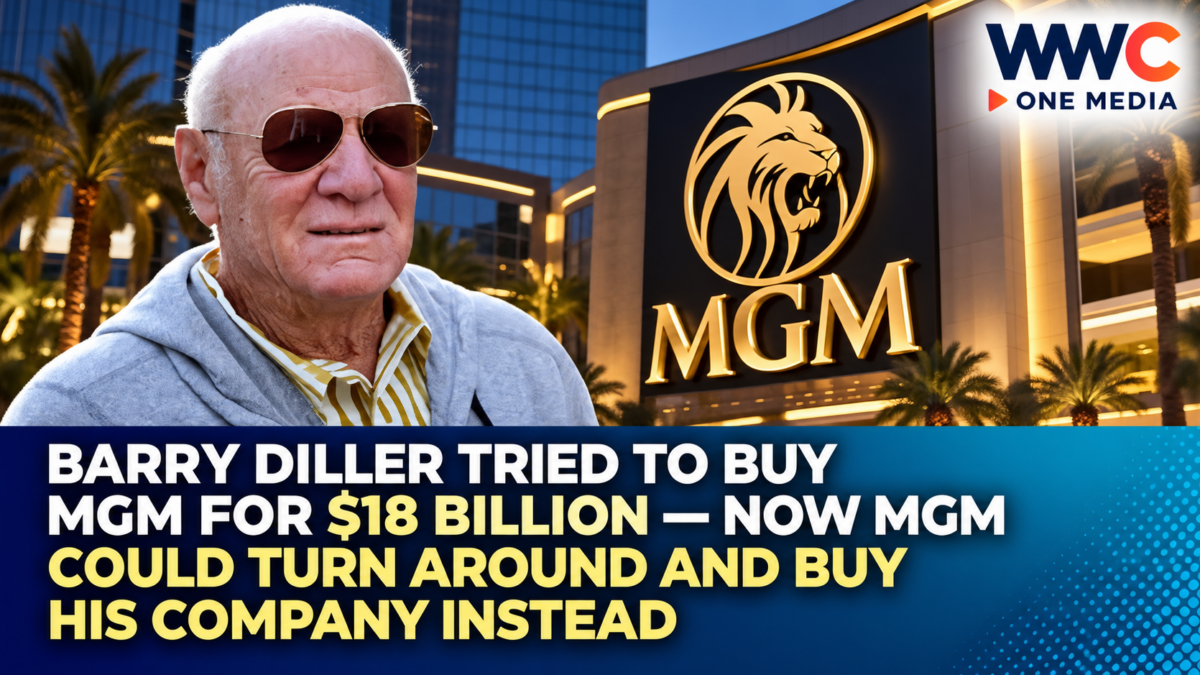
LAS VEGAS — One of the strangest takeover battles of 2026 has taken another unexpected turn: after billionaire Barry Diller abandoned an attempt to take MGM Resorts International private, the casino giant is now leaving the door open to a deal involving Diller’s own People Inc.
The corporate reversal comes only days after People Inc., formerly known as IAC, withdrew its $48.30-per-share cash proposal to acquire all MGM shares it did not already own.
The June proposal valued MGM at more than $18 billion including debt and represented a premium of more than 30% to MGM’s 90-day volume-weighted average share price before the bid.
People Inc. already owns approximately 27% of MGM Resorts, making it the casino operator’s largest shareholder.
But on September 23, Diller abruptly walked away.
And now MGM CEO Bill Hornbuckle is signaling that the relationship between the two companies may not be finished.
Asked whether MGM might consider buying People Inc., Hornbuckle said MGM would continue pursuing whatever creates the most shareholder value while attempting to unlock what management believes is a significantly undervalued company.
That does not mean MGM has formally launched an acquisition offer.
But it does mean a transaction that initially looked like People buying MGM could conceivably be reversed into MGM buying People — one of the more unusual possibilities emerging from the current wave of casino-sector consolidation.
Barry Diller’s $48.30 MGM Bid Is Dead — For Now
Diller’s People Inc. officially withdrew its offer on September 23.
In a regulatory filing, Diller said the various elements required to complete the transaction were not coming together as expected.
People nevertheless made clear that it had not lost confidence in MGM.
The company continues to own 66.8 million MGM shares, representing approximately 27% of the casino operator.
Diller also said People remained open to a potential strategic transaction involving MGM in the future.
That wording left the door unusually wide open.
The original privatization proposal may be gone.
The relationship is not.
What Diller Originally Wanted
People Inc.’s original June 1 proposal offered $48.30 in cash for every MGM share it did not already own.
At the time, People held approximately 26.1% of MGM’s common stock.
The offer represented:
24.1% premium to MGM’s 30-day volume-weighted average price,
more than a 30% premium to its 90-day average,
and a 10.6% premium to its immediately preceding closing price.
People argued MGM was being undervalued by public markets.
Diller believed MGM’s collection of casinos, resorts and digital gambling operations represented a rare combination of physical assets and technology-linked businesses that would be difficult for artificial intelligence or other digital disruption to replace.
That “AI-proof” argument became one of the more unusual elements of the investment thesis.
Diller Started Buying MGM During the Pandemic
The relationship dates back to 2020.
Diller’s IAC invested in MGM when the Covid-19 pandemic devastated Las Vegas tourism and temporarily shut casino floors across the United States.
The company initially invested roughly $1 billion, betting that MGM would eventually recover as tourism, live entertainment and casino traffic returned.
That bet worked extremely well.
People’s MGM stake later grew to roughly 27%, worth billions of dollars.
But Diller eventually decided owning a minority position was not enough.
The June 2026 proposal attempted to take MGM private entirely.
Why the Deal Fell Apart
Diller has not provided a detailed public explanation.
His official statement simply said the “mix” required to complete the transaction had not come together as hoped.
Bloomberg reported that Diller had difficulty raising additional outside equity needed for the complicated transaction.
That helps explain the challenge.
People already owned a large MGM stake, but buying the remaining shares would still have required enormous amounts of capital.
The deal was expected to involve:
People’s existing cash,
new debt,
and additional investors.
Financing an $18-billion-plus casino transaction in a high-interest-rate environment is substantially more difficult than it would have been several years ago.
MGM Never Appeared Convinced $48.30 Was Enough
MGM created a special committee to review the bid after receiving it.
The company said its board would evaluate the proposal based on the best interests of shareholders.
Subsequent reporting suggested MGM believed Diller’s offer undervalued the company.
That is easy to understand from management’s perspective.
MGM operates some of the most recognizable casino resorts in the world, including:
Bellagio
MGM Grand
Mandalay Bay
Aria
and The Cosmopolitan of Las Vegas.
It also owns major regional casinos, has exposure to Macau through MGM China and owns half of online betting business BetMGM.
The company is additionally developing the enormous MGM Osaka integrated resort in Japan.
MGM’s board argued those assets created a path toward greater long-term shareholder value as an independent company.
MGM Shares Fell Hard After Diller Walked Away
The market clearly had been pricing in some probability that Diller’s bid would succeed.
When People withdrew the proposal, MGM shares dropped roughly 8% in after-hours trading.
The decline showed how much takeover speculation had supported the stock.
By September 30, MGM closed at $31.05, almost 40% below its 52-week high of $51.59 reached in June.
That huge gap creates an uncomfortable question for MGM management.
If the board believed $48.30 undervalued the company, but the market is valuing it close to $31, management now has to convince investors that MGM can create enough value independently to close that gap.
That May Explain MGM’s Interest in Dealmaking
Hornbuckle’s latest comments should be understood in that context.
MGM is searching for ways to unlock shareholder value.
One theoretical option is acquiring People Inc. itself.
The idea sounds bizarre at first.
MGM operates casinos, resorts and online betting.
People Inc. owns media brands.
But the financial relationship between the companies makes a transaction more logical than it appears.
People owns roughly 27% of MGM.
If MGM acquired People, it could effectively regain control of those shares.
That makes the transaction partly resemble an unusually complicated stock buyback.
Reuters Breakingviews estimated People’s MGM stake was worth around $2.3 billion, while People itself had an enterprise value of roughly $3 billion around the time the deal speculation emerged.
So MGM would not simply be buying a magazine publisher.
It would also be effectively acquiring a huge block of its own stock.
The Deal Could Be More Financial Engineering Than Strategic Marriage
That is why analysts have questioned whether the two businesses actually belong together.
People Inc. owns well-known digital and publishing brands.
Its portfolio includes properties associated with lifestyle, food, travel and celebrity media.
MGM operates giant physical casino resorts and gaming businesses.
There is some potential overlap around:
travel,
hospitality,
entertainment,
advertising,
and customer acquisition.
But the businesses are hardly natural twins.
Reuters Breakingviews argued that the most convincing rationale might simply be financial: MGM could buy People largely as a way to reacquire the MGM shares People already owns.
That would make the transaction one of the most elaborate share-repurchase structures imaginable.
People Inc. Is More Than Just PEOPLE Magazine
The company formerly known as IAC was renamed People Incorporated following a major corporate restructuring.
Its publishing operations include a collection of large digital brands spanning entertainment, food, home, health and travel.
People also retains investments outside publishing.
Reuters noted that the business has exposure to companies including car-sharing platform Turo.
Diller has spent decades building, acquiring and spinning off internet and media businesses.
Among his most famous investments was Expedia.
He acquired control of the online travel company through IAC before eventually spinning it out as a separate public company.
That history partly explains why investors take his unusual deals seriously.
Diller’s MGM Bet Was Also a Bet Against AI Disruption
One of the more interesting reasons People invested in MGM was technological.
Diller argued MGM represented the kind of business that technology could not easily eliminate.
Artificial intelligence can disrupt:
publishing,
search,
advertising,
software,
and many digital services.
It cannot easily replicate the experience of staying at Bellagio, attending a concert, gambling in a physical casino or visiting a resort complex.
People explicitly cited MGM’s “real world assets” as businesses that AI could not easily replicate or disintermediate when it made its takeover proposal.
That thesis has become even more relevant as AI increasingly disrupts People Inc.’s own core publishing business.
People’s SEC filings specifically identify AI-powered search and changes in online content discovery as potential business risks.
So Diller’s MGM investment effectively represented diversification away from the technology risks affecting digital media.
MGM Has Its Own Digital Ambition
MGM is not simply a collection of physical casinos either.
Its biggest digital asset is BetMGM, its 50-50 online-gambling joint venture with Entain.
The platform operates online sports betting and casino gaming across North America.
MGM management has repeatedly pointed to BetMGM as an important long-term growth business.
That digital exposure helps explain why People originally saw MGM as attractive.
Physical resorts provide durable real-world assets.
Online gambling provides technology-driven growth.
Macau Is Another Critical Piece
MGM also has significant exposure to China through MGM China.
The Macau casino market has recovered strongly from pandemic-era restrictions, although it remains subject to regulatory and economic risks.
For MGM, Macau provides another growth engine independent of Las Vegas.
That geographic diversification matters because Las Vegas tourism has shown signs of weakness during parts of 2026.
Reuters reported that lower visitor numbers were among the challenges weighing on MGM before Diller withdrew his bid.
A weaker Vegas environment can pressure:
room rates,
casino revenue,
restaurant spending,
and convention business.
Macau and BetMGM help reduce the company’s dependence on one market.
MGM Osaka Could Transform the Company Again
Then there is Japan.
MGM is developing a multibillion-dollar integrated resort in Osaka, one of the biggest casino projects ever approved in Japan.
MGM’s board specifically cited Osaka as part of the company’s long-term value proposition after Diller abandoned his takeover.
The resort is expected to introduce MGM to an enormous new tourism market.
Japan has historically prohibited casino gambling outside narrowly defined categories.
Its decision to allow integrated resorts opened an entirely new market for international operators.
If MGM Osaka succeeds, it could become a major Asian earnings engine.
That future value is one reason MGM’s board may have resisted selling at $48.30.
The Entire Casino Industry Is Consolidating
The MGM-People drama is happening during a broader wave of gambling-sector dealmaking.
Caesars Entertainment shareholders recently approved a $17.6 billion acquisition by Fertitta Entertainment.
The timing was striking.
People withdrew its MGM bid only one day after Caesars shareholders approved their own transaction.
That puts two of Las Vegas’ most recognizable casino companies on very different paths.
Caesars is heading toward private ownership.
MGM says it will remain independent — at least for now.
But Hornbuckle’s comments suggest MGM is still willing to participate in consolidation as a buyer.
Why Casinos Are Attractive Takeover Targets
Large gaming companies own something increasingly difficult to replicate:
scarce physical assets.
Las Vegas Strip resorts require billions of dollars to develop.
Casino licenses are limited.
Prime land is scarce.
And established resorts generate revenue across multiple channels:
hotel rooms,
gaming,
restaurants,
nightclubs,
concerts,
conventions,
retail,
and sports betting.
Those characteristics make casino operators attractive to long-term investors.
Their businesses may be cyclical.
But barriers to entry are enormous.
That was one of Diller’s core arguments when he first invested in MGM during 2020.
Real Estate Makes Casino Valuation Complicated
Modern casino companies have also transformed their balance sheets.
Many operators sold resort real estate to specialized real-estate investment trusts and then leased the properties back.
MGM has used this asset-light strategy extensively.
That freed capital for expansion and share repurchases.
But it also means casino companies carry substantial long-term lease obligations.
The result can make simple market-cap comparisons misleading.
Investors must consider:
debt,
leases,
real-estate ownership,
digital businesses,
and joint ventures
when deciding what a casino operator is actually worth.
That complexity contributed to the debate over whether Diller’s $48.30 offer adequately valued MGM.
People Inc. Could Still Sell Its MGM Stake
Even if MGM never acquires People, another major question remains.
What happens to People’s 27% stake?
Diller said he continues to believe strongly in MGM and has no announced plan to sell.
But a position that large cannot easily be liquidated without affecting the market.
People could:
hold the stake indefinitely,
sell portions gradually,
negotiate a repurchase with MGM,
exchange it in another transaction,
or revisit a strategic deal later.
Every possibility could have major consequences for MGM shareholders.
That makes People’s ownership position almost as important as the failed takeover itself.
An MGM Takeover of People Would Be Extremely Unusual
Imagine the sequence.
People buys roughly one-quarter of MGM.
People offers to buy the rest of MGM.
People withdraws.
Then MGM buys People.
That would mean the target effectively becomes the acquirer of its former bidder.
Corporate finance has seen similar reversals before, but rarely involving companies this different in size and business model.
It would also immediately raise difficult questions.
Does MGM actually want People’s publishing business?
Would MGM keep those assets?
Could they eventually be sold?
How would the transaction be financed?
And most importantly:
What price would make the deal beneficial to MGM shareholders?
None of those questions has been answered yet.
There Is No Confirmed MGM Bid for People
That is the most important caution for investors.
MGM has not announced a formal offer for People Inc.
Hornbuckle’s comments indicate openness to transactions that could increase shareholder value.
Reports have also said MGM has considered a potential bid.
But consideration is not the same as negotiation.
Negotiation is not the same as an offer.
And an offer is not the same as a completed acquisition.
The history of the past several months makes that distinction especially important.
People had a public $48.30 MGM proposal on the table for months.
It still collapsed.
MGM Now Has to Prove Diller Was Right About One Thing
Perhaps the biggest irony is that Diller and MGM’s board actually agreed on one central point:
MGM is undervalued.
Diller believed the solution was taking it private at $48.30 a share.
MGM’s board appears to believe the company can ultimately create greater value independently.
But with MGM shares recently trading close to $31, public investors have not yet endorsed that argument.
That leaves management with a difficult assignment.
It must improve Las Vegas performance.
Keep BetMGM growing.
Capture Macau’s recovery.
Execute MGM Osaka.
And convince investors those businesses collectively deserve a much higher valuation.
If management succeeds, rejecting Diller’s bid could look smart.
If it fails, shareholders may wonder why MGM did not take the money.
The Casino Deal That Refuses to Die
People Inc.’s official takeover attempt is over.
But the corporate chess match may only have entered its next phase.
Diller still controls roughly 27% of MGM.
People remains open to strategic transactions.
MGM says it wants to unlock shareholder value.
And MGM management has not ruled out a transaction involving its largest shareholder.
That makes the situation far more complicated than a failed takeover.
The bidder and target remain financially intertwined.
And depending on what happens next, the company that Barry Diller tried to buy could ultimately end up buying him out instead.