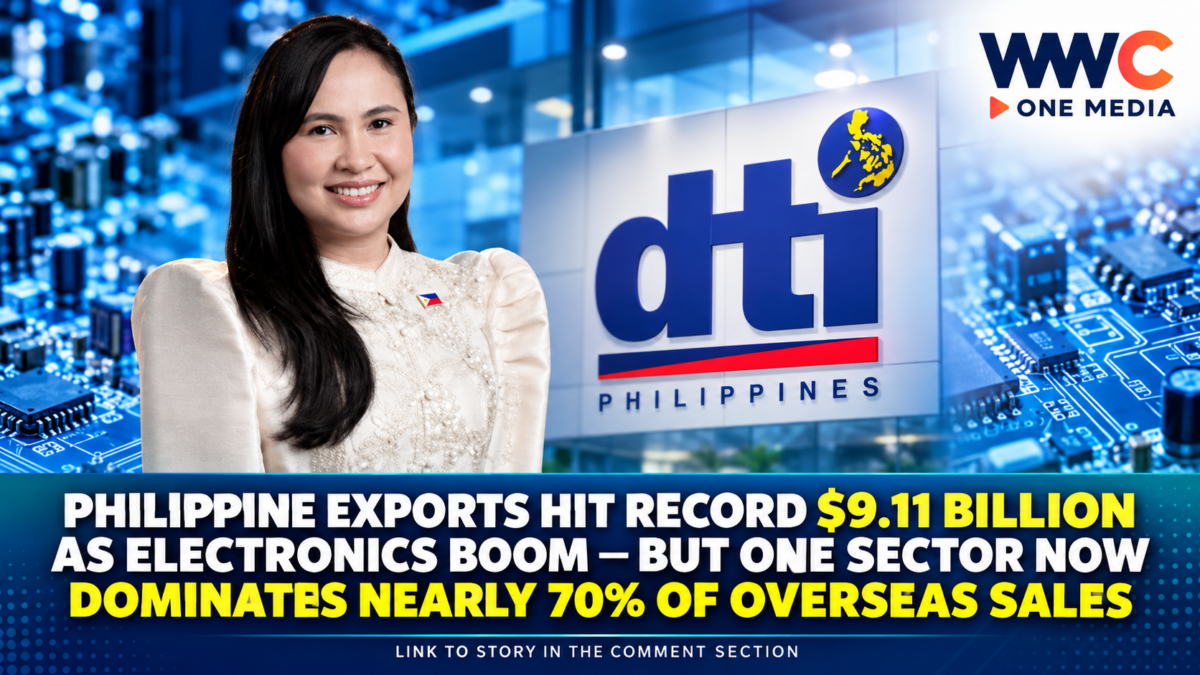
MANILA, Philippines — Philippine merchandise exports surged to a record $9.11 billion in August 2026, the highest monthly value since the government’s current trade data series began in 1991, as electronics shipments rode booming global demand linked to artificial intelligence, semiconductors and data centers.
The August result represented a 27.8% jump from $7.13 billion in August 2025 and extended the country’s year-on-year export growth streak to 20 consecutive months.
It also marked a significant acceleration from July, when Philippine exports totaled about $8.16 billion.
Seasonally adjusted PSA data provide another indication that the improvement was not merely a calendar effect: exports rose 13.4% month-on-month to $8.89 billion after seasonal factors were removed.
The historic result is a major bright spot for the Philippine economy.
But beneath the headline number lies an equally important story: more than two-thirds of everything the Philippines exported in August came from electronics.
Electronics Generated $6.2 Billion — 68% of All Exports
Electronic products remained the country’s undisputed export engine, generating $6.20 billion in August, equivalent to 68.1% of total Philippine merchandise exports.
Compared with the same month last year, electronics exports added about $2.32 billion, the largest absolute increase among all commodity groups.
More detailed trade figures show just how strong the surge was.
Electronic-product exports climbed around 59.9% year-on-year, while semiconductor shipments — the industry’s most important segment — rose approximately 73.5%. Consumer electronics and office equipment also recorded sharp increases.
The Department of Trade and Industry said the sector has benefited from strong global demand associated with artificial intelligence and data-center investment, which continues to increase demand for semiconductors and electronic components.
That puts the Philippines in a potentially favorable position as companies worldwide pour billions of dollars into AI computing infrastructure.
Philippine factories are deeply embedded in international semiconductor and electronics supply chains, producing components that ultimately feed into computers, servers, telecommunications equipment, vehicles and other technology products.
AI Boom Is Reaching Philippine Factories
The AI investment boom is often associated with companies such as Nvidia, Microsoft, Google, Amazon and other global technology giants.
But the supply chain extends far beyond the companies building AI models.
Data centers require enormous amounts of processors, memory, power-management components, storage equipment, networking hardware and other electronics.
That demand eventually reaches semiconductor manufacturing and assembly hubs across Asia — including the Philippines.
The country’s August trade numbers suggest that global technology investment is now translating into substantially higher Philippine export receipts.
Electronics exports alone were larger than the country’s total merchandise exports in many individual months during earlier years.
And the surge was broad enough to push overall monthly exports above $9 billion for the first time in the PSA’s current 35-year statistical series.
Other Exports Were Much Smaller
The scale of electronics becomes even clearer when compared with the Philippines’ other major exports.
After electronics, other mineral products generated just $393.54 million, representing 4.3% of exports.
Gold followed at $321.27 million, or 3.5% of total shipments.
Gold exports increased by about $41.83 million from the previous year, while electronic equipment and parts outside the main electronics category added roughly $32.09 million.
Manufactured goods as a whole accounted for $7.69 billion, or 84.4% of all Philippine exports.
Mineral products contributed $800.62 million, while agro-based products generated $455.26 million.
That composition shows that the Philippines’ record export performance remains overwhelmingly manufacturing-led rather than agriculture-led.
US Becomes the Philippines’ Biggest Export Customer
The United States remained the country’s largest export destination in August, purchasing $2.17 billion worth of Philippine goods, or almost 23.8% of total exports.
Shipments to the United States nearly doubled from a year earlier, rising approximately 94.6%, according to trade data compiled from PSA figures.
Hong Kong ranked second at $1.57 billion, followed by:
China — $1.05 billion
Japan — $704.49 million
Taiwan — $516.01 million
Together, those figures highlight how heavily Philippine exports are tied to the United States and the Asian electronics manufacturing network.
Asia-Pacific Economic Cooperation economies accounted for $7.94 billion, or 87.2%, of Philippine exports in August.
Eight-Month Exports Also Hit a Record
August was not an isolated spike.
Philippine exports reached $64.04 billion from January through August 2026, up 14.8% from $55.80 billion during the same period in 2025.
The eight-month total was also the highest ever recorded for that period since the PSA series began in 1991.
Earlier government data showed electronics had already been driving the expansion during the first half of the year.
Electronic exports totaled $26.12 billion from January through June, representing 55.8% of all exports during the period and posting the largest annual increase among major commodity groups.
That means electronics’ share jumped even further in August as semiconductor shipments accelerated.
Trade Deficit Shrinks to Lowest in 15 Months
The export surge also produced another important economic result.
The Philippines’ merchandise trade deficit narrowed to approximately $3.85 billion in August, down from $6.35 billion in July and $3.99 billion in August 2025.
It was the smallest monthly trade deficit since May 2025.
Imports remained much larger than exports at $12.96 billion, increasing 16.6% from a year earlier.
But because exports grew substantially faster than imports, the trade gap narrowed by about 3.5% year-on-year.
Total Philippine merchandise trade reached $22.07 billion in August, up 21% from a year earlier.
There Is Still a Bigger Trade Deficit Problem
The August improvement should not be mistaken for a complete turnaround in the country’s external trade position.
From January through August, the Philippines imported $105.60 billion worth of goods, up 19.1% from the same period of 2025 and also the highest eight-month import value on record.
With exports at $64.04 billion, that leaves an eight-month trade deficit of approximately $41.6 billion, substantially wider than the roughly $32.9-billion gap recorded a year earlier.
So while August produced the strongest monthly export result in 35 years, the country continues to buy significantly more goods from overseas than it sells abroad.
Electronics Are Also Driving Imports
There is another side to the electronics boom.
Electronics were not only the Philippines’ biggest export — they were also its largest import.
The country imported $4.51 billion worth of electronic products in August, accounting for 34.8% of all imports.
That partly reflects the structure of global semiconductor manufacturing.
Philippine factories often import intermediate components and raw materials, process, assemble or test them locally, and then export finished or semi-finished electronic products.
Raw materials and intermediate goods accounted for $5.14 billion, or 39.7% of August imports, while capital goods totaled $3.60 billion.
China was the Philippines’ biggest source of imports at $2.94 billion, followed closely by South Korea at $2.73 billion.
DTI Says Filipino Exporters Are Becoming More Competitive
Trade Secretary Cristina Roque said the record showed Philippine companies are increasingly able to compete in international markets.
She said the government would continue helping exporters meet international standards, connect with foreign buyers and penetrate additional markets.
The DTI has also been pushing exporters to expand beyond traditional products and destinations.
Eleven Philippine food companies recently joined the country’s first national participation in Fine Food Australia, part of efforts to market halal-certified, health-oriented and premium Filipino products to Australia and the wider Oceania market.
That diversification may prove increasingly important.
Agriculture Is Not Sharing Equally in the Boom
Despite record overall exports, the benefits are not spread evenly throughout the economy.
The DTI acknowledged that agricultural and agro-processed exporters continue to face supply and logistics constraints.
Agro-based exports totaled only $455.26 million in August, about 5% of the country’s total shipments.
Seasonally adjusted PSA figures also show agro-based exports falling 8.5% from July to August, even as manufactured exports increased 15.8%.
That divergence illustrates one of the biggest challenges behind the impressive headline number.
The Philippines is participating strongly in the global electronics boom, but other export industries are not necessarily experiencing the same surge.
A Historic Record — With One Major Vulnerability
There is little doubt that $9.11 billion in monthly exports is a milestone for the Philippine economy.
It marks the strongest monthly performance in the PSA’s 35-year trade series, extends a 20-month export growth streak and comes alongside the narrowest trade deficit in more than a year.
The AI and data-center investment boom could provide further opportunities if semiconductor demand remains strong.
But the same numbers reveal a potential vulnerability.
With electronics supplying 68.1% of August export revenue, the country’s merchandise trade performance has become extraordinarily dependent on one sector.
If global semiconductor and AI investment stays strong, that concentration could continue powering record Philippine exports.
But if the global technology cycle turns down, demand for chips weakens or geopolitical tensions disrupt international electronics supply chains, the same concentration could quickly become a weakness.
For now, the Philippines has reached a historic export milestone.
The bigger challenge is turning an electronics-driven boom into broader and more diversified export growth before the next global technology cycle turns.