
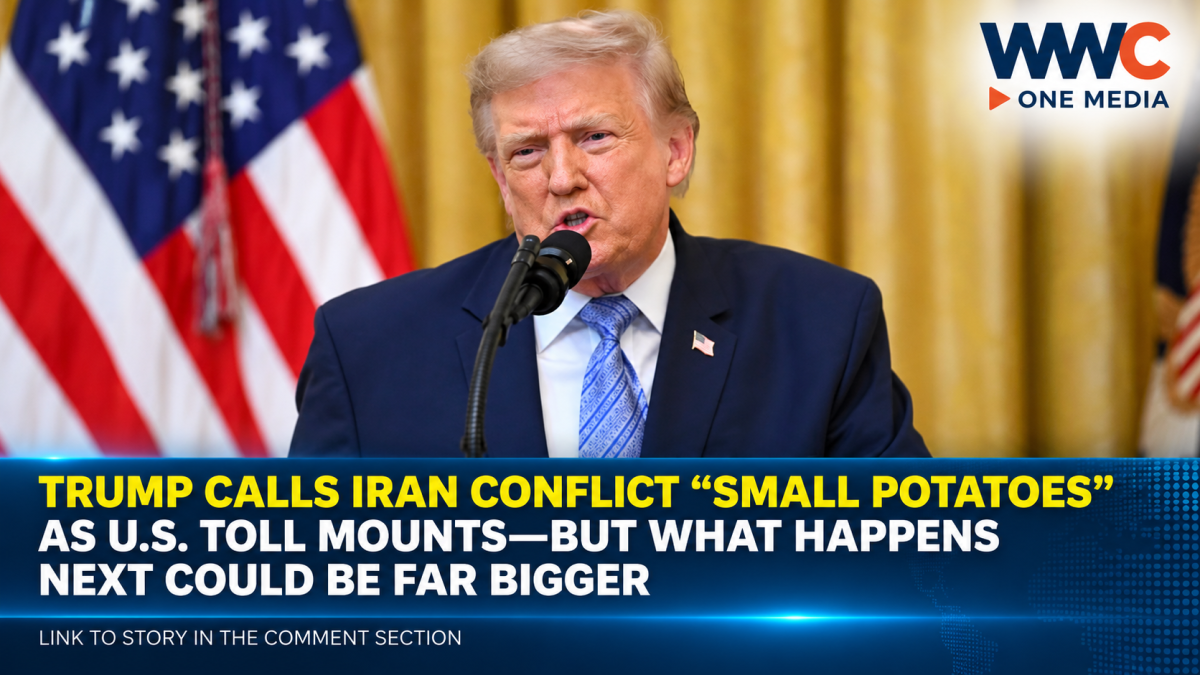
WASHINGTON — U.S. President Donald Trump is pushing back against efforts to describe the ongoing confrontation with Iran as a full-scale war, calling the conflict “small potatoes” for the United States and defending Vice President JD Vance, who said the fighting should not be labeled a war.
Trump made the remarks Friday, September 4, after Vance said a day earlier that he would not call the months-long U.S.-Iran fighting a war because there was no active shooting at that particular moment.
The comments come despite renewed U.S. strikes on Iran, Iranian retaliation against U.S. allies in the Gulf, rising fuel prices and significant American military casualties.
Trump: It is a “military conflict”
Asked about Vance’s characterization, Trump said he understood the vice president’s position and described the situation as a “military conflict.”
Trump argued that U.S. strikes had become intermittent and said the conflict was relatively limited compared with previous American wars.
He also pointed to the absence of U.S. ground troops fighting inside Iran as part of his argument.
But the terminology has drawn attention because American and Iranian forces have continued to exchange attacks, while the conflict has entered its seventh month.
18 U.S. service members have been killed
The administration’s description of the conflict comes against a significant human and financial cost.
According to reporting from AP and Reuters, 18 U.S. service members have been killed, while the Pentagon has put the cost of the conflict at approximately $37.5 billion. Reuters also reported that more than 750 U.S. personnel had been wounded as of September 3.
Trump was questioned about describing the conflict as “small potatoes” despite the deaths.
He compared the current casualty figures with losses suffered during earlier U.S. conflicts, including Vietnam, while maintaining that the campaign had substantially weakened Iran’s nuclear capabilities.
Trump also reiterated his position that Iran will not obtain a nuclear weapon under his administration.
Vance says there is no active shooting
Vance’s comments on Thursday came as the administration attempted to explain the current state of the conflict.
He said he would not call it a war because there was no active shooting at that moment, even though Iran had recently fired at U.S. ally Kuwait in retaliation for American strikes.
Vance also said Washington’s immediate priority was protecting commercial shipping through the Strait of Hormuz, a critical global energy route.
The distinction is politically significant.
Calling the confrontation a “military conflict” rather than a “war” comes as the Trump administration faces growing public concern over the length and cost of the campaign.
Fighting has not actually disappeared
Despite the administration’s language, recent events indicate that tensions remain high.
The United States launched another series of strikes against Iranian targets earlier this week, while Iran responded with attacks involving U.S. allies and positions across the Gulf.
AP reported that Iranian attacks targeted countries including Kuwait and Bahrain, while Washington has continued military operations connected to threats against shipping in and around the Strait of Hormuz.
Trump also said Friday that the United States could soon strike Pickaxe Mountain, a heavily fortified Iranian site near the damaged Natanz nuclear facility. The possibility of another strike raises the prospect of further escalation even as the administration argues that the conflict is limited.
Iran conflict is becoming a political problem
The debate over whether the confrontation is a “war” is unfolding just weeks before the November 3 U.S. midterm elections.
The conflict has become increasingly unpopular among Americans.
A Reuters/Ipsos poll published September 4 found that only 25% of Americans believed the war was worthwhile. Reuters reported that concerns about casualties, economic costs and higher gasoline prices are contributing to the negative public mood.
Reuters has also reported that Trump administration officials are concerned that the conflict could hurt Republicans as they attempt to defend their narrow congressional majorities.
That makes the administration’s messaging particularly important.
Gas prices and the Strait of Hormuz add another layer
The conflict is also affecting Americans far beyond the battlefield.
Vance acknowledged that gasoline prices have risen and blamed Iran’s actions for the increase. He declined to promise when prices would return to lower levels.
The Strait of Hormuz has become one of the central pressure points in the confrontation because of its importance to global oil and gas shipments. Reuters reported that Washington’s military strategy has increasingly focused on keeping commercial shipping routes open.
Civilian casualties are adding pressure
The renewed fighting has also generated scrutiny over civilian casualties.
Reuters reported that a September 1 explosion at a wedding gathering in southern Iran killed four people initially and injured at least 68, with another victim later dying. A Reuters visual investigation concluded that the evidence pointed toward a direct hit by a U.S. munition, while U.S. officials said the incident was being investigated.
The episode has added another layer of controversy as Washington insists its military operations are directed at military objectives.
Washington is combining military and economic pressure
The Trump administration is pursuing pressure on Tehran on more than one front.
On August 24, the White House announced “Operation Economic Outcast,” a broad sanctions campaign aimed at cutting Iran’s financial connections and targeting sectors including digital assets, technology, gold, aviation and shipping.
On September 4, the U.S. Treasury also sanctioned a Turkish investment bank and two subsidiaries over alleged financial dealings connected to Iran and the Islamic Revolutionary Guard Corps’ Qods Force. The bank rejected the allegations and said it planned to pursue legal remedies.
At the same time, Washington and its European allies are pushing for stronger international action over Iran’s nuclear activities, including efforts at the International Atomic Energy Agency to refer the issue to the U.N. Security Council.
The bigger question: What happens next?
Trump insists the conflict is limited, while Vance argues that the current situation does not meet his definition of a war.
Yet the facts on the ground tell a more complicated story: American service members have died, billions of dollars have been spent, U.S. and Iranian forces have exchanged attacks, Gulf allies have come under fire, energy markets have been disrupted and Washington is threatening additional strikes.
The administration is also refusing to give a clear timetable for when the confrontation will end.
Vance said an end to the fighting depends in part on Iran stopping attacks against commercial shipping, while Reuters reported that the United States was not currently holding negotiations with Tehran.
So while Trump may call the conflict “small potatoes,” the next move could determine whether the confrontation finally winds down—or enters an even more dangerous phase.
WWC ONE MEDIA M.J.E


Leave a Reply