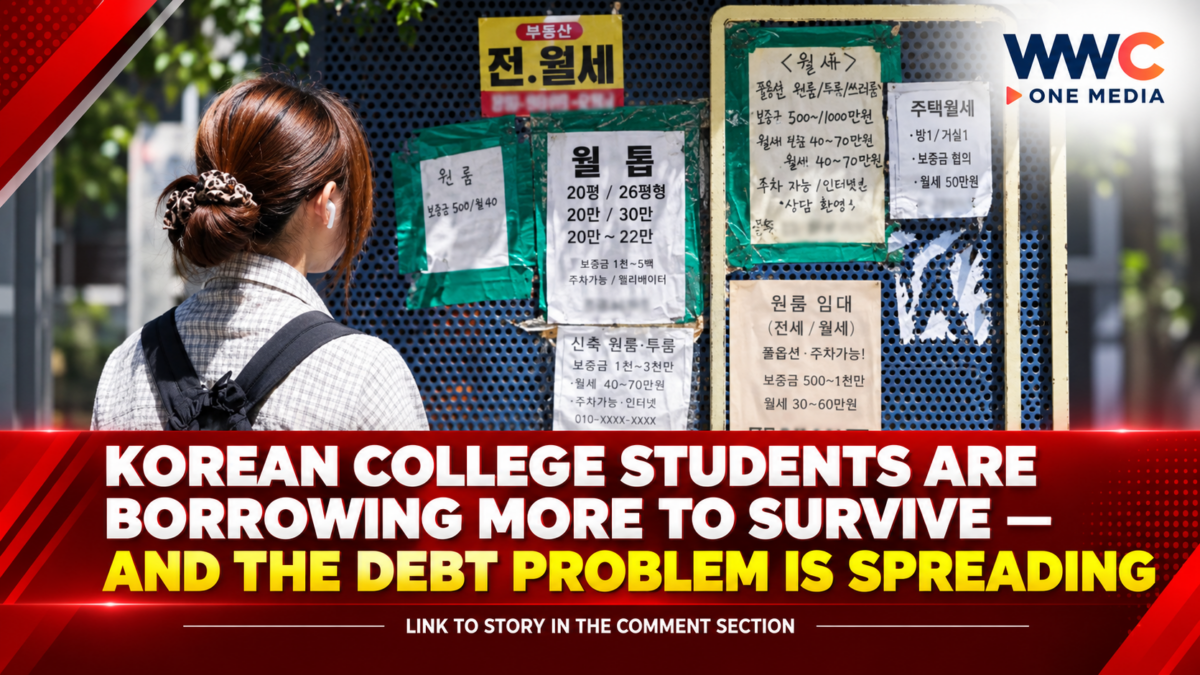
SEOUL — South Korean college students are increasingly turning to living-expense loans to cover everyday costs as housing, food and transportation expenses put more pressure on their budgets.
Data submitted by the Korea Student Aid Foundation (KOSAF) show that university students’ living-expense borrowing reached 850.6 billion won ($620 million) in 2025, up 32.8% from 640.67 billion won in 2023.
The number of loans also increased, reaching 457,129 in 2025, compared with 432,171 two years earlier.
Housing and Food Costs Are Adding Pressure
For some students, the loans are becoming a way to bridge the gap between limited income and rising daily expenses.
One Seoul university student quoted by The Korea Times said she earns around 600,000 won a month from a cafe job, but still struggles to cover rent and living costs even with some financial help from her parents. She said she was considering applying for a KOSAF living-expense loan for the following semester.
Housing costs have also become a particular concern around university districts.
Recent data cited by Seoul media showed that the combined rent and maintenance costs for small one-room apartments near 10 major universities in Seoul averaged 709,000 won per month in July, based on a 10 million-won deposit. Average monthly rent alone increased 7.7% year on year, from 581,000 won to 625,000 won.
Borrowing Is Rising Across Income Groups
The increase isn’t limited to students from the lowest-income households.
Living-expense loans among low-income students — including basic livelihood recipients, near-poor households and students in income-support brackets 1 through 3 — rose 33.9% between 2023 and 2025, reaching 363.474 billion won.
But borrowing also increased among students in higher income brackets.
Loans taken by students in brackets 9 and 10 climbed from 89.15 billion won in 2023 to 103.79 billion won in 2025. Loans among students whose income bracket had not yet been determined also rose substantially.
The figures suggest that living-expense borrowing is not confined to one segment of the student population.
Repayment Problems Are Growing Too
The increase in borrowing has been accompanied by a rise in overdue payments.
The number of borrowers behind on living-expense loan payments reached 8,101 in 2025, up 29.8% from 6,241 in 2023.
The overdue balance increased 31.1%, from 29.52 billion won to 38.69 billion won during the same period.
That has raised concerns about the longer-term impact of living-cost debt on young adults, particularly for students who enter the workforce already carrying financial obligations.
What Are Students Using the Loans For?
KOSAF’s survey of 44,818 living-expense loan borrowers found that most respondents reported using the money for intended everyday expenses such as food and transportation.
KOSAF currently allows eligible university and graduate students to borrow up to 2 million won per semester for expenses such as accommodation, meals, textbooks and transportation. Repayment begins when income is generated, depending on the borrower’s income level.
The Korean government’s Study in Korea portal also lists housing, food and transportation among the main living expenses students need to plan for, illustrating the range of costs students face beyond tuition.
The Bigger Issue: Student Debt Before Graduation
The latest numbers have prompted calls for a closer examination of why young people are increasingly borrowing for basic living costs.
The data show that the growth is occurring across income groups, while overdue balances are rising alongside total borrowing.
For policymakers and universities, the issue is therefore moving beyond tuition assistance. The challenge is increasingly about whether students can meet basic living expenses without accumulating debt that follows them into their early working years.
As housing and everyday costs continue to shape student budgets, the next question is becoming harder to ignore: how much debt will today’s students carry with them after graduation?
WWC ONE MEDIA G,A