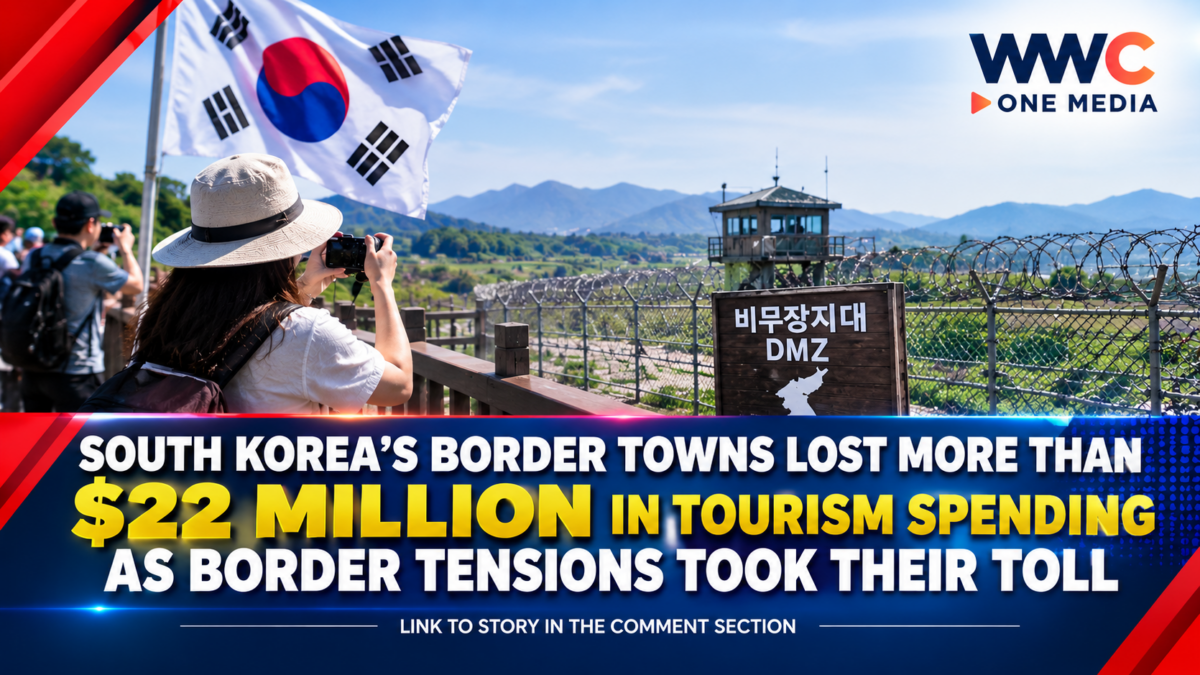
SEOUL, South Korea — Rising tensions along the inter-Korean border have taken a measurable toll on tourism in South Korea’s frontier communities, with tourism spending in five Gangwon border counties falling by roughly 30.3 billion won ($22 million) in 2024 compared with the previous year.
The figures, based on Korea Tourism Data Lab data analyzed by the office of National Assembly Foreign Affairs and Unification Committee member Woo Won-shik, show how security tensions can quickly spill over into local economies that depend heavily on visitors.
The affected counties — Cheorwon, Hwacheon, Yanggu, Inje and Goseong — recorded combined tourism spending of about 414.16 billion won in 2024, down from approximately 444.46 billion won in 2023.
That represented a 6.8% decline, or about 30.3 billion won.
Visitor Numbers Also Fell
The drop was not limited to tourism spending.
The five Gangwon border counties recorded approximately 35.47 million visitors in 2024, down around 1.89 million, or 5.1%, from approximately 37.36 million visitors in 2023.
Tourism spending recovered slightly in 2025, reaching approximately 416.98 billion won.
But that was still about 27.5 billion won below the 2023 level, indicating that the economic impact had not completely disappeared.
The numbers are particularly significant for communities that market their proximity to the Demilitarized Zone (DMZ) and other security-related attractions as part of their tourism economy.
Camp Greaves Takes a Major Hit
One of the sharpest declines was recorded at Camp Greaves, a security-tourism destination in Gyeonggi Province.
Annual visitors fell from 389,842 in 2024 to 132,996 in 2025 — a decrease of approximately 65.9%, or more than 256,000 visitors.
The decline came amid heightened tensions involving border loudspeaker broadcasts, North Korean trash-balloon launches and other confrontations along the inter-Korean frontier.
Border Tensions Had a Wider Economic Cost
The tourism losses were accompanied by direct damage in Gyeonggi’s border communities.
Between May 28, 2024 and Nov. 28, 2025, authorities recorded 24 cases of damage linked to North Korean trash and waste balloons across 10 cities and counties.
The reported damage totaled approximately 414.4 million won, including damage to vehicles, homes, factories, warehouses, greenhouses and machinery. One warehouse fire in Paju alone accounted for about 146 million won in reported damage.
Residents in border communities also reported disruption from North Korean loudspeaker broadcasts.
Gyeonggi Province received 11 related complaints, while emergency funding was used for soundproof windows and doors, psychological support and temporary accommodation for residents of Daeseong-dong village in Paju.
A New Security Issue Is Adding Pressure
The economic figures come as security concerns have again intensified following a Sept. 21 land-mine blast inside the DMZ that injured three South Korean soldiers.
South Korea’s military and the United Nations Command said a joint investigation found an active North Korean anti-personnel mine south of the Military Demarcation Line and determined that an armistice violation had occurred. North Korea has rejected South Korea’s findings and denied responsibility.
On Oct. 2, South Korean Unification Minister Chung Dong-young proposed talks with North Korea to address border issues, including concerns surrounding the Military Demarcation Line.
The developments illustrate how security conditions can affect not only military operations and diplomacy, but also communities whose businesses depend on visitors.
Tourism Begins to Show Signs of Recovery
There are signs that conditions can improve when tensions ease.
According to the data analyzed by Woo’s office, visitors and commercial activity in border areas began recovering after inter-Korean loudspeaker broadcasts were halted.
But the latest figures show that the recovery remains incomplete.
For towns along South Korea’s northern frontier, the DMZ is both a security boundary and a tourism asset. When tensions rise, visitors can stay away; when conditions stabilize, those same attractions can once again draw travelers.
The result is an economic equation that is becoming increasingly visible: what happens along the border can quickly reach the shops, restaurants, tour operators and communities far beyond it.
WWC ONE MEDIA G,A