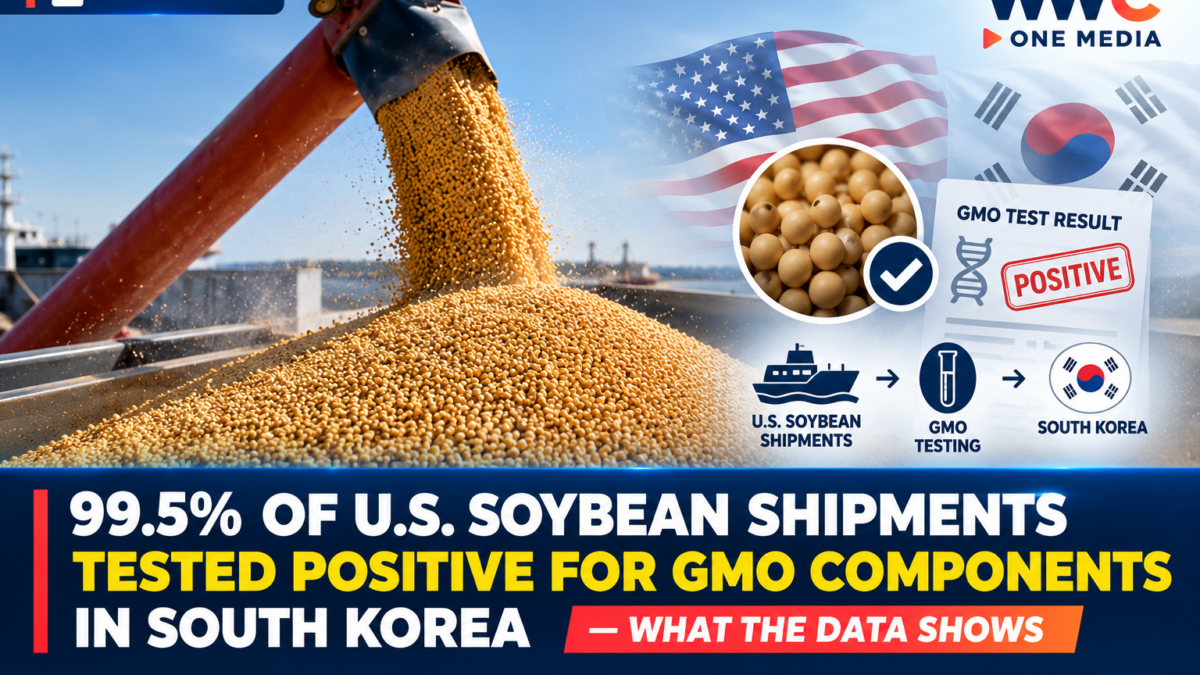
SEOUL, South Korea — Nearly every shipment of U.S. soybeans tested by South Korean authorities over the past decade contained detectable genetically modified organism (GMO) components, according to data submitted by the Korea Agro-Fisheries & Food Trade Corp. (aT).
The figures, covering 2017 through September 2026, show that 400 of 402 U.S. soybean import shipments tested positive for GMO components — equivalent to 99.5% of shipments. The United States supplied about 1.60 million tons, accounting for 91.5% of the soybean import volume covered by the data.
The figures were highlighted by National Assembly member Song Ok-joo, who called for greater diversification of soybean import sources and changes to the way government-backed imports are evaluated. Her comments represent a policy position rather than an independent finding that the detected GMO components pose a health risk.
U.S. Soybeans Dominate Imports
The data shows how heavily South Korea relies on U.S. soybeans.
From 2017 through September 2026, South Korea imported about 1.60 million tons from the United States across 402 shipments.
By comparison, imports from China totaled about 112,124 tons across 18 shipments, while Russia supplied approximately 7,870 tons across six shipments. No GMO components were detected in the Chinese or Russian shipments included in the data.
That difference has prompted calls for South Korea to consider not only price when selecting suppliers, but also factors such as previous GMO testing results and product quality.
Why U.S. Soybeans Dominate the Market
Price is an important part of the equation.
The reported 2024 import price for U.S. soybeans was approximately $663 per ton, compared with around $1,093 per ton for Chinese soybeans — making the U.S. product roughly 40% cheaper in that comparison.
South Korea’s government-backed soybean imports use competitive bidding among companies meeting specified requirements, with the lowest bidder generally selected.
Critics of the current system argue that this approach may give greater weight to price than to a supplier’s historical GMO profile.
What Does a Positive GMO Test Mean?
The figures require some context.
South Korea permits the import and distribution of approved genetically modified agricultural products after safety assessments. The government says approved GMO foods and agricultural products can legally enter the Korean market.
A GMO test detecting genetic material therefore does not automatically mean that a shipment is unsafe or illegal.
The current controversy is instead focused on sourcing, labeling, testing standards and how much GMO material can be unintentionally mixed into products marketed as non-GMO.
South Korean rules currently allow certain agricultural products and processed foods to avoid GMO labeling when unintended GMO mixing remains at or below 3%, according to recent reporting on the country’s labeling system.
The Issue Reaches the Tofu and Soy-Food Market
Soybeans are particularly important because they are used to make familiar Korean foods such as tofu, soy milk and doenjang.
Recent testing of imported-soybean tofu has also detected GMO components in some products, adding to the debate over how non-GMO ingredients are sourced and labeled.
At the same time, Korean-grown soybeans are generally associated with non-GMO production, although domestic soybeans typically cost considerably more than imported alternatives.
That creates a difficult supply-chain balance between cost, availability, domestic agriculture and consumer demand for non-GMO products.
Calls for a New Import Strategy
Song has proposed that South Korea consider a more comprehensive evaluation system that incorporates each country’s GMO testing history and product quality, rather than relying predominantly on price in government-backed procurement.
She also called for stronger controls on shipments contracted as non-GMO, including inspections before shipment and penalties for violations. Another proposal would lower the permitted threshold for unintended GMO mixing from 3% to 0.9%, aligning it with the European Union’s commonly cited threshold.
These are proposals from a lawmaker and are not, by themselves, changes to South Korean regulations.
A Bigger Question for South Korea
The latest figures expose a broader issue in South Korea’s food supply chain: how to balance affordable imported agricultural products with consumer demand for traceability and non-GMO ingredients.
The data does not establish that GMO soybeans are inherently unsafe. Instead, it highlights the extent of South Korea’s dependence on U.S. soybean imports and the policy debate surrounding how those imports are purchased, tested and labeled.
As Seoul weighs possible changes to its procurement and labeling systems, the soybean market could become an important test of how South Korea balances food costs, domestic farmers, international suppliers and consumer expectations.
WWC ONE MEDIA G,A