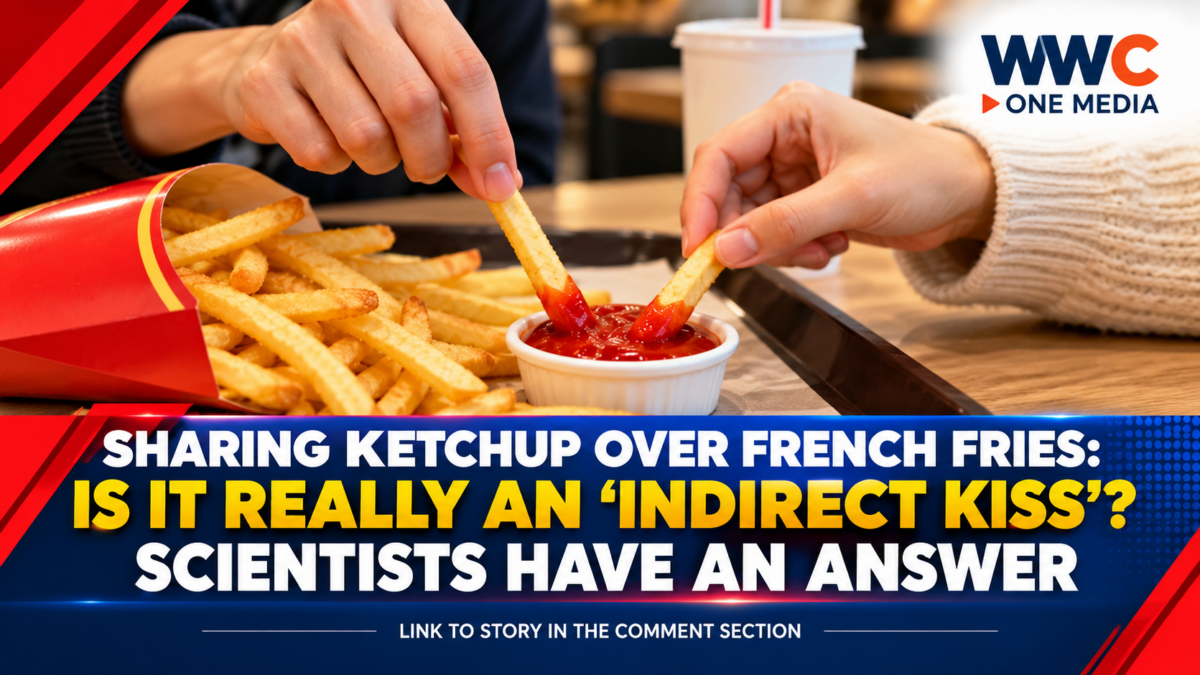
SEOUL — That innocent-looking dip of a French fry into shared ketchup may be doing more than adding flavor. Scientists say double-dipping can transfer bacteria from the mouth into a communal sauce—although calling it an “indirect kiss” is more playful than scientific.
The question was highlighted in a new report by The Korea Times, which examined research into what happens when someone takes a bite of food and then dips the same piece back into a shared sauce.
The practice, commonly known as double-dipping, can introduce oral bacteria into the sauce that other people may later eat.
What Happens When You Double-Dip?
Researchers at Clemson University studied bacterial transfer associated with double-dipping and found that bacteria from a person’s mouth can enter shared sauces after bitten food is dipped again.
Under the conditions studied, researchers estimated that a single double dip could transfer roughly 50 to 100 bacteria.
That number sounds surprisingly small compared with another comparison cited in the report.
A separate study published in Microbiome estimated that an intimate 10-second kiss can transfer an average of about 80 million bacteria between partners.
Using those figures, the report notes that it would take roughly 800,000 double dips at 100 bacteria each to reach the same numerical total.
But there is an important catch: the studies examined completely different situations, so the figures should not be interpreted as proof that double-dipping and kissing carry equivalent health effects.
Not All Sauces React the Same Way
The type of sauce also appears to matter.
Researchers detected approximately 1,000 colony-forming units per milliliter in salsa immediately after double-dipping, compared with about 200 CFU/mL in cheese dip and 150 CFU/mL in chocolate dip.
The researchers suggested that differences in properties such as viscosity could help explain why bacteria behaved differently across sauces.
Salsa’s acidity may also affect how long some bacteria survive, meaning a higher initial bacterial count does not necessarily translate into the same level of contamination over time.
Shared Bottles and Utensils Can Also Transfer Bacteria
The issue isn’t limited to ketchup or other dipping sauces.
Research cited by The Korea Times found that drinking directly from a shared bottle can leave bacteria around the bottle opening and in the remaining beverage. Studies have also shown that bacteria can move between mouths, utensils and food.
That doesn’t mean every shared meal is dangerous. The health significance depends heavily on which microorganisms are present, rather than simply the number of bacteria transferred.
However, when someone is sick with a contagious illness such as a cold or flu, avoiding practices such as double-dipping and sharing bottles or eating utensils is a sensible hygiene precaution.
So, Is Double-Dipping Really an “Indirect Kiss”?
Not literally.
The phrase is best understood as a humorous way of describing the possibility that microorganisms from one person’s mouth can reach another person’s food through a shared sauce.
The science does show that double-dipping can transfer oral bacteria. But comparing the bacterial totals from separate studies does not establish that the two behaviors are biologically equivalent.
So the next time a group shares fries, the biggest takeaway may be simple: once a bitten fry goes back into the communal sauce, bacteria can go along with it.
WWC ONE MEDIA G,A