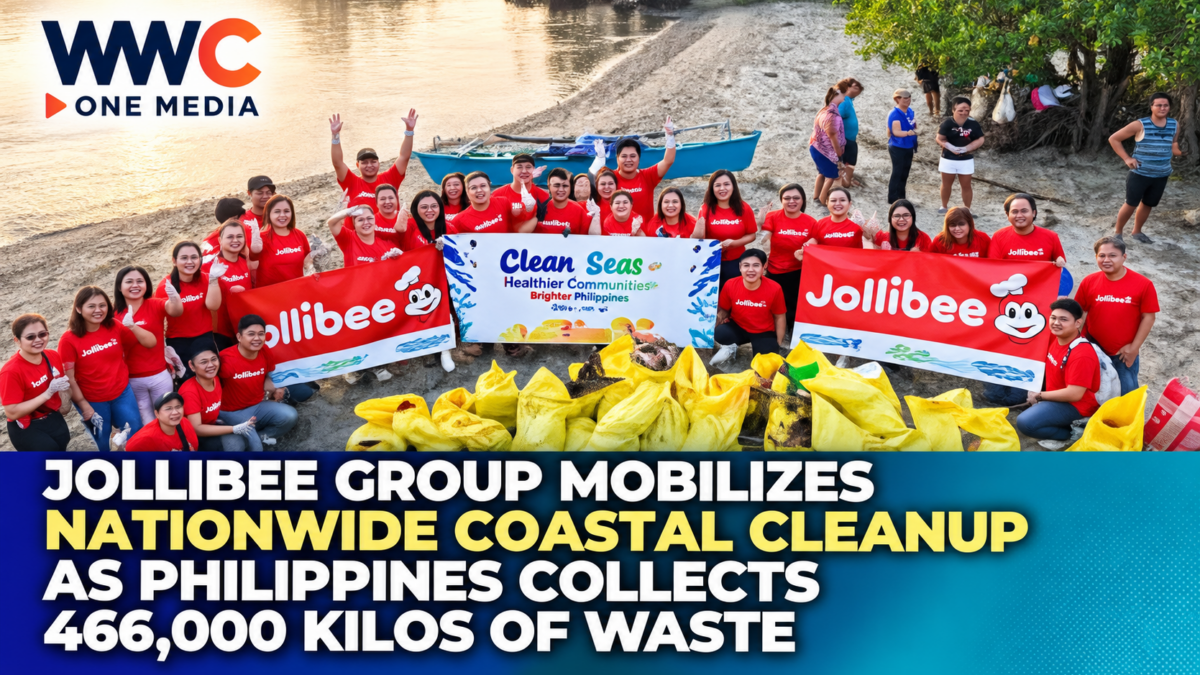
MANILA — Jollibee Group employees traded restaurant counters and offices for gloves and garbage sacks as teams joined coastal cleanups across Luzon, Visayas and Mindanao, supporting a nationwide environmental drive that removed hundreds of thousands of kilograms of trash from Philippine shorelines and waterways.
The homegrown restaurant group mobilized employees from brands including Jollibee, Mang Inasal, Chowking and Greenwich during the September 19 International Coastal Cleanup, expanding an employee-volunteer effort that Jollibee has been building as part of its broader sustainability program.
At one major activity, more than 90 Jollibee Group employees joined the cleanup and helped collect more than 400 kilograms of coastal waste.
Another 266 colleagues joined simultaneous cleanup drives in other parts of Luzon, Visayas and Mindanao, while the broader coordinated effort reportedly involved more than 1,100 participants nationwide.
The activity marked Jollibee Group’s second consecutive year of participating in the International Coastal Cleanup.
But the scale of the trash collected nationwide shows why one-day volunteer drives alone cannot solve the Philippines’ marine-pollution problem.
MORE THAN 103,000 VOLUNTEERS JOINED THE NATIONAL CLEANUP
Jollibee’s participation formed part of a much bigger environmental mobilization.
The Department of Environment and Natural Resources said the 2026 International Coastal Cleanup attracted more than:
103,000 volunteers
across
369 coastal, river, waterway and underwater sites
in
all 17 Philippine regions.
Volunteers collectively removed more than:
466,000 kilograms of waste.
That is roughly 466 metric tons of garbage collected in a single nationwide campaign.
Participants included:
Government agencies
Local governments
Schools
Private companies
Civic organizations
Community groups
and individual volunteers.
CAVITE ALONE COLLECTED THOUSANDS OF KILOS
Jollibee Foods Corporation was among the private-sector organizations supporting cleanup activities in Cavite.
At Barangays 8 and 11 in Cavite City, approximately 657 participants joined the September 19 activity coordinated by environmental authorities and local partners.
Teams cleaned hundreds of meters of coastline.
At Barangay 8 alone, volunteers collected:
678 kilograms of residual waste
431 kilograms of recyclables
1,382 kilograms of biodegradable material
and
1 kilogram of special waste.
That puts the total collected at the site at nearly 2.5 metric tons.
The waste was then segregated and scheduled for proper handling and disposal.
DAVAO VOLUNTEERS COLLECTED ANOTHER 4,832 KILOS
The waste problem was even more visible in Davao City.
At Barangay Matina Aplaya, 852 volunteers from 92 organizations collected approximately:
4,832 kilograms of waste.
The cleanup covered an 804-meter coastal stretch.
Among the most common discarded items were:
Plastic bags
Plastic bottles
Bottle caps
Food wrappers
Sachets
Clothing
and
Footwear.
Jollibee Foods Corporation joined government agencies, private companies and community groups supporting the Davao activity.
The amount recovered from just one coastal area underscores the scale of waste entering waterways before cleanup teams ever arrive.
THIS IS BIGGER THAN A ONE-DAY BEACH CLEANUP
International Coastal Cleanup activities are highly visible.
Volunteers gather.
Trash is removed.
Before-and-after photographs show cleaner beaches.
But environmental officials increasingly emphasize that the real objective is not simply removing garbage after it reaches the coast.
It is preventing the waste from getting there in the first place.
Environment Secretary Juan Miguel “Mitch” Cuna has stressed that effective solid-waste management requires responsibility throughout the entire waste chain—from consumption and segregation to collection, recycling and disposal.
That shifts the discussion from cleanup toward prevention.
PLASTIC REMAINS ONE OF THE BIGGEST PROBLEMS
The trash removed during coastal cleanups repeatedly includes:
Sachets
Plastic bottles
Food packaging
Disposable containers
and other single-use plastics.
Many of these materials begin far from the sea.
Improperly discarded waste can move through:
Drainage systems
Creeks
Rivers
and
Floodwaters
before eventually reaching Manila Bay and other coastal ecosystems.
A plastic wrapper thrown on a city street can therefore become marine pollution kilometers away.
That is why coastal cleanup is ultimately tied to urban waste management.
THE PHILIPPINES HAS BEEN EXPANDING CLEANUP PARTICIPATION
The scale of the International Coastal Cleanup has grown significantly in recent years.
In 2024, approximately 74,075 volunteers from 1,913 organizations participated at 250 coastal sites.
They collected around:
352,479 kilograms of waste.
By 2026, participation had risen above 103,000 volunteers and the amount recovered exceeded 466,000 kilograms.
The increase shows stronger public participation.
But it also reveals an uncomfortable reality:
there is still an enormous volume of waste available to collect.
JOLLIBEE ALREADY JOINED THE CLEANUP IN 2025
This was not Jollibee Group’s first environmental volunteer drive.
During the 2025 International Coastal Cleanup, 108 Jollibee Group volunteers worked at SM by the Bay.
They contributed:
540 volunteer hours
and collected approximately:
546 kilograms of waste.
Employees participated from brands and business units including:
Jollibee
Chowking
Mang Inasal
Greenwich
Red Ribbon
Burger King
Panda Express
Yoshinoya
and other group companies.
The 2026 campaign therefore expands on an initiative already established the previous year.
EMPLOYEE VOLUNTEERING IS PART OF “JOY FOR TOMORROW”
The cleanup activities fall under Jollibee Group’s Joy for Tomorrow sustainability agenda.
The program covers several areas of corporate responsibility, including environmental protection, community support, responsible production and employee participation.
Jollibee has set a goal of generating around:
10,000 volunteer hours every year.
That strategy increasingly uses employees not only as workers within the business but also as participants in community programs.
The company has also used employee volunteerism for:
Education programs
Environmental initiatives
Disaster response
and
Community feeding.
JOLLIBEE IS A MUCH BIGGER COMPANY THAN IT WAS A DECADE AGO
The environmental impact of Jollibee’s operations matters partly because the company itself has grown enormously.
Jollibee Group now operates more than:
10,400 stores and cafés
across
33 countries
through a portfolio of around 20 brands.
Its 2025 systemwide sales reached approximately:
₱455.1 billion.
Consolidated revenue totaled:
₱305.1 billion.
The company is therefore no longer simply a Philippine fast-food chain.
It is one of Southeast Asia’s largest restaurant groups.
That scale increases the importance of how it handles:
Packaging
Energy
Water
Food waste
and
Supply chains.
JOLLIBEE HAS ALSO BEEN WORKING ON WASTE INSIDE ITS FACTORIES
The company’s environmental agenda extends beyond volunteer cleanup activities.
In 2026, Jollibee Group received sustainability awards for manufacturing programs involving:
Waste management
Responsible production
Energy efficiency
and
Water efficiency.
Its manufacturing and logistics division has been working on circular-waste initiatives designed to reduce material sent to disposal sites.
That distinction is important.
Picking up waste from a shoreline deals with pollution after it has escaped into the environment.
Reducing waste inside manufacturing and restaurant operations attempts to prevent the problem earlier.
99% OF ELECTRICITY AT COVERED PHILIPPINE COMMISSARIES HAS SHIFTED TO RENEWABLE SOURCES
Jollibee has also reported progress in its energy use.
Across covered Philippine commissaries, the company says approximately:
99% of electricity consumption
has shifted toward renewable energy, including geothermal sources.
Jollibee estimates the shift has the potential to reduce greenhouse-gas emissions from those facilities by more than:
70%.
Its newer Danao Commissary in Cebu has also earned LEED Gold certification for measures involving:
Energy efficiency
Water conservation
Renewable energy
and
Construction-waste management.
These operational changes arguably have a much larger long-term environmental effect than a single cleanup event.
JOLLIBEE ALSO WORKS WITH LAGUNA LAKE AUTHORITIES
Jollibee Group has an existing partnership with the Laguna Lake Development Authority supporting waste-recovery activities around Laguna de Bay.
Company employees have previously participated in monthly or twice-monthly cleanups in waterways around:
Metro Manila
Rizal
and
Laguna.
Collected plastics are also turned over to waste-processing partners for proper handling.
The LLDA formally recognized the group for its participation in those programs in 2024.
THE EPR LAW IS CHANGING WHAT LARGE COMPANIES MUST DO
Corporate action on plastics is no longer purely voluntary.
The Philippines’ Extended Producer Responsibility Act of 2022 requires large companies covered by the law to recover an increasing share of the plastic packaging they introduce into the market.
The statutory recovery targets progressively increase.
For 2026, covered companies are expected to recover:
60% of their plastic packaging footprint.
That rises to:
70% in 2027
and
80% from 2028 onward.
This changes the role of corporations.
Companies are increasingly expected not only to sell products packaged in plastic, but also to help finance the recovery and recycling of those materials afterward.
CLEANUPS CANNOT SUBSTITUTE FOR EPR COMPLIANCE
This distinction is important.
A beach cleanup may demonstrate employee engagement.
But it is not a replacement for formal waste-recovery obligations.
Companies must still build systems involving:
Collection
Recycling
Waste diversion
and
Packaging reduction.
The real environmental test therefore comes from whether corporate cleanup campaigns are paired with measurable reductions in waste generated by the business itself.
THE COUNTRY IS ALSO RECONSIDERING ITS 25-YEAR-OLD WASTE LAW
The national conversation around solid waste is also changing.
The Philippines’ Ecological Solid Waste Management Act has been in place for roughly 25 years.
President Ferdinand Marcos Jr. called for its modernization in his 2026 State of the Nation Address.
The government is looking at newer technologies and approaches covering:
Waste segregation
Collection
Recycling
Resource recovery
Waste treatment
and potentially
Waste-to-energy.
The challenge is no longer simply passing environmental rules.
It is enforcing them consistently from barangay level to major cities.
WHY COASTAL WASTE MATTERS BEYOND DIRTY BEACHES
Marine litter affects much more than tourism aesthetics.
Plastic waste can harm:
Fish
Sea turtles
Birds
Coral ecosystems
and other marine organisms.
Larger plastics eventually fragment into smaller particles.
These microplastics can persist in the environment for long periods and enter food chains.
Waste can also clog urban waterways and drainage infrastructure, contributing to flooding during heavy rainfall.
That means plastic pollution creates environmental, economic and public-infrastructure costs.
CORPORATE VOLUNTEERING CAN STILL HAVE VALUE
None of this means cleanup drives are meaningless.
They provide immediate benefits.
Waste is physically removed from waterways.
Employees see the scale of pollution firsthand.
Communities become more aware of environmental problems.
Organizations also collect information about the types of waste appearing most frequently.
Those records can help governments and environmental groups identify where pollution originates.
But the biggest value may be cultural.
A worker who spends a morning collecting hundreds of plastic sachets from a shoreline may think differently about waste afterward.
MORE COMPANIES ARE MOBILIZING THEIR WORKFORCES
Jollibee is not alone.
Several major Philippine companies joined the 2026 International Coastal Cleanup.
2GO, for example, mobilized 149 employee volunteers across locations including:
Manila
Cebu
Davao
Cagayan de Oro
and
Zamboanga.
SM Cares coordinated cleanup events across dozens of malls and coastal areas nationwide.
Other corporate participants joined government and civic groups across the country.
The increasingly broad participation demonstrates that coastal pollution is becoming a mainstream corporate sustainability issue rather than simply an environmental advocacy campaign.
BUT BIGGER CLEANUPS CAN REVEAL A BIGGER PROBLEM
There is a paradox in the numbers.
More volunteers are good.
More waste being removed is good.
But rising collection totals are not necessarily evidence that the environmental problem is improving.
The ideal long-term outcome would eventually be:
more volunteers
but
less trash available to collect.
That would indicate that waste is being prevented before it reaches beaches and waterways.
As long as hundreds of thousands of kilograms continue appearing along Philippine coasts every year, the cleanup is treating the symptom.
THE BIGGER STORY: THE BEST COASTAL CLEANUP IS THE WASTE THAT NEVER REACHES THE SEA
Jollibee Group’s nationwide mobilization demonstrates the scale employee volunteerism can reach when a major corporation activates its workforce.
Hundreds of employees joined activities across Luzon, Visayas and Mindanao.
Thousands more volunteers participated alongside them nationally.
And more than 466,000 kilograms of waste were removed from Philippine waterways and coastlines during the broader International Coastal Cleanup.
That is a meaningful accomplishment.
But the volume collected also tells a more uncomfortable story.
The Philippines does not simply need larger cleanups.
It needs less waste reaching the coast in the first place.
That means corporations, consumers and government agencies have to move further upstream:
reduce unnecessary packaging,
improve segregation,
recover more plastics,
build reliable collection systems,
and
stop garbage before it enters rivers and drainage networks.
So the real measure of success will not be whether next year attracts even more volunteers.
It will be whether those volunteers eventually have less trash left to pick up.