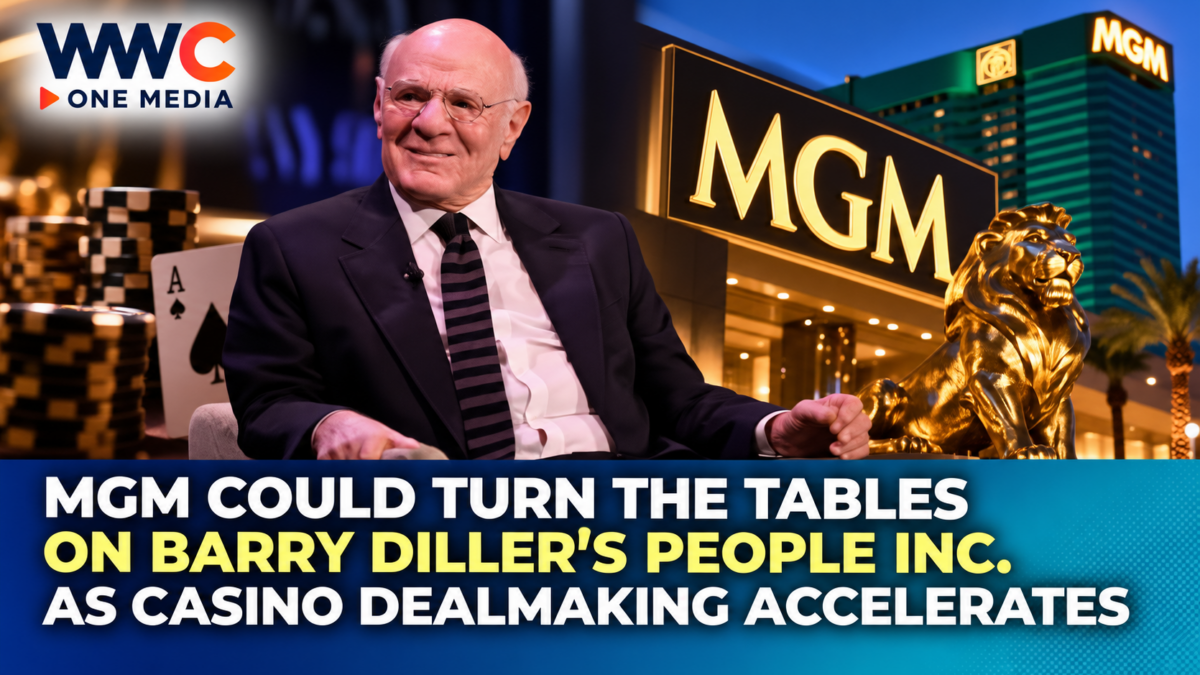
LAS VEGAS — One of the strangest takeover stories in corporate America has taken another turn: weeks after Barry Diller’s People Incorporated abandoned a multibillion-dollar attempt to take MGM Resorts private, MGM CEO Bill Hornbuckle is now leaving open the possibility that the casino giant could buy its own largest shareholder instead.
The role reversal comes at a moment when dealmaking is sweeping through the casino industry.
Caesars Entertainment is already preparing to go private in a $17.6 billion acquisition by Fertitta Entertainment, while MGM and Wynn Resorts are pouring billions into new casino resorts in Japan and the United Arab Emirates.
For MGM, the sudden question is no longer simply whether it will be acquired.
It is whether the company could become the acquirer.
PEOPLE INC. TRIED TO BUY MGM FOR $48.30 A SHARE
The story began on June 1, when People Incorporated—formerly known as IAC—made a non-binding offer to acquire all MGM Resorts shares it did not already own for:
$48.30 per share in cash.
At the time, the offer represented a 24.1% premium to MGM’s 30-day volume-weighted average share price and more than a 30% premium to its 90-day average.
People Incorporated already owned more than a quarter of MGM.
Its goal was to take the casino company private.
Barry Diller argued that MGM’s public-market valuation failed to reflect the long-term strength of its assets.
DILLER’S ARGUMENT WAS THAT MGM WAS UNDERVALUED
People Incorporated first invested in MGM during the pandemic in 2020, when Las Vegas casinos were facing one of the worst crises in their history.
Diller’s thesis was unusual but simple.
Physical entertainment experiences could prove more resilient than businesses vulnerable to digital disruption.
People Incorporated later said MGM represented a business with real-world assets that artificial intelligence could not easily replicate or disintermediate.
MGM owns or operates some of the most recognizable casino and resort properties in Las Vegas, including:
Bellagio
MGM Grand
Aria
and
Cosmopolitan-related operations.
It also owns international casino assets and a large digital-gambling business through BetMGM.
THEN THE DEAL COLLAPSED
After months of discussions, People Incorporated withdrew the proposal on September 23.
Diller said the ingredients necessary to complete the transaction were not coming together as expected.
But he did not walk away from MGM.
People Incorporated said it still owned approximately 66.8 million MGM shares, representing roughly 27% of the company, and continued to have confidence in management and MGM’s long-term prospects.
The company also said it remained open to potential strategic opportunities involving MGM.
That language is important because it means the relationship did not end when the takeover bid did.
MGM NOW APPEARS TO BE CONSIDERING THE REVERSE
At the Global Gaming Expo in Las Vegas, Hornbuckle was asked whether MGM could turn the tables and acquire People Incorporated.
He did not reject the idea.
Instead, he said MGM would continue to pursue whatever creates the most value for shareholders and would keep looking for ways to unlock value in a company he believes is “grossly undervalued.”
That answer immediately revived speculation that MGM could eventually pursue a transaction involving People Incorporated.
But there is an important distinction.
MGM has not announced a formal offer.
There is no disclosed price.
There is no merger agreement.
And there is no guarantee a transaction will happen.
At this stage, it is an option management has refused to rule out.
WHY WOULD MGM BUY ITS OWN LARGEST SHAREHOLDER?
At first glance, the idea sounds backwards.
People Incorporated owns roughly 27% of MGM.
Why would MGM acquire the company that owns part of MGM itself?
The answer lies in what People Incorporated has become.
Formerly known as IAC, the company officially changed its name to People Incorporated in June 2026 and now owns publishing group People Inc., the former Dotdash Meredith business.
Its media portfolio includes more than 40 well-known brands such as:
PEOPLE
Travel + Leisure
Food & Wine
Allrecipes
Better Homes & Gardens
Entertainment Weekly
Investopedia
and
Southern Living.
A deal could therefore create a very unusual company combining:
casinos
hotels
online gambling
travel
entertainment
and
consumer media.
TRAVEL + LEISURE COULD BE STRATEGICALLY INTERESTING
One of the clearest potential connections is travel content.
MGM depends heavily on visitors traveling to destinations such as:
Las Vegas
Macao
and eventually
Osaka.
People Inc. owns major travel and lifestyle media properties capable of reaching millions of consumers.
That could theoretically create marketing and customer-acquisition opportunities.
But that does not automatically mean a merger would make financial sense.
The original People Incorporated takeover collapsed partly because the expected combination did not come together as planned.
MGM would still have to explain why owning the publishing business creates more shareholder value than simply remaining partners or separate companies.
PEOPLE INC. IS NOT JUST A MEDIA COMPANY
People Incorporated is also unusual because its own balance sheet includes its MGM investment.
Its SEC filings describe the company as the owner of People Inc. Group and a significant minority holder of MGM shares.
That creates an almost circular ownership structure.
If MGM bought People Incorporated, it would effectively acquire a company that already owns roughly 27% of MGM itself.
Any potential transaction would therefore require careful structuring.
Investment bankers, lawyers and boards would have to determine how those MGM shares are treated in a combination.
MGM’S BOARD SAYS IT IS HAPPY TO STAY INDEPENDENT
After Diller withdrew his bid, MGM’s board publicly reaffirmed its commitment to executing MGM’s existing strategy as a standalone company.
That is another reason a reverse takeover should not be treated as inevitable.
MGM does not need to buy People Incorporated simply because the idea has been discussed.
Management can continue operating independently while maintaining Diller as a major shareholder.
DILLER STILL HAS ENORMOUS INFLUENCE
Even without a takeover, Diller remains one of MGM’s most important investors.
People Incorporated’s approximately 27% position makes it MGM’s largest shareholder.
The relationship is also governed by a voting agreement.
According to People Incorporated’s filings, shares controlled by the company and Diller above a specified voting threshold must generally be voted proportionally with other MGM shareholders.
That arrangement limits the ability of one investor to dominate votes despite the unusually large stake.
MGM’S VALUE ARGUMENT IS BIGGER THAN LAS VEGAS
Hornbuckle’s comments about undervaluation are rooted in the breadth of MGM’s assets.
The company is increasingly more than a Las Vegas casino operator.
Its major growth platforms include:
BetMGM
Macao
MGM Osaka
and its existing U.S. resorts.
That mix gives MGM exposure to physical casinos, online gambling and international tourism.
MGM OSAKA COULD BECOME A HUGE NEW BUSINESS
One of MGM’s biggest bets is in Japan.
MGM Osaka, the country’s first approved integrated resort, is scheduled to open in 2030.
The project is being developed as a huge entertainment complex combining:
casino gaming
hotels
restaurants
retail
convention space
and other attractions.
Industry coverage from G2E reported that Hornbuckle expects the approximately $10 billion development eventually to become a major cash-flow generator for MGM.
That future earnings stream is one reason MGM executives believe public investors may be undervaluing the company today.
BETMGM IS ANOTHER IMPORTANT PIECE
MGM also owns half of BetMGM, its online betting joint venture.
Digital gaming provides exposure to:
sports betting
online casino games
and
mobile gambling.
The online gambling market is strategically important because it allows casino operators to reach customers without requiring them to visit a physical resort.
But the industry remains highly competitive.
BetMGM faces major rivals including:
FanDuel
DraftKings
and other digital operators.
The question for investors is whether MGM’s online operations can become large enough to materially change the valuation of the parent company.
MACAO REMAINS CRITICAL TOO
MGM also operates casinos in Macao through MGM China.
Macao is one of the world’s biggest gambling markets and has recovered substantially from the pandemic-era travel restrictions that damaged the industry.
MGM has focused heavily on premium customers and non-gaming attractions as operators adapt to the Chinese government’s push for more diversified tourism.
That international exposure gives MGM another growth engine outside the United States.
THE CASINO INDUSTRY IS ENTERING A MAJOR DEAL CYCLE
The MGM-People Incorporated drama is unfolding during a much bigger wave of consolidation.
The clearest example is Caesars Entertainment.
Hospitality billionaire Tilman Fertitta’s Fertitta Entertainment agreed in May to buy Caesars for $17.6 billion, including approximately $11.9 billion of debt.
Caesars shareholders will receive $31 per share in cash, representing roughly a 49% premium to the company’s unaffected share price before takeover speculation emerged.
That deal would take Caesars private.
CAESARS’ DEAL IS NOT FINISHED YET
The Caesars transaction still faces regulatory scrutiny.
The U.S. Federal Trade Commission issued a second request for additional information in September, extending the antitrust review.
That is important because Fertitta already owns Golden Nugget casino properties and other hospitality businesses.
Regulators will examine whether the combination reduces competition in relevant casino, hospitality or regional markets.
The deal demonstrates that casino consolidation can be attractive—but also complicated.
LAS VEGAS HAS BEEN UNDER PRESSURE
One reason operators may be considering transactions is the uneven Las Vegas economy.
The city has experienced periods of softer visitor numbers and concerns about affordability.
Hotel prices, resort fees, dining costs and gaming expenses have risen sharply over the past several years.
Casino executives have been increasingly vocal about maintaining value for middle-income visitors.
Hornbuckle has warned that Las Vegas cannot afford to alienate value-conscious customers even as high-end demand remains relatively strong.
That creates pressure to find new growth sources.
INTERNATIONAL CASINOS ARE BECOMING MORE IMPORTANT
Major operators are increasingly looking overseas.
MGM is developing Japan.
Wynn Resorts is developing the first integrated resort in the United Arab Emirates.
Wynn Al Marjan Island in Ras Al Khaimah is scheduled to open in September 2027 after regional disruptions pushed the timeline back.
The project is expected to include approximately:
1,530 hotel rooms and suites
22 restaurants, lounges and bars
a theater
retail
and
gaming.
WYNN’S UAE PROJECT JUST GOT $600 MILLION MORE EXPENSIVE
The Middle East conflict and supply-chain disruption increased the Wynn project’s budget by approximately $600 million.
Wynn executives said about half of the increase was directly tied to regional disruptions involving:
shipping
materials
insurance
and project delays.
That illustrates another reason scale matters in the modern casino business.
Integrated resorts can cost billions of dollars and take years to build.
Large companies have greater ability to finance those projects and absorb construction risk.
MGM OSAKA FACES THE SAME SCALE CHALLENGE
MGM’s Osaka resort is similarly enormous.
Projects of that size require:
billions in financing
government cooperation
construction partners
tourism infrastructure
and years of planning.
For MGM, international development creates potential long-term growth.
But it also requires substantial capital.
That makes the company’s balance sheet and valuation particularly important.
WHY DILLER LIKES PHYSICAL ENTERTAINMENT IN AN AI WORLD
One of the most interesting ideas behind People Incorporated’s original investment remains relevant.
Diller argues that physical experiences are difficult for technology to replace.
Artificial intelligence can disrupt:
media
software
search
and many forms of digital work.
But AI cannot fully replicate:
a casino floor
a concert
a luxury hotel
a restaurant
or
a Las Vegas vacation.
That scarcity may make physical entertainment assets more strategically valuable in an increasingly digital economy.
It was one of the main reasons People Incorporated initially bought MGM shares.
IRONICALLY, PEOPLE INC.’S OWN MEDIA BUSINESS IS MORE EXPOSED TO AI
That creates an unusual contrast.
People Incorporated owns digital publishing businesses.
Those operations are among the industries most exposed to changes in:
search traffic
AI-generated answers
digital advertising
and consumer behavior.
MGM owns hotels, casinos and resorts.
Those businesses are far harder to digitize away.
A merger could therefore combine a technology-exposed media company with a physical-experience business that Diller himself has argued is more resilient.
THE REAL QUESTION IS CAPITAL ALLOCATION
For MGM shareholders, however, strategic logic is not enough.
Any acquisition of People Incorporated would need to outperform other uses of MGM’s capital.
MGM could instead use money to:
Buy back shares
Reduce debt
Invest in Osaka
Expand BetMGM
or
Upgrade existing resorts.
Management would therefore need to prove that buying People Incorporated produces a better return than those alternatives.
That is especially important when MGM management itself believes its shares are undervalued.
If the stock is cheap, repurchasing MGM shares may be an attractive option.
A DEAL COULD ALSO CREATE COMPLEXITY
Casino companies are already complicated businesses.
They operate under extensive gaming regulations.
Media companies face completely different commercial pressures.
Combining the two could introduce:
Management complexity
Different regulatory regimes
Different capital requirements
and
Different investor expectations.
Any synergy would have to be large enough to justify those complications.
That may be one reason People Incorporated ultimately withdrew its original proposal.
THE ORIGINAL BID WOULD HAVE TAKEN MGM PRIVATE
Diller’s proposal envisioned People Incorporated owning just over 50.1% of the equity of a privately held MGM, with other investors holding minority positions.
Funding was expected to come from:
existing cash
MGM cash
new debt
and
additional equity commitments.
That was a highly ambitious structure.
Taking MGM private would have required substantial financing.
The reversal toward a potential MGM acquisition of People Incorporated could involve an entirely different structure.
THERE IS STILL NO DEAL
That point needs to remain clear.
People Incorporated’s MGM offer is dead.
MGM’s possible acquisition of People Incorporated is not currently a formal bid.
The companies remain independent.
The only confirmed facts are:
People Incorporated owns roughly 27% of MGM.
Its $48.30-per-share MGM proposal was withdrawn.
MGM CEO Bill Hornbuckle has declined to rule out a reverse transaction.
Anything beyond that remains potential dealmaking rather than an agreed takeover.
THE BIGGER STORY: LAS VEGAS IS ENTERING A NEW ERA OF CONSOLIDATION
The casino industry is changing quickly.
Caesars is moving toward private ownership.
MGM’s largest shareholder tried to buy it and then abandoned the plan.
MGM may now be contemplating the reverse.
At the same time, the biggest casino operators are investing billions of dollars in:
Japan
Macao
the UAE
and
online gambling.
The old casino model was heavily centered on owning properties in Las Vegas.
The next generation of gaming companies is becoming more global, more digital and much larger.
That is why the MGM-People Incorporated story matters even if no merger ultimately happens.
It shows that some of the industry’s biggest companies are questioning whether their existing corporate structures still make sense.
Barry Diller tried to take MGM private because he believed the market undervalued it.
Now MGM appears to be asking an entirely different question:
If Wall Street is undervaluing the casino giant, should MGM remain the takeover target—or become the buyer instead?