
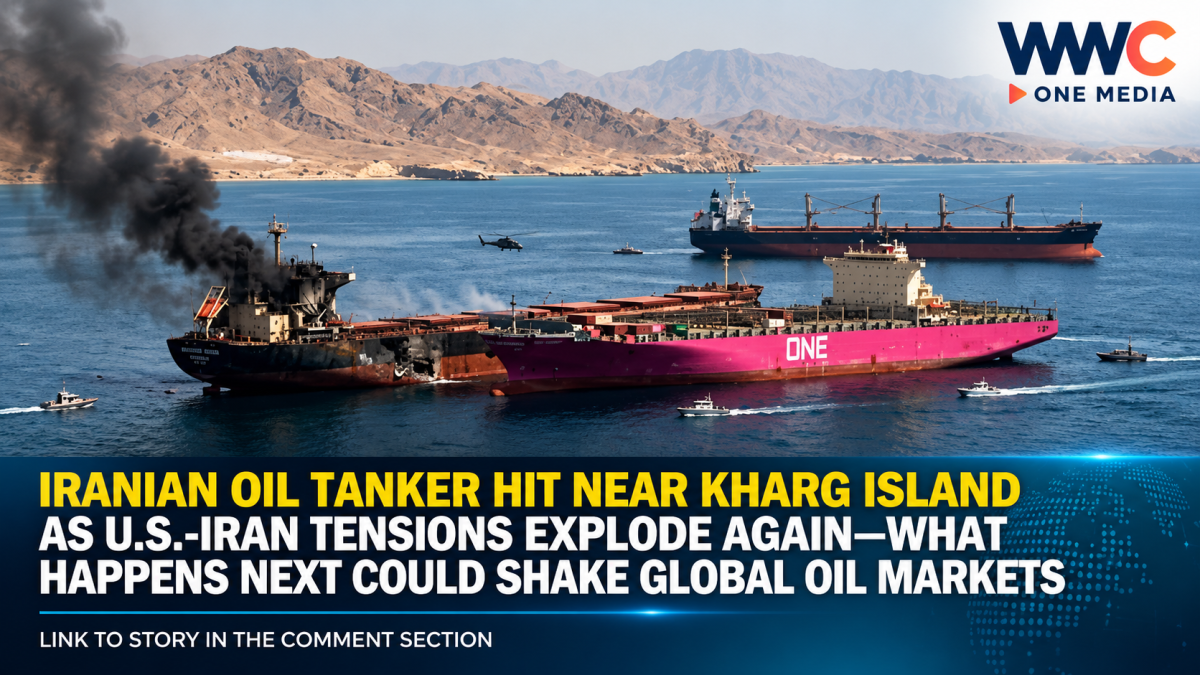
DUBAI — September 5, 2026 — A new flashpoint has emerged in the escalating U.S.-Iran conflict after Iranian media reported that an oil tanker was struck by four U.S. missiles near Kharg Island, Iran’s strategically vital oil-export hub in the Persian Gulf.
The reported strike, carried by Iran’s semi-official Tasnim news agency and cited by Reuters, occurred near the anchorage off Kharg Island. Iranian reports said the vessel was hit by four missiles and that its crew was being evacuated. No casualties were reported.
However, the circumstances surrounding the incident remain unresolved.
Neither Iranian authorities nor the U.S. military had publicly provided independent confirmation of the reported tanker strike at the time of publication. U.S. Central Command had not immediately responded to requests for comment, according to Reuters and The Associated Press.
That uncertainty is critical: while multiple outlets are reporting the Iranian claim, the reported U.S. attack on the tanker should not yet be presented as independently confirmed fact.
Why Kharg Island matters
The location makes the incident particularly significant.
Kharg Island is the centerpiece of Iran’s oil-export infrastructure. Reuters reports that Iran historically shipped about 90% of its crude exports through Kharg Island before the war and that the island sits roughly 26 kilometers off Iran’s coast.
Any sustained disruption around the island could therefore have consequences extending far beyond Iran.
Iran is one of OPEC’s largest producers, and disruption to its oil infrastructure comes at a time when maritime traffic through the Strait of Hormuz—one of the world’s most important energy chokepoints—has already been severely affected by the conflict.
The strait carried nearly one-fifth of global crude oil and liquefied natural gas shipments before the war, according to Reuters reporting.
The reported strike follows a dangerous escalation
The tanker incident comes only days after the conflict entered another volatile phase.
U.S. forces recently struck Iranian military targets on Larak Island, saying the operation was intended to prevent Iranian forces from deploying sea mines in the Strait of Hormuz. Iran subsequently launched missiles toward U.S. positions in the region.
The renewed fighting followed a period of relative calm and has raised fresh concerns about the possibility of a wider confrontation across the Gulf.
The latest tanker report could further increase those concerns because it places the alleged attack close to one of Iran’s most important economic assets.
Trump had already put Kharg Island in the spotlight
The reported tanker strike also comes after U.S. President Donald Trump made a striking statement about Kharg Island on August 31.
Trump posted that the Iranian oil hub was being “blown to smithereens,” alongside a video. Reuters later reported that the accompanying footage was artificially generated and that there was no evidence at the time that the United States had attacked Kharg Island itself. A U.S. official also said the military had not targeted the island at that point.
That earlier episode makes Saturday’s reported tanker strike particularly sensitive.
It also illustrates why independent confirmation is important: dramatic claims surrounding Kharg Island have circulated before without immediate evidence establishing what had actually happened.
Oil markets are watching closely
The biggest question now may extend beyond the tanker itself.
If the incident develops into sustained attacks against vessels or infrastructure around Kharg Island, the consequences could reach international energy markets.
Reuters previously reported that Iran’s oil shipments from Kharg had already been disrupted by the U.S. blockade, while Al Jazeera reported this week that shipping through the Strait of Hormuz remains dramatically below normal levels.
Shipping data cited by Al Jazeera showed only a small fraction of normal vessel traffic moving through the waterway in recent days, although tracking systems can underestimate actual movements because some vessels switch off their identification signals.
That means another major escalation around Iran’s oil infrastructure could put additional pressure on already-fragile energy flows.
What happens next?
For now, one fact is clear: the reported tanker strike has not been independently confirmed by Washington.
But the strategic significance of the allegation is difficult to ignore.
A confirmed U.S. strike on a tanker near Kharg Island would represent a major development in a conflict already centered on Iran’s oil exports, the Strait of Hormuz and the ability of commercial vessels to move safely through the Gulf.
Iran has repeatedly warned that attacks on Kharg Island could trigger further escalation, while Washington has continued to apply military and economic pressure on Tehran.
The next statements from the Pentagon, U.S. Central Command and Iranian authorities could therefore determine whether Saturday’s incident remains a disputed battlefield report—or becomes the latest major escalation in the U.S.-Iran conflict.
For now, the tanker has reportedly been hit. The bigger question is what comes next.
WWC ONE MEDIA M.J.E




Leave a Reply