
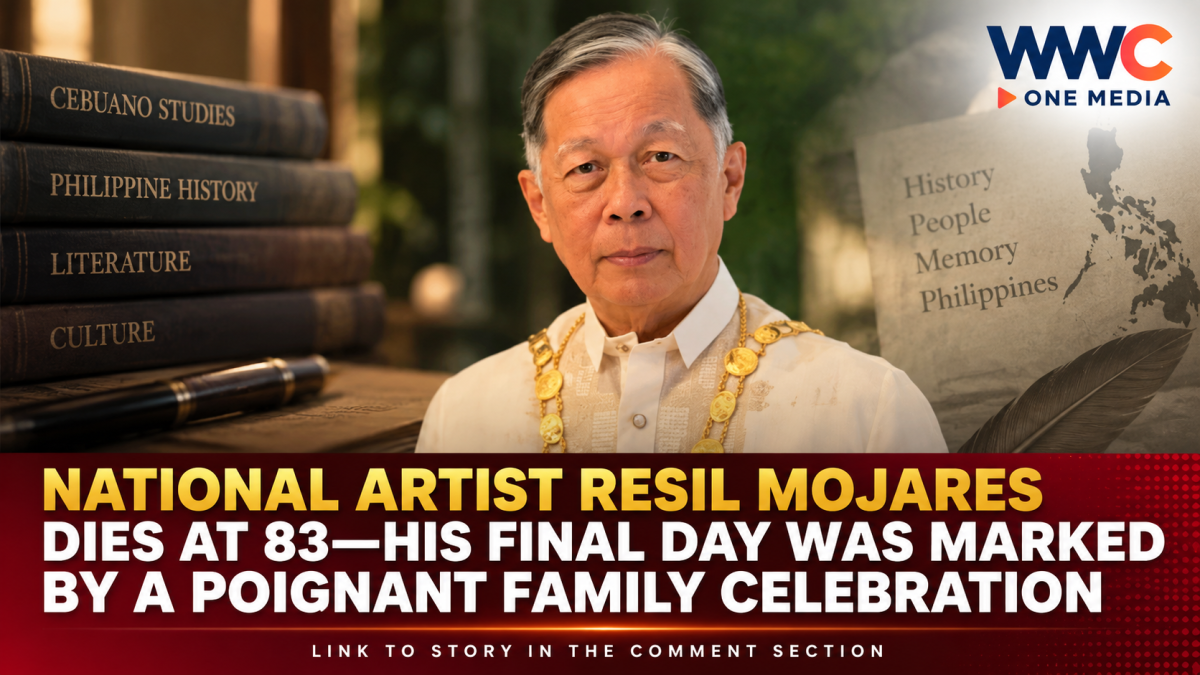
MANILA, Philippines — The Philippines has lost one of its most respected literary scholars and historians.
National Artist for Literature Resil B. Mojares died in the early hours of Saturday, September 5, 2026, at the age of 83, just one day after celebrating his birthday, according to his family. His passing was also reported by several major Philippine news organizations.
His daughter, Anna Leigh Go Mojares, announced the family’s loss in a statement shared on social media, saying the family had spent his final day celebrating his life.
Mojares was born on September 4, 1943, in Polanco, Zamboanga del Norte, to parents who were public school teachers. Although he was born in Mindanao, Cebu became the center of his professional and intellectual life, where he emerged as an influential historian, literary critic, essayist, teacher and cultural researcher.
A National Artist who put Cebu at the center of Philippine scholarship
Mojares was named National Artist for Literature in 2018, one of the country’s highest recognitions for contributions to the arts. He was also widely regarded as a pioneering figure in Philippine local studies and an important voice in documenting Cebuano history and culture.
He founded the Cebuano Studies Center at the University of San Carlos in 1975 and served as its director until 1996. The center became an important institution for research into Cebuano language, literature, history and culture.
His scholarship extended well beyond Cebu. His books explored Philippine history, politics, literature and cultural identity, while his work as a literary critic and essayist helped generations of Filipinos understand the country’s past from perspectives often overlooked in mainstream historical narratives.
Among his best-known works are Brains of the Nation, The War Against the Americans: Resistance and Collaboration in Cebu, Waiting for Mariang Makiling, Isabelo’s Archive, and House of Memory. Several of his books received National Book Awards.
More than a writer and historian
Mojares’ influence reached classrooms, universities, cultural institutions and historical research communities.
He held teaching and research fellowships from organizations including the Ford Foundation, Rockefeller Foundation and Fulbright Program, and served as a visiting professor or fellow at universities in the Philippines, the United States and Asia.
His academic career was also shaped by the country’s turbulent political history. According to a 2018 profile by the Philippine Daily Inquirer, Mojares was detained during martial law because of his work as a columnist and his opposition to the Marcos administration.
His work also influenced how Filipinos understand history
From 2018 to 2021, Mojares chaired a panel of experts convened by the National Historical Commission of the Philippines to examine competing claims concerning the location of the 1521 Easter Sunday Mass.
The panel, commonly referred to as the Mojares Panel, reaffirmed Limasawa in Southern Leyte as the site of the historic event.
His contribution to Philippine scholarship therefore went far beyond literary criticism. He helped preserve local histories, investigate national historical questions and bring regional experiences into the broader Philippine story.
A loss deeply felt in Cebu
News of Mojares’ death has resonated particularly strongly in Cebu, where colleagues, students, writers and cultural institutions have remembered him as a mentor and an intellectual force.
Historian Jose Eleazar “Jobers” Bersales described his passing as the loss of a mentor, friend and fellow traveler in the study of history, while the National Museum Cebu highlighted Mojares’ contribution to understanding Cebuano history and cultural heritage.
The University of San Carlos’ Cebuano Studies Center likewise preserves a record of his decades-long contribution to scholarship, noting his work in literature, history, cultural research and local studies.
When Mojares was named a National Artist in 2018, he became the first Cebuano to receive the distinction, a milestone that was celebrated widely in Cebu.
A legacy that will outlive the page
Mojares’ death closes the life of a scholar whose work was built around a simple but profound pursuit: understanding the Philippines through its people, memories, literature and history.
His books will remain references for researchers. His essays will continue to challenge readers. And the institutions he helped build will continue the work of preserving regional histories and cultural traditions.
For Cebu and for Philippine scholarship, the loss is enormous.
But the questions Mojares spent his life asking—and the stories he worked to preserve—are likely to remain long after his passing.
Resil B. Mojares may be gone, but the Philippine history he spent a lifetime documenting is still speaking through his work.
WWC ONE MEDIA J.M.D




Leave a Reply